
Choosing the right headlight bulb for your 2013 Hyundai Sonata is essential for safety, visibility, and performance. This guide breaks down the exact bulb sizes, types, and replacement tips so you can confidently upgrade or replace your headlights without confusion.
Have you ever found yourself staring at a wall of headlight bulbs at the auto parts store, completely overwhelmed by the options? You’re not alone. Whether your 2013 Hyundai Sonata’s headlights are dimming, flickering, or have finally burned out, knowing the correct bulb size is the first step toward a safe and effective fix. The good news? It’s simpler than you think—once you know what to look for.
The 2013 Hyundai Sonata is a popular midsize sedan known for its reliability, comfort, and sleek design. But like any vehicle, it requires regular maintenance—and that includes keeping your headlights in top shape. Properly functioning headlights aren’t just about seeing the road at night; they’re also about being seen by other drivers. A burnt-out or underperforming bulb can reduce your visibility by up to 50%, especially in rain, fog, or on poorly lit roads. That’s why understanding your headlight bulb size isn’t just a technical detail—it’s a safety essential.
In this comprehensive guide, we’ll walk you through everything you need to know about the headlight bulb size for your 2013 Hyundai Sonata. From identifying the correct bulb type to choosing between halogen, LED, and HID options, we’ve got you covered. Whether you’re a DIY enthusiast or planning to visit a mechanic, this article will give you the confidence and knowledge to make the right choice. Let’s shine a light on the details—literally.
In This Article
- 1 Key Takeaways
- 2 📑 Table of Contents
- 3 Understanding Headlight Bulb Basics
- 4 Headlight Bulb Sizes for the 2013 Hyundai Sonata
- 5 Halogen vs. LED vs. HID: Which Is Right for You?
- 6 Step-by-Step Guide to Replacing Your Headlight Bulbs
- 7 Common Mistakes to Avoid
- 8 Conclusion
- 9 Frequently Asked Questions
- 9.1 What size headlight bulb does a 2013 Hyundai Sonata use?
- 9.2 Can I use an H9 bulb instead of H8 in my Sonata’s fog lights?
- 9.3 Are LED bulbs legal for my 2013 Sonata?
- 9.4 Do I need special tools to replace the headlight bulbs?
- 9.5 How often should I replace my headlight bulbs?
- 9.6 Can I upgrade to HID headlights on my 2013 Sonata?
Key Takeaways
- Low Beam Bulb Size: The 2013 Hyundai Sonata uses an H7 bulb for the low beam headlights.
- High Beam Bulb Size: The high beam headlights require an H7 bulb as well, making it a dual-H7 setup.
- Fog Light Bulb: If your model has fog lights, they use an H8 bulb (also compatible with H9 in some cases).
- Halogen vs. LED vs. HID: The stock setup is halogen, but you can upgrade to LED or HID for brighter, longer-lasting light—just check local laws.
- Bulb Compatibility: Always verify bulb fitment using your owner’s manual or a trusted auto parts lookup tool.
- DIY Replacement Tips: Replacing bulbs is simple—no special tools needed, but wear gloves to avoid oil transfer from your skin.
- Professional Help: If you’re unsure or have projector-style headlights, consider a mechanic to avoid damage.
📑 Table of Contents
Understanding Headlight Bulb Basics
Before diving into the specifics for your 2013 Hyundai Sonata, it helps to understand how headlight bulbs work and why the right size matters. Headlight bulbs are more than just light sources—they’re precision components designed to fit specific housings and deliver optimal illumination patterns. Using the wrong bulb can lead to poor visibility, glare for other drivers, or even damage to your vehicle’s electrical system.
What Is a Bulb Size?
A bulb size—often referred to as a “bulb type” or “bulb number”—is a standardized code that describes the physical dimensions, electrical specifications, and base type of a light bulb. These codes, like H7, H8, or 9005, are set by international standards so that bulbs are interchangeable across compatible vehicles. For example, an H7 bulb has a specific filament design, wattage, and base shape that ensures it fits securely and performs correctly in designated headlight assemblies.
Why Size Matters
Using the correct bulb size ensures that the light beam is properly focused. Modern headlights, especially on vehicles like the 2013 Sonata, often use reflector or projector-style housings. These systems are engineered to work with specific bulb types. If you install a bulb that’s too large, too small, or has a different base, it may not seat properly, leading to loose connections, flickering, or misaligned beams. In worst-case scenarios, incorrect bulbs can overheat and damage the headlight housing.
Common Bulb Types Explained
Here’s a quick rundown of the most common headlight bulb types you might encounter:
- H1, H3, H7: These are single-filament halogen bulbs commonly used in low or high beam applications. The H7 is particularly popular in European and Asian vehicles, including Hyundai.
- H8, H9, H11: Often used for fog lights or auxiliary lighting. The H8 and H9 are similar in size and can sometimes be interchanged with adapters.
- 9005, 9006, 9007: These are American-standard halogen bulbs used in many domestic vehicles. They’re not typically found in Hyundai models.
- HID (High-Intensity Discharge): These produce bright, bluish-white light and require ballasts. They’re not plug-and-play with halogen systems.
- LED (Light-Emitting Diode): Energy-efficient and long-lasting, but may require additional heat sinks or CANbus resistors to work properly in older vehicles.
Understanding these basics will help you navigate the world of automotive lighting with confidence. Now, let’s apply that knowledge to your 2013 Hyundai Sonata.
Headlight Bulb Sizes for the 2013 Hyundai Sonata
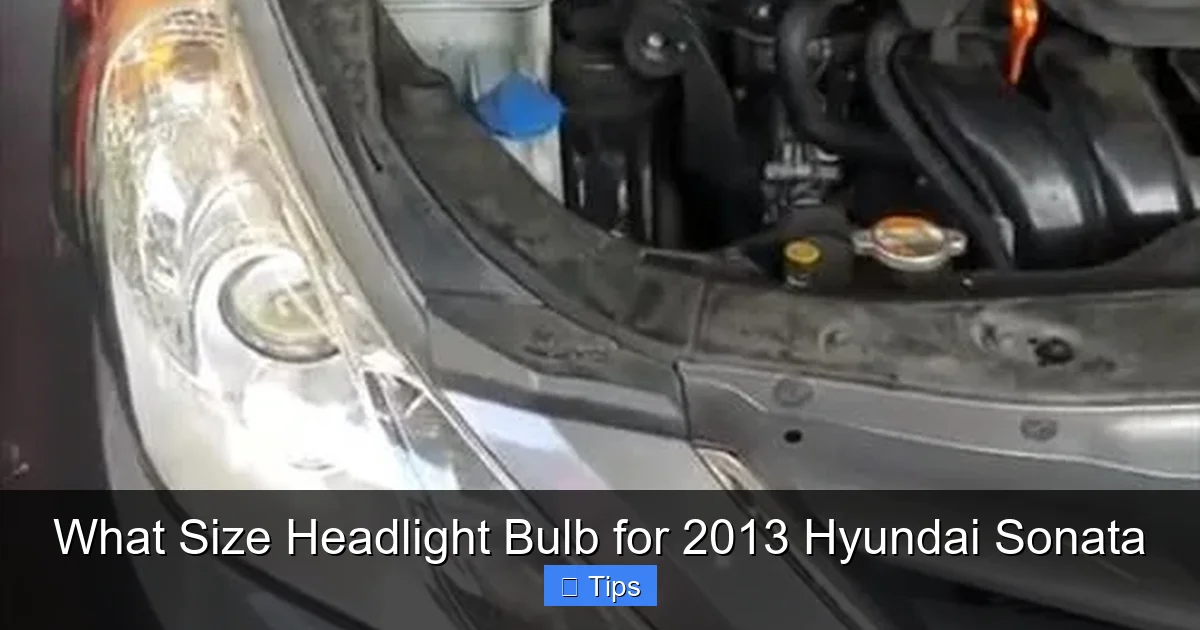
Now for the main event: what size headlight bulb does your 2013 Hyundai Sonata need? The answer depends on which lights you’re replacing—low beam, high beam, or fog lights. Let’s break it down by function.
Visual guide about What Size Headlight Bulb for 2013 Hyundai Sonata
Image source: backyardmechanic.org
Low Beam Headlights: H7
The low beam headlights on the 2013 Hyundai Sonata use an H7 bulb. This is a single-filament halogen bulb that provides focused, downward lighting for nighttime driving. It’s designed to illuminate the road without blinding oncoming traffic. The H7 is a common bulb type found in many modern vehicles, especially those manufactured in Europe and Asia.
When replacing your low beam bulbs, make sure to purchase H7 halogen bulbs unless you’re upgrading to LED or HID (more on that later). Always replace both low beam bulbs at the same time—even if only one is out—to ensure even lighting and prevent the other from failing soon after.
High Beam Headlights: H7
Here’s a fun fact: the 2013 Sonata uses the same H7 bulb for both low and high beams. This is known as a “dual-H7” setup, where two separate H7 bulbs are used—one for low beam and one for high beam. This design simplifies maintenance since you only need to stock one bulb type.
When you switch to high beam, the second H7 bulb activates, providing a brighter, longer-range light for highway driving or poorly lit rural roads. Because both beams use the same bulb, replacing a high beam is just as straightforward as replacing a low beam.
Fog Lights: H8 (or H9)
If your 2013 Sonata is equipped with fog lights (typically found on higher trims like the Limited or Sport), they use an H8 bulb. The H8 is a 35-watt halogen bulb designed for low, wide illumination that cuts through fog, rain, and snow.
Some owners report success using H9 bulbs in place of H8s, as they are nearly identical in size and base. However, H9 bulbs are slightly brighter (55 watts), so they may draw more current. While this usually isn’t a problem, it’s safer to stick with H8 unless you’ve confirmed compatibility with your vehicle’s electrical system.
Turn Signals and DRLs
While not technically headlights, it’s worth noting that the 2013 Sonata’s daytime running lights (DRLs) and turn signals use different bulb types. The front turn signals typically use a 7440 or 7443 bulb (amber-colored), while the DRLs may share the low beam circuit or use separate bulbs depending on the trim. Always consult your owner’s manual or a parts diagram for exact specifications.
Bulb Wattage and Voltage
All standard halogen bulbs for the 2013 Sonata operate at 12 volts and typically range from 35 to 55 watts. The H7 bulbs used for low and high beams are usually 55 watts, while the H8 fog lights are 35 watts. Sticking to these ratings ensures compatibility and prevents overloading your vehicle’s wiring.
How to Confirm Your Bulb Size
If you’re ever unsure, here are three reliable ways to confirm your bulb size:
- Check the Owner’s Manual: The manual includes a lighting section with bulb specifications for every light on the vehicle.
- Look at the Old Bulb: The bulb type is usually printed on the glass or base. For example, you might see “H7” stamped near the connector.
- Use an Online Lookup Tool: Websites like Sylvania, Philips, or AutoZone allow you to enter your vehicle’s year, make, and model to find the correct bulb sizes.
With this information, you can confidently shop for replacements or upgrades. But before you buy, let’s talk about the different types of bulbs available.
Halogen vs. LED vs. HID: Which Is Right for You?
Once you know your bulb size, the next decision is choosing the right type of bulb. The 2013 Hyundai Sonata comes standard with halogen bulbs, but many owners choose to upgrade for better performance, longevity, or style. Let’s compare the three main options.
Visual guide about What Size Headlight Bulb for 2013 Hyundai Sonata
Image source: ic.suncentauto.com
Halogen Bulbs: The Standard Choice
Halogen bulbs are the original equipment on the 2013 Sonata. They’re affordable, easy to find, and simple to install. Halogen technology uses a tungsten filament enclosed in a quartz envelope filled with halogen gas, which allows the filament to burn hotter and brighter than traditional incandescent bulbs.
Pros:
- Inexpensive (typically $10–$20 per bulb)
- Easy to replace—no special tools or modifications needed
- Widely available at auto parts stores, gas stations, and online
- Compatible with factory wiring and housings
Cons:
- Shorter lifespan (usually 500–1,000 hours)
- Lower light output compared to LED or HID
- Generate more heat, which can degrade headlight lenses over time
If you’re on a budget or prefer a straightforward replacement, halogen is the way to go. Just make sure to buy high-quality brands like Philips, Sylvania, or Osram for better performance and longevity.
LED Bulbs: Bright, Efficient, and Modern
LED (Light-Emitting Diode) bulbs are becoming increasingly popular due to their brightness, energy efficiency, and long lifespan. They produce a crisp, white light that closely mimics daylight, improving visibility and reducing eye strain.
Pros:
- Longer lifespan (up to 30,000 hours)
- Lower power consumption—great for vehicles with sensitive electronics
- Instant-on brightness with no warm-up time
- Available in various color temperatures (e.g., 6000K for a cool white look)
Cons:
- Higher upfront cost ($30–$100 per bulb)
- May require additional components like heat sinks or CANbus resistors
- Not all LED bulbs are road-legal—some may cause glare or fail inspections
- Fitment can be tricky in reflector-style housings
For the 2013 Sonata, LED upgrades are possible, but proceed with caution. Look for “CANbus-compatible” H7 LED bulbs designed for halogen housings. Brands like Beamtech, Auxbeam, or LASFIT offer plug-and-play options that minimize flicker and error messages. Always check local regulations—some states prohibit non-DOT-approved LED conversions.
HID (Xenon) Bulbs: Maximum Brightness
HID (High-Intensity Discharge) bulbs, also known as xenon lights, produce an intense, bluish-white light that’s significantly brighter than halogen. They’re commonly found in luxury vehicles and are popular among enthusiasts who want maximum visibility.
Pros:
- Extremely bright—up to 3x the output of halogen
- Longer lifespan (2,000–3,000 hours)
- Modern, high-end appearance
Cons:
- Require a ballast and wiring harness—not plug-and-play
- Expensive ($100–$300 for a full kit)
- Can cause glare if not properly aligned
- May not be legal in all areas without projector housings
Converting your 2013 Sonata to HID is possible, but it’s a more complex project. You’ll need an HID conversion kit with H7-compatible bulbs and ballasts. However, because the Sonata uses reflector-style headlights (not projectors), HID bulbs may scatter light and blind other drivers. For safety and legality, HID is best left to vehicles with factory projector housings.
Which Should You Choose?
For most 2013 Sonata owners, a high-quality halogen bulb is the safest and most practical choice. If you want an upgrade, LED is a great middle ground—offering better light and efficiency without the complexity of HID. Just make sure to buy reputable brands and verify compatibility.
Step-by-Step Guide to Replacing Your Headlight Bulbs
Replacing headlight bulbs on a 2013 Hyundai Sonata is a straightforward DIY job that takes about 15–20 minutes per side. You don’t need special tools—just a few basic items and some patience. Here’s how to do it safely and correctly.
Visual guide about What Size Headlight Bulb for 2013 Hyundai Sonata
Image source: ic.suncentauto.com
Tools and Materials You’ll Need
- New H7 bulbs (for low/high beam)
- New H8 bulbs (if replacing fog lights)
- Clean gloves (to avoid touching the bulb glass)
- Phillips screwdriver (optional, for some trim pieces)
- Owner’s manual (for reference)
Step 1: Prepare Your Vehicle
Park your Sonata on a flat surface and turn off the engine. Engage the parking brake for safety. Open the hood and locate the headlight assembly at the front of the engine bay. The 2013 Sonata has a straightforward access design—no need to remove the bumper or wheel well liners.
Step 2: Access the Bulb Housing
Behind each headlight, you’ll see a round or rectangular rubber dust cover. Gently twist it counterclockwise and pull it off. This reveals the back of the bulb socket. You’ll see electrical wires connected to the bulb base.
Step 3: Remove the Old Bulb
Carefully disconnect the wiring harness by pressing the release tab and pulling it straight out. Next, locate the metal clip or spring that holds the bulb in place. Press or lift the clip to release the bulb, then gently pull it straight out. Important: Never touch the glass part of a halogen bulb with your bare hands. The oils from your skin can cause hot spots and shorten the bulb’s life.
Step 4: Install the New Bulb
Take your new H7 bulb (wearing gloves) and align the tabs on the base with the slots in the housing. Push it in gently until it seats fully. Reattach the metal clip to secure it. Then, reconnect the wiring harness until it clicks into place.
Step 5: Reassemble and Test
Replace the rubber dust cover by twisting it clockwise until snug. Repeat the process on the other side if needed. Close the hood, start the car, and test both low and high beams to ensure they’re working properly. Check for flickering or error messages on the dashboard.
Tips for Success
- Replace both bulbs at the same time to maintain even lighting.
- If you’re upgrading to LED, follow the manufacturer’s instructions for heat sink orientation.
- After installation, adjust your headlights if they seem misaligned (use the adjustment screws near the headlight assembly).
- Dispose of old bulbs responsibly—many auto parts stores offer recycling programs.
Common Mistakes to Avoid
Even simple tasks like changing a headlight bulb can go wrong if you’re not careful. Here are some common pitfalls and how to avoid them.
Using the Wrong Bulb Size
This is the #1 mistake. Always double-check that you’re buying H7 for low/high beams and H8 for fog lights. Using a 9005 or H11 bulb will result in a poor fit and potential damage.
Touching the Bulb Glass
As mentioned earlier, skin oils can ruin halogen bulbs. Always wear gloves or use a clean cloth when handling new bulbs.
Forcing the Bulb Into Place
If the bulb doesn’t slide in easily, don’t force it. Check the alignment of the tabs and ensure the housing isn’t obstructed. Forcing it can crack the bulb or damage the socket.
Ignoring the Dust Cover
The rubber dust cover protects the bulb from moisture and debris. Always reinstall it securely. A loose or missing cover can lead to condensation inside the headlight, which reduces visibility and can cause electrical issues.
Not Testing After Installation
Always test your headlights after replacement. A bulb may appear to work but could be misaligned or flickering. Testing ensures safety and helps you catch issues early.
Upgrading Without Research
If you’re switching to LED or HID, don’t assume it’s a simple swap. Research compatibility, legality, and installation requirements. Some upgrades may void your warranty or fail state inspections.
Conclusion
Knowing the correct headlight bulb size for your 2013 Hyundai Sonata—H7 for low and high beams, H8 for fog lights—is the foundation of safe, effective lighting. Whether you’re replacing a burnt-out bulb or upgrading for better performance, this guide gives you the knowledge and confidence to make the right choice.
Remember, your headlights are more than just a convenience—they’re a critical safety feature. Regular maintenance, proper bulb selection, and careful installation can make a big difference in your driving experience. So the next time you’re shopping for bulbs, you’ll know exactly what to look for. Stay safe, stay bright, and keep those roads well-lit.
Frequently Asked Questions
What size headlight bulb does a 2013 Hyundai Sonata use?
The 2013 Hyundai Sonata uses an H7 bulb for both low beam and high beam headlights. If your model has fog lights, they use an H8 bulb.
Can I use an H9 bulb instead of H8 in my Sonata’s fog lights?
While H9 bulbs are similar in size and can sometimes fit, they are brighter and draw more power. It’s safer to use the recommended H8 bulb unless you’ve confirmed compatibility.
Are LED bulbs legal for my 2013 Sonata?
LED bulbs can be legal if they are DOT-approved and properly installed. However, some states restrict non-factory LED conversions, so check local laws before upgrading.
Do I need special tools to replace the headlight bulbs?
No, you only need your hands and possibly a screwdriver for trim pieces. The process is designed to be DIY-friendly.
How often should I replace my headlight bulbs?
Halogen bulbs typically last 500–1,000 hours. Replace them when they dim, flicker, or burn out. It’s best to replace both at the same time.
Can I upgrade to HID headlights on my 2013 Sonata?
Yes, but it requires a conversion kit with ballasts and wiring. Due to the reflector-style housing, HID may cause glare, so proceed with caution and check local regulations.

At CarLegit, we believe information should be clear, factual, and genuinely helpful. That’s why every guide, review, and update on our website is created with care, research, and a strong focus on user experience.