
The Hyundai Sonata typically holds between 16.4 and 18.5 gallons of fuel, depending on the model year and engine type. This capacity supports an impressive driving range, making it a reliable choice for daily commutes and long road trips alike.
If you’re driving a Hyundai Sonata—or considering buying one—you’ve probably asked yourself: “How many gallons does a Hyundai Sonata hold?” It’s a practical question, especially if you’re planning a road trip, tracking fuel costs, or just trying to understand your car’s capabilities. The answer isn’t one-size-fits-all, though. Depending on the year, trim level, and engine configuration, the fuel tank capacity can vary slightly. But don’t worry—we’ve got you covered with a detailed breakdown.
The Hyundai Sonata has been a popular midsize sedan for over a decade, known for its smooth ride, modern tech, and excellent fuel economy. Whether you’re behind the wheel of a 2015 base model or a brand-new 2024 Hybrid SEL, understanding your fuel tank size helps you plan better, save money, and avoid unexpected stops at the pump. In this guide, we’ll walk you through everything you need to know about the Sonata’s fuel capacity, how it impacts your driving range, and tips to get the most out of every gallon.
So, let’s dive in. By the end of this article, you’ll not only know exactly how many gallons your Sonata holds—but also how to make those gallons go further.
In This Article
- 1 Key Takeaways
- 2 📑 Table of Contents
- 3 Understanding Fuel Tank Capacity in the Hyundai Sonata
- 4 Hyundai Sonata Fuel Tank Capacity by Model Year
- 5 How Fuel Tank Size Affects Driving Range
- 6 Tips for Maximizing Fuel Efficiency in Your Hyundai Sonata
- 7 Common Myths About Fuel Tank Capacity and Efficiency
- 8 Conclusion: Getting the Most Out of Your Sonata’s Fuel Capacity
- 9 Frequently Asked Questions
- 9.1 How many gallons does a 2023 Hyundai Sonata hold?
- 9.2 Can I increase my Sonata’s fuel tank capacity?
- 9.3 Does the Sonata Hybrid have a smaller gas tank?
- 9.4 How far can a Hyundai Sonata go on a full tank?
- 9.5 Should I use premium gas in my Hyundai Sonata?
- 9.6 What happens if I run my Sonata on empty?
Key Takeaways
- Fuel tank capacity varies by model year: Most Hyundai Sonatas from 2011 to 2024 hold between 16.4 and 18.5 gallons, with newer models trending toward larger tanks.
- Engine type affects efficiency, not tank size: Whether you have a 2.5L four-cylinder, 1.6L turbo, or hybrid engine, the physical tank size remains similar across trims.
- Hybrid models have slightly smaller tanks: The Sonata Hybrid typically holds around 15.3 gallons to accommodate battery and motor components.
- Real-world range exceeds 500 miles: With highway mileage up to 50 mpg in hybrid versions, drivers can go over 750 miles on a single tank.
- Fuel gauge accuracy matters: Always refuel when the low fuel light comes on—running near empty can damage the fuel pump over time.
- Use premium fuel only if recommended: Most Sonatas run optimally on regular unleaded; check your owner’s manual before upgrading.
- Regular maintenance improves efficiency: Clean air filters, proper tire pressure, and timely oil changes help maximize your Sonata’s miles per gallon.
📑 Table of Contents
- Understanding Fuel Tank Capacity in the Hyundai Sonata
- Hyundai Sonata Fuel Tank Capacity by Model Year
- How Fuel Tank Size Affects Driving Range
- Tips for Maximizing Fuel Efficiency in Your Hyundai Sonata
- Common Myths About Fuel Tank Capacity and Efficiency
- Conclusion: Getting the Most Out of Your Sonata’s Fuel Capacity
Understanding Fuel Tank Capacity in the Hyundai Sonata
When people ask, “How many gallons does a Hyundai Sonata hold?” they’re usually looking for a single number. But the truth is, the answer depends on several factors, including the model year, engine type, and whether it’s a conventional gasoline model or a hybrid. Most gasoline-powered Sonatas from recent years (2011–2024) feature a fuel tank that holds between 16.4 and 18.5 gallons. That’s a solid range for a midsize sedan, offering plenty of driving distance between fill-ups.
For example, the 2023 Hyundai Sonata with the standard 2.5L four-cylinder engine has an 18.5-gallon tank. That’s on the larger side for its class, giving it a competitive edge over rivals like the Toyota Camry (15.8 gallons) or Honda Accord (14.8 gallons). The extra capacity means fewer stops on long drives and more flexibility for drivers who don’t want to visit gas stations every week.
But why the variation? Hyundai has made subtle changes to the Sonata’s design over the years. Earlier models, like those from the 2011–2014 generation, often had slightly smaller tanks—around 16.4 to 17.2 gallons. As the car evolved, especially with the introduction of more fuel-efficient engines and aerodynamic improvements, Hyundai increased tank sizes to match the improved efficiency. A bigger tank paired with better mileage equals a longer range—something every driver appreciates.
It’s also worth noting that the physical dimensions of the Sonata’s fuel tank are designed to fit neatly under the rear seats and trunk area, minimizing intrusion into passenger or cargo space. This thoughtful engineering ensures that you get maximum fuel capacity without sacrificing comfort or utility.
Why Tank Size Matters More Than You Think
You might think fuel tank size is just a number—but it actually plays a big role in your daily driving experience. A larger tank means fewer trips to the gas station, which saves time and reduces wear on your vehicle’s fuel system. It also gives you peace of mind on long road trips, especially in rural areas where gas stations can be few and far between.
For instance, if your Sonata gets 35 miles per gallon on the highway and has an 18.5-gallon tank, you can theoretically drive up to 647 miles on a single fill-up. That’s more than enough to get from Los Angeles to San Francisco and back—without stopping once. Even in city driving, where mileage drops to around 28 mpg, you’re still looking at over 500 miles per tank. That’s a huge advantage over smaller sedans with tighter fuel capacities.
Moreover, a larger tank allows for more consistent fuel management. If you tend to drive long distances or have a variable schedule, knowing you can go a week or more without refueling is a major convenience. It also helps during emergencies—like sudden road closures or detours—where having extra range can make all the difference.
Hyundai Sonata Fuel Tank Capacity by Model Year
Visual guide about How Many Gallons Does a Hyundai Sonata Hold
Image source: hyundaimaintenance.com
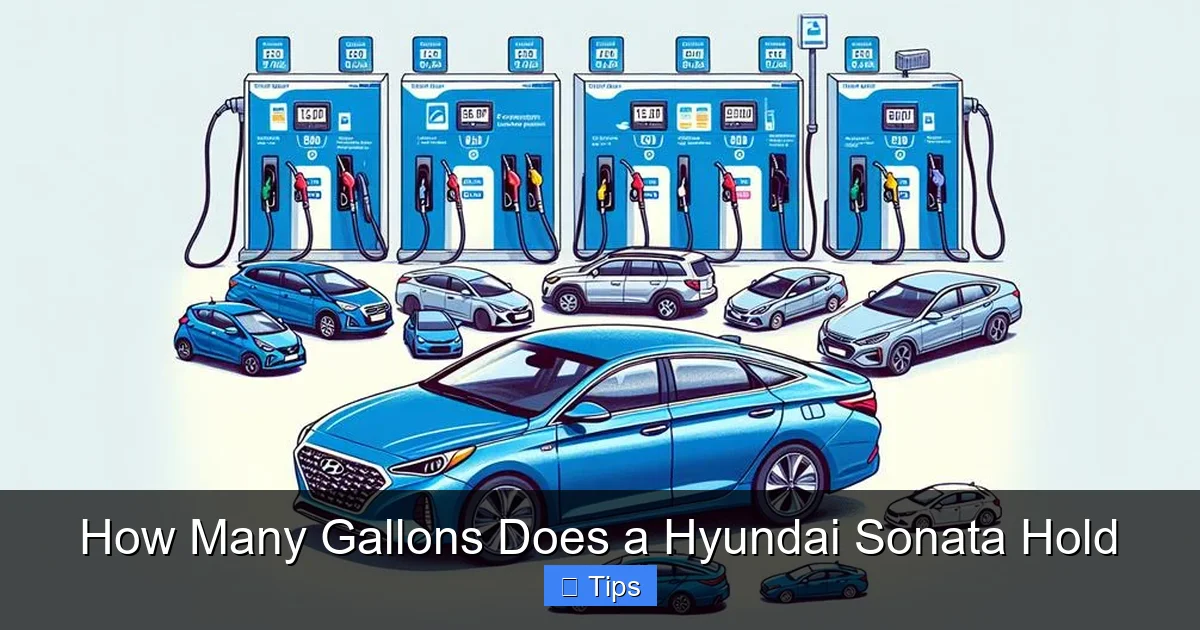
To give you a clearer picture, let’s break down the fuel tank capacities across different Sonata generations. This will help you identify your specific model and understand what to expect at the pump.
2011–2014 Hyundai Sonata (Fifth Generation)
The fifth-generation Sonata, introduced in 2011, marked a major redesign for Hyundai. It featured a sleek, aerodynamic body and a choice of efficient engines. During this period, the fuel tank capacity was typically **16.4 to 17.2 gallons**, depending on the trim and engine.
– The base 2.4L four-cylinder engine models usually had a 16.4-gallon tank.
– Higher trims with the 2.0L turbocharged engine often came with a slightly larger 17.2-gallon tank.
This generation was known for its impressive fuel economy, with the 2.4L engine achieving up to 35 mpg on the highway. Combined with the 16.4-gallon tank, that gave drivers a range of about 574 miles—quite respectable for the time.
2015–2019 Hyundai Sonata (Sixth Generation)
The 2015 redesign brought a more refined look, updated tech, and improved efficiency. Fuel tank sizes increased slightly during this period, with most models holding **17.2 to 18.5 gallons**.
– The standard 2.4L engine models typically had an 18.5-gallon tank.
– The 2.0L turbo and 3.3L V6 trims also used the same 18.5-gallon capacity.
This was a smart move by Hyundai. With better aerodynamics and engine tuning, the Sonata could now go further on a tank of gas. The 2.4L engine, for example, delivered up to 37 mpg highway, meaning an 18.5-gallon tank could take you over 680 miles—perfect for cross-country travel.
2020–2024 Hyundai Sonata (Seventh Generation)
The current-generation Sonata, launched in 2020, features a bold new design, advanced safety tech, and even more efficient powertrains. Fuel tank capacity remains strong, with most gasoline models holding **18.5 gallons**.
– The 2.5L four-cylinder engine (standard on most trims) uses the full 18.5-gallon tank.
– The 1.6L turbocharged engine (available on sportier trims) also shares the same capacity.
Interestingly, Hyundai kept the tank size consistent across trims, even as engine technology improved. This ensures that all drivers—whether they prioritize fuel economy or performance—get the same range advantage.
Hyundai Sonata Hybrid and Plug-in Hybrid Models
Now, let’s talk about the eco-friendly options. The Sonata Hybrid and Plug-in Hybrid (PHEV) models have slightly different fuel tank capacities due to the space needed for hybrid components.
– The **Sonata Hybrid** (2020–2024) holds approximately **15.3 gallons** of fuel.
– The **Sonata Plug-in Hybrid** (2020–2022) has a similar 15.3-gallon tank.
At first glance, this might seem like a downgrade. But remember: hybrid models rely partly on electric power, so they don’t need as much gasoline to achieve excellent range. The Sonata Hybrid, for example, gets up to 50 mpg combined. With a 15.3-gallon tank, that’s still over 765 miles of driving—far exceeding most gasoline-only sedans.
The smaller tank also helps reduce weight and frees up space for the battery pack under the rear seats. It’s a smart engineering compromise that enhances efficiency without sacrificing practicality.
How Fuel Tank Size Affects Driving Range
Visual guide about How Many Gallons Does a Hyundai Sonata Hold
Image source: hyundaimaintenance.com
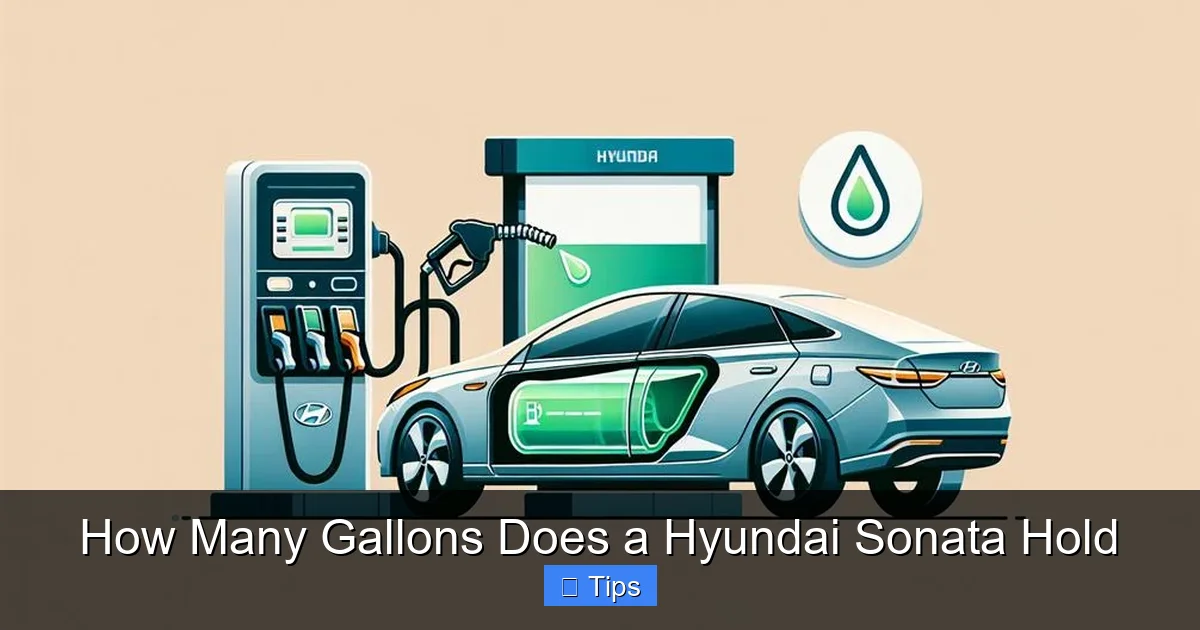
Knowing how many gallons your Sonata holds is one thing—but understanding how that translates into real-world driving range is what really matters. Range is the total distance you can drive on a full tank, and it’s calculated by multiplying your car’s fuel economy (miles per gallon) by the tank size (gallons).
Let’s look at a few examples using real-world data:
Example 1: 2023 Sonata SEL (2.5L Engine)
– Fuel tank: 18.5 gallons
– EPA-estimated fuel economy: 28 mpg city / 38 mpg highway
– City range: 18.5 × 28 = **518 miles**
– Highway range: 18.5 × 38 = **703 miles**
That’s impressive. Even in heavy city traffic, you can go over 500 miles without stopping. On the highway, you could drive from Chicago to Denver (about 1,000 miles) with just one refuel stop.
Example 2: 2023 Sonata Hybrid (1.6L Turbo Hybrid)
– Fuel tank: 15.3 gallons
– EPA-estimated fuel economy: 47 mpg combined (50 mpg highway)
– Combined range: 15.3 × 47 = **719 miles**
– Highway range: 15.3 × 50 = **765 miles**
Despite the smaller tank, the hybrid’s incredible efficiency gives it the longest range of any Sonata. It’s perfect for commuters who want to minimize fuel stops and reduce their carbon footprint.
Example 3: 2015 Sonata Limited (2.4L Engine)
– Fuel tank: 18.5 gallons
– EPA-estimated fuel economy: 25 mpg city / 37 mpg highway
– City range: 18.5 × 25 = **462.5 miles**
– Highway range: 18.5 × 37 = **684.5 miles**
Even older models hold their own. The 2015 Sonata can still go nearly 700 miles on the highway—enough for a weekend getaway without worrying about gas.
Factors That Influence Real-World Range
While EPA estimates are helpful, your actual range may vary based on several factors:
– **Driving habits:** Aggressive acceleration and braking reduce fuel efficiency.
– **Weather conditions:** Cold weather can lower gas mileage by 10–20%, especially in hybrids.
– **Cargo and passengers:** Extra weight decreases fuel economy.
– **Tire pressure:** Underinflated tires increase rolling resistance and reduce mpg.
– **Use of accessories:** Running the AC, heater, or infotainment system draws power and can slightly reduce range.
To maximize your Sonata’s range, practice smooth driving, keep tires properly inflated, and avoid carrying unnecessary weight. Small changes can add up to dozens of extra miles per tank.
Tips for Maximizing Fuel Efficiency in Your Hyundai Sonata
Visual guide about How Many Gallons Does a Hyundai Sonata Hold
Image source: hyundaimaintenance.com
Now that you know how many gallons your Sonata holds and how far it can go, let’s talk about how to make every gallon count. Fuel efficiency isn’t just about the car—it’s also about how you drive and maintain it.
1. Drive Smoothly
One of the easiest ways to save fuel is to avoid sudden acceleration and hard braking. These habits waste fuel and increase wear on your brakes. Instead, accelerate gradually and anticipate stops by easing off the gas early. This “eco-driving” technique can improve your mileage by 15–30%, especially in city traffic.
2. Maintain Proper Tire Pressure
Check your tire pressure at least once a month. Underinflated tires create more rolling resistance, which forces your engine to work harder. The recommended pressure for most Sonatas is between 32 and 35 PSI (check your door jamb sticker for the exact number). Keeping tires inflated can improve fuel economy by up to 3%.
3. Use Cruise Control on Highways
Cruise control helps maintain a steady speed, which reduces fuel consumption on long highway drives. Avoid frequent speed changes, as they burn extra gas. Just remember to turn it off in heavy traffic or on winding roads for safety.
4. Reduce Excess Weight
Every extra pound in your car reduces fuel efficiency. Remove roof racks, heavy cargo, or unused items from your trunk. Even small reductions—like taking out golf clubs after a round—can make a difference over time.
5. Keep Up with Regular Maintenance
A well-maintained Sonata runs more efficiently. Follow the recommended service schedule for:
– Oil changes (use the correct grade, usually 0W-20 or 5W-30)
– Air filter replacements (a dirty filter restricts airflow and reduces power)
– Spark plug inspections (worn plugs can cause misfires and lower mpg)
Hyundai recommends oil changes every 7,500 miles under normal driving conditions, but check your owner’s manual for specifics.
6. Use the Right Fuel
Most Sonatas are designed to run on regular unleaded gasoline (87 octane). Unless your owner’s manual specifies premium fuel (which is rare), there’s no benefit to using higher-octane gas. In fact, it’s a waste of money. Premium fuel only helps if your engine is tuned for it—otherwise, it just burns cleaner without improving performance.
7. Take Advantage of Eco Mode
Many Sonata models come with an “Eco Mode” button that adjusts throttle response, transmission shifting, and climate control to maximize efficiency. While it may feel slightly less responsive, it can boost your mileage by 5–10%, especially in stop-and-go traffic.
Common Myths About Fuel Tank Capacity and Efficiency
There are a lot of misconceptions floating around about fuel tanks and efficiency. Let’s clear up a few of the most common myths.
Myth 1: “A Bigger Tank Means Worse Fuel Economy”
Not true. Tank size doesn’t directly affect fuel economy—your engine, aerodynamics, and driving habits do. A larger tank just means you can go further between fill-ups. In fact, some of the most fuel-efficient cars (like hybrids) have smaller tanks but achieve incredible range thanks to efficiency.
Myth 2: “You Should Always Fill Up When the Tank Is Half Empty”
This is unnecessary and can actually waste fuel due to extra trips to the station. Modern fuel pumps are designed to work efficiently even when the tank is low. It’s perfectly safe to wait until the low fuel light comes on—just don’t make a habit of running on fumes, as it can damage the fuel pump over time.
Myth 3: “Premium Gas Makes Any Car Run Better”
Only if your car requires it. Most Sonatas are optimized for regular unleaded. Using premium gas in a car that doesn’t need it won’t improve performance, mileage, or longevity—it just costs more.
Myth 4: “Hybrids Don’t Need Gas”
While hybrids use electric power, they still rely on gasoline for longer trips and to recharge the battery. The Sonata Hybrid, for example, uses its gas engine frequently, especially at highway speeds. Think of it as a team effort—electric for city driving, gas for distance.
Conclusion: Getting the Most Out of Your Sonata’s Fuel Capacity
So, how many gallons does a Hyundai Sonata hold? The answer ranges from about 15.3 gallons in hybrid models to 18.5 gallons in most gasoline versions. That’s more than enough to keep you on the road for hundreds of miles between fill-ups. Whether you’re driving a 2015 base model or a 2024 Hybrid, your Sonata is built for efficiency, comfort, and long-range travel.
Understanding your fuel tank capacity helps you plan better, save money, and drive with confidence. But remember—range isn’t just about tank size. It’s also about how you drive, maintain your car, and use available features like Eco Mode and cruise control.
By following the tips in this guide, you can stretch every gallon further and enjoy the full potential of your Hyundai Sonata. From daily commutes to cross-country adventures, your Sonata is ready to go the distance.
So next time you pull up to the pump, you’ll know exactly what to expect—and how far your next tank will take you.
Frequently Asked Questions
How many gallons does a 2023 Hyundai Sonata hold?
The 2023 Hyundai Sonata with the standard 2.5L engine holds 18.5 gallons of fuel. The Sonata Hybrid version holds slightly less at 15.3 gallons due to space for hybrid components.
Can I increase my Sonata’s fuel tank capacity?
No, the fuel tank size is fixed by the manufacturer and cannot be increased. However, you can improve range by driving efficiently and maintaining your vehicle properly.
Does the Sonata Hybrid have a smaller gas tank?
Yes, the Sonata Hybrid has a 15.3-gallon fuel tank, compared to 18.5 gallons in gasoline models. This is because space is needed for the hybrid battery and electric motor.
How far can a Hyundai Sonata go on a full tank?
Depending on the model and driving conditions, a Sonata can travel between 500 and 765 miles on a full tank. Hybrids typically offer the longest range due to superior fuel economy.
Most Sonatas are designed to run on regular unleaded gasoline (87 octane). Only use premium if your owner’s manual specifically recommends it—otherwise, it’s unnecessary and more expensive.
What happens if I run my Sonata on empty?
Running your Sonata on empty can damage the fuel pump, which relies on gasoline for cooling and lubrication. It’s best to refuel when the low fuel light comes on, but avoid making a habit of driving with very little gas.

At CarLegit, we believe information should be clear, factual, and genuinely helpful. That’s why every guide, review, and update on our website is created with care, research, and a strong focus on user experience.