
Yes, a Toyota Tundra can pull a fifth wheel—but only if properly equipped and within its towing limits. With the right configuration, hitch setup, and weight management, the Tundra can handle many mid-sized fifth wheels safely and efficiently.
Thinking about hitting the open road with your Toyota Tundra and a cozy fifth wheel in tow? You’re not alone. More and more adventure seekers are pairing capable trucks like the Tundra with spacious, home-like RVs for cross-country trips, weekend getaways, or full-time travel. But before you hitch up and head out, there’s one big question you need answered: Can a Toyota Tundra pull a fifth wheel?
The short answer? Yes—but with important caveats. The Toyota Tundra is a robust, full-size pickup known for its reliability, strong V8 engine (in most models), and solid towing capabilities. However, fifth wheels are among the heaviest and most demanding types of trailers to tow. They require not just raw power, but also precise setup, careful weight distribution, and an understanding of your truck’s limits. So while the Tundra isn’t built specifically for heavy-duty fifth wheel towing like a Ford F-350 or Ram 3500, it can absolutely handle the job—if you choose the right trailer and prepare properly.
In this guide, we’ll walk you through everything you need to know about using your Toyota Tundra to tow a fifth wheel. From understanding towing and payload ratings to selecting the right hitch and trailer, we’ll cover the essentials so you can tow safely, confidently, and without blowing your budget—or your truck.
In This Article
- 1 Key Takeaways
- 2 📑 Table of Contents
- 3 Understanding Towing Capacity and Payload
- 4 Can the Toyota Tundra Handle a Fifth Wheel?
- 5 Choosing the Right Fifth Wheel for Your Tundra
- 6 Hitch and Setup Requirements
- 7 Safety, Maintenance, and Driving Tips
- 8 Alternatives to Consider
- 9 Final Thoughts
- 10 Frequently Asked Questions
- 10.1 What is the maximum fifth wheel weight a Toyota Tundra can tow?
- 10.2 Do I need a special hitch to tow a fifth wheel with a Tundra?
- 10.3 Can a 2023 Toyota Tundra tow a 12,000-pound fifth wheel?
- 10.4 Is payload or towing capacity more important when towing a fifth wheel?
- 10.5 Can I use a gooseneck adapter to tow a fifth wheel with my Tundra?
- 10.6 What are some good fifth wheels for a Toyota Tundra?
Key Takeaways
- Towing Capacity Matters: The Toyota Tundra’s max towing capacity ranges from 8,800 to 10,200 lbs depending on model year and configuration—know your specific truck’s rating.
- Fifth Wheel Weight is Critical: Most fifth wheels weigh between 10,000 and 20,000 lbs; only lighter models (under 10,000 lbs) are suitable for Tundra towing.
- Proper Hitch Setup is Essential: A fifth wheel requires a specialized hitch mounted in the truck bed—factory or aftermarket—plus a compatible gooseneck adapter if needed.
- Payload Capacity Can Be the Limiting Factor: Even with high towing numbers, the Tundra’s payload (typically 1,500–1,900 lbs) may restrict how much you can safely carry, including passengers and gear.
- Drive Smart and Maintain Your Rig: Regular maintenance, proper tire pressure, and smooth driving habits improve safety and performance when towing heavy loads.
- Consider Upgrades for Better Performance: Suspension enhancements, brake controllers, and aerodynamic aids can make towing a fifth wheel smoother and safer.
- Always Check Manufacturer Guidelines: Toyota provides specific towing recommendations—never exceed them, even if your hitch or trailer seems capable.
📑 Table of Contents
Understanding Towing Capacity and Payload
Before you even think about hitching up, you need to understand two critical numbers: towing capacity and payload capacity. These aren’t just suggestions—they’re engineering limits set by Toyota to ensure your safety and the longevity of your vehicle.
Towing capacity refers to the maximum weight your Tundra can pull behind it. This number varies significantly based on your truck’s configuration. For example, a 2023 Toyota Tundra with the i-FORCE 3.4L twin-turbo V6 engine, rear-wheel drive, and the Tow Package can tow up to 10,200 pounds. Older models with the 5.7L V8 might max out around 10,000 pounds, while base models without the tow package could be as low as 8,800 pounds. Always check your owner’s manual or Toyota’s official towing guide for your exact model year and trim.
But here’s the catch: towing capacity alone doesn’t tell the whole story. That’s where payload capacity comes in. Payload is the total weight your truck can carry inside the cabin and bed—including passengers, cargo, fuel, and the tongue weight of your trailer. Fifth wheels are unique because they rest directly over the truck bed, transferring significant weight onto the rear axle. This means the trailer’s pin weight (typically 15–25% of the total trailer weight) counts toward your payload, not just your towing capacity.
For most Tundras, payload ranges from about 1,500 to 1,900 pounds. If your fifth wheel has a pin weight of 1,800 pounds and you’ve got two adults, luggage, and a full tank of gas onboard, you could easily exceed your payload limit—even if the trailer itself is under your towing capacity. Exceeding payload can lead to poor handling, suspension damage, brake failure, and increased risk of accidents.
So how do you check? Start by finding your truck’s tire placard (usually on the driver’s door jamb). It lists the Gross Vehicle Weight Rating (GVWR) and tire pressure recommendations. Subtract your truck’s curb weight (found in the manual) from the GVWR to get your max payload. Then, subtract the weight of passengers, gear, and fuel to see how much room you have for the trailer’s pin weight.
Can the Toyota Tundra Handle a Fifth Wheel?
Visual guide about Can a Toyota Tundra Pull a Fifth Wheel
Image source: movrify.com
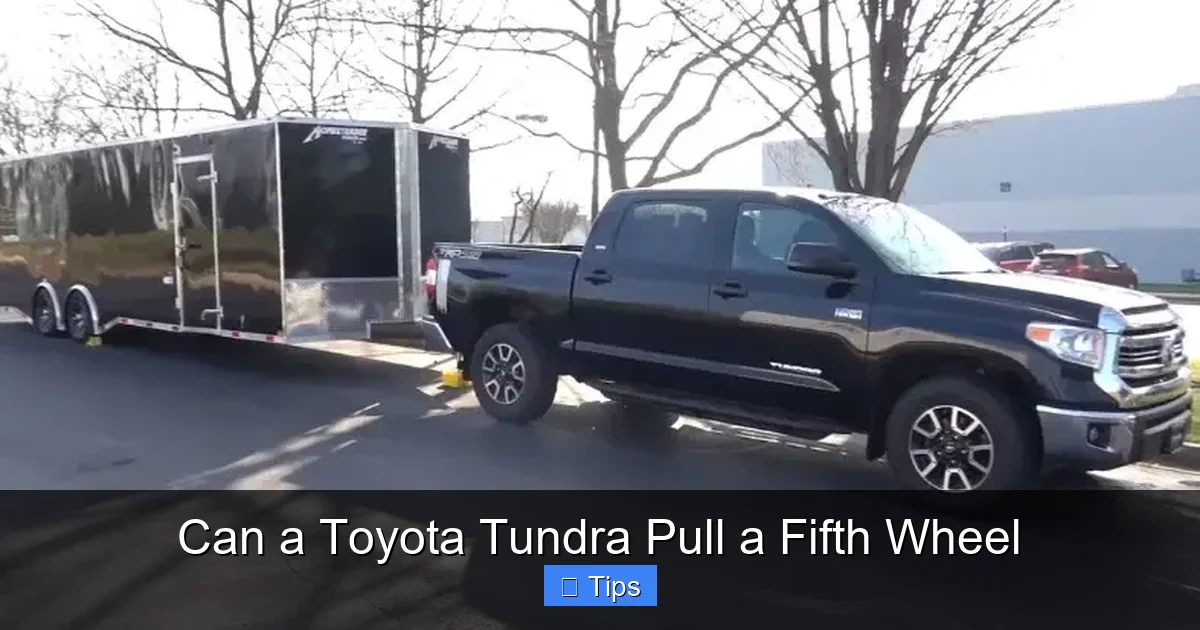
Now for the million-dollar question: can the Toyota Tundra actually pull a fifth wheel? The answer depends on the size and weight of the trailer you’re considering.
Most fifth wheels on the market today weigh between 10,000 and 20,000 pounds when fully loaded. Full-size luxury models with multiple slide-outs, full kitchens, and king beds often tip the scales at 15,000+ pounds. These are simply too heavy for a Tundra—even at its maximum towing capacity of 10,200 pounds.
However, there’s a growing segment of lightweight or mid-sized fifth wheels designed for half-ton trucks like the Tundra. These models typically range from 7,000 to 10,000 pounds dry weight (unloaded), and around 9,000 to 11,000 pounds when loaded with water, propane, and gear. Examples include the Grand Design Imagine XLS, Jayco Eagle HT, and Forest River Rockwood Ultra Lite. Some ultra-light models, like the Keystone Outback Ultra-Lite or the Winnebago Minnie Plus, are specifically engineered for half-ton towing.
So, if you’re eyeing a fifth wheel under 10,000 pounds loaded weight—and your Tundra is properly equipped—you’re in good shape. But remember: that’s the loaded weight, not the dry weight. Always plan for at least 1,500–2,000 pounds of added weight from water tanks, batteries, food, clothing, and accessories.
Let’s look at a real-world example. Say you have a 2021 Toyota Tundra SR5 with the 5.7L V8 and Tow Package. Its towing capacity is 10,000 pounds, and payload is about 1,650 pounds. You’re considering a 28-foot fifth wheel that weighs 8,500 pounds dry. After loading it up, it’s now 10,200 pounds—right at your truck’s max towing limit. But the pin weight is 1,900 pounds. Add two passengers (300 lbs), gear (200 lbs), and a full tank of gas (100 lbs), and you’re already at 2,500 pounds of payload—far exceeding your truck’s capacity.
In this case, the trailer is too heavy—not because of towing, but because of payload. This is why many Tundra owners opt for smaller fifth wheels or even consider a travel trailer instead.
Choosing the Right Fifth Wheel for Your Tundra
Visual guide about Can a Toyota Tundra Pull a Fifth Wheel
Image source: movrify.com
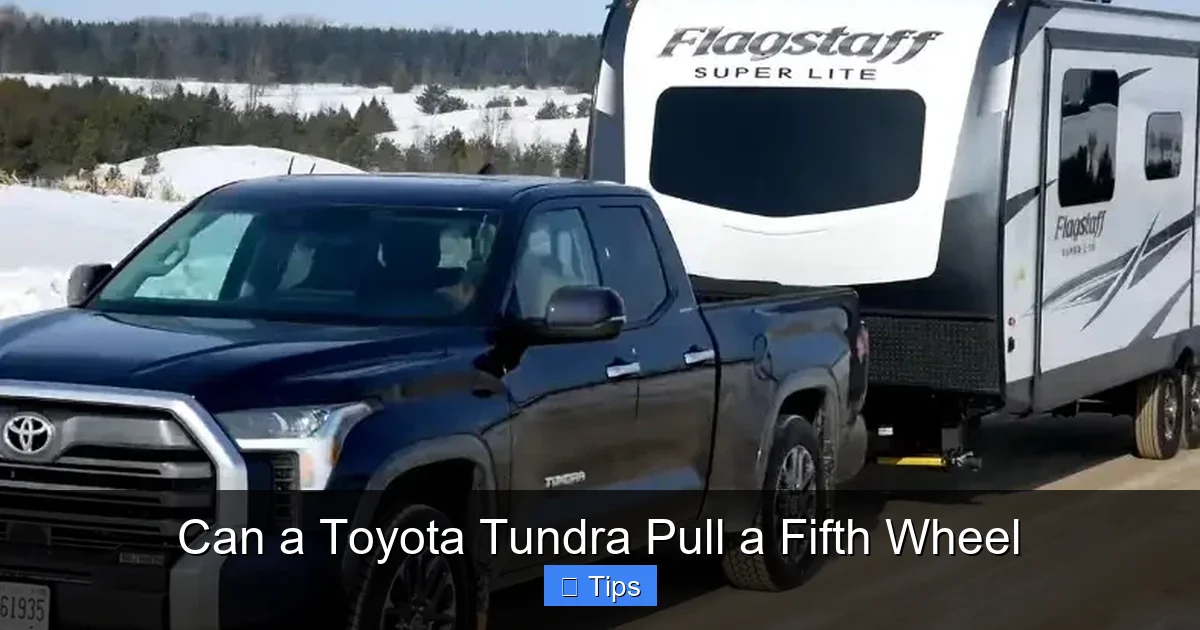
If you’re set on towing a fifth wheel with your Toyota Tundra, your best bet is to focus on lightweight, compact models designed for half-ton trucks. These RVs sacrifice some luxury features for better towability, but they still offer comfort, functionality, and plenty of space for most travelers.
When shopping, look for these key features:
- Dry Weight Under 8,500 lbs: This gives you room for loading without exceeding your towing capacity.
- Pin Weight Under 1,500 lbs: Ideally, aim for 1,200–1,400 lbs to leave margin for passengers and cargo.
- Compact Floor Plans: Shorter models (25–30 feet) are easier to maneuver and put less stress on your truck.
- Lightweight Construction: Look for aluminum frames, fiberglass exteriors, and minimal slide-outs.
- Tow Rating for Half-Ton Trucks: Many manufacturers now label RVs as “half-ton towable”—a good sign they’re Tundra-friendly.
Popular fifth wheels that often work well with the Tundra include:
- Grand Design Imagine XLS 24BHS: Dry weight ~7,800 lbs, pin weight ~1,300 lbs. Features a bunkhouse layout ideal for families.
- Jayco Eagle HT 27.5RLTS: Dry weight ~8,200 lbs, pin weight ~1,400 lbs. Offers a spacious rear living area and modern amenities.
- Forest River Rockwood Ultra Lite 2706WS: Dry weight ~8,000 lbs, pin weight ~1,350 lbs. Great for couples or small families with a rear kitchen design.
- Keystone Outback Ultra-Lite 250URS: Dry weight ~7,600 lbs, pin weight ~1,200 lbs. Compact and efficient, with a rear utility room.
When comparing models, always request the manufacturer’s weight specifications and ask for the “loaded” or “as-towed” weight estimate. Don’t rely solely on dry weight—real-world usage adds significant pounds.
Also, consider your travel style. If you plan to boondock or visit remote parks, a lighter trailer means better fuel economy and easier access to tight campsites. If you’re sticking to RV resorts with full hookups, you might afford a slightly heavier model—but never push the limits.
Hitch and Setup Requirements
Visual guide about Can a Toyota Tundra Pull a Fifth Wheel
Image source: movrify.com
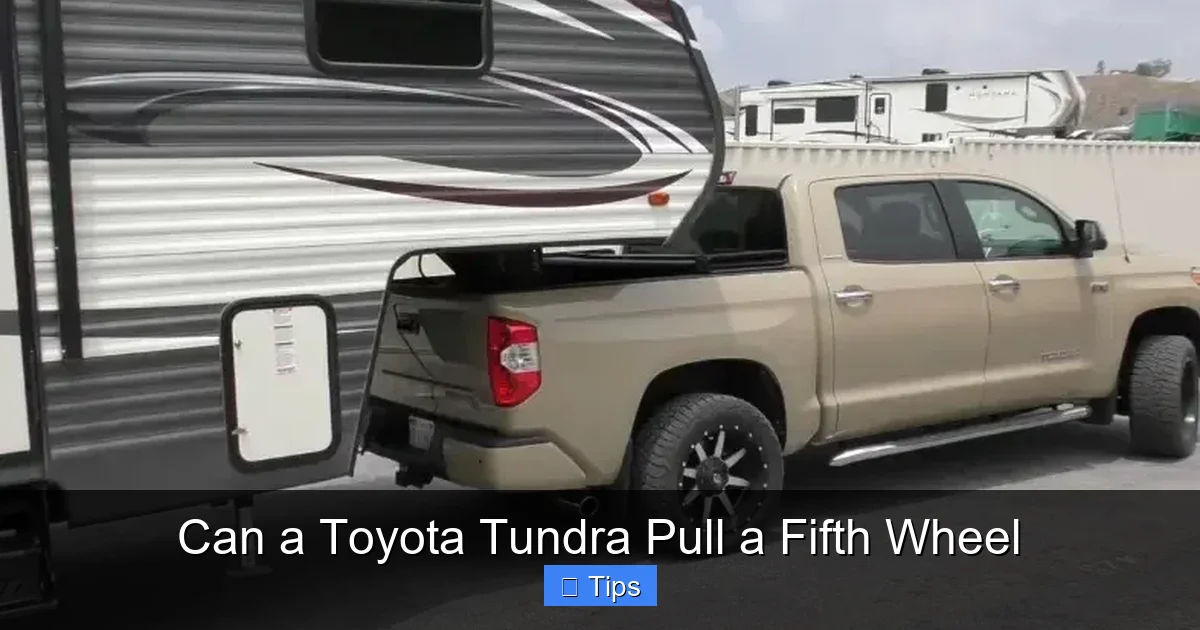
Towing a fifth wheel isn’t as simple as hooking up a bumper-pull trailer. You need a specialized hitch system mounted directly in the bed of your truck. Unlike travel trailers that use a ball hitch, fifth wheels use a kingpin that locks into a fifth wheel hitch—a large, U-shaped mechanism that sits over the rear axle.
For the Toyota Tundra, you have several hitch options:
- OEM Toyota Fifth Wheel Hitch: Toyota offers a factory-installed fifth wheel prep package on some Tundra models (especially newer ones). This includes a reinforced frame, wiring harness, and mounting points. You can then install a compatible hitch like the Curt A16 or Reese M5.
- Aftermarket Hitches: Brands like B&W, Andersen, and Demco make high-quality fifth wheel hitches that fit the Tundra. These range from $1,000 to $3,000 depending on features like sliding mechanisms (for better turning clearance) and weight capacity.
- Gooseneck Adapter: If your Tundra has a gooseneck hitch (common with the factory tow package), you can use a fifth wheel-to-gooseneck adapter. This is a cost-effective option, but adapters can reduce stability and aren’t recommended for heavy or long trailers.
Installation is critical. A fifth wheel hitch must be properly aligned, torqued, and secured to the truck bed. Most owners hire a professional installer to ensure it’s done right. Improper installation can lead to hitch failure, trailer detachment, or damage to your truck’s frame.
Once the hitch is in, you’ll also need a brake controller. The Tundra doesn’t come with one standard, so you’ll need to install an aftermarket unit like the Tekonsha Prodigy P3 or Curt Spectrum. This device allows you to control the trailer’s electric brakes from the cab, improving stopping power and safety.
Other setup tips:
- Use a weight distribution system if your trailer has a high pin weight.
- Check hitch height—your trailer should sit level when connected.
- Install backup cameras or side mirrors for better visibility.
- Practice hooking up and disconnecting in an empty parking lot.
Safety, Maintenance, and Driving Tips
Towing a fifth wheel with a Tundra is doable, but it demands respect for the added weight and complexity. Safety should always be your top priority.
Pre-Trip Checks: Before every trip, inspect your hitch, safety chains, brake connections, and tire pressure. Check that all lights work and that your trailer is level. Use a tire pressure monitoring system (TPMS) for both truck and trailer tires—underinflated tires are a leading cause of blowouts when towing.
Driving Habits: Towing changes how your truck handles. Expect longer stopping distances, reduced acceleration, and wider turns. Avoid sudden maneuvers, and always leave extra space between you and other vehicles. Use lower gears on hills to reduce brake wear—your Tundra’s engine brake (if equipped) can help.
Maintenance: Towing puts extra strain on your truck. Regularly check your transmission fluid, coolant, brakes, and suspension. Consider upgrading to heavy-duty shocks, airbags, or a leveling kit to improve ride quality and stability. Also, rotate your tires more frequently and inspect for uneven wear.
Fuel Economy: Don’t expect great mileage. Towing a fifth wheel can drop your Tundra’s fuel economy from 15–18 mpg down to 8–10 mpg, depending on terrain and load. Plan your fuel stops accordingly, especially in remote areas.
Emergency Preparedness: Carry a roadside emergency kit, spare tire (for both truck and trailer), and tools for minor repairs. Know how to manually release your hitch in case of electrical failure. And always have a plan for where you can safely stop if something goes wrong.
Alternatives to Consider
If you find that your ideal fifth wheel is just too heavy for your Tundra, don’t despair. There are alternatives that might better suit your truck and lifestyle.
Travel Trailers: These bumper-pull trailers are lighter and easier to tow. Many models under 8,000 pounds work well with the Tundra, and they don’t require a bed-mounted hitch. You’ll still need a weight distribution hitch and brake controller, but setup is simpler.
Teardrop or Small Campers: For minimalist travelers, teardrop trailers or pop-up campers offer comfort without the bulk. These are ideal for weekend trips and can be towed effortlessly by a Tundra.
Upgrade Your Truck: If you’re committed to a larger fifth wheel, consider upgrading to a heavy-duty truck like a Toyota Tundra TRD Pro with enhanced suspension, or switch to a Ford F-250 or Ram 2500. These trucks offer higher towing and payload capacities, making them better suited for full-size RVs.
Gooseneck Trailers: Some RVs are designed to be towed with a gooseneck hitch, which can offer better weight distribution than a fifth wheel. If your Tundra has a gooseneck setup, this might be a viable option.
Ultimately, the best choice depends on your budget, travel goals, and how much you’re willing to compromise on space versus towability.
Final Thoughts
So, can a Toyota Tundra pull a fifth wheel? The answer is a cautious yes—if you do your homework, choose the right trailer, and respect your truck’s limits. The Tundra is a capable and reliable truck, but it’s not designed for the heaviest fifth wheels on the market. By focusing on lightweight models, ensuring proper hitch installation, and driving safely, you can enjoy the freedom of RV life without overloading your vehicle.
Remember: towing isn’t just about power—it’s about preparation. Know your numbers, plan your trips, and never exceed your truck’s towing or payload ratings. With the right setup, your Tundra can be a trustworthy partner on the road to adventure.
Whether you’re exploring national parks, visiting family across the country, or living the full-time RV dream, the journey is always better when you’re confident in your rig. So hitch up smart, drive safe, and enjoy the ride.
Frequently Asked Questions
What is the maximum fifth wheel weight a Toyota Tundra can tow?
The Toyota Tundra can typically tow up to 10,200 pounds when properly equipped, but most fifth wheels suitable for the Tundra should be under 10,000 pounds loaded weight to stay within safe towing and payload limits.
Do I need a special hitch to tow a fifth wheel with a Tundra?
Yes, you need a fifth wheel hitch mounted in the truck bed. The Tundra may require a factory prep package or aftermarket installation, and a brake controller is also recommended for safe operation.
Can a 2023 Toyota Tundra tow a 12,000-pound fifth wheel?
No, a 2023 Tundra’s maximum towing capacity is 10,200 pounds. A 12,000-pound fifth wheel exceeds this limit and would also likely overload the truck’s payload capacity.
Is payload or towing capacity more important when towing a fifth wheel?
Payload is often the limiting factor. Fifth wheels transfer significant weight (pin weight) to the truck bed, which counts toward payload—not towing capacity—and can easily exceed your Tundra’s limit.
Can I use a gooseneck adapter to tow a fifth wheel with my Tundra?
Yes, if your Tundra has a gooseneck hitch, you can use a fifth wheel-to-gooseneck adapter. However, this setup may reduce stability and is best for lighter trailers.
What are some good fifth wheels for a Toyota Tundra?
Lightweight models like the Grand Design Imagine XLS, Jayco Eagle HT, and Forest River Rockwood Ultra Lite are popular choices that typically stay within the Tundra’s towing and payload limits.

At CarLegit, we believe information should be clear, factual, and genuinely helpful. That’s why every guide, review, and update on our website is created with care, research, and a strong focus on user experience.