
The Toyota Sienna has a fuel tank capacity ranging from 18 to 20 gallons, depending on the model year and drivetrain. This minivan is known for its impressive fuel efficiency, especially with the hybrid powertrain introduced in 2021. Whether you’re planning a road trip or daily commuting, understanding its fuel capacity helps you plan smarter and drive farther with fewer stops.
[FEATURED_IMAGE_PLACEHODEL]
In This Article
- 1 Key Takeaways
- 2 📑 Table of Contents
- 3 How Many Gallons Does a Toyota Sienna Hold?
- 4 Fuel Tank Capacity by Model Year
- 5 Understanding Fuel Efficiency and Real-World Range
- 6 Fuel Type and Octane Recommendations
- 7 Maintenance Tips to Maintain Fuel Efficiency
- 8 Planning Long Trips: Refueling Strategies
- 9 Environmental Impact and Eco-Friendly Driving
- 10 Conclusion
- 11 Frequently Asked Questions
Key Takeaways
- Fuel tank size varies by model year: Older Siennas (pre-2021) typically hold 18–19 gallons, while newer hybrid models hold up to 20 gallons.
- Hybrid models offer better efficiency: The 2021 and newer Sienna comes standard with a hybrid engine, improving gas mileage and extending driving range.
- All-wheel drive affects fuel economy: AWD models may have slightly lower MPG but offer better traction in adverse weather.
- Real-world range exceeds 500 miles: With efficient driving, many owners report traveling over 500 miles on a single tank.
- Regular maintenance improves fuel performance: Keeping tires inflated, using recommended oil, and servicing the engine helps maintain optimal efficiency.
- Fuel type matters: Always use regular unleaded gasoline (87 octane) unless otherwise specified for your trim.
- Plan refueling stops wisely: Use apps like GasBuddy or Waze to find the best fuel prices and plan stops during long trips.
📑 Table of Contents
- How Many Gallons Does a Toyota Sienna Hold?
- Fuel Tank Capacity by Model Year
- Understanding Fuel Efficiency and Real-World Range
- Fuel Type and Octane Recommendations
- Maintenance Tips to Maintain Fuel Efficiency
- Planning Long Trips: Refueling Strategies
- Environmental Impact and Eco-Friendly Driving
- Conclusion
How Many Gallons Does a Toyota Sienna Hold?
If you’re considering buying a Toyota Sienna or already own one, you’ve probably asked: “How many gallons does a Toyota Sienna hold?” It’s a smart question—knowing your vehicle’s fuel tank capacity helps you plan road trips, estimate fuel costs, and understand how far you can go between fill-ups. The answer isn’t one-size-fits-all, though. The fuel tank size in a Toyota Sienna depends on the model year, engine type, and drivetrain configuration.
In this comprehensive guide, we’ll break down everything you need to know about the Toyota Sienna’s fuel capacity. Whether you drive a 2015 model with a V6 engine or a brand-new 2024 hybrid, we’ve got the details. We’ll also cover fuel efficiency, real-world driving range, maintenance tips, and how to get the most out of every gallon. By the end, you’ll not only know how many gallons your Sienna holds—you’ll know how to make those gallons go the extra mile.
Fuel Tank Capacity by Model Year

Visual guide about How Many Gallons Does a Toyota Sienna Hold
Image source: thecarhow.com
One of the most common questions Sienna owners and shoppers ask is about fuel tank size. The good news? Toyota has kept the fuel tank capacity fairly consistent over the years, with only minor changes between generations. Let’s look at how the numbers stack up across different model years.
Pre-2021 Models (V6 Engine)
From 2011 to 2020, the Toyota Sienna was powered by a 3.5-liter V6 engine. During this period, the fuel tank capacity was typically **18 to 19 gallons**. Most models, including the LE, XLE, and Limited trims, came with an 18.5-gallon tank. Some higher trims or special editions might have had a slightly larger 19-gallon capacity, but the difference was minimal.
For example, a 2018 Toyota Sienna LE with front-wheel drive (FWD) has an 18.5-gallon tank. If you drive mostly in the city with an average of 18 MPG, you can expect to travel about 333 miles on a full tank. On the highway, where fuel economy improves to around 25 MPG, that range jumps to over 460 miles. That’s a solid distance for family road trips or long commutes.
2021 and Newer Models (Hybrid Engine)
In 2021, Toyota made a major shift: the Sienna went fully hybrid. This change brought not only improved fuel efficiency but also a slightly larger fuel tank. Most 2021–2024 Sienna models come with a **20-gallon fuel tank**. This increase, combined with the hybrid powertrain, significantly boosts the vehicle’s range.
The 2023 Toyota Sienna XLE Hybrid, for instance, has a 20-gallon tank and an EPA-estimated 36 MPG combined (35 city / 36 highway). That means you can drive approximately 720 miles on a single tank under ideal conditions. Even with mixed driving, most owners report easily exceeding 600 miles per fill-up.
All-Wheel Drive (AWD) Considerations
If your Sienna has all-wheel drive, the fuel tank size remains the same—18.5 to 20 gallons depending on the year. However, AWD does impact fuel economy. The added mechanical components and weight reduce efficiency slightly. For example, a 2022 Sienna AWD Hybrid gets about 35 MPG combined, compared to 36 MPG for the FWD version.
Despite the small drop in MPG, the larger tank in newer models still ensures excellent range. So even with AWD, you’re unlikely to feel limited on long drives.
Understanding Fuel Efficiency and Real-World Range
Visual guide about How Many Gallons Does a Toyota Sienna Hold
Image source: 2025toyota.com
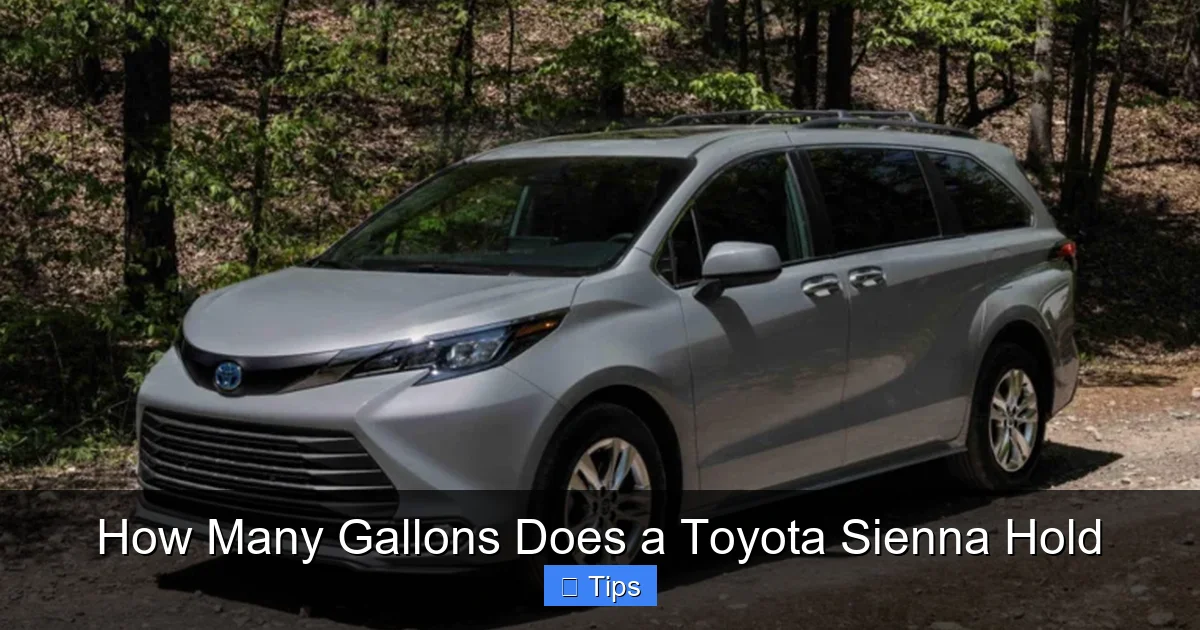
Knowing the fuel tank size is only half the story. To truly understand how far your Sienna can go, you need to consider fuel efficiency—how many miles per gallon (MPG) it gets in real-world driving.
EPA Ratings vs. Real-World Performance
The Environmental Protection Agency (EPA) provides standardized fuel economy ratings, but your actual MPG may vary based on driving habits, terrain, weather, and load. For example, the 2023 Sienna Hybrid FWD is rated at 36 MPG combined. In practice, many drivers report achieving 34–38 MPG, especially on highways or with smooth acceleration.
City driving tends to be less efficient due to frequent stops and starts. However, the hybrid system in newer Siennas helps recapture energy during braking, improving city MPG compared to older V6 models.
Calculating Your Driving Range
To estimate how far you can go on a full tank, use this simple formula:
Range (miles) = Fuel Tank Capacity (gallons) × MPG
Let’s apply this to a few examples:
– A 2019 Sienna (18.5 gallons, 20 MPG combined): 18.5 × 20 = 370 miles
– A 2023 Sienna Hybrid FWD (20 gallons, 36 MPG): 20 × 36 = 720 miles
– A 2023 Sienna AWD Hybrid (20 gallons, 35 MPG): 20 × 35 = 700 miles
As you can see, the newer hybrid models offer a massive improvement in range. That’s a game-changer for families who travel frequently or live in areas with fewer gas stations.
Tips to Maximize Your Range
Want to stretch every gallon even further? Here are some practical tips:
– Drive smoothly: Avoid rapid acceleration and hard braking. Gradual speed changes improve fuel efficiency.
– Use cruise control: On highways, cruise control helps maintain a steady speed, reducing fuel waste.
– Reduce weight: Remove unnecessary items from the cargo area. Extra weight lowers MPG.
– Keep tires properly inflated: Underinflated tires increase rolling resistance. Check pressure monthly.
– Use the Eco mode: Most Siennas have an Eco driving mode that adjusts throttle response and climate control to save fuel.
– Plan efficient routes: Use GPS apps to avoid traffic and find the shortest, smoothest path.
Fuel Type and Octane Recommendations
Visual guide about How Many Gallons Does a Toyota Sienna Hold
Image source: appgecet.co.in
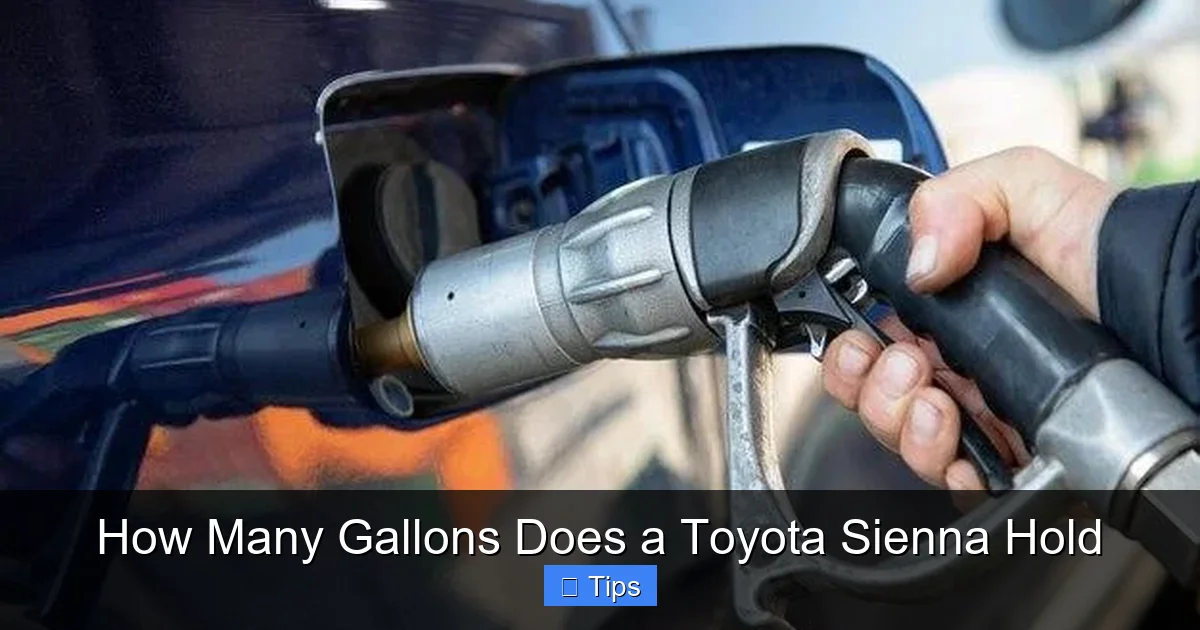
Using the right fuel is essential for optimal performance and longevity of your Sienna’s engine. Toyota recommends using **regular unleaded gasoline with an octane rating of 87** for all Sienna models, including the hybrid versions.
Can You Use Premium Gas?
You might wonder if premium gas (91 or 93 octane) will improve performance or efficiency. The short answer: it’s not necessary. The Sienna’s engine is designed to run efficiently on regular fuel. Using premium won’t damage the engine, but it also won’t boost MPG or power in most cases.
In rare situations—like towing heavy loads or driving at high altitudes—higher octane fuel might help prevent engine knocking. But for everyday driving, stick with regular unleaded to save money at the pump.
Ethanol Blends and Fuel Quality
Most gasoline sold in the U.S. contains up to 10% ethanol (E10). The Sienna can safely use E10 without issues. However, avoid fuels with higher ethanol content (like E15 or E85) unless your vehicle is specifically designed for it. Flex-fuel vehicles can handle E85, but the Sienna is not one of them.
Also, choose reputable gas stations. Lower-quality fuel can contain contaminants that affect engine performance over time. If you notice rough idling or reduced MPG, it might be worth trying a different station or adding a fuel system cleaner.
Maintenance Tips to Maintain Fuel Efficiency
Even with a large fuel tank and efficient engine, your Sienna’s MPG can drop if it’s not properly maintained. Regular upkeep ensures your van runs smoothly and efficiently for years to come.
Regular Oil Changes
Toyota recommends changing the oil every 5,000 to 10,000 miles, depending on driving conditions. Use the manufacturer-recommended oil grade—typically 0W-20 synthetic for newer models. Clean oil reduces engine friction, improving fuel economy.
Air Filter Replacement
A dirty air filter restricts airflow to the engine, forcing it to work harder and burn more fuel. Check the air filter every 15,000 miles and replace it if it’s clogged or dirty. This is an easy DIY task that can improve MPG by up to 10%.
Spark Plug Maintenance
Spark plugs ignite the fuel-air mixture in the engine. Worn or fouled plugs can cause misfires, reduced power, and lower fuel efficiency. Most Siennas need new spark plugs every 60,000 to 100,000 miles. Follow your owner’s manual for the exact interval.
Tire Care and Alignment
Properly inflated and aligned tires reduce rolling resistance and improve handling. Check tire pressure monthly and rotate tires every 5,000 to 7,500 miles. Misaligned wheels can cause uneven wear and drag, lowering MPG.
Brake System Check
Sticking brake calipers or worn pads can create drag, forcing the engine to work harder. If you notice a pulling sensation or reduced fuel economy, have your brakes inspected.
Fuel System Cleaning
Over time, carbon deposits can build up in the fuel injectors and intake valves. Using a quality fuel system cleaner every 3,000 to 5,000 miles can help maintain performance. For deeper cleaning, consider a professional service every 30,000 miles.
Planning Long Trips: Refueling Strategies
With a range of 500 to 700+ miles, the Sienna is perfect for long-distance travel. But even the best fuel economy requires smart planning on road trips.
When to Refuel
Don’t wait until the fuel light comes on. Most Siennas have a reserve of about 2–3 gallons when the light illuminates. That’s roughly 60–100 miles of driving, depending on conditions. Refuel when the tank is around ¼ full to avoid running out unexpectedly.
Using Fuel Apps
Apps like GasBuddy, Waze, and AAA TripTik help you find the cheapest gas along your route. They also show station amenities, wait times, and user reviews. Planning stops in advance saves time and money.
Off-Peak Refueling
Gas prices often fluctuate throughout the day. In many areas, prices are lower in the early morning or late evening. If you’re on a long trip, consider filling up during these times to save a few dollars.
Carrying Extra Fuel (Not Recommended)
Some drivers consider carrying a gas can for emergencies. However, this is not advised for the Sienna. The vehicle’s design doesn’t accommodate portable fuel containers safely, and improper storage can be a fire hazard. Instead, rely on roadside assistance or plan your route with gas stations in mind.
Environmental Impact and Eco-Friendly Driving
The Toyota Sienna, especially the hybrid models, is one of the most eco-friendly minivans on the market. With high fuel efficiency and low emissions, it’s a great choice for families who want to reduce their carbon footprint.
Hybrid Technology Benefits
The 2021+ Sienna uses a hybrid system that combines a 2.5-liter four-cylinder engine with electric motors. This setup reduces reliance on gasoline, especially in stop-and-go traffic. The electric motor powers the vehicle at low speeds, cutting emissions and saving fuel.
Regenerative Braking
Every time you brake, the Sienna’s hybrid system captures energy that would otherwise be lost as heat. This energy recharges the battery, reducing the need to burn fuel. It’s a smart, sustainable feature that improves efficiency.
Driving Habits That Help the Planet
Small changes in driving behavior can make a big difference:
– Avoid idling for long periods.
– Combine errands into one trip to reduce cold starts.
– Use remote start sparingly—it burns fuel without moving the vehicle.
– Carpool or use the Sienna’s seating for group trips instead of multiple cars.
Conclusion
So, how many gallons does a Toyota Sienna hold? The answer depends on your model year, but most Siennas hold between 18 and 20 gallons of fuel. Older V6 models typically have an 18.5-gallon tank, while newer hybrid versions come with a 20-gallon capacity. This, combined with impressive fuel efficiency—especially in the hybrid lineup—means you can drive hundreds of miles between fill-ups.
Whether you’re commuting to work, shuttling kids to soccer practice, or embarking on a cross-country adventure, the Sienna’s fuel capacity and efficiency make it a reliable choice. By following maintenance tips, driving smart, and planning your trips wisely, you can get the most out of every gallon.
The Toyota Sienna isn’t just a minivan—it’s a fuel-efficient, family-friendly workhorse designed for real life. And now that you know exactly how many gallons it holds and how far those gallons can take you, you’re ready to hit the road with confidence.
Frequently Asked Questions
How many gallons does a 2023 Toyota Sienna hold?
The 2023 Toyota Sienna has a 20-gallon fuel tank. This applies to all trims, including the LE, XLE, and Limited, whether they’re front-wheel drive or all-wheel drive.
You can use premium gas, but it’s not required. The Sienna is designed to run efficiently on regular unleaded gasoline (87 octane). Using premium won’t improve performance or fuel economy in most cases.
How far can a Toyota Sienna go on a full tank?
Depending on the model, a Sienna can travel 500 to over 700 miles on a full tank. Newer hybrid models with 36 MPG and a 20-gallon tank can exceed 700 miles under ideal conditions.
Does all-wheel drive reduce fuel tank size?
No, all-wheel drive does not reduce fuel tank size. AWD models have the same 18.5 to 20-gallon capacity as FWD versions, though they may get slightly lower MPG due to added weight.
How often should I refuel my Sienna?
It’s best to refuel when the tank is around ¼ full. This avoids running out of gas and gives you enough reserve to reach the next station, especially on long trips.
What type of fuel does the Toyota Sienna hybrid use?
The Toyota Sienna hybrid uses regular unleaded gasoline (87 octane). It does not require premium fuel, and using higher octane offers no significant benefit.

At CarLegit, we believe information should be clear, factual, and genuinely helpful. That’s why every guide, review, and update on our website is created with care, research, and a strong focus on user experience.