
Car insurance typically does not cover theft of personal items from your vehicle under standard auto policies. However, comprehensive coverage may reimburse you for stolen items in some cases, though limits and exclusions apply. For full protection, rely on homeowners or renters insurance, not your auto policy.
Have you ever parked your car, run into a store for just a few minutes, and returned to find a shattered window and your backpack—or laptop, phone, or sunglasses—gone? It’s a gut-wrenching experience, and the first question that pops into your head is: “Will my car insurance cover this?”
The short answer? Probably not—at least not fully. While car insurance is essential for protecting your vehicle and covering damages from accidents, theft of the car itself, or injuries, it’s surprisingly limited when it comes to personal items stolen from inside your car. Most drivers assume that because their car is insured, everything inside it is protected too. But that’s a common misconception that can lead to financial loss and frustration.
Understanding what your car insurance actually covers—and what it doesn’t—can save you from unpleasant surprises. In this guide, we’ll break down exactly how car insurance handles theft of personal items, what types of coverage might help (and how much), and why your homeowners or renters policy is often the real hero in these situations. We’ll also share practical tips to protect your belongings and steps to take if you’re ever a victim of car break-ins. Whether you’re a daily commuter, a weekend road-tripper, or just someone who keeps a spare jacket in the back seat, this information is vital.
In This Article
- 1 Key Takeaways
- 2 📑 Table of Contents
- 3 What Does Car Insurance Typically Cover?
- 4 When Might Car Insurance Cover Stolen Personal Items?
- 5 Why Homeowners or Renters Insurance Is the Better Option
- 6 Real-Life Examples: What Happens When Items Are Stolen?
- 7 How to Protect Your Belongings and Prevent Theft
- 8 What to Do If Your Items Are Stolen
- 9 Final Thoughts: Know Your Coverage Before You Need It
- 10 Frequently Asked Questions
- 10.1 Does car insurance cover theft of personal items from my car?
- 10.2 Will my homeowners or renters insurance cover items stolen from my car?
- 10.3 What should I do immediately after discovering a theft from my car?
- 10.4 Can I claim stolen items on both my car and home insurance?
- 10.5 Are there items that are never covered, even by homeowners insurance?
- 10.6 How can I increase coverage for valuable items stolen from my car?
Key Takeaways
- Standard auto insurance does not cover personal items: Liability, collision, and even comprehensive coverage are designed for vehicle damage, not personal belongings.
- Comprehensive coverage may offer limited reimbursement: If your car is broken into, comprehensive insurance might pay for stolen items, but only up to a low limit (often $100–$250).
- Homeowners or renters insurance is your best bet: These policies usually cover personal items stolen from your car, regardless of location, with higher limits and better protection.
- Documentation is crucial: Keep receipts, photos, and a detailed inventory of valuable items to support claims.
- Report theft immediately: File a police report and notify your insurer promptly to avoid claim denials.
- Prevention reduces risk: Never leave valuables in plain sight—use trunks, lockers, or take items with you.
- Review your policies annually: Ensure your coverage limits match your current belongings and lifestyle.
📑 Table of Contents
- What Does Car Insurance Typically Cover?
- When Might Car Insurance Cover Stolen Personal Items?
- Why Homeowners or Renters Insurance Is the Better Option
- Real-Life Examples: What Happens When Items Are Stolen?
- How to Protect Your Belongings and Prevent Theft
- What to Do If Your Items Are Stolen
- Final Thoughts: Know Your Coverage Before You Need It
What Does Car Insurance Typically Cover?
Before diving into personal item theft, it’s important to understand the basics of car insurance coverage. Most policies include several types of protection, each serving a different purpose. The three main components are liability, collision, and comprehensive coverage.
Liability insurance is mandatory in nearly every state and covers damages or injuries you cause to others in an accident. It does not cover your own vehicle or personal belongings. Collision coverage pays for repairs to your car after an accident, regardless of fault. Again, this is strictly for the vehicle—not what’s inside it.
That leaves comprehensive coverage, which is the only part of your auto policy that might touch on theft-related incidents. Comprehensive insurance protects your car from non-collision events like vandalism, fire, natural disasters, and yes—theft of the vehicle itself. But here’s the catch: while it covers the car being stolen, it generally does not extend to personal items inside the car when it’s broken into.
For example, if someone steals your entire car, comprehensive coverage will help replace or repair it (minus your deductible). But if they smash your window and take your gym bag, laptop, or jewelry, your auto insurer likely won’t pay for those items. Why? Because car insurance is designed to protect the vehicle and third-party liabilities, not your personal property.
Some insurers may offer a small reimbursement—often called “personal effects coverage” or “personal property coverage”—but this is rare and usually limited to $100–$250. That’s not enough to replace a $1,200 laptop or a $500 camera. So while comprehensive coverage is valuable, it’s not a reliable safety net for your belongings.
When Might Car Insurance Cover Stolen Personal Items?
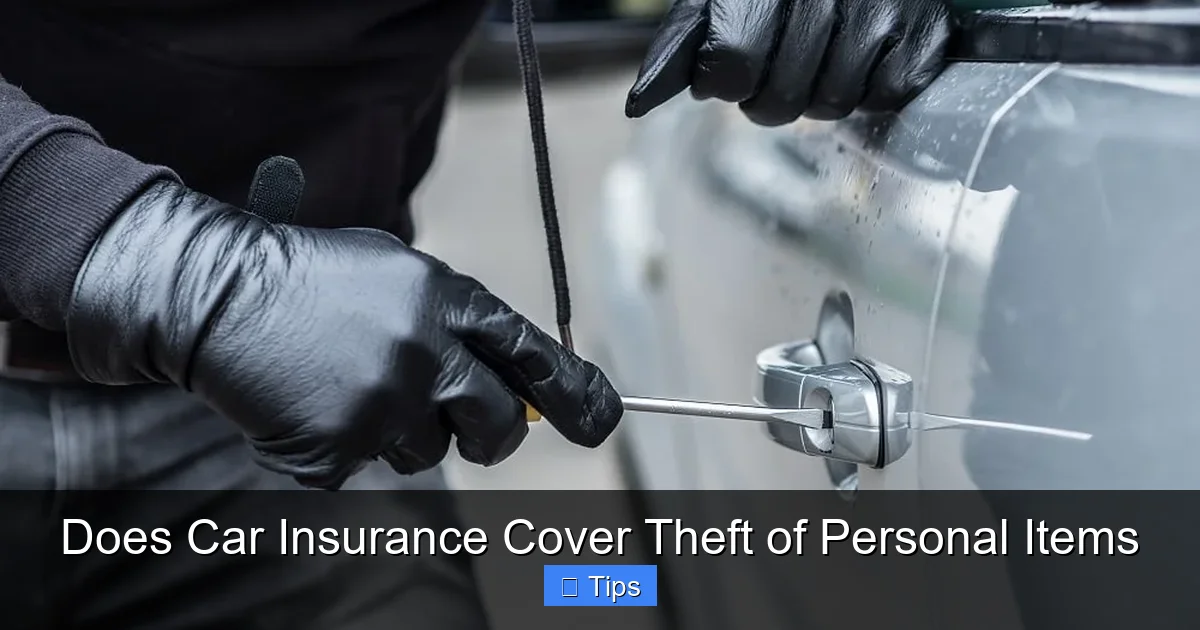
Visual guide about Does Car Insurance Cover Theft of Personal Items
Image source: clovered.com
Now, let’s get into the gray area: are there any situations where car insurance might help with stolen personal items? The answer is: possibly, but with major caveats.
Comprehensive Coverage and Limited Reimbursement
As mentioned, comprehensive coverage is the only part of your auto policy that could potentially cover theft of personal items—but only under very specific conditions. Some insurance companies include a small allowance for personal effects stolen from your vehicle. This is often buried in the fine print and not widely advertised.
For instance, State Farm’s comprehensive coverage includes up to $100 for personal items stolen from your car. Allstate offers a similar benefit, typically around $250. These amounts are meant to cover small, everyday items like sunglasses, a phone charger, or a backpack—not high-value electronics or luxury goods.
To qualify, you usually need to file a claim under your comprehensive coverage and provide proof of the theft (like a police report). However, you’ll still have to pay your deductible, which could be $500 or more. So if your deductible is $500 and the insurer only reimburses $100, you’re still out $400—and that’s before considering the actual value of your stolen items.
Exceptions and Add-Ons
A few insurers offer optional add-ons or endorsements that increase personal property coverage. For example, some companies allow you to purchase “personal effects coverage” as an extra rider. This might raise the limit to $500 or $1,000, but it comes at an additional cost.
It’s also worth noting that these coverages often exclude certain items. High-value electronics, musical instruments, firearms, and business equipment are frequently left out. So even if you have an add-on, your $2,000 camera might not be covered.
In rare cases, if the theft occurs while your car is being repaired at a dealership or repair shop, their garage liability insurance might cover your belongings. But this is highly situational and not something you can rely on.
The bottom line? While there are narrow circumstances where car insurance might offer a small payout for stolen personal items, it’s not a dependable solution. Relying on your auto policy for this kind of protection is like using a bandage for a broken leg—it might help a little, but it’s not the right tool for the job.
Why Homeowners or Renters Insurance Is the Better Option
Visual guide about Does Car Insurance Cover Theft of Personal Items
Image source: lemonade.com
If car insurance isn’t the answer, where should you turn? The real solution lies in your homeowners or renters insurance policy. These policies are specifically designed to protect your personal belongings—both inside and outside your home.
Coverage Beyond the Home
One of the most powerful features of homeowners and renters insurance is that it covers your personal property anywhere in the world. Yes, that means if your laptop is stolen from your car in a parking lot in another state, your policy may still cover it. This is known as “off-premises coverage” and is typically included in standard policies.
Most policies cover personal items up to 50–70% of your total personal property limit. For example, if your policy has a $50,000 personal property limit, you could be covered for up to $25,000–$35,000 worth of items stolen from your car. That’s a huge difference compared to the $100–$250 you might get from car insurance.
Types of Items Covered
Homeowners and renters insurance generally covers a wide range of personal items, including:
– Electronics (laptops, tablets, phones, cameras)
– Clothing and accessories
– Jewelry (though often with sub-limits)
– Sports equipment
– Musical instruments
– Bags and luggage
However, there are limits. High-value items like expensive jewelry, art, or collectibles may have sub-limits—say, $1,500 for jewelry—unless you purchase a separate rider or floater. So if your $3,000 engagement ring is stolen from your car, you might only get $1,500 unless it’s specifically scheduled on your policy.
Deductibles and Claim Process
Like car insurance, homeowners and renters policies have deductibles—typically $500 to $2,500. You’ll need to pay this amount before the insurer covers the rest. But because the coverage limits are much higher, it’s often worth filing a claim for significant losses.
To file a claim, you’ll need to:
1. Report the theft to the police and get a report number.
2. Contact your insurance company as soon as possible.
3. Provide documentation: receipts, photos, serial numbers, or a detailed list of stolen items.
4. Fill out a claim form and possibly meet with an adjuster.
The process can take a few weeks, but it’s far more likely to result in fair compensation than trying to claim through your auto insurer.
Real-Life Examples: What Happens When Items Are Stolen?
Visual guide about Does Car Insurance Cover Theft of Personal Items
Image source: images.contentstack.io
Let’s look at a few real-world scenarios to see how these policies play out in practice.
Example 1: Laptop Stolen from a Parked Car
Sarah leaves her laptop in her car while she runs into a coffee shop. When she returns, the window is smashed and the laptop is gone. She has comprehensive car insurance with a $500 deductible and a $100 personal effects allowance. She also has renters insurance with a $1,000 deductible and $30,000 in personal property coverage.
– Car insurance: Pays $100 (minus $500 deductible = she pays $400 out of pocket).
– Rent insurance: Covers the $1,200 laptop after she pays the $1,000 deductible. She’s out $1,000 but gets $200 back.
In this case, renters insurance is the better option, even with the higher deductible.
Example 2: Sunglasses and Phone Charger Taken
Mike’s car is broken into, and the thief takes his $200 sunglasses and $50 phone charger. His car insurance offers $250 for personal items with a $250 deductible. His renters policy has a $500 deductible.
– Car insurance: Pays $250 minus $250 deductible = $0.
– Renters insurance: Doesn’t make sense to file—deductible is higher than the loss.
Here, neither policy helps much, but Mike learns to never leave valuables in sight.
Example 3: Expensive Camera Stolen During a Road Trip
Jen’s $3,000 camera is stolen from her rental car while she’s hiking. She has comprehensive car insurance with no personal effects coverage and a $1,000 deductible. Her homeowners policy has a $1,000 deductible and covers personal items worldwide.
– Car insurance: Denies claim—no coverage for personal items.
– Homeowners insurance: Covers $2,000 after deductible (assuming no rider for the camera).
Jen realizes she should have added a rider for her camera and now does so for future trips.
These examples show that while car insurance rarely helps, homeowners or renters insurance can make a big difference—especially for valuable items.
How to Protect Your Belongings and Prevent Theft
The best way to deal with theft is to avoid it altogether. Here are practical tips to keep your personal items safe:
Never Leave Valuables in Plain Sight
Thieves often act on impulse. If they see a laptop bag, phone, or shopping bag on the seat, they’re more likely to break in. Always store items in the trunk—or better yet, take them with you.
Use Anti-Theft Devices
Consider installing a car alarm, steering wheel lock, or GPS tracker. These won’t stop all thefts, but they can deter opportunistic criminals.
Park Smart
Choose well-lit, busy areas with security cameras. Avoid parking in isolated or poorly lit spots, especially at night.
Keep an Inventory
Maintain a list of your valuable items, including photos, serial numbers, and receipts. Store this list in a secure cloud folder or with a trusted friend. This makes claims much easier.
Use a Portable Safe
For frequent travelers, a small, lockable safe that fits in the trunk can protect essentials like passports, wallets, and electronics.
Be Mindful of “Hidden” Spots
Thieves know to check glove compartments, under seats, and door pockets. Don’t assume these are safe.
Prevention is always cheaper and less stressful than dealing with theft and insurance claims.
What to Do If Your Items Are Stolen
If the worst happens, act quickly to protect your rights and maximize your chances of recovery:
1. **Call the police immediately.** File a report and get a copy. This is required by most insurers.
2. **Document the scene.** Take photos of the damaged car and any remaining items.
3. **Notify your insurance companies.** Contact both your auto and homeowners/renters insurers.
4. **Gather evidence.** Collect receipts, photos, and any proof of ownership.
5. **File your claim promptly.** Delays can lead to denials.
6. **Follow up regularly.** Stay in touch with adjusters and provide any additional info they request.
Remember, honesty is key. Don’t exaggerate losses—insurers can verify claims, and dishonesty can void your policy.
Final Thoughts: Know Your Coverage Before You Need It
Car insurance is a vital part of responsible driving, but it’s not a catch-all solution for personal property theft. While comprehensive coverage might offer a small reimbursement in rare cases, it’s not designed to protect your belongings.
Your homeowners or renters insurance is the true guardian of your personal items—whether they’re at home, in your car, or on the go. By understanding the limits of each policy and taking preventive steps, you can protect yourself from financial loss and peace-of-mind disruption.
Take a few minutes today to review your policies. Check your deductibles, coverage limits, and any exclusions. Update your inventory. And next time you leave the house, ask yourself: “Would I be okay if this were stolen?” If the answer is no, take it with you.
Because when it comes to theft, the best insurance isn’t just a policy—it’s preparation.
Frequently Asked Questions
Does car insurance cover theft of personal items from my car?
Generally, no. Standard car insurance policies, including comprehensive coverage, are designed to protect the vehicle—not personal belongings inside it. Some insurers offer minimal reimbursement (e.g., $100–$250), but it’s rarely enough to cover significant losses.
Will my homeowners or renters insurance cover items stolen from my car?
Yes, in most cases. Homeowners and renters insurance typically cover personal property anywhere in the world, including items stolen from your vehicle. Just be aware of deductibles and sub-limits for high-value items like jewelry or electronics.
What should I do immediately after discovering a theft from my car?
Call the police to file a report, document the damage with photos, and contact your insurance companies as soon as possible. A police report is usually required for any claim.
Can I claim stolen items on both my car and home insurance?
No, you cannot double-dip. You must choose one policy to file a claim under. Most experts recommend using homeowners or renters insurance due to higher coverage limits.
Are there items that are never covered, even by homeowners insurance?
Yes. Cash, vehicles, and certain high-value items like art or collectibles may have limited or no coverage unless specifically scheduled on your policy with a rider.
How can I increase coverage for valuable items stolen from my car?
Consider adding a personal articles floater or scheduled personal property endorsement to your homeowners or renters policy. This allows you to insure specific high-value items for their full worth.

At CarLegit, we believe information should be clear, factual, and genuinely helpful. That’s why every guide, review, and update on our website is created with care, research, and a strong focus on user experience.