
You can’t just drop any engine into any car and expect it to run smoothly. While engine swaps are possible, they require careful planning, mechanical know-how, and often major modifications. Compatibility, space, electronics, and legal rules all play a role in whether a swap will succeed.
So, you’ve seen those wild YouTube videos where someone drops a massive V8 into a tiny hatchback or swaps a diesel engine into a sports car. It looks cool—and it is—but can you really put any engine in any car? The short answer? Not exactly. The long answer? It’s complicated, but totally possible with the right knowledge, tools, and patience.
Engine swapping—the process of replacing a car’s original engine with a different one—has been around almost as long as cars themselves. Enthusiasts do it for more power, better fuel economy, or just the thrill of building something unique. But while the idea sounds simple, the reality involves a maze of mechanical, electrical, and legal challenges. You can’t just grab an engine from a truck, bolt it into a compact sedan, and expect it to drive off into the sunset. There’s a lot more to it.
Think of your car like a puzzle. The engine is one big piece, but it connects to dozens of others: the transmission, the cooling system, the fuel lines, the electronics, and even the body structure. Swap the engine, and you might need to change half the puzzle to make it fit. That’s why understanding compatibility, planning ahead, and knowing your limits are crucial before you start wrenching.
In This Article
- 1 Key Takeaways
- 2 📑 Table of Contents
- 3 What Is an Engine Swap?
- 4 Why You Can’t Just Put Any Engine in Any Car
- 5 Factors That Determine Swap Success
- 6 Legal and Emissions Considerations
- 7 Tips for a Successful Engine Swap
- 8 When an Engine Swap Makes Sense
- 9 Conclusion
- 10 Frequently Asked Questions
- 10.1 Can I legally swap engines in my car?
- 10.2 How much does an engine swap cost?
- 10.3 Do I need a new transmission when swapping engines?
- 10.4 Can I swap a diesel engine into a gasoline car?
- 10.5 Is an electric motor swap easier than a gasoline engine swap?
- 10.6 Where can I find parts for an engine swap?
Key Takeaways
- Engine swaps aren’t one-size-fits-all: Not every engine fits every car due to size, weight, and mounting differences.
- Compatibility matters most: The engine must match the car’s chassis, drivetrain, and electrical system to function properly.
- Modern engines need more than just bolts: Computers, sensors, and wiring harnesses add complexity to swaps.
- Legal and emissions rules apply: Swapping engines may violate local laws, especially in states with strict emissions standards.
- Budget for hidden costs: Beyond the engine, you may need new mounts, exhaust, cooling, and transmission parts.
- Expert help saves time and money: Consulting mechanics or swap specialists can prevent costly mistakes.
- Some swaps are easier than others: Staying within the same brand or generation often simplifies the process.
📑 Table of Contents
What Is an Engine Swap?
An engine swap is exactly what it sounds like: replacing a vehicle’s original engine with a different one. This could mean upgrading to a more powerful engine, switching to a more efficient one, or even changing the engine type—like going from gasoline to diesel or electric.
People swap engines for all kinds of reasons. Some want more horsepower for racing or towing. Others are looking for better fuel economy or reliability. And then there are the purists who want to restore a classic car with a period-correct engine that was never factory-installed. Whatever the motivation, the goal is usually the same: improve performance, functionality, or personal satisfaction.
But here’s the thing—engine swaps aren’t just about power. They’re about integration. A successful swap means the new engine works seamlessly with the car’s existing systems. That includes everything from the transmission and driveshaft to the dashboard gauges and emissions controls. If one piece doesn’t match, the whole thing can fall apart.
Types of Engine Swaps
Not all engine swaps are created equal. Some are simple bolt-ins, while others require cutting, welding, and custom fabrication. Here are the most common types:
– **Same-family swaps:** Replacing an engine with another from the same manufacturer and platform. For example, swapping a 2.0L engine in a Honda Civic for a 2.4L from an Accord. These are usually the easiest because many parts are interchangeable.
– **Cross-platform swaps:** Using an engine from a different model or brand but within the same general class. Like putting a Ford V8 into a Mustang—this is common and often well-documented.
– **Radical swaps:** Installing an engine that’s completely different in size, type, or origin. Think electric motors in classic cars or turbocharged race engines in daily drivers. These require the most work and customization.
– **Hybrid swaps:** Combining parts from different engines or systems. For example, using a modern ECU with an older engine block to improve performance and emissions.
Each type comes with its own challenges. Same-family swaps are beginner-friendly. Radical swaps? Better left to experienced builders with deep pockets and plenty of time.
Why You Can’t Just Put Any Engine in Any Car
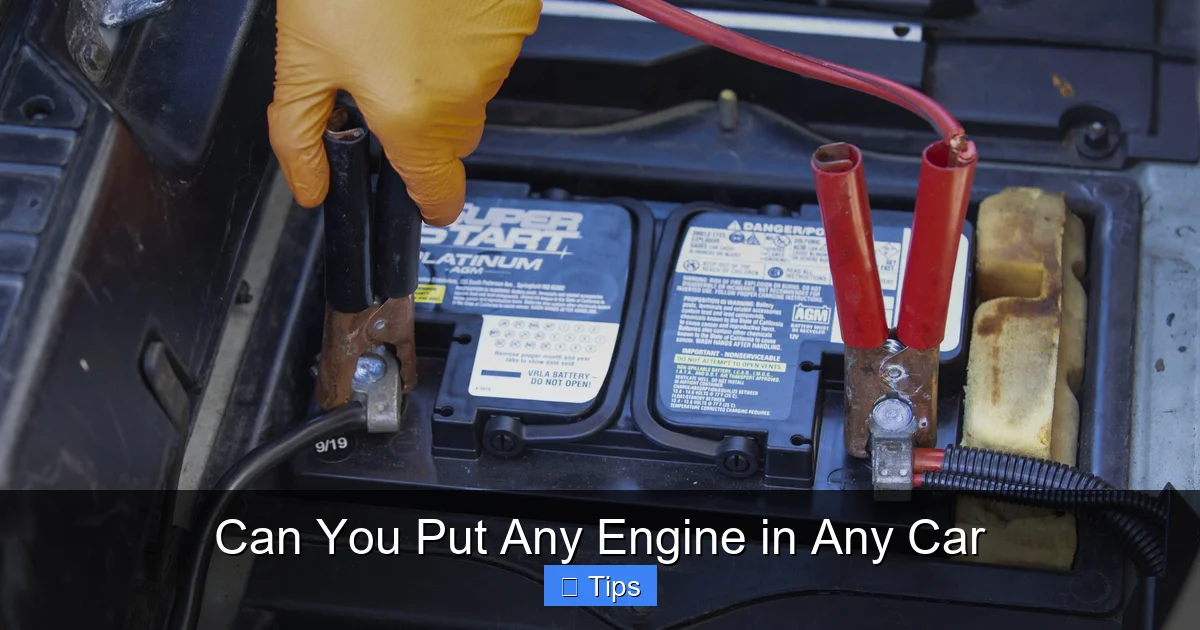
Visual guide about Can You Put Any Engine in Any Car
Image source: hips.hearstapps.com
Now, let’s get to the heart of the question: can you put any engine in any car? The truth is, you *can* physically install almost any engine into almost any car—if you’re willing to modify everything around it. But that doesn’t mean you *should*.
There are several reasons why a random engine swap might fail or become a nightmare:
– **Physical space:** Engines come in all shapes and sizes. A compact four-cylinder might fit snugly in a small engine bay, but a big-block V8? That could take up twice the space and require cutting into the firewall or suspension components.
– **Weight distribution:** Adding a heavier engine can throw off your car’s balance. Too much weight in the front can make the car understeer or wear out tires faster. In extreme cases, it can even affect safety in a crash.
– **Mounting points:** Engines are bolted to the chassis using specific mounts. If the new engine doesn’t have matching bolt patterns, you’ll need custom motor mounts—which means welding, fabrication, and precise measurements.
– **Drivetrain compatibility:** The engine must work with the existing transmission, driveshaft, and differential. A manual transmission from one car might not bolt up to an engine from another. And if the gear ratios don’t match, you could end up with poor performance or transmission damage.
– **Cooling and exhaust:** Bigger engines generate more heat and need bigger radiators, fans, and coolant lines. They also need larger exhaust systems to handle increased airflow. If your car’s cooling system wasn’t designed for the new engine, it could overheat in traffic.
– **Fuel system:** High-performance engines often require higher fuel pressure and larger injectors. Your stock fuel pump and lines might not be up to the task, leading to lean conditions and engine damage.
– **Electronics and sensors:** Modern engines rely heavily on computers. The ECU (engine control unit) talks to sensors, the transmission, the ABS, and even the infotainment system. Swapping in a different engine usually means dealing with a new ECU, wiring harness, and possibly reprogramming or replacing other modules.
In short, it’s not just about bolting in a new engine. It’s about rebuilding the car around it.
Real-World Example: The LS Swap
One of the most popular engine swaps in the automotive world is the “LS swap”—installing a General Motors LS-series V8 engine into a non-GM vehicle. Why is it so popular? Because LS engines are lightweight, powerful, reliable, and relatively affordable. Plus, there’s a huge aftermarket support network.
But even the LS swap isn’t plug-and-play. You still need custom motor mounts, a compatible transmission (like a T56 or 4L60E), a modified exhaust system, and often a new wiring harness and ECU. Some swaps even require cutting the frame or modifying the suspension to fit the engine.
And yet, thousands of people have successfully done LS swaps in everything from classic muscle cars to compact imports. It’s proof that with the right plan and parts, even complex swaps are possible.
Factors That Determine Swap Success
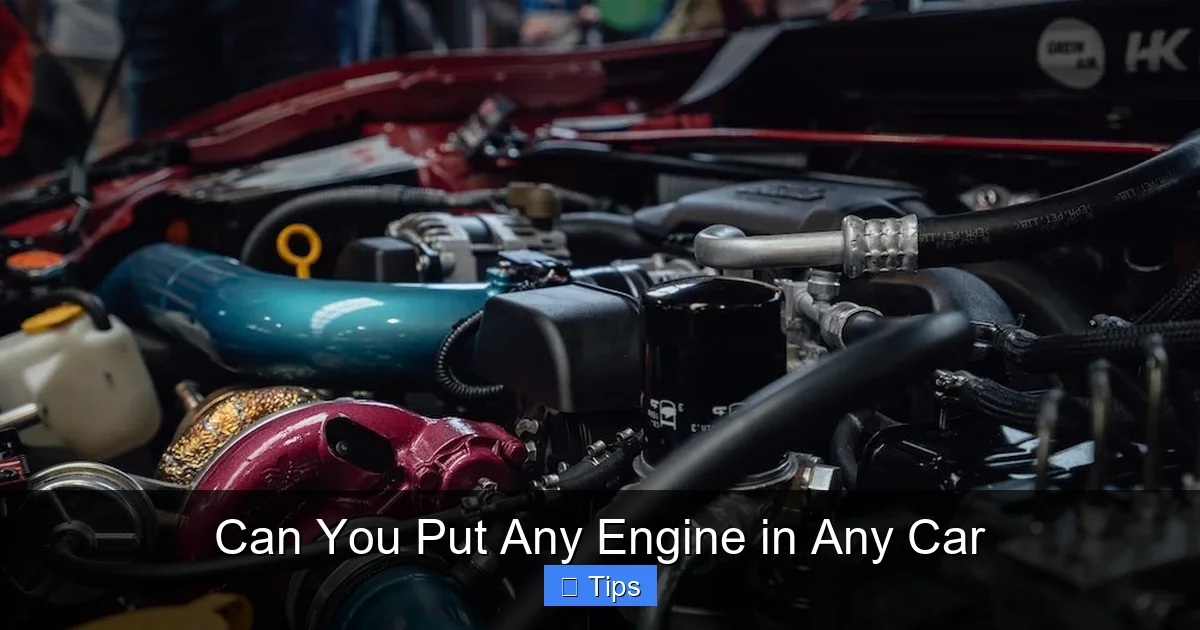
Visual guide about Can You Put Any Engine in Any Car
Image source: motorverso.com
So, what makes an engine swap succeed or fail? It usually comes down to a few key factors: compatibility, preparation, budget, and skill level.
1. Compatibility
This is the most important factor. Ask yourself:
– Does the engine physically fit in the engine bay?
– Will it bolt up to the transmission?
– Are the mounting points compatible?
– Can the cooling and exhaust systems handle it?
– Is the electrical system compatible?
If you’re swapping within the same brand or platform, compatibility is much higher. For example, swapping a Toyota 2JZ engine into a Toyota Supra is straightforward because they were designed to work together. But putting that same engine into a Honda Civic? Much harder.
2. Preparation and Planning
A successful swap starts long before you turn a wrench. You need a detailed plan that includes:
– Researching the swap (forums, guides, videos)
– Gathering all necessary parts (engine, mounts, wiring, etc.)
– Checking local laws and emissions requirements
– Setting a realistic timeline and budget
Skipping the planning phase is a recipe for frustration. You might buy an engine only to find out it needs a $2,000 wiring harness or a custom transmission adapter.
3. Budget
Engine swaps can get expensive fast. The engine itself might cost $3,000–$8,000, but add in:
– Motor mounts: $200–$600
– Transmission adapter: $300–$1,000
– Wiring harness and ECU: $500–$2,000
– Exhaust system: $400–$1,500
– Cooling upgrades: $300–$800
– Labor (if you’re not doing it yourself): $2,000–$5,000+
And that’s before unexpected costs like fabrication, tuning, or repairs. A swap that starts at $5,000 can easily balloon to $15,000 or more.
4. Skill Level
Are you a weekend wrench-turner or a professional mechanic? Be honest about your abilities. Some swaps require welding, machining, or advanced electrical work. If you’re not confident, consider hiring a specialist or starting with a simpler project.
That said, many swaps are within reach of dedicated hobbyists. With the right tools, patience, and help from online communities, you can learn as you go.
Legal and Emissions Considerations

Visual guide about Can You Put Any Engine in Any Car
Image source: m.media-amazon.com
Here’s something many first-time swappers forget: the law. In many places, engine swaps are regulated—especially when it comes to emissions.
In the U.S., the Environmental Protection Agency (EPA) and state agencies like California’s CARB (California Air Resources Board) have strict rules about engine changes. Generally, you can swap an engine as long as:
– The new engine is the same or newer model year as the original
– It meets or exceeds the emissions standards of the original engine
– It’s from the same type of vehicle (e.g., car to car, not truck to car)
In California, for example, you can only install an engine that’s certified for that specific vehicle model and year. Swapping in a newer engine from the same manufacturer might be allowed, but a completely different engine? Likely not.
Even in states with looser rules, you may need to pass an emissions test or inspection after the swap. And if you’re caught driving an illegally modified vehicle, you could face fines, registration issues, or even have your car impounded.
What About Electric Swaps?
Electric vehicle (EV) conversions are becoming more popular, especially for classic cars. Swapping in an electric motor can give you instant torque, quiet operation, and zero emissions. But they come with their own legal challenges.
Most states treat EV conversions as “kit cars” or “replica vehicles,” which may require special registration and inspections. You’ll also need to ensure the battery pack, inverter, and charging system meet safety standards.
And don’t forget insurance. Some companies won’t cover heavily modified vehicles, or they’ll charge higher premiums.
Tips for a Successful Engine Swap
Ready to take the plunge? Here are some practical tips to increase your chances of success:
Start Simple
If you’re new to swaps, pick a well-documented project. Look for engines and cars with plenty of online guides, forums, and aftermarket support. The LS swap, for example, has thousands of tutorials and parts available.
Use OEM Parts When Possible
Original equipment manufacturer (OEM) parts are designed to work together. If you can use factory mounts, brackets, or wiring from the donor vehicle, do it. It saves time and reduces the risk of failure.
Upgrade Supporting Systems
Don’t just focus on the engine. Upgrade the cooling, fuel, and electrical systems to handle the new power. A high-flow radiator, larger fuel pump, and reinforced driveshaft can make a big difference.
Get It Tuned
Even if the engine runs, it might not run well. A professional tune ensures the air-fuel ratio, ignition timing, and transmission shifts are optimized. This is especially important with modern ECUs.
Document Everything
Take photos, keep receipts, and write down every modification. This helps if you sell the car later or need to troubleshoot issues.
Join a Community
Online forums, Facebook groups, and local car clubs are goldmines of information. Other swappers can offer advice, recommend parts, and even help you troubleshoot problems.
When an Engine Swap Makes Sense
Not every car is a good candidate for an engine swap. Here’s when it might be worth it:
– **The original engine is damaged or worn out:** Instead of rebuilding, a swap can be a cost-effective way to get more power and reliability.
– **You want more performance:** A turbocharged or larger engine can transform a slow car into a speed demon.
– **You’re building a project car:** Swaps are common in restomods, race cars, and custom builds.
– **You’re going electric:** Converting a classic car to electric can preserve its look while modernizing its drivetrain.
But if you’re driving a modern, fuel-efficient car with low mileage, a swap probably isn’t worth it. The cost and effort often outweigh the benefits.
Conclusion
So, can you put any engine in any car? Technically, yes—if you’re willing to modify nearly everything around it. But practically? Not without serious planning, investment, and expertise.
Engine swaps are a blend of art, engineering, and passion. They let you personalize your ride, push performance limits, and breathe new life into old metal. But they’re not for the faint of heart. You’ll face mechanical challenges, electrical puzzles, and legal hurdles along the way.
The key to success is knowing your limits, doing your research, and starting with a realistic goal. Whether you’re swapping a V8 into a compact car or converting a classic to electric, the journey is as rewarding as the result.
Just remember: it’s not about putting *any* engine in *any* car. It’s about finding the right engine for *your* car—and making it work.
Frequently Asked Questions
Can I legally swap engines in my car?
It depends on your location and the type of swap. In many U.S. states, you can swap engines if the new one is the same or newer model year and meets emissions standards. California and other strict states have additional rules, so always check local laws before starting.
How much does an engine swap cost?
Costs vary widely, but a typical swap ranges from $5,000 to $15,000 or more. This includes the engine, mounts, wiring, transmission adapters, and labor. Complex swaps or electric conversions can cost even more.
Do I need a new transmission when swapping engines?
Not always, but often. The new engine must be compatible with your existing transmission. If not, you may need an adapter plate or a completely different transmission, which adds to the cost and complexity.
Can I swap a diesel engine into a gasoline car?
Yes, but it’s challenging. Diesel engines are heavier, require different fuel systems, and often need stronger transmissions. You’ll also need to consider emissions and noise regulations.
Is an electric motor swap easier than a gasoline engine swap?
It depends. Electric swaps eliminate exhaust and emissions concerns but require high-voltage battery packs, inverters, and cooling systems. They also need custom mounting and often a complete rewire, so they’re not necessarily easier—just different.
Where can I find parts for an engine swap?
Check junkyards, online marketplaces (like eBay or Craigslist), specialty swap shops, and forums. Many companies also sell swap kits with mounts, wiring, and adapters for popular combinations like LS swaps.

At CarLegit, we believe information should be clear, factual, and genuinely helpful. That’s why every guide, review, and update on our website is created with care, research, and a strong focus on user experience.