
Yes, a car can technically run without a catalytic converter, but it’s not advisable. Removing this part may boost performance slightly and reduce backpressure, but it leads to increased emissions, potential legal penalties, and engine warning lights. Always consider environmental impact and local laws before making changes.
In This Article
- 1 Key Takeaways
- 2 📑 Table of Contents
- 3 Can a Car Run Without a Catalytic Converter?
- 4 How a Catalytic Converter Works
- 5 What Happens When You Remove the Catalytic Converter?
- 6 Legal Consequences of Removing a Catalytic Converter
- 7 Environmental and Health Impacts
- 8 Performance Myths and Realities
- 9 What to Do If Your Catalytic Converter Is Stolen
- 10 Conclusion: Should You Remove Your Catalytic Converter?
- 11 Frequently Asked Questions
- 11.1 Can a car run without a catalytic converter?
- 11.2 Is it illegal to drive without a catalytic converter?
- 11.3 Will removing the catalytic converter improve performance?
- 11.4 Why do thieves steal catalytic converters?
- 11.5 What happens if my catalytic converter is stolen?
- 11.6 Can I replace my catalytic converter with a straight pipe?
Key Takeaways
- Yes, a car can run without a catalytic converter: The engine will still start and operate, but emissions will rise significantly.
- Removal may improve performance slightly: Some drivers notice a small increase in horsepower and throttle response due to reduced exhaust backpressure.
- It’s illegal in most places: In the U.S., removing or tampering with a catalytic converter violates federal and state emissions laws, including the Clean Air Act.
- Check engine lights are common: Modern vehicles use oxygen sensors to detect converter efficiency; removal often triggers a check engine light.
- Environmental harm is significant: Catalytic converters reduce harmful pollutants like carbon monoxide, nitrogen oxides, and hydrocarbons by up to 90%.
- Insurance and resale issues may arise: Modified vehicles without converters may face higher insurance premiums or difficulty selling.
- Alternatives exist for performance gains: High-flow catalytic converters or performance exhaust systems offer legal ways to improve power without breaking the law.
📑 Table of Contents
- Can a Car Run Without a Catalytic Converter?
- How a Catalytic Converter Works
- What Happens When You Remove the Catalytic Converter?
- Legal Consequences of Removing a Catalytic Converter
- Environmental and Health Impacts
- Performance Myths and Realities
- What to Do If Your Catalytic Converter Is Stolen
- Conclusion: Should You Remove Your Catalytic Converter?
Can a Car Run Without a Catalytic Converter?
If you’ve ever popped the hood of your car or chatted with a mechanic, you’ve probably heard about the catalytic converter. It’s that mysterious metal box tucked under your vehicle, usually near the engine. But what happens if it’s gone? Can your car still run without it? The short answer is yes—but there’s a lot more to the story.
The catalytic converter plays a crucial role in reducing harmful emissions from your vehicle’s exhaust. It transforms toxic gases like carbon monoxide, nitrogen oxides, and unburned hydrocarbons into less harmful substances like carbon dioxide, nitrogen, and water vapor. Without it, your car becomes a major polluter. But mechanically speaking, your engine doesn’t rely on the catalytic converter to function. It’s not part of the combustion process. So, if you remove it, the engine will still turn over, the fuel will still burn, and the car will still move.
However, just because a car *can* run without a catalytic converter doesn’t mean it *should*. There are serious legal, environmental, and mechanical consequences to consider. In this article, we’ll explore what happens when you remove a catalytic converter, the risks involved, and smarter alternatives if you’re looking to improve performance or save money.
How a Catalytic Converter Works
Visual guide about Can a Car Run Without a Catalytic Converter
Image source: autocareaids.com
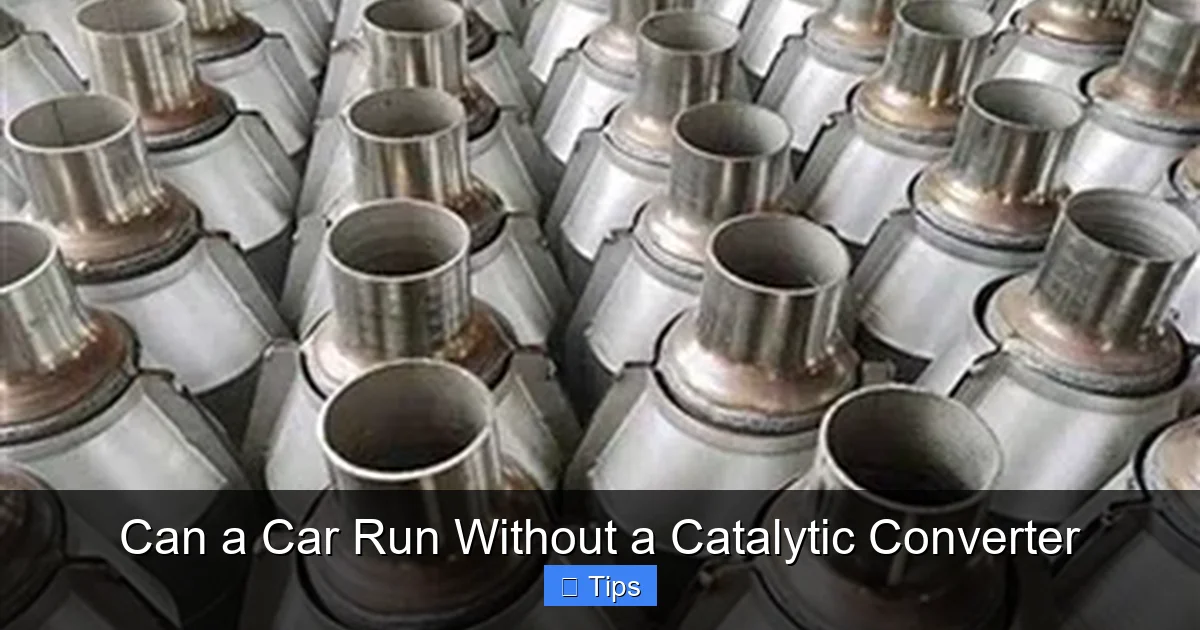
To understand why removing a catalytic converter is a big deal, it helps to know what it actually does. Think of the catalytic converter as your car’s personal pollution filter. It’s part of the exhaust system and sits between the engine and the muffler. When exhaust gases flow through it, they pass over a honeycomb-like structure coated with precious metals like platinum, palladium, and rhodium.
These metals act as catalysts—hence the name—speeding up chemical reactions that convert harmful pollutants into safer ones. For example, carbon monoxide (a deadly gas) is turned into carbon dioxide, and nitrogen oxides (which contribute to smog) are broken down into nitrogen and oxygen. Unburned fuel (hydrocarbons) is oxidized into water and carbon dioxide.
This process happens quickly and efficiently, especially once the converter reaches its optimal operating temperature—usually within a few minutes of starting the engine. Modern vehicles are designed with oxygen sensors before and after the catalytic converter to monitor its efficiency. If the converter isn’t working properly, the engine control unit (ECU) detects the imbalance and triggers a check engine light.
Types of Catalytic Converters
Not all catalytic converters are the same. There are two main types used in gasoline-powered vehicles:
- Two-way catalytic converter: Found in older vehicles, this type reduces carbon monoxide and hydrocarbons but doesn’t handle nitrogen oxides.
- Three-way catalytic converter: Standard in most modern cars, it reduces all three major pollutants—carbon monoxide, hydrocarbons, and nitrogen oxides—in one unit.
Diesel engines use a different system, often including a diesel oxidation catalyst and a diesel particulate filter, but the principle is similar: reduce harmful emissions before they exit the tailpipe.
Why It’s More Than Just a Filter
Some people mistakenly think the catalytic converter is just a muffler or a decorative part. But it’s a high-tech emissions control device that’s essential for meeting environmental standards. Without it, your car would emit far more pollution than legally allowed—sometimes up to 10 times the legal limit.
For example, a single car without a catalytic converter can release as much carbon monoxide in one hour as a properly equipped car would in an entire day of driving. That’s not just bad for the planet—it’s dangerous for people, especially in enclosed spaces like garages.
What Happens When You Remove the Catalytic Converter?
Visual guide about Can a Car Run Without a Catalytic Converter
Image source: sefunm.com
So, what actually happens when you take out the catalytic converter? Let’s break it down.
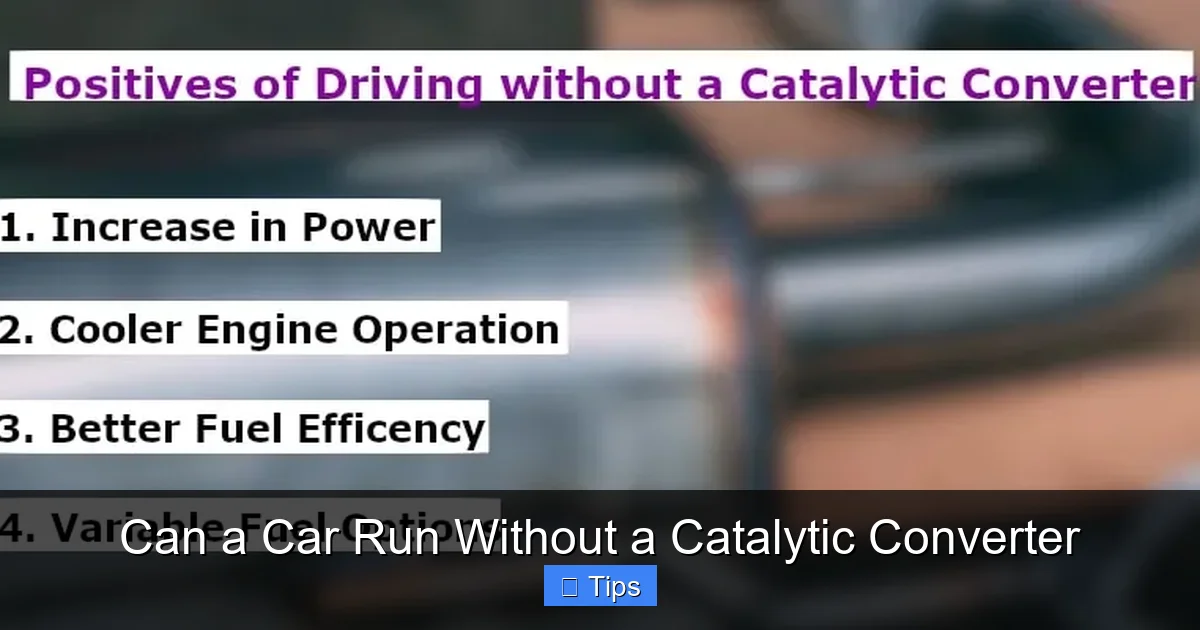
First, the car will still start and run. The engine doesn’t depend on the converter to produce power. In fact, some people remove it to reduce exhaust backpressure, which can slightly improve engine efficiency and power output. This is especially noticeable in older or high-performance vehicles where the stock exhaust system is restrictive.
You might hear a louder exhaust note—some describe it as a “growl” or “roar.” That’s because the converter acts as a muffler to some extent, and removing it allows exhaust gases to escape more freely. For car enthusiasts, this sound can be appealing, but it’s often louder than legal noise limits in many cities.
However, there are several downsides:
- Check engine light: Most modern cars have oxygen sensors that monitor the efficiency of the catalytic converter. If the converter is missing or not functioning, the ECU detects abnormal readings and triggers a diagnostic trouble code (DTC), usually P0420 or P0430. This turns on the check engine light.
- Failed emissions tests: In states that require emissions inspections, a missing catalytic converter will cause an automatic failure. You won’t be able to renew your registration until it’s fixed.
- Reduced fuel efficiency: While some claim better mileage after removal, studies show that most vehicles actually see a slight drop in fuel economy. The engine may run leaner or richer than optimal, leading to wasted fuel.
- Increased emissions: This is the biggest concern. Without the converter, your car releases far more toxic gases into the atmosphere, contributing to air pollution, smog, and health problems.
Real-World Example: The 2005 Honda Civic
Let’s say you own a 2005 Honda Civic with a 1.7L engine. This car comes with a three-way catalytic converter as standard. If you remove it and replace the exhaust with a straight pipe, you might notice a slight increase in horsepower—maybe 3 to 5 HP on a dyno. The exhaust note will be louder, and the car might feel more responsive at high RPMs.
But when you go for your annual emissions test, the inspector will immediately notice the missing converter. Even if the car passes the visual inspection, the OBD-II scanner will detect the P0420 code and fail the vehicle. You’ll need to reinstall a converter—or install a high-flow aftermarket one—to pass.
Legal Consequences of Removing a Catalytic Converter
Visual guide about Can a Car Run Without a Catalytic Converter
Image source: i0.wp.com
This is where things get serious. Removing or tampering with a catalytic converter is not just a bad idea—it’s illegal in most parts of the world.
In the United States, the Clean Air Act of 1970 made it a federal offense to remove or disable emissions control devices, including catalytic converters. The Environmental Protection Agency (EPA) enforces these rules, and violations can result in fines up to $4,819 per violation as of 2023. That means if you remove the converter and get caught, you could be looking at a hefty penalty.
But it’s not just federal law. Most states have their own emissions regulations. California, for example, has some of the strictest rules in the country. Under the California Air Resources Board (CARB), any modification that affects emissions—including removing a catalytic converter—is illegal. Even installing an aftermarket converter that isn’t CARB-certified can result in fines.
State-by-State Variations
While all 50 states follow the federal Clean Air Act, enforcement varies. States like New York, Colorado, and Washington require annual emissions testing for most vehicles. If your car fails due to a missing converter, you can’t legally drive it until it’s repaired.
Other states, like Texas and Florida, have fewer emissions requirements, but that doesn’t mean you’re off the hook. Law enforcement can still issue citations for tampering with emissions equipment, and insurance companies may deny claims if they discover illegal modifications.
What About Older Cars?
Some people argue that older vehicles—say, pre-1995 models—don’t need catalytic converters because they weren’t originally equipped with them. But that’s not entirely accurate. If a vehicle was originally sold with a catalytic converter, it must remain installed, regardless of age. Only vehicles manufactured before emissions standards took effect (generally before 1975) are exempt.
Even then, if you modify an older car by adding fuel injection or other modern systems, you may be required to install a converter to meet current standards.
Environmental and Health Impacts
Let’s talk about the bigger picture. Why do we even have catalytic converters? Because air pollution is a serious problem.
Cars without catalytic converters emit significantly higher levels of:
- Carbon monoxide (CO): A colorless, odorless gas that reduces oxygen delivery in the bloodstream. High levels can be fatal.
- Nitrogen oxides (NOx): Contribute to smog, acid rain, and respiratory issues like asthma.
- Hydrocarbons (HC): React with sunlight to form ground-level ozone, a major component of smog.
According to the EPA, motor vehicles are responsible for nearly 75% of carbon monoxide emissions in the U.S. Catalytic converters have helped reduce these emissions by over 90% since the 1970s.
Imagine if just 10% of cars on the road removed their catalytic converters. The increase in pollution would be staggering—equivalent to adding millions of new vehicles to the road overnight. That’s why governments around the world continue to enforce strict emissions standards.
Health Risks in Urban Areas
In cities with high traffic density, the absence of catalytic converters would lead to dangerous levels of air pollution. Children, the elderly, and people with respiratory conditions are especially vulnerable. Studies have linked vehicle emissions to increased rates of asthma, bronchitis, and even heart disease.
By keeping your catalytic converter intact, you’re not just following the law—you’re helping protect public health and the environment.
Performance Myths and Realities
Now, let’s address the elephant in the room: performance. Some car enthusiasts believe that removing the catalytic converter will give their vehicle a significant power boost. Is that true?
The short answer is: maybe—but not as much as you think.
Catalytic converters do create some backpressure in the exhaust system. In theory, reducing backpressure allows exhaust gases to exit more freely, which can improve engine efficiency and power. In high-performance applications, this can make a difference.
But in most everyday vehicles, the gain is minimal—often less than 5 horsepower. And that’s only if the rest of the exhaust system is optimized. If you just remove the converter and leave everything else stock, you might not notice any improvement at all.
When Removal Might Help
There are a few scenarios where removing the catalytic converter could provide a measurable benefit:
- Race cars or track-only vehicles: In closed-course racing, emissions laws don’t apply. Many race cars run without catalytic converters to maximize performance.
- Older, carbureted engines: Some vintage cars with restrictive exhaust systems may see a slight improvement in throttle response after converter removal.
- Turbocharged engines: In some turbo setups, reducing backpressure can improve turbo spool and overall efficiency.
But even in these cases, the gains are often offset by other factors—like increased noise, legal risks, and the need for custom tuning.
Better Alternatives for Performance
If you’re looking to boost your car’s performance, there are smarter, legal ways to do it:
- High-flow catalytic converters: These are designed to reduce backpressure while still meeting emissions standards. Brands like MagnaFlow and Flowmaster offer CARB-approved options.
- Performance exhaust systems: Upgrading to a full cat-back or axle-back exhaust can improve flow and sound without removing the converter.
- Engine tuning: A custom ECU tune can optimize air-fuel ratios and ignition timing for better power and efficiency.
- Cold air intakes: These increase airflow to the engine, which can improve horsepower and throttle response.
These modifications are legal, often more effective, and won’t trigger check engine lights or emissions failures.
What to Do If Your Catalytic Converter Is Stolen
Unfortunately, catalytic converter theft has become a major issue in recent years. Thieves target them because they contain precious metals like platinum, palladium, and rhodium, which can be sold for hundreds of dollars.
If your converter is stolen, your car will still run—but you’ll likely hear a loud rumbling noise from the exhaust. The check engine light will probably come on, and you may notice reduced performance or poor fuel economy.
Immediate Steps to Take
- Report the theft: Contact local law enforcement and file a report. This is important for insurance claims.
- Get it inspected: Take your car to a trusted mechanic to assess the damage. Sometimes, the exhaust manifold or oxygen sensors are also damaged.
- Install a replacement: You’ll need to install a new catalytic converter to pass emissions and avoid legal issues. Aftermarket options are available, but make sure they’re EPA- or CARB-compliant.
- Consider anti-theft measures: Welding the converter to the frame, installing a protective shield, or parking in well-lit areas can deter thieves.
Insurance Coverage
Comprehensive auto insurance typically covers catalytic converter theft. Check your policy to see if you’re protected. If not, consider adding it—especially if you live in an area with high theft rates.
Conclusion: Should You Remove Your Catalytic Converter?
So, can a car run without a catalytic converter? Absolutely. But should it? Almost certainly not.
While your engine will still function, removing the converter comes with serious downsides: increased emissions, legal risks, check engine lights, and potential insurance issues. The minor performance gains—if any—are not worth the consequences.
Instead of removing your catalytic converter, consider legal alternatives that improve performance without breaking the law. High-flow converters, performance exhausts, and engine tuning are all great options that keep your car compliant and environmentally friendly.
Remember, your car is part of a larger system. By keeping your catalytic converter intact, you’re helping reduce pollution, protect public health, and follow the law. And that’s something every driver can feel good about.
Whether you’re a daily commuter, a weekend racer, or a classic car enthusiast, there’s a way to enjoy your vehicle responsibly. Don’t let short-term gains lead to long-term problems. Keep your catalytic converter—and keep driving smart.
Frequently Asked Questions
Can a car run without a catalytic converter?
Yes, a car can run without a catalytic converter. The engine will still start and operate normally, but emissions will increase significantly, and the check engine light may come on.
Is it illegal to drive without a catalytic converter?
Yes, in most places it’s illegal. Removing or tampering with a catalytic converter violates federal and state emissions laws, including the Clean Air Act, and can result in fines.
Will removing the catalytic converter improve performance?
It may provide a slight increase in horsepower due to reduced backpressure, but the gain is usually minimal—less than 5 HP in most cases. Legal alternatives like high-flow converters offer better results.
Why do thieves steal catalytic converters?
Thieves steal catalytic converters because they contain valuable precious metals like platinum, palladium, and rhodium, which can be sold for cash at scrap yards.
What happens if my catalytic converter is stolen?
Your car will still run, but you’ll likely hear a loud exhaust noise, see a check engine light, and may fail emissions tests. You’ll need to replace it to drive legally.
Can I replace my catalytic converter with a straight pipe?
Technically yes, but it’s illegal in most areas and will cause your car to fail emissions tests. It also increases pollution and may trigger engine warning lights.

At CarLegit, we believe information should be clear, factual, and genuinely helpful. That’s why every guide, review, and update on our website is created with care, research, and a strong focus on user experience.