
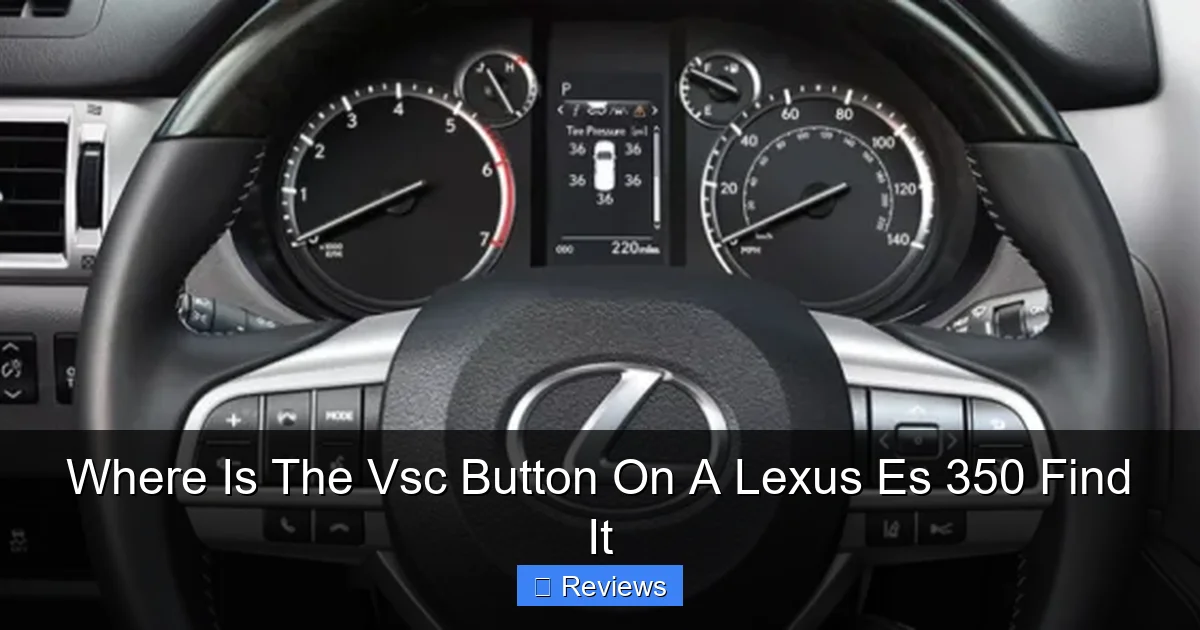
Featured image for where is the vsc button on a lexus es 350
Image source: dealerinspire-image-library-prod.s3.us-east-1.amazonaws.com
Most Lexus ES 350 models do not feature a dedicated VSC button. Instead, drivers looking to manage Vehicle Stability Control (VSC) should typically locate the TRAC OFF button, which controls both traction control and, in many cases, VSC. Understanding this integrated system is key to temporarily adjusting stability features for specific driving scenarios.
In This Article
- 1 Where Is The Vsc Button On A Lexus Es 350 Find It
- 1.1 Key Takeaways
- 1.2 Understanding the VSC System in Your Lexus ES 350
- 1.3 The Quest for the VSC Button on Your Lexus ES 350: Model Year Variations
- 1.4 When and Why You Might Disable VSC: Understanding the Risks
- 1.5 Interactive Features and VSC: How Your Lexus ES 350 Manages Stability
- 1.6 Practical Tips and Troubleshooting for Your Lexus ES 350’s VSC System
- 1.7 A Legacy of Stability: The Evolution of Safety Features in the Lexus ES 350
- 1.8 VSC Button Location by Lexus ES 350 Generation: A Quick Reference
- 1.9 Conclusion
- 1.10 Frequently Asked Questions
- 1.10.1 Where is the VSC button located on a Lexus ES 350?
- 1.10.2 What does the VSC button do on a Lexus ES 350?
- 1.10.3 How do I turn the VSC system off and on in my Lexus ES 350?
- 1.10.4 What does the VSC button look like on a Lexus ES 350?
- 1.10.5 Do all Lexus ES 350 models have a VSC button?
- 1.10.6 When should I turn off the VSC on my Lexus ES 350?
Where Is The Vsc Button On A Lexus Es 350 Find It
The Lexus ES 350, a paragon of automotive luxury and sophisticated engineering, is celebrated for its serene ride, plush interiors, and robust performance. Yet, beneath its elegant facade lies a suite of advanced safety features designed to keep you, and your passengers, secure on the road. Among these critical systems is Vehicle Stability Control (VSC), a technology that silently works to prevent loss of traction and maintain directional stability in challenging driving conditions. While most drivers appreciate VSC for its invisible guardian-like presence, there are specific, rare instances where knowing the location of the VSC button on a Lexus ES 350 becomes incredibly important.
For many Lexus ES 350 owners, especially those new to the brand or unfamiliar with their vehicle’s more intricate controls, locating a specific button like the one for VSC can feel like a minor quest. It’s not a button you’ll use daily, or even monthly, which often leads to its placement being overlooked. However, understanding its function and knowing precisely where to find the VSC button on a Lexus ES 350 is a fundamental aspect of truly mastering your vehicle, empowering you with full control when unique circumstances demand it. This comprehensive guide will not only pinpoint the elusive VSC button but also delve into the system’s vital role, the reasons one might consider disabling it, and critical safety considerations.
Join us as we navigate through the refined interior of the Lexus ES 350, exploring its VSC system, its evolution across different model years, and providing you with all the knowledge necessary to confidently locate and understand the often-misunderstood VSC button on a Lexus ES 350. Our aim is to demystify this crucial safety feature, ensuring you’re well-equipped for any driving scenario, from navigating snowy terrains to simply understanding your vehicle’s capabilities.
Key Takeaways
- Locate the VSC button: Typically found to the left of the steering wheel on a Lexus ES 350.
- Check under the dashboard: Some models position the button below the instrument panel.
- Disable VSC intentionally: Use it for specific low-traction conditions like deep snow or mud.
- Understand VSC’s purpose: It enhances vehicle stability, preventing skids and loss of control.
- Verify VSC status: Look for the “VSC OFF” indicator light on your dashboard.
- Re-enable VSC for safety: Always reactivate it for regular, safe driving conditions.
- VSC often resets automatically: It may re-engage after an ignition cycle or at higher speeds.
Understanding the VSC System in Your Lexus ES 350
Before we embark on the specific hunt for the VSC button on a Lexus ES 350, it’s essential to grasp what Vehicle Stability Control (VSC) truly is and why it holds such a prominent place in your car’s safety architecture. VSC is not just a feature; it’s a sophisticated guardian, continuously monitoring your vehicle’s behavior to prevent skids and help you maintain control, especially during sudden maneuvers or on slippery surfaces.
What is VSC and Why is it Important?
VSC, or Vehicle Stability Control, is an advanced active safety system designed to assist drivers in maintaining control of their vehicle under adverse driving conditions or during sudden, evasive maneuvers. It works by detecting and correcting oversteer or understeer, two common scenarios that can lead to a loss of control. Oversteer occurs when the rear wheels lose traction and the car’s rear end swings out, while understeer happens when the front wheels lose grip, causing the car to plow wide when turning.
The system constantly gathers data from an array of sensors throughout the vehicle. These include wheel speed sensors, a yaw rate sensor (which measures the car’s rotation around its vertical axis), and a steering angle sensor. When the VSC’s Electronic Control Unit (ECU) detects a discrepancy between the driver’s intended path (based on steering input) and the vehicle’s actual path, it intervenes. This intervention is precise and swift: VSC can individually apply the brakes to one or more wheels and/or reduce engine power. For instance, if the car starts to oversteer, VSC might apply the brake to the outer front wheel to help bring the rear back into line. If understeer is detected, it might brake the inner rear wheel. This almost imperceptible corrective action happens within milliseconds, often before the driver even realizes a loss of control was imminent.
The importance of VSC cannot be overstated. It significantly enhances vehicle safety, reducing the risk of accidents caused by skidding or loss of traction. Its widespread adoption has been a major factor in improving road safety across the globe, making it a standard feature on most modern vehicles, including every Lexus ES 350. It’s a passive safety net that actively works to keep you on your intended path, making it a cornerstone of the premium driving experience offered by Lexus.
VSC Versus Traction Control (TRAC)
While often grouped together and sometimes controlled by the same VSC button on a Lexus ES 350, it’s crucial to distinguish between VSC and Traction Control (TRAC). Although both are integral components of your Lexus ES 350’s stability management system and aim to prevent wheel slip, they address different aspects of traction.
- Traction Control (TRAC): This system is primarily concerned with preventing wheel spin during acceleration. If you press the accelerator too hard on a slippery surface (like ice, snow, or gravel), the drive wheels might spin freely, leading to a loss of forward momentum. TRAC detects this wheel spin via the wheel speed sensors and then intervenes by reducing engine power and/or applying the brakes to the spinning wheel(s). This helps the wheel regain grip, allowing for smoother and more controlled acceleration. You’ll typically see a TRAC indicator light flash on your dashboard when this system is active.
- Vehicle Stability Control (VSC): As discussed, VSC goes beyond just managing acceleration. It monitors the vehicle’s lateral stability, intervening to prevent skids during turns or sudden evasive maneuvers. It focuses on the car’s overall directional stability, correcting oversteer or understeer by selectively braking individual wheels and reducing engine power. While TRAC helps you get going, VSC helps you stay in control while cornering or reacting to unexpected hazards.
In many Lexus ES 350 models, pressing the VSC button on a Lexus ES 350 once will disable TRAC, indicated by a “TRAC OFF” light on the dash. Holding the button down for a few seconds might disable both TRAC and VSC, which will be indicated by “VSC OFF” and/or “TRAC OFF” lights, along with the VSC warning light. This integrated control highlights their complementary roles within the vehicle’s broader stability management system. Understanding their individual functions is key to appreciating their combined effectiveness.
The Quest for the VSC Button on Your Lexus ES 350: Model Year Variations
The location of the VSC button on a Lexus ES 350 isn’t rigidly fixed across all model years. Like many automotive control interfaces, its placement has evolved, influenced by design trends, technological advancements, and the consolidation of controls. While a physical button has been a common fixture for generations, newer models might integrate this function into digital menus or multi-purpose drive mode selectors. Identifying your specific model year is the first step in successfully locating this important control.
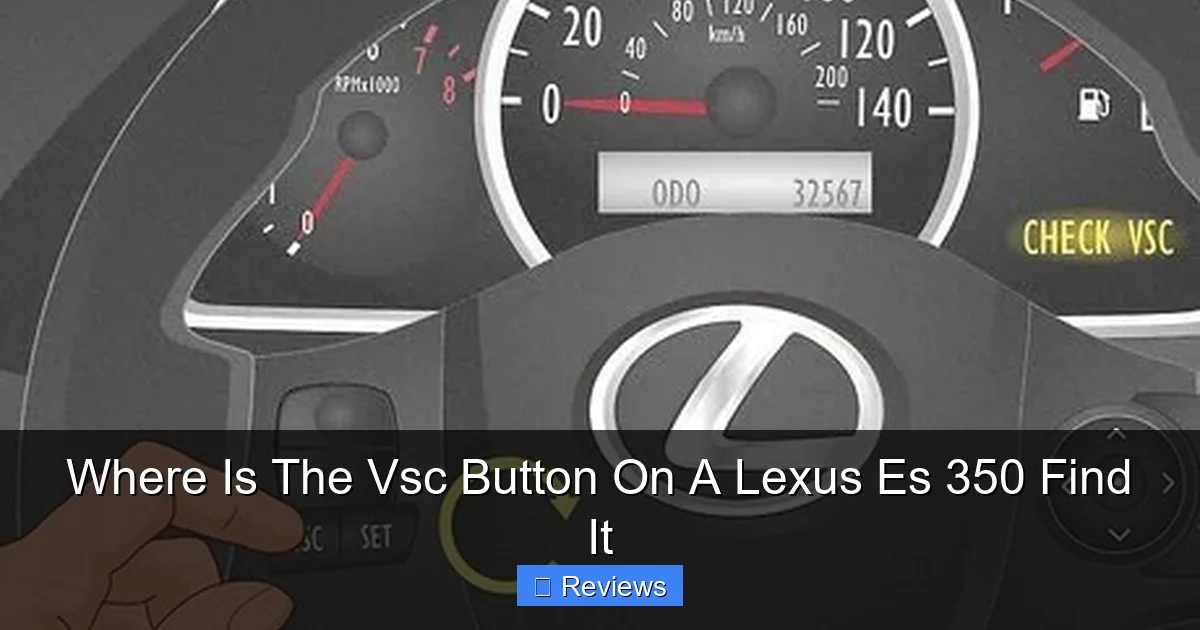
Visual guide about where is the vsc button on a lexus es 350
Image source: wikihow.com
Early Generations (2007-2012)
For Lexus ES 350 models from the 5th generation (2007-2012), the VSC button on a Lexus ES 350 is typically a physical push button located on the lower left side of the dashboard. This area is commonly referred to as the “driver’s knee bolster” or the “lower left dash panel.” You’ll often find it alongside other lesser-used buttons, such as those for mirror controls, dashboard illumination dimmer, or perhaps a trunk release. To find it:
- Sit in the driver’s seat.
- Look down and to your left, below the steering wheel and near your left knee.
- It’s usually part of a cluster of buttons.
- The button will typically be labeled “VSC OFF” or “TRAC OFF,” or it might feature an icon depicting a car with two wavy lines underneath it, symbolizing a vehicle losing traction.
In these earlier models, a quick press of the button might disable only Traction Control (TRAC), indicated by a “TRAC OFF” light on the instrument panel. To fully disable Vehicle Stability Control (VSC) as well, you would generally need to press and hold the VSC button on a Lexus ES 350 for a few seconds (typically 3-5 seconds). This action would illuminate a “VSC OFF” light, along with the TRAC OFF light, confirming that both systems are disengaged.
Mid Generations (2013-2018)
As the Lexus ES 350 entered its 6th generation (2013-2018), the philosophy for control placement remained largely consistent with its predecessor. The VSC button on a Lexus ES 350 from this era is still predominantly found on the lower left side of the dashboard, adjacent to other auxiliary controls. However, minor aesthetic and ergonomic tweaks might have altered its exact position within that panel.
- The principle remains the same: look to your left, below the steering wheel.
- The button’s appearance might be slightly more integrated into the dashboard’s design, perhaps with a more subtle bezel or different tactile feel.
- Labels like “VSC OFF” or the car-with-wavy-lines icon are still the primary identifiers.
Operationally, these models generally follow the same pattern: a short press for TRAC OFF, and a sustained press (3-5 seconds) for full VSC and TRAC disablement. It’s important to always verify the status of these systems by checking the dashboard indicator lights, which confirm whether TRAC, VSC, or both are currently deactivated. The consistency in this generation means that if you’re familiar with the earlier models, you’ll likely find the VSC button on a Lexus ES 350 of this period with relative ease.
Current Generations (2019-Present)
The 7th generation Lexus ES 350 (2019-Present) represents a significant leap in interior design and technological integration. While the general principle of keeping less-frequently used buttons somewhat out of direct sight persists, some models have moved towards integrating VSC controls more subtly. While a dedicated VSC button on a Lexus ES 350 might still be present on the lower left dash panel for many configurations, its interaction with the Drive Mode Select system has become more pronounced.
- Location: Often, you will still find a physical “TRAC OFF” button on the lower left side of the dashboard, below the steering wheel. This button, when held down, usually disables both TRAC and VSC.
- Drive Mode Select: In newer ES 350s, the various drive modes (Eco, Normal, Sport, Sport S+) can subtly alter the parameters of the VSC and TRAC systems, making them either more or less intrusive. However, to explicitly turn off VSC, you typically still need to use a dedicated physical button.
- Infotainment Integration (Less Common for VSC OFF): While many settings are now managed through the infotainment system, core safety features like VSC usually retain a physical override for quick access. It’s rare for the primary “VSC OFF” function to be buried deep within touchscreen menus, primarily due to safety regulations and usability during driving.
For the most recent models, the label might specifically say “TRAC OFF” or use the skidding car icon. Disabling VSC generally requires a longer press of this button (often 3-5 seconds). The dashboard will clearly display “TRAC OFF” and/or “VSC OFF” messages or illuminate the corresponding warning lights to confirm the system’s status. Always consult your owner’s manual for the precise location and operation of the VSC button on a Lexus ES 350 from the 2019 model year onwards, as subtle variations can exist based on trim levels and regional specifications.
What to Look For: Identifying the VSC OFF Button
Regardless of the specific generation, identifying the VSC button on a Lexus ES 350 boils down to recognizing its common labels and icons:
- “VSC OFF” or “TRAC OFF”: These are the most direct labels you’ll find.
- Car with Wavy Lines Icon: This is a universal symbol for stability control systems. It depicts a car with two curved, wavy lines trailing behind it, indicating a loss of traction or stability.
When you press the button, confirm its activation or deactivation by observing the instrument cluster. Corresponding indicator lights (e.g., “TRAC OFF,” “VSC OFF,” or the illuminated skidding car icon) should appear, informing you of the system’s current state. If you find multiple buttons in the lower left dash, carefully examine each for these specific labels or icons to ensure you’re pressing the correct one. Remember, an incorrect button press could activate a different function, so precision in identification is key.
When and Why You Might Disable VSC: Understanding the Risks
The Vehicle Stability Control (VSC) system is a fundamental safety feature in your Lexus ES 350, designed to keep you safe and in control. For the vast majority of driving conditions, VSC should always remain active. However, there are very specific, legitimate scenarios where temporarily disabling the VSC button on a Lexus ES 350 might be necessary or beneficial. It’s crucial to understand these situations, as well as the inherent risks associated with driving without VSC.
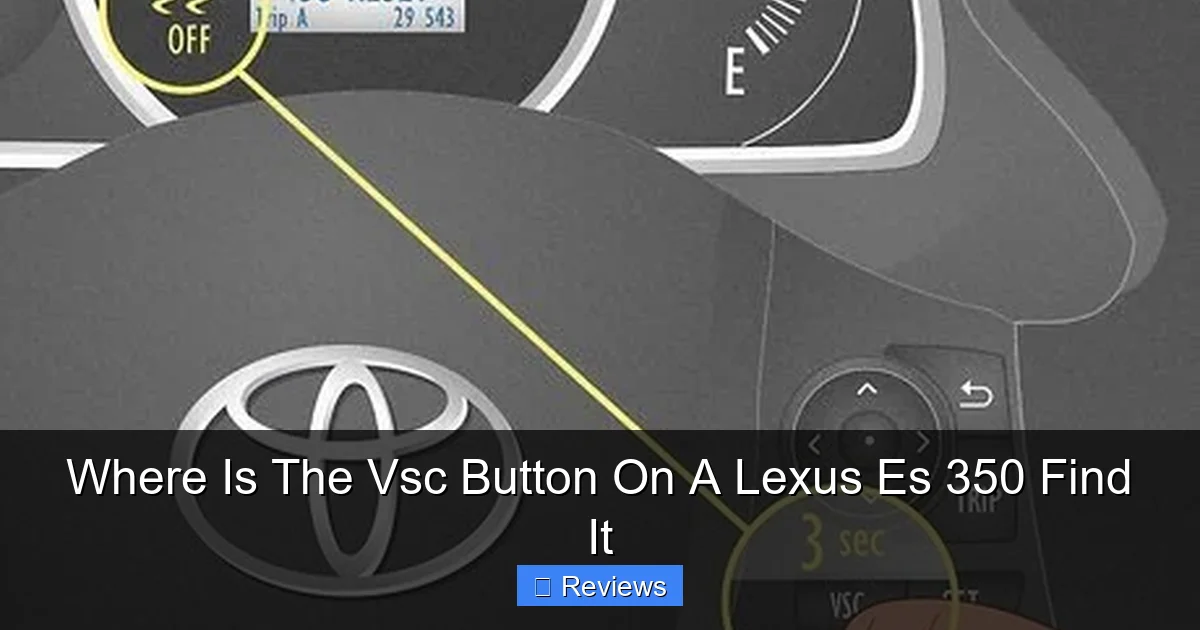
Visual guide about where is the vsc button on a lexus es 350
Image source: wikihow.com
Legitimate Scenarios for Disabling
Disabling the VSC system should be considered only under very particular circumstances where wheel spin is actually advantageous for vehicle movement. These are typically low-speed scenarios where maximum traction is needed to free the vehicle, rather than maintain stability at speed.
- Deep Snow or Mud: When your Lexus ES 350 is stuck in deep snow, slush, or mud, VSC (and TRAC) might prevent the wheels from spinning freely. In such situations, a controlled amount of wheel spin can be essential to “rock” the vehicle back and forth or to allow the tires to dig down to a firmer surface to regain traction. If VSC is active, it will try to prevent this wheel spin by cutting engine power, making it harder to free the vehicle. Disabling VSC allows you to apply full power and spin the wheels to get unstuck.
- Driving on Sand or Gravel: Similar to snow or mud, driving through deep sand or loose gravel can cause VSC and TRAC to limit power excessively. On these surfaces, a slight amount of wheel spin helps the tires to “float” over the soft material or maintain momentum without bogging down. Disabling the systems temporarily can provide the necessary power and wheel speed to navigate these challenging terrains.
- Using Snow Chains: When driving with snow chains installed on your tires, the irregular rolling diameter caused by the chains can sometimes interfere with the VSC and TRAC sensors, leading to erroneous activation. In such cases, disabling the systems might be recommended by the vehicle manufacturer to prevent unnecessary interference and allow the chains to work effectively.
- Competitive or Track Driving (Highly Experienced Drivers Only): For a very select group of highly experienced drivers on a closed race track, fully disabling VSC and TRAC allows for maximum control over the vehicle’s dynamics. This enables techniques like controlled drifts or precise power delivery without electronic intervention. This scenario is
never applicable to public road driving and should only be attempted by professionals in a safe, controlled environment.
In all these legitimate scenarios, the intent behind using the VSC button on a Lexus ES 350 is to gain temporary manual control over wheel spin or power delivery to overcome a specific obstacle, not to enhance performance on public roads. As soon as the specific driving condition is no longer present, VSC should be re-enabled.
The Dangers of Unnecessary Disabling
Despite the specific scenarios listed above, it is critical to emphasize that VSC is a life-saving technology. Disabling it unnecessarily, especially during normal driving on paved roads, can dramatically increase the risk of an accident. The dangers include:
- Loss of Control: Without VSC, your Lexus ES 350 will not automatically correct for oversteer or understeer. If you take a corner too quickly, encounter black ice, or react suddenly to an obstacle, the vehicle can easily skid out of control.
- Increased Accident Risk: Statistics consistently show that vehicles equipped with VSC have a significantly lower rate of single-vehicle crashes and rollovers. Disabling it removes this crucial layer of protection.
- Misconceptions about Performance: Some drivers mistakenly believe that disabling VSC will make their car faster or more “sporty” on public roads. While it might remove power limitations, it also removes the safety net, making the car much more challenging to control at its limits, which are easily reached in emergency situations.
- Unpredictable Behavior: In wet, icy, or gravelly conditions, even minor steering or acceleration inputs can lead to unexpected and rapid loss of traction without VSC to moderate.
It cannot be stressed enough: for everyday driving, particularly on highways, in rain, snow, ice, or during any conditions requiring evasive maneuvers, VSC should always be active. The moments when you would legitimately use the VSC button on a Lexus ES 350 are rare and typically involve very low-speed, stuck-vehicle scenarios.
How to Disable and Re-enable the System
Knowing how to correctly operate the VSC button on a Lexus ES 350 is as important as knowing where it is. The procedure is generally consistent across most generations:
- To Disable TRAC Only: Locate the VSC/TRAC button (often labeled “TRAC OFF” or with the skidding car icon). Press it once. You should see a “TRAC OFF” indicator light illuminate on your instrument panel. This allows for some wheel spin during acceleration but keeps VSC active for stability.
- To Disable TRAC and VSC: Press and hold the same VSC/TRAC button for approximately 3-5 seconds. After a few seconds, you should see both the “TRAC OFF” light and a “VSC OFF” light or the main VSC warning light (the skidding car icon) illuminate steadily on your dashboard. This confirms that both systems are disengaged.
To Re-enable the System:
- Manual Re-enablement: Simply press the VSC button on a Lexus ES 350 again. All associated warning lights on the dashboard should turn off, indicating that TRAC and VSC are now active.
- Automatic Re-enablement: In many Lexus ES 350 models, VSC and TRAC will automatically re-engage when you restart the vehicle. Some models may also automatically re-engage the systems once you reach a certain speed (e.g., above 30-40 mph), even if you hadn’t manually re-enabled them, as a safety precaution. However, it’s always best practice to manually re-enable them once the challenging conditions have passed to ensure full safety coverage.
Always double-check your dashboard indicator lights to confirm the status of the VSC and TRAC systems. These lights are your primary visual cues for when the systems are active or deactivated. Familiarity with these procedures ensures you can confidently manage your Lexus ES 350’s stability systems when absolutely necessary.
Interactive Features and VSC: How Your Lexus ES 350 Manages Stability
The Vehicle Stability Control (VSC) system in your Lexus ES 350 doesn’t operate in isolation. It’s intricately woven into the vehicle’s broader ecosystem of dynamic handling and advanced safety features. Understanding how VSC interacts with other controls, like the Drive Mode Select, and how it forms part of the Lexus Safety System+ (LSS+) provides a more complete picture of your vehicle’s comprehensive approach to safety and performance. This holistic view helps appreciate the intelligence behind your Lexus’s design, making the operation of the VSC button on a Lexus ES 350 part of a larger, coordinated effort.
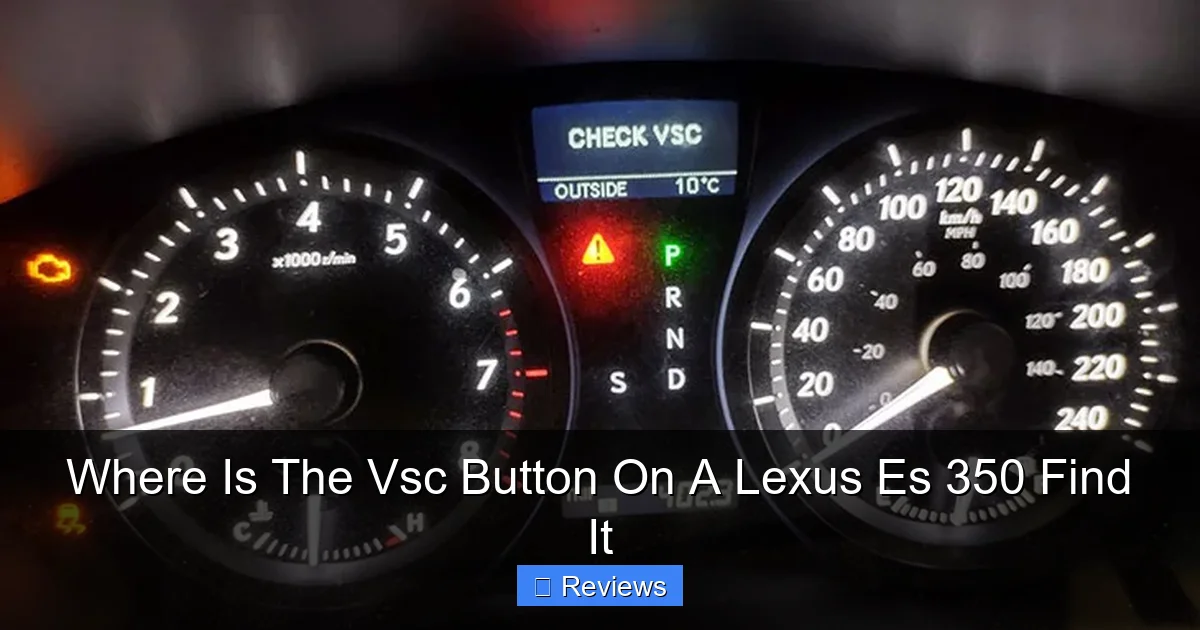
Visual guide about where is the vsc button on a lexus es 350
Image source: bryansgarage.com
Drive Mode Select and VSC Interaction
Modern Lexus ES 350 models come equipped with a Drive Mode Select system, allowing drivers to tailor the vehicle’s performance characteristics to their preferences or driving conditions. Common modes include Eco, Normal, Sport, and sometimes Sport S+. While these modes primarily adjust throttle response, transmission shift points, and steering feel, they can also influence the parameters of the VSC and TRAC systems.
- Eco Mode: In Eco mode, the VSC and TRAC systems are typically at their most intrusive, designed to maximize fuel efficiency and provide the safest, most stable ride possible. They will intervene quickly to prevent any hint of wheel spin or instability, ensuring smooth and economical driving.
- Normal Mode: This is the balanced mode for everyday driving. VSC and TRAC operate at their standard settings, providing a good blend of safety and responsiveness.
- Sport Mode (and Sport S+): When you select Sport mode, the VSC and TRAC systems might become slightly less intrusive. This means they allow for a greater degree of wheel slip or yaw before intervening, giving the driver a more “connected” feel to the road and allowing for a bit more spirited driving. However, it’s crucial to understand that even in Sport mode, VSC is still active and will intervene before you completely lose control. It’s a subtle adjustment, not a full disablement. To fully disable VSC, you would still need to press and hold the VSC button on a Lexus ES 350.
It’s important to remember that changes in drive mode primarily adjust the *thresholds* at which VSC and TRAC intervene, not their fundamental on/off state. For complete disengagement, especially of VSC, the physical VSC button on a Lexus ES 350 remains the primary control.
Advanced Safety Systems and VSC
Lexus is renowned for its commitment to safety, exemplified by the Lexus Safety System+ (LSS+), a comprehensive suite of active safety technologies. VSC is a foundational element that works in conjunction with many of these advanced systems to provide holistic protection:
- Anti-lock Braking System (ABS): VSC relies on the ABS hardware to apply brakes to individual wheels. ABS prevents wheel lock-up during hard braking, allowing the driver to maintain steering control.
- Electronic Brakeforce Distribution (EBD): EBD optimizes braking force to each wheel based on load distribution, enhancing braking stability. VSC integrates with EBD to ensure effective and balanced braking during its corrective actions.
- Brake Assist (BA): BA detects emergency braking situations and automatically provides additional braking force if the driver doesn’t press the pedal hard enough. VSC, in turn, can utilize these enhanced braking capabilities for its own stability interventions.
- Pre-Collision System (PCS): While PCS primarily warns of impending collisions and can even apply autonomous braking, VSC underpins the vehicle’s fundamental stability during any evasive maneuvers the driver might make in response to PCS warnings.
- Lane Departure Alert (LDA): If the vehicle drifts out of its lane, LDA might provide steering assistance. VSC ensures that any steering corrections are made safely, maintaining overall vehicle stability.
This integration means that VSC is not just a standalone feature, but a critical component of a layered safety strategy. Its intelligent intervention capabilities provide a stable platform upon which other advanced safety systems can operate effectively, contributing to the Lexus ES 350’s impressive safety ratings and the driver’s peace of mind.
Maintenance and VSC: Error Codes
Like any complex electronic system, VSC can sometimes encounter issues. When a problem arises within the VSC system or related components, your Lexus ES 350 will typically alert you through specific warning lights on the dashboard. It’s crucial to understand what these lights mean:
- VSC Warning Light: This is often the iconic skidding car symbol. If it illuminates steadily, it indicates a fault within the VSC system itself. The system may be deactivated.
- TRAC OFF Light: While this light typically appears when you intentionally press the VSC button on a Lexus ES 350 to disable TRAC, it can also illuminate if there’s a fault with the Traction Control system.
- ABS Warning Light: Since VSC uses the ABS system’s components (like wheel speed sensors and brake actuators), a fault in the ABS system will often trigger the VSC warning light as well. If the ABS light is on, it’s highly likely VSC is also compromised.
- Check Engine Light: In some cases, issues with engine performance or emissions can indirectly affect VSC’s ability to reduce engine power, potentially triggering the VSC warning light alongside the Check Engine Light.
If any of these warning lights illuminate unexpectedly, especially if they stay on after starting the car, it’s a strong indication that the VSC system (or a related system) is not functioning correctly. Driving with a disabled or malfunctioning VSC system means you’re without a critical safety net. In such situations, it’s imperative to:
- Reduce speed and drive cautiously.
- Avoid sudden steering or braking maneuvers.
- Contact a Lexus service center or trusted mechanic as soon as possible for diagnosis and repair. Common issues can include faulty wheel speed sensors, a malfunctioning steering angle sensor, low brake fluid, or problems with the VSC’s ECU.
Ignoring these warning lights compromises your safety and could lead to more significant repair costs down the line. Regular maintenance and prompt attention to warning indicators ensure your Lexus ES 350’s VSC system remains fully operational and effective.
Practical Tips and Troubleshooting for Your Lexus ES 350’s VSC System
Having a firm grasp of your Lexus ES 350’s VSC system and the location and function of the VSC button on a Lexus ES 350 is a significant step towards confident and safe driving. Beyond just knowing where the button is, there are several practical tips and troubleshooting approaches that can enhance your understanding and ensure optimal use of this crucial safety feature.
Always Consult Your Owner’s Manual
This cannot be stressed enough: the most definitive and accurate source of information for your specific Lexus ES 350 model year is its owner’s manual. While this blog post provides general guidance, the owner’s manual will detail the exact location of the VSC button on a Lexus ES 350 for your particular vehicle, specific operating procedures (e.g., how long to hold the button for full disablement), and precise interpretations of dashboard indicator lights.
- Where to find it: Your glove compartment should contain a physical copy. If not, Lexus provides digital versions on their official website (usually under the “Owners” or “Support” sections) and often through their Lexus Enform or Lexus Link mobile apps.
- Why it’s crucial: Features and their controls can have subtle differences between model years, trim levels, and even regional specifications. The manual clarifies these nuances, ensuring you’re not relying on potentially outdated or generalized information.
Before attempting to locate or operate the VSC button on a Lexus ES 350, a quick reference to your owner’s manual can save time and prevent confusion.
Familiarize Yourself with Dashboard Indicators
Your instrument cluster is the primary communication hub between your Lexus ES 350 and you. Understanding its symbols is paramount for safe operation, especially concerning safety systems like VSC and TRAC.
- TRAC OFF Light: Usually text, indicating Traction Control is off.
- VSC OFF Light: Also typically text, indicating Vehicle Stability Control is off.
- Skidding Car Icon: This symbol (a car with wavy lines behind it) can serve multiple purposes:
- Flashing: Indicates that VSC or TRAC is actively intervening to correct a skid or wheel spin.
- Solid (steady on): Indicates that VSC has been manually turned off, or there is a malfunction in the VSC system.
- ABS Light: If the ABS warning light is on, it generally means there’s an issue with the Anti-lock Braking System, which will also disable VSC.
Take a few moments to review these symbols in your owner’s manual. Knowing what each light means at a glance allows you to react appropriately and quickly understand the status of your vehicle’s stability systems after using the VSC button on a Lexus ES 350.
Test the Button in a Safe Environment
If you’re unsure about the exact operation of the VSC button on a Lexus ES 350 in your vehicle, or if you’ve recently acquired a new model, it’s a good idea to test it out. However, this should always be done with extreme caution and in a controlled setting:
- Choose an appropriate location: Find a large, empty, private parking lot or a deserted dirt road. Ensure there are no obstacles, other vehicles, or pedestrians nearby.
- At low speed: Never attempt to test the VSC system or its disablement at high speeds. Start by moving at a very slow crawl (e.g., 5-10 mph).
- Observe the dashboard: Press the VSC button on a Lexus ES 350 as per your manual’s instructions (short press, long press) and observe the dashboard lights. Confirm that the “TRAC OFF” and/or “VSC OFF” indicators illuminate as expected.
- Gentle maneuvers (if safe): If comfortable and in a completely safe area, you could briefly experience the difference in traction control by attempting to accelerate gently on a loose surface with TRAC on, then with TRAC off. However, never attempt to induce a skid with VSC off unless you are a highly trained professional on a track.
This controlled experiment will solidify your understanding of how the VSC button on a Lexus ES 350 functions in your specific vehicle and how the dashboard indicators respond, without putting yourself or others at risk.
When to Seek Professional Help
While locating and operating the VSC button on a Lexus ES 350 is generally straightforward, there are situations where professional assistance is warranted:
- Persistent Warning Lights: If the VSC, TRAC, or ABS warning lights remain illuminated even after attempting to reset them (e.g., by restarting the car) and without you having pressed the VSC button, there’s likely an underlying issue.
- Unusual Vehicle Behavior: If your Lexus ES 350 feels unstable, pulls to one side, or exhibits abnormal braking behavior, especially if accompanied by warning lights, do not delay seeking professional diagnosis.
- Difficulty Locating/Operating: If you’ve reviewed your manual and still cannot find or properly operate the VSC button on a Lexus ES 350, a Lexus dealership or certified mechanic can quickly demonstrate its location and function.
- After a Jump Start or Battery Disconnect: Sometimes, after a power interruption, certain sensors or systems might require recalibration. While often self-correcting, persistent VSC/TRAC lights after a battery service might need a professional scan tool to clear codes or perform a specific calibration procedure.
Timely professional intervention ensures that your Lexus ES 350’s critical safety systems are always in optimal working order, providing the peace of mind and protection you expect from a luxury vehicle.
A Legacy of Stability: The Evolution of Safety Features in the Lexus ES 350
The journey to understand the VSC button on a Lexus ES 350 is more than just a search for a control; it’s an exploration of Lexus’s unwavering commitment to safety and engineering excellence. The ES 350, as a flagship luxury sedan, has consistently been at the forefront of incorporating advanced safety technologies, with Vehicle Stability Control playing a pivotal role in its storied history.
Lexus’s Commitment to Safety
From its inception, Lexus, as Toyota’s luxury division, has prioritized safety alongside luxury and performance. Vehicle Stability Control (VSC) itself was pioneered by Toyota, with the first production electronic stability control system (VSC as Toyota called it) introduced in the 1995 Toyota Crown Majesta and Lexus GS 300. This innovation quickly proliferated across the Lexus lineup, becoming standard on the ES 350 long before it was mandated in many countries.
- Pioneer in Active Safety: Lexus didn’t just adopt VSC; it integrated it seamlessly into the driving experience, ensuring that interventions were smooth and confidence-inspiring rather than jarring.
- The ES 350 as a Benchmark: The Lexus ES 350, renowned for its serene and stable ride, owes much of its reputation to sophisticated chassis dynamics augmented by VSC. This system allows the car to maintain its composure even when road conditions are less than ideal, reinforcing the ES 350’s status as a safe and reliable choice for discerning drivers.
- Continuous Improvement: Over the years, Lexus has continually refined the VSC system, making it more responsive, intelligent, and integrated with other driver-assist technologies. This ongoing evolution ensures that every generation of the ES 350 benefits from the latest advancements in stability management, making the operation of the VSC button on a Lexus ES 350 a testament to decades of engineering refinement.
This dedication to safety underscores why understanding features like VSC is so important; it’s a core part of the Lexus identity and promises to its owners.
The Future of Stability Control
As automotive technology rapidly advances, the role and interaction of stability control systems like VSC are also evolving. The future promises even more sophisticated integration and potentially new ways of managing vehicle dynamics:
- Enhanced Sensor Technology: Next-generation sensors will provide even more precise data on vehicle position, driver input, and road conditions, allowing VSC to anticipate and react with even greater accuracy.
- Integration with Autonomous Driving: As vehicles move towards higher levels of autonomy, VSC will become an indispensable component, working in conjunction with AI and advanced computing to ensure vehicle stability during autonomous driving maneuvers, especially in emergency situations.
- Predictive Capabilities: Future systems might leverage mapping data, real-time weather information, and vehicle-to-infrastructure (V2I) communication to predict potential stability challenges and preemptively adjust vehicle dynamics before a loss of traction even begins.
- User Experience Improvements: While the physical VSC button on a Lexus ES 350 might remain for specific overrides, future interfaces could offer more intuitive digital controls or adaptive settings that automatically adjust VSC parameters based on driver style, road type, or weather, making the process even more seamless.
The foundational principles of VSC – sensing, assessing, and correcting – will remain, but the methods and sophistication will continue to advance, further solidifying the Lexus ES 350’s position at the leading edge of automotive safety.
Balancing Control and Convenience
The existence of a dedicated VSC button on a Lexus ES 350 highlights an ongoing debate in automotive design: the balance between physical controls for critical functions and the shift towards digital, screen-based interfaces. While many non-essential functions are moving into infotainment menus, safety-critical features often retain physical buttons for quick, tactile access without diverting eyes from the road.
- The Role of Physical Buttons: The VSC button, like hazard lights or emergency brake, represents a direct, fail-safe method for immediate intervention. This ensures that even if a touchscreen or digital system were to malfunction, the driver still has a direct means to manage fundamental vehicle safety.
- Evolving Driver Preferences: As drivers become more accustomed to digital interfaces in all aspects of their lives, automotive manufacturers continually evaluate which controls are best served by a physical button versus a digital menu. For a system like VSC, where inadvertent disabling could be dangerous, a deliberate press-and-hold action on a clearly marked physical button is often preferred.
- Lexus’s Approach: Lexus has historically blended traditional craftsmanship with cutting-edge technology. The placement and operation of the VSC button on a Lexus ES 350 reflect this philosophy – an advanced system that offers a direct and intuitive override when needed, reinforcing the driver’s ultimate control over their vehicle.
This careful consideration ensures that while the Lexus ES 350 offers a luxurious and technologically advanced experience, it never compromises on the fundamental principles of safety and driver empowerment. The VSC system, and its accessible button, stand as a testament to this balanced approach.
VSC Button Location by Lexus ES 350 Generation: A Quick Reference
To help consolidate the information regarding the VSC button on a Lexus ES 350, here’s a convenient table summarizing common locations and operational notes across different generations. Always refer to your specific owner’s manual for the most accurate and detailed information.
| Lexus ES 350 Generation | Model Years | Common VSC Button Location | Typical Label/Icon | Operation Notes |
|---|---|---|---|---|
| 5th Generation | 2007-2012 | Lower left dash, below steering wheel, near knee level. Often part of a panel with other auxiliary buttons. | “VSC OFF”, “TRAC OFF”, or a car with wavy lines icon. | Single push button. Short press for TRAC OFF. Long press (3-5 seconds) for full TRAC and VSC OFF. Re-engages on restart. |
| 6th Generation | 2013-2018 | Still primarily lower left dash, but may be slightly redesigned within its panel. | “VSC OFF”, “TRAC OFF”, or car with wavy lines icon. | Similar operation to 5th gen. Short press for TRAC OFF, long press (3-5 seconds) for full TRAC and VSC OFF. Re-engages on restart. |
| 7th Generation | 2019-Present | Often on the lower left dash panel. In some configurations, functionality might be accessed via drive mode selector or infotainment settings (less common for full VSC OFF). | Often “TRAC OFF” (VSC might be harder to fully disable or managed automatically). Look for car with wavy lines icon. | Typically requires a long press (3-5 seconds) for full TRAC and VSC disablement. Consult manual for specific model year. Re-engages on restart. |
This table provides a quick visual reference for where to begin your search for the VSC button on a Lexus ES 350 based on its production era. Remember that interior design, and thus button placement, can sometimes vary slightly with specific trim levels or minor refresh cycles within a generation.
Conclusion
The journey to find the VSC button on a Lexus ES 350 is more than just locating a piece of plastic on your dashboard; it’s an exercise in understanding a fundamental aspect of your vehicle’s safety engineering. Vehicle Stability Control is a silent guardian, working tirelessly to ensure your Lexus ES 350 maintains its composure and trajectory, even in the most challenging driving conditions. Its presence is a testament to Lexus’s unwavering commitment to luxury harmonized with paramount safety.
While the exact location of the VSC button on a Lexus ES 350 may shift slightly across different model years, the guiding principle remains consistent: it’s typically found on the lower left side of the dashboard, often requiring a specific press-and-hold action to fully disengage the system. The critical takeaway is not just knowing where it is, but understanding why it’s there and when it should (or, more importantly, should not) be used. For nearly all normal driving, VSC should always be active, standing ready as your car’s intelligent co-pilot against skids and loss of control.
Only in specific, low-speed scenarios like getting unstuck from deep snow or mud, where controlled wheel spin is necessary, should you ever consider engaging the VSC button on a Lexus ES 350 to temporarily disable the system. And in such instances, the moment the challenge is overcome, it is paramount to re-enable VSC to restore your vehicle’s full safety capabilities. Always consult your owner’s manual for precise instructions tailored to your specific ES 350 model year, and pay close attention to dashboard indicators to confirm the system’s status.
Ultimately, the Lexus ES 350 offers a refined blend of exhilarating performance, opulent comfort, and cutting-edge safety. By familiarizing yourself with every aspect of its operation, including the nuances of its VSC system, you unlock the full potential of your vehicle, driving with greater confidence, mastery, and, most importantly, safety. Your Lexus ES 350 is engineered for excellence, and a well-informed driver is its perfect complement.
Frequently Asked Questions
The VSC (Vehicle Stability Control) button on most Lexus ES 350 models is typically found near the driver’s left knee. Look for it among a bank of small buttons, often grouped with controls for the fuel door or trunk release.
The VSC button allows you to manually disable the Vehicle Stability Control system. This system helps prevent skidding and loss of traction, but you might want to turn it off in specific situations like getting unstuck from snow or mud.
How do I turn the VSC system off and on in my Lexus ES 350?
To turn VSC off, press and hold the VSC button for a few seconds until an indicator light illuminates on your dashboard. To turn it back on, simply press the button again briefly, and the light should turn off.
The VSC button on a Lexus ES 350 is usually a small, rectangular button. It may be labeled “VSC OFF” or have an icon resembling a car with wavy lines underneath it, indicating traction control.
Yes, all Lexus ES 350 models come equipped with a VSC (Vehicle Stability Control) system as a standard safety feature. Therefore, there will always be a dedicated control to disable it, typically a specific VSC button.
When should I turn off the VSC on my Lexus ES 350?
You might consider temporarily turning off VSC when trying to free your car from deep snow, mud, or sand, as the system can sometimes hinder the wheel spin needed to gain traction. Remember to re-enable it once you’re on stable ground for optimal safety.

At CarLegit, we believe information should be clear, factual, and genuinely helpful. That’s why every guide, review, and update on our website is created with care, research, and a strong focus on user experience.