

Featured image for Does A Maserati Need An Oil Change Every 3000 Miles
Image source: dontbelievethat.com
No, a Maserati does not need an oil change every 3000 miles. Modern synthetic oils and advanced engineering allow for extended intervals, typically between 7500 and 10000 miles. Always refer to your owner’s manual for the precise schedule to ensure peak performance and longevity.
In This Article
- 1 Key Takeaways
- 2 📑 Table of Contents
- 3 Does a Maserati Really Need an Oil Change Every 3000 Miles?
- 4 The 3000-Mile Myth: Where Did It Come From and Why It’s Outdated
- 5 What Maserati Actually Recommends: The Official Word
- 6 It’s Not Just About Mileage: The Critical Role of Oil Type and Quality
- 7 Your Driving Style: The Ultimate Factor in Oil Change Frequency
- 8 The True Cost: Saving Money vs. Protecting Your Investment
- 9 A Practical Guide: What You Should Actually Do
- 10 Conclusion: Drive More, Worry Less (But Be Smart)
- 11 Frequently Asked Questions
- 11.1 Does a Maserati really need an oil change every 3000 miles?
- 11.2 What is the actual recommended oil change interval for a Maserati?
- 11.3 Why is the 3000-mile oil change myth so persistent for cars like Maserati?
- 11.4 What are the risks of not changing oil every 3000 miles in a Maserati?
- 11.5 Can I go longer than 3000 miles between oil changes for my Maserati?
- 11.6 How does the cost of a Maserati oil change compare to the 3000-mile recommendation?
Key Takeaways
- Follow Manufacturer Guidelines: Maserati recommends intervals longer than 3000 miles.
- Use Synthetic Oil: Essential for optimal engine performance and longevity.
- Consult Your Owner’s Manual: Find the exact service schedule for your model.
- Monitor Driving Conditions: Severe usage may require more frequent changes.
- Avoid Outdated Myths: 3000-mile intervals are unnecessary for modern cars.
- Check Oil Quality Regularly: Use dipstick or sensors to assess condition.
- Seek Professional Advice: Always consult a Maserati-certified technician.
📑 Table of Contents
- Does a Maserati Really Need an Oil Change Every 3000 Miles?
- The 3000-Mile Myth: Where Did It Come From and Why It’s Outdated
- What Maserati Actually Recommends: The Official Word
- It’s Not Just About Mileage: The Critical Role of Oil Type and Quality
- Your Driving Style: The Ultimate Factor in Oil Change Frequency
- The True Cost: Saving Money vs. Protecting Your Investment
- A Practical Guide: What You Should Actually Do
- Conclusion: Drive More, Worry Less (But Be Smart)
Does a Maserati Really Need an Oil Change Every 3000 Miles?
Let’s be honest. When you finally get behind the wheel of a Maserati, you’re not just driving a car. You’re piloting a piece of automotive passion. The roar of the Ferrari-derived engine, the scent of fine leather, the sheer presence of it—it’s an experience. And like any great love affair, you want to take care of it.
Which brings us to that age-old question, probably whispered in the back of your mind during your first exhilarating drive: “How often do I need to change the oil?” For decades, the rule of thumb for many was simple: every 3,000 miles. It was drilled into us. But here you are, the proud owner of a sophisticated Italian masterpiece. Does the same rusty rule apply? Is your Maserati’s complex, high-performance engine really on the same schedule as the average commuter sedan?
The short answer is a resounding no. Sticking rigidly to a 3000-mile oil change interval for your modern Maserati isn’t just unnecessary—it’s potentially a misunderstanding of how to care for it. Let’s dive into why that old rule is obsolete and what your trident-badged beauty actually needs to keep singing its glorious song for years to come.
The 3000-Mile Myth: Where Did It Come From and Why It’s Outdated
We need to clear the air on this first. The “3,000-mile oil change” isn’t some universal law of physics. It’s a relic, a ghost from a different automotive era that’s proven incredibly hard to shake.
Visual guide about Does A Maserati Need An Oil Change Every 3000 Miles
Image source: i.pinimg.com
A Hangover from a Simpler Time
Back in the 1970s and 80s, engine tolerances were looser, oil technology was less advanced, and fuel systems were cruder. Conventional motor oil broke down faster. Cars often had shorter recommended intervals. The 3000-mile number was easy to remember, and quick-lube businesses found it a profitable rhythm to promote. It became marketing gospel, not engineering necessity.
The Modern Reality: Smarter Engines, Smarter Oils
Fast forward to today. Your Maserati is a technological tour de force. Its engine is built with incredibly tight tolerances. More importantly, the oil you put in it is a far cry from the simple petroleum blends of the past. Today’s full synthetic oils—the only kind you should use in a Maserati—are engineered to withstand extreme heat and stress for much, much longer. They have advanced additive packages that fight viscosity breakdown, neutralize acids, and keep contaminants in suspension. The car itself is also smarter. Its computer constantly monitors oil life based on your actual driving, not just a simple mileage counter.
Applying the 3000-mile rule to a modern performance car is like using a sundial to time a Formula 1 pit stop. The tool and the context are completely mismatched.
What Maserati Actually Recommends: The Official Word
Forget the quick-lube sign down the street. The only schedule that truly matters is the one in your owner’s manual. Maserati engineers, who know every micron of that engine, have provided clear guidance.

Visual guide about Does A Maserati Need An Oil Change Every 3000 Miles
Image source: 1.bp.blogspot.com
The Standard Interval: A Big Leap from 3000
For most modern Maserati models (think post-2010 or so), the manufacturer’s standard recommended oil change interval is typically every 12 months or 12,500 miles, whichever comes first. Yes, you read that right. In some cases, for certain models and under ideal conditions, the onboard service computer may even extend that to 15,000 miles or more. This is a world away from 3,000 miles.
The “whichever comes first” part is crucial. If you only drive your Maserati 3,000 miles a year on beautiful Sunday afternoons, you still change the oil once a year. Time itself can degrade oil, as moisture and fuel contaminants accumulate even when the car sits.
Model-Specific Examples
While you must check your specific manual, here’s a general idea:
- Maserati Ghibli & Quattroporte: Typically follow the 12-month/12,500-mile guideline for their twin-turbo V6 engines.
- Maserati Levante: Similar schedule, though heavy towing or extreme off-road use would necessitate more frequent changes.
- Maserati MC20 & High-Performance Models: These are the exceptions that prove the rule. For a track-focused machine like the MC20, Maserati may recommend a significantly shorter interval (e.g., every 5,000 miles or after track use) due to the extreme stresses involved.
This variance alone shows why a one-size-fits-all 3000-mile rule is meaningless.
It’s Not Just About Mileage: The Critical Role of Oil Type and Quality
Changing your oil “on time” is only half the battle. Changing it with the correct oil is the other, perhaps more important, half. This is where you should be meticulous.

Visual guide about Does A Maserati Need An Oil Change Every 3000 Miles
Image source: carfromjapan.com
Full Synthetic is Non-Negotiable
Your Maserati’s engine was designed and tested with full synthetic oil. Using conventional or even a synthetic blend is a disservice. Full synthetic provides superior protection against high-temperature deposits (vital for turbocharged engines), flows better at startup to protect components, and maintains its protective properties far longer.
The Right Spec is Everything
It’s not enough to just pour in any 5W-40 synthetic. You must use an oil that meets Maserati’s specific manufacturer approval. For most newer models, this is the ACEA C4 specification or Maserati’s own 9.55586-SM1 standard. These specs ensure the oil is low in sulfated ash, phosphorous, and sulfur (Low SAPS), which is essential for protecting your expensive catalytic converters and emissions systems. Using the wrong oil can lead to clogged DPFs and costly repairs down the line.
Practical Tip: When you take your car in for service, ask to see the oil bottles. Don’t be shy. A reputable shop specializing in exotics will be happy to show you they’re using the correct, approved product.
Your Driving Style: The Ultimate Factor in Oil Change Frequency
This is the most important concept for any performance car owner to grasp. Your driving habits are the single biggest variable in determining oil life. The manufacturer’s 12,500-mile interval assumes a mix of driving. But “severe service” conditions demand more frequent attention.
What Constitutes “Severe Service”?
According to Maserati and every other performance manufacturer, the following conditions shorten oil life dramatically:
- Frequent Short Trips: When the engine never fully reaches optimal operating temperature, moisture and fuel don’t burn off, contaminating the oil.
- Extreme Temperatures: Both blistering heat and freezing cold.
- Heavy Stop-and-Go Traffic: Constant low-speed operation with high engine load.
- Towing or Carrying Heavy Loads.
- Aggressive, High-RPM Driving: This is the big one for sports car owners. If you regularly explore the upper ranges of the tachometer, you’re putting immense thermal stress on the oil.
- Track Use: This is the most severe condition possible. An oil change after a track day is often mandatory.
The “Trust the Computer” Approach
This is your best friend. Modern Maseratis have a sophisticated Oil Change Indicator system. It doesn’t just count miles. It uses algorithms that factor in engine RPM, temperature, load, and driving time to calculate the actual degradation of your oil. If you drive hard, the warning light will come on much sooner than 12,500 miles. If you do a lot of gentle highway cruising, it might extend beyond. Let this computer be your guide. It’s far more accurate than any static mileage number.
The True Cost: Saving Money vs. Protecting Your Investment
Let’s talk numbers. Some owners think, “Changing it more often can’t hurt, and it’s cheap insurance.” But with a Maserati, the calculus is different.
The Financial Math of Over-Maintaining
A Maserati oil change isn’t a $50 special. Between 8-10 quarts of approved full synthetic oil and a premium filter, the parts alone can be $150-$300. Labor at a specialist adds more. If you followed the 3000-mile rule on a car you drive 12,000 miles a year, you’d be doing this 4 times a year. Following Maserati’s schedule, you’d do it once, maybe twice if the computer says so. That’s an annual savings of thousands of dollars with zero detriment to your engine—in fact, you’re following the correct procedure.
The Hidden Cost of Neglect
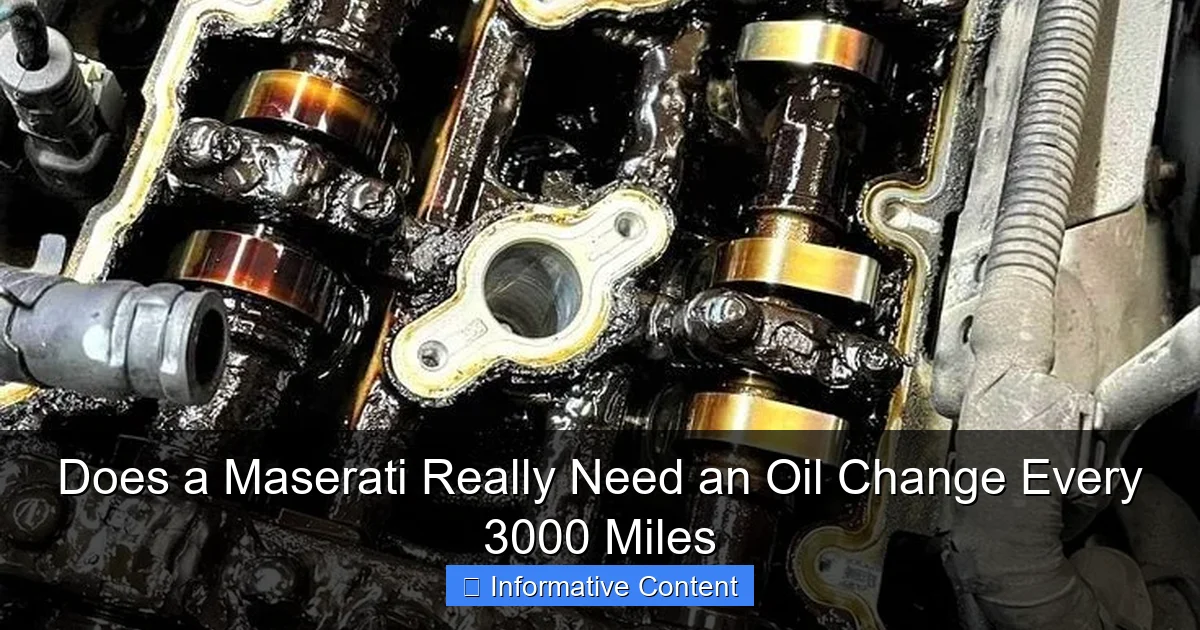
The opposite risk is stretching intervals too far to save money. Oil is the lifeblood of your engine. Degraded, sludgy oil can lead to:
- Increased wear on turbocharger bearings (a very costly repair).
- Clogged oil passages and reduced lubrication.
- Overheating and potential engine damage.
The repair bill for a neglected Maserati engine can easily run into five figures. The cost of an extra, prudent oil change is trivial by comparison.
A Practical Guide: What You Should Actually Do
So, with all this information, what’s the game plan? Let’s make it simple.
Your Actionable Maintenance Checklist
- Step 1: Read Your Manual. Find the official recommended interval for your specific model and year. This is your bible.
- Step 2: Heed the Dashboard. When the service indicator lights up, schedule the appointment. Don’t ignore it.
- Step 3: Be Honest About Your Driving. Are you a “severe service” driver? If your daily drive is a spirited canyon run, consider changing oil at 6,000-8,000 miles, regardless of the indicator. For track use, change it immediately afterward.
- Step 4: Choose Your Service Center Wisely. Use a Maserati dealership or a highly respected independent exotic car specialist. They will have the correct oil, filters, tools, and knowledge.
- Step 5: Consider the Annual Minimum. Even if you only drive 1,000 miles, change the oil once a year to flush out contaminants that accumulate with time.
Sample Oil Change Interval Data for Common Maserati Models
This table illustrates the dramatic difference from the 3000-mile myth and how driving conditions alter the schedule.
| Model (Example) | Manufacturer Standard Recommendation | Recommended Oil Type (Example) | “Severe Service” / Performance Driving Suggestion |
|---|---|---|---|
| Maserati Ghibli (V6 Twin-Turbo) | 12 months / 12,500 miles | Full Synthetic 0W-40 or 5W-40 (meeting ACEA C4 / 9.55586-SM1) | Every 6,000 – 8,000 miles |
| Maserati Quattroporte (V8) | 12 months / 12,500 miles | Full Synthetic 0W-40 (meeting ACEA C4 / 9.55586-SM1) | Every 5,000 – 7,000 miles |
| Maserati Levante | 12 months / 12,500 miles | Full Synthetic 0W-40 (meeting ACEA C4 / 9.55586-SM1) | Every 8,000 – 10,000 miles (or after heavy towing) |
| Maserati MC20 (Track-Oriented) | Consult Manual (often far shorter, e.g., 5,000 miles) | Specific High-Performance Synthetic (Exact spec critical) | After every track event / Aggressive driving |
Conclusion: Drive More, Worry Less (But Be Smart)
Owning a Maserati is about the joy of driving. It shouldn’t be shackled by an outdated maintenance myth born from a different age of automobiles. The constant anxiety of a 3000-mile oil change schedule is not only a waste of money but also a misunderstanding of your car’s advanced engineering.
The key takeaway is to move from a rigid, mileage-based mindset to a condition-based one. Trust the sophisticated systems in your car. Understand the impact of your driving. Use only the highest-quality, manufacturer-approved fluids. By doing this, you’re not being lax on maintenance—you’re being precisely correct. You’re giving your Maserati exactly what it needs to deliver that breathtaking performance reliably for the long haul. So, go ahead, enjoy that next drive. Listen to the engine. Your oil, assuming you follow Maserati’s real guidelines, is perfectly happy doing its job.
Frequently Asked Questions
Does a Maserati really need an oil change every 3000 miles?
No, modern Maseratis do not typically require oil changes every 3000 miles. This interval is an outdated guideline based on older vehicles and less advanced oil technology. Instead, refer to your owner’s manual for the manufacturer’s recommended schedule, which is often between 7500 to 10000 miles.
What is the actual recommended oil change interval for a Maserati?
Maserati recommends oil changes based on driving conditions and model specifics, but generally, intervals range from 7500 to 10000 miles or once a year. Always check your vehicle’s owner’s manual for the exact interval, as it can vary depending on the engine and usage.
Why is the 3000-mile oil change myth so persistent for cars like Maserati?
The 3000-mile oil change myth persists due to historical practices and marketing from quick-lube shops. However, with synthetic oils and advanced engine technology, modern Maseratis are designed to go much longer between changes. Following the manufacturer’s guidelines ensures optimal performance and longevity.
What are the risks of not changing oil every 3000 miles in a Maserati?
If you ignore the recommended interval and go too long without an oil change, it can lead to sludge buildup, increased engine wear, and potential damage. However, the risk is low if you follow Maserati’s longer intervals, as synthetic oil maintains its properties well beyond 3000 miles.
Can I go longer than 3000 miles between oil changes for my Maserati?
Yes, you can and should go longer than 3000 miles between oil changes for your Maserati. Most models are designed with longer intervals in mind, using high-quality synthetic oils. Always follow the manufacturer’s recommendations to maintain warranty coverage and engine health.
How does the cost of a Maserati oil change compare to the 3000-mile recommendation?
A Maserati oil change can cost between $200 to $500, depending on the model and location. If you were to change it every 3000 miles, this would add up quickly, but since intervals are longer, the annual cost is more manageable. Adhering to the correct schedule ensures cost-effectiveness without compromising care.

At CarLegit, we believe information should be clear, factual, and genuinely helpful. That’s why every guide, review, and update on our website is created with care, research, and a strong focus on user experience.