
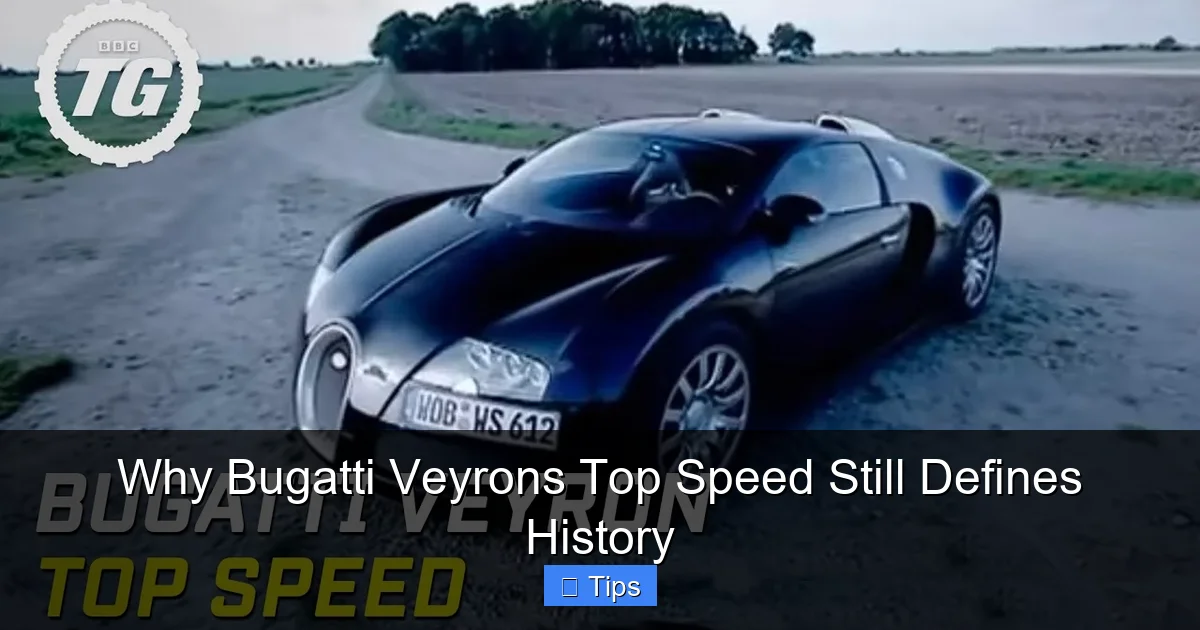
Featured image for Bugatti Veyron Top Speed
Image source: i.ytimg.com
The Bugatti Veyron’s record-breaking top speed remains a pivotal moment in automotive history, not merely for the number itself, but for the profound engineering challenges it overcame. This monumental achievement redefined what was possible for production cars, pushing boundaries of performance and luxury like never before. Its legacy continues to resonate, demonstrating an unparalleled commitment to speed that forever altered the supercar landscape.
In the vast tapestry of human endeavor, certain moments stand out—feats of engineering, daring ambition, and raw power that redefine what’s possible. For aviation, it was breaking the sound barrier. For space, landing on the moon. And for the automotive world, it was the moment the Bugatti Veyron shattered the 400 km/h barrier, securing its place in automotive history as the fastest production car on Earth. This wasn’t merely a number on a speedometer; it was a profound declaration of intent, a monument to a vision that seemed almost impossible, and a permanent shift in the landscape of high-performance vehicles.
The quest for top speed is as old as the automobile itself. From the earliest petrol-powered contraptions to the sleek, aerodynamic marvels of today, manufacturers have consistently pushed the boundaries of velocity. However, the Bugatti Veyron’s achievement transcended simple speed. It represented a confluence of luxury, daily drivability, and otherworldly performance, a combination previously thought to be mutually exclusive. The sheer audacity of Ferdinand Piëch’s vision for a 1,000-horsepower, 400 km/h supercar that could also be driven to the opera set a new, almost unattainable, standard.
Decades after its initial record-breaking run, the Bugatti Veyron’s top speed remains a touchstone, a benchmark against which all subsequent hypercars are measured. It isn’t just about the raw figure; it’s about the incredible engineering challenges overcome, the psychological barriers broken, and the lasting influence it had on automotive design and innovation. The Veyron didn’t just go fast; it redefined what ‘fast’ meant for a road-legal vehicle, forever etching its legacy into the annals of automotive history.
In This Article
- 1 Key Takeaways
- 2 📑 Table of Contents
- 3 The Engineering Marvel Behind the Number
- 4 Beyond Speed: Setting New Benchmarks for Production Cars
- 5 The Record-Breaking Run: A Moment Frozen in Time
- 6 Legacy and Influence: Paving the Way for Hyperspeed
- 7 Economic and Cultural Impact: Beyond the Track
- 8 Bugatti Veyron Performance Milestones and Context
- 9 Conclusion
- 10 Frequently Asked Questions
- 10.1 What was the Bugatti Veyron’s top speed record and why was it so groundbreaking?
- 10.2 How did Bugatti engineers manage to achieve the Veyron’s unprecedented top speed?
- 10.3 Are there faster cars than the Bugatti Veyron today, and if so, why does its top speed still hold historical significance?
- 10.4 What unique challenges did Bugatti overcome to make the Veyron’s extreme top speed safe and reliable?
- 10.5 Beyond just the number, what broader impact did the Bugatti Veyron’s top speed achievement have on the automotive industry?
- 10.6 Why is the Bugatti Veyron’s top speed often described as a “defining moment” rather than just another record?
Key Takeaways
- Veyron redefined automotive limits: Shattered speed barriers, setting a new benchmark.
- Engineering mastered extremes: Unprecedented power met everyday usability seamlessly.
- Set the hypercar standard: Established new expectations for performance and luxury.
- Its legacy inspires innovation: Continues to drive future hypercar development.
- Symbolized ultimate ambition: Showcased what’s possible with focused resources.
- Transformed speed perception: Made once-unthinkable velocities a tangible reality.
📑 Table of Contents
- The Engineering Marvel Behind the Number
- Beyond Speed: Setting New Benchmarks for Production Cars
- The Record-Breaking Run: A Moment Frozen in Time
- Legacy and Influence: Paving the Way for Hyperspeed
- Economic and Cultural Impact: Beyond the Track
- Bugatti Veyron Performance Milestones and Context
- Conclusion
The Engineering Marvel Behind the Number
The Bugatti Veyron’s record-setting top speed was not a stroke of luck or a simple tuning job; it was the result of an unprecedented engineering effort, costing billions and pushing every known boundary of automotive design. The goal was clear yet audacious: a car with over 1,000 horsepower that could exceed 400 km/h, be luxurious, and yet remain completely street-legal and reliable. This vision demanded innovation at every turn, transforming what many considered an impossible dream into a tangible reality.
From Concept to Reality: Ferdinand Piëch’s Vision
The genesis of the Bugatti Veyron lay in the ambitious vision of Ferdinand Piëch, then chairman of the Volkswagen Group. His mandate was to create a car that was incomparable, a technical masterpiece that would reclaim Bugatti’s historical prestige and elevate the VW Group’s engineering prowess. He famously sketched the specifications on a napkin: 1,000 horsepower, over 400 km/h, and the ability to comfortably transport two people in luxury. This seemingly insurmountable challenge became the blueprint for the Veyron, pushing engineers to innovate in ways previously unimagined for a production vehicle. The commitment to this vision, even in the face of immense technical hurdles and cost overruns, underscores the importance of a clear, ambitious goal in driving revolutionary progress.
The W16 Engine: A Symphony of Power
At the heart of the Bugatti Veyron lies its colossal 8.0-liter W16 engine. This unique configuration, essentially two narrow-angle V8 engines joined at the crankshaft, was a feat of mechanical ingenuity. Equipped with four turbochargers, it initially produced 1,001 PS (987 hp), a figure that at the time seemed mythical for a road car. This engine wasn’t just about raw power; it was engineered for seamless delivery, remarkable refinement, and incredible durability, allowing the Veyron to achieve its phenomenal top speed safely and repeatedly. The complexity involved in cooling, lubricating, and managing such immense power in a relatively compact package was monumental.
Aerodynamics and Cooling: Taming the Air
Achieving and sustaining a top speed over 400 km/h presents immense aerodynamic challenges. The Bugatti Veyron had to generate sufficient downforce to remain stable without creating excessive drag that would hinder speed. This required an active aerodynamic system, featuring a rear wing that could adjust its angle based on speed and driving mode, acting as an air brake when needed. Furthermore, the sheer amount of heat generated by the W16 engine and its associated systems demanded an extraordinary cooling setup. The Veyron incorporated 10 radiators, each dedicated to cooling different components, a testament to the extreme thermal management required for such performance.
Materials Science and Chassis Integrity
To cope with the immense forces at extreme speeds, the Bugatti Veyron utilized advanced materials and structural design. Its monocoque chassis was constructed from carbon fiber, providing exceptional rigidity and strength while keeping weight as low as possible. High-strength alloys were used for critical suspension and drivetrain components. The structural integrity of the Veyron was paramount not just for performance, but for occupant safety, especially during its record-breaking top speed runs. The precision engineering and material science behind every component were crucial to the vehicle’s success.
Tires: The Unsung Heroes
Often overlooked, the tires are critical components in achieving ultra-high speeds. For the Bugatti Veyron, standard tires simply wouldn’t suffice. Michelin developed bespoke PAX system tires specifically for the Veyron, capable of withstanding the centrifugal forces generated at 400+ km/h, where each tire experiences forces equivalent to roughly 3,000 times the force of gravity. These tires were not only incredibly strong but also designed to maintain optimal grip and stability under extreme conditions, highlighting the comprehensive approach to engineering required for the Veyron’s groundbreaking performance.
Beyond Speed: Setting New Benchmarks for Production Cars
The Bugatti Veyron’s achievement of its incredible top speed was not just about raw velocity; it was about setting a new paradigm for what a production car could be. It wasn’t a stripped-down, single-purpose land speed record contender, but a fully functional, luxurious vehicle that could be driven every day. This holistic approach to performance and usability is what truly solidified its place in automotive history.
Visual guide about Bugatti Veyron Top Speed
Image source: s1.dmcdn.net
The Quadruple Crown: Speed, Luxury, Drivability, and Reliability
What truly distinguished the Bugatti Veyron from previous attempts at ultimate speed was its commitment to what can be called the “Quadruple Crown.” It had to be outrageously fast, providing an unmatched top speed experience. It had to be luxuriously appointed, offering a cabin experience befitting its multi-million-dollar price tag. Crucially, it had to be drivable, meaning it could navigate city streets and highways with relative ease, without requiring specialist mechanics after every outing. And finally, it had to be reliable, a monumental feat considering the stress placed on every component. This combination was revolutionary and set a new standard for hypercars globally. The Veyron proved that extreme performance didn’t have to come at the expense of comfort or practicality, offering a “tip” to future manufacturers: the ultimate car should excel in all dimensions, not just one.
Redefining Automotive Engineering Standards
The development of the Bugatti Veyron forced engineers to rethink established practices across the board. From the cooling systems that managed immense heat to the sophisticated active aerodynamics that balanced downforce and drag, and from the bespoke tires to the advanced electronics, every system had to operate at unprecedented levels of efficiency and reliability. This push for perfection across all disciplines elevated the engineering standards for the entire automotive industry, particularly in the high-performance segment. It demonstrated that with enough resources, vision, and talent, seemingly impossible engineering challenges could be overcome.
The Psychological Barrier of 400 km/h
Long before the Bugatti Veyron, 400 km/h (approximately 250 mph) was a mythical figure for road cars. It was seen as an insurmountable psychological and physical barrier. Previous cars had approached it, but none had definitively surpassed it as a fully street-legal, production vehicle. The Veyron’s breakthrough was not just quantitative; it was qualitative. It proved that a car could operate safely and stably at such extreme velocities, fundamentally changing perceptions of what was achievable. This psychological impact resonated deeply within the automotive community, inspiring a new generation of hypercar manufacturers to aim higher.
A Testament to German Engineering Prowess (VW Group)
The Bugatti Veyron, though bearing a French nameplate, was largely a product of German engineering and the vast resources of the Volkswagen Group. It showcased the meticulous attention to detail, rigorous testing protocols, and sheer technical expertise synonymous with German automotive manufacturing. The project served as a powerful demonstration of what a well-funded, highly skilled engineering team could achieve when given a seemingly impossible brief, cementing the VW Group’s reputation for pushing technological boundaries in automotive history.
The Record-Breaking Run: A Moment Frozen in Time
The achievement of the Bugatti Veyron’s groundbreaking top speed was not just about the car itself; it was about the specific, meticulously planned event that sealed its place in the record books. These runs were moments of high drama, precision, and immense pressure, captivating the world and validating years of arduous development.
Visual guide about Bugatti Veyron Top Speed
Image source: paultan.org
The Ehra-Lessien Test Track
To safely achieve its unprecedented top speed, the Bugatti Veyron required an equally extraordinary testing ground. The Volkswagen Group’s private Ehra-Lessien test track in Germany was the ideal location. This track features a 9-kilometer (5.6-mile) straight, one of the longest in the world, specifically designed for high-speed testing. Its perfectly smooth surface, minimal banking, and remote location provided the controlled environment necessary to push the Veyron to its absolute limit without external interference. This choice of venue was critical for ensuring accurate measurements and driver safety, reinforcing the “tip” that optimal conditions are paramount for record-breaking endeavors.
Piloting the Beast: The Human Element
While the Veyron was an engineering marvel, achieving its top speed required exceptional driving talent. Skilled test drivers like Andy Wallace and Pierre Henri Raphanel were tasked with these perilous runs. Their ability to maintain focus, execute precise inputs, and manage the car at extreme velocities was as crucial as the car’s engineering. These drivers were not just accelerating; they were navigating a razor’s edge where aerodynamic forces, tire integrity, and vehicle stability were pushed to their absolute limits. Their skill ensured that the car’s full potential for a new top speed was realized and officially recorded.
The Atmospheric and Technical Conditions
Setting an official world record for top speed is an incredibly stringent process. It requires multiple runs in opposite directions to account for wind and gradient, overseen by independent adjudicators like TÜV SÜD. Specific atmospheric conditions, such as temperature and humidity, also play a role in engine performance and tire grip. For the Veyron’s record attempts, every variable was meticulously controlled, from fuel quality to tire pressure, ensuring that the conditions were optimal and the results verifiable. This rigorous methodology is a key “tip” for anyone aiming for peak performance, whether in racing or any other field: success hinges on controlling every possible variable.
Witnessing History: The Impact of the Achievement
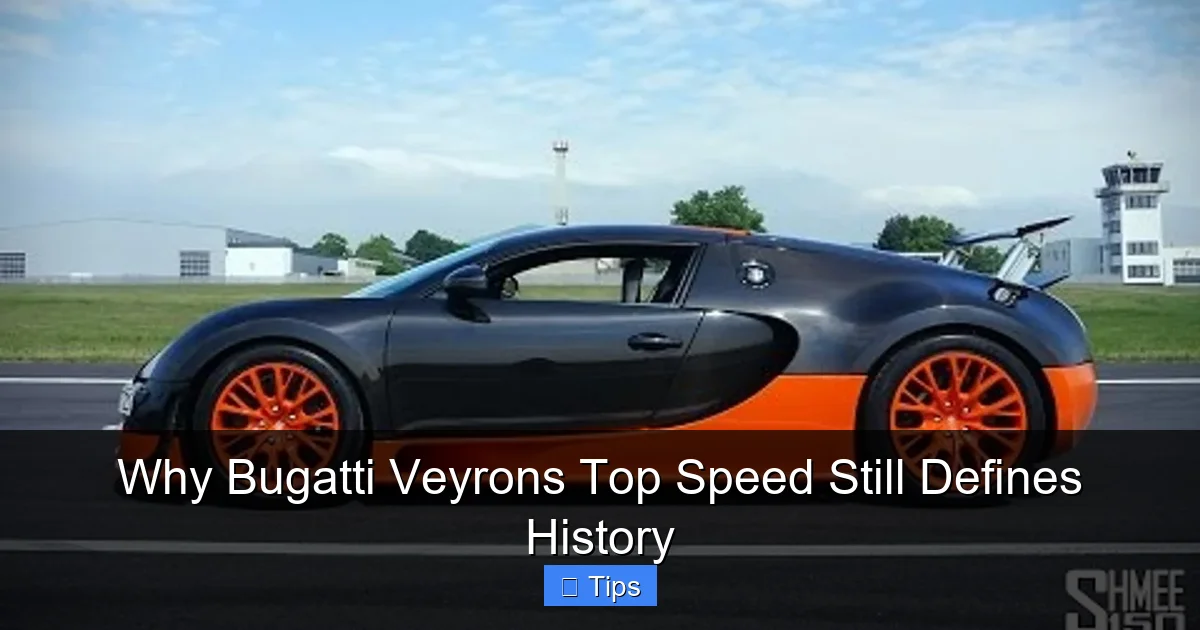
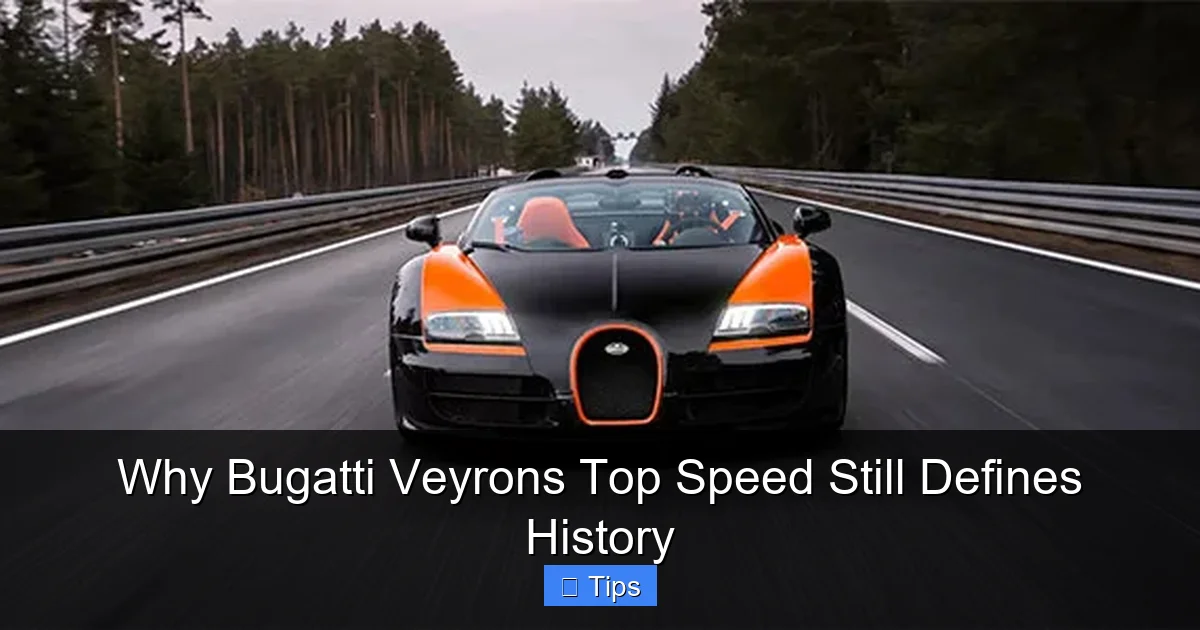
When the original Bugatti Veyron 16.4 hit 407 km/h (253 mph) in 2005, and later the Veyron Super Sport reached 431 km/h (268 mph) in 2010, the automotive world took notice. These events were widely covered, capturing the imagination of enthusiasts and the general public alike. The sheer audacity of these speeds for a production car resonated globally, showcasing not just Bugatti’s capabilities but the potential for automotive engineering as a whole. It became a powerful symbol of progress and human ambition, forever ingrained in automotive history.
Legacy and Influence: Paving the Way for Hyperspeed
The Bugatti Veyron’s impact extends far beyond its own production run. Its record-breaking top speed and engineering philosophy created a ripple effect, profoundly influencing the entire hypercar segment and inspiring subsequent generations of extreme performance vehicles. It fundamentally altered the trajectory of ultra-high-performance car development.
Visual guide about Bugatti Veyron Top Speed
Image source: carsflow.com
Inspiring a New Breed of Hypercars
Before the Bugatti Veyron, the hypercar landscape was less defined. Post-Veyron, the bar for extreme performance was irrevocably raised. Manufacturers like SSC North America, Koenigsegg, and Hennessey, among others, were directly influenced by the Veyron’s achievement, setting their sights on similar or even higher top speed records. The Veyron legitimized the pursuit of such stratospheric speeds in a production car, turning a niche aspiration into a global competition. This competition continues today, pushing innovation forward at an incredible pace, directly traceable back to the Veyron’s initial breakthrough.
The Pursuit of Perfection: A Continuous Drive for Innovation
The Bugatti Veyron demonstrated that ultimate performance is not achieved through incremental improvements but through a commitment to radical innovation. Every component, every system had to be reinvented or perfected. This pursuit of perfection became a guiding principle for many high-performance manufacturers. The Veyron encouraged engineers and designers to think beyond conventional limits, fostering an environment where audacious ideas were not immediately dismissed but actively explored. A key “tip” from the Veyron’s story for innovators in any field is the importance of a “moonshot” goal to galvanize a team and foster groundbreaking solutions.
Changing Perceptions of Automotive Performance
Prior to the Veyron, discussions of cars reaching speeds over 400 km/h were often limited to purpose-built land speed record vehicles, often jet- or rocket-powered, and certainly not street-legal. The Bugatti Veyron changed this perception entirely. It showed that a car could be incredibly fast, luxurious, and usable on public roads. It broadened the definition of what a “supercar” could achieve, introducing the term “hypercar” to describe vehicles that pushed performance far beyond what was previously imagined for a road-going machine, setting a new paradigm in automotive history.
The Genesis of the Chiron
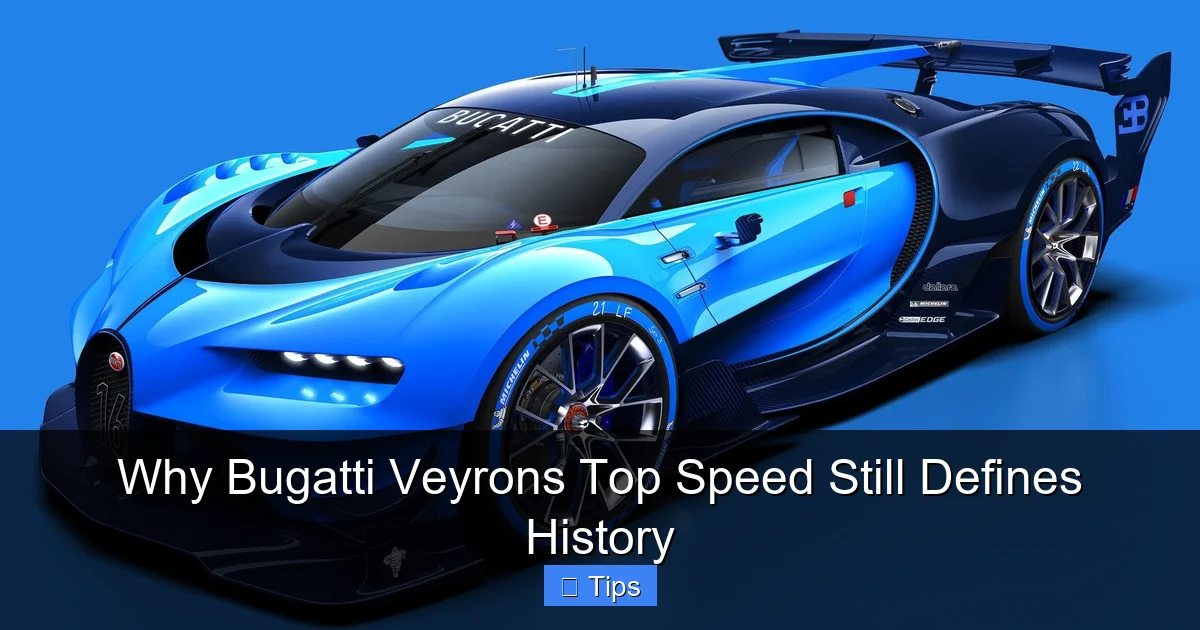
The lessons learned from the development and production of the Bugatti Veyron were invaluable for its successor, the Bugatti Chiron. While the Chiron aimed for even higher levels of power and performance, the foundational engineering principles, the challenges of managing immense heat and aerodynamic forces, and the commitment to luxury and usability were all directly inherited from the Veyron. The Chiron stands as a direct testament to the pioneering work done on the Veyron, demonstrating how one record-breaker can inform and inspire the next generation of excellence in the quest for ultimate top speed.
Economic and Cultural Impact: Beyond the Track
The significance of the Bugatti Veyron’s top speed achievement wasn’t confined to engineering breakthroughs or track records. It had a profound ripple effect on the automotive economy, brand perception, and even popular culture, establishing itself as an iconic status symbol and a cultural touchstone.
Exclusivity and Brand Building
The Bugatti Veyron was never intended to be a mass-market product. Its exorbitant price tag and limited production numbers (450 units) cemented its status as a pinnacle of exclusivity. Its record-breaking top speed achievement was a cornerstone of Bugatti’s strategy to re-establish itself at the very apex of the automotive world, not just in performance but also in luxury and desirability. Owning a Veyron was more than just buying a car; it was buying into a legacy, a statement, and a piece of automotive history. This strategic use of an extreme product to elevate an entire brand is a powerful “tip” for luxury goods manufacturers.
A Collectible Icon: Value and Appreciation
Even years after its production ceased, the Bugatti Veyron remains a highly sought-after collectible. Its historical significance as the first production car to break the 400 km/h barrier, combined with its limited numbers and bespoke craftsmanship, ensures its value appreciates over time. Special editions and pristine examples command prices far exceeding their original sticker price at auction, demonstrating its enduring appeal as an investment piece and a cultural artifact. The Veyron effectively created its own collectible market segment within the hypercar world.
Cultural Reference Point: Pop Culture and Media
The Bugatti Veyron transcended the automotive enthusiast community, permeating popular culture. Its striking design, immense power, and record-setting top speed made it a recurring presence in movies, music videos, video games, and television shows. It became shorthand for ultimate speed, luxury, and technological prowess. This widespread cultural recognition further cemented its legendary status, making it one of the most recognizable and revered cars of the 21st century.
The “Halo Car” Effect
The Bugatti Veyron served as a perfect example of a “halo car” – a flagship vehicle designed to elevate the entire brand and even the parent company. While direct profits from the Veyron itself were reportedly minimal due to its immense development costs, its value to the Volkswagen Group was incalculable. It showcased VW’s engineering capabilities, attracted top talent, and provided an aspirational benchmark that benefited all brands under its umbrella. This “halo effect” is a valuable business “tip” demonstrating how extreme innovation, even if not directly profitable, can yield immense returns in terms of brand prestige and technological advancement across an entire corporate portfolio.
Bugatti Veyron Performance Milestones and Context
To fully appreciate the Bugatti Veyron’s place in automotive history, it’s helpful to look at its core specifications and how its two primary versions defined the top speed benchmark.
| Feature | Bugatti Veyron 16.4 | Bugatti Veyron Super Sport |
|---|---|---|
| Engine | 8.0L Quad-Turbo W16 | 8.0L Quad-Turbo W16 |
| Horsepower | 1,001 PS (987 hp) | 1,200 PS (1,184 hp) |
| Torque | 1,250 Nm (922 lb-ft) | 1,500 Nm (1,106 lb-ft) |
| Top Speed (Record) | 407 km/h (253 mph) | 431 km/h (268 mph) |
| 0-100 km/h (0-62 mph) | 2.5 seconds | 2.5 seconds |
| Production Years | 2005-2011 | 2010-2011 |
| Units Produced | Approximately 300 Coupés | 30 Units |
| Price (approx. new) | $1.7 million | $2.4 million |
This table clearly illustrates the monumental jump in performance between the original Veyron 16.4 and the even more extreme Super Sport. The Super Sport’s ability to achieve an additional 24 km/h (15 mph) required significant engineering revisions, including more powerful turbochargers, larger intercoolers, and a revised aerodynamic package. Each iteration further pushed the boundaries of what was conceivable for a road-legal vehicle, with the Super Sport solidifying the Bugatti Veyron’s top speed record as a seemingly untouchable benchmark for years to come.
Conclusion
The Bugatti Veyron’s top speed is far more than a mere numerical entry in a record book; it represents a defining chapter in automotive history. It was born from an audacious vision, nurtured by unparalleled engineering prowess, and culminated in a moment that shattered both physical and psychological barriers. The Veyron proved that the seemingly impossible could be achieved, combining supercar performance with luxury, drivability, and reliability in a package previously thought to be mutually exclusive.
Its legacy resonates powerfully today, influencing countless hypercars that followed, raising the bar for automotive engineering standards, and forever changing our perception of what a road-legal vehicle can accomplish. The Bugatti Veyron didn’t just chase speed; it redefined the very essence of extreme performance, leaving an indelible mark on engineering, design, and popular culture. It stands as a timeless monument to human ambition, technical ingenuity, and the relentless pursuit of perfection, ensuring that the Bugatti Veyron’s top speed will continue to inspire and define automotive excellence for generations to come.
Frequently Asked Questions
What was the Bugatti Veyron’s top speed record and why was it so groundbreaking?
The original Bugatti Veyron 16.4 set a world record for production cars with a verified top speed of 408.47 km/h (253.81 mph) in 2005. This achievement was groundbreaking because it shattered the 400 km/h barrier, proving such speeds were attainable for a road-legal vehicle and pushing the boundaries of automotive engineering.
How did Bugatti engineers manage to achieve the Veyron’s unprecedented top speed?
Achieving the Bugatti Veyron’s extraordinary top speed required unparalleled engineering innovation. It leveraged a quad-turbocharged 8.0-liter W16 engine generating 1,001 horsepower, combined with highly advanced aerodynamics, a robust cooling system, and specialized components like high-performance tires to handle the extreme forces.
Are there faster cars than the Bugatti Veyron today, and if so, why does its top speed still hold historical significance?
While several hypercars have since surpassed the original Bugatti Veyron’s top speed, its record maintains immense historical significance. It was the first production car to unequivocally break the 400 km/h barrier, establishing a new benchmark and fundamentally reshaping expectations for performance vehicles.
What unique challenges did Bugatti overcome to make the Veyron’s extreme top speed safe and reliable?
Bugatti engineers faced immense challenges, including managing staggering heat generation, developing tires that wouldn’t disintegrate at over 400 km/h, and designing aerodynamic elements for stability. Overcoming these obstacles demonstrated a monumental feat of engineering, making the Veyron’s extreme performance both safe and reliable.
Beyond just the number, what broader impact did the Bugatti Veyron’s top speed achievement have on the automotive industry?
The Bugatti Veyron’s top speed achievement had a profound impact, ushering in a new era of hypercar development and inspiring other manufacturers to push technological limits. It proved that luxury, comfort, and extreme performance could coexist in a road-legal vehicle, thereby raising the bar for the entire automotive industry.
Why is the Bugatti Veyron’s top speed often described as a “defining moment” rather than just another record?
The Bugatti Veyron’s top speed is considered a “defining moment” because it wasn’t merely about setting a numerical record; it represented a paradigm shift. It proved that a car could offer both everyday usability and unprecedented speed, forever changing perceptions of what a production vehicle could achieve and igniting a new quest for ultimate performance.

At CarLegit, we believe information should be clear, factual, and genuinely helpful. That’s why every guide, review, and update on our website is created with care, research, and a strong focus on user experience.