
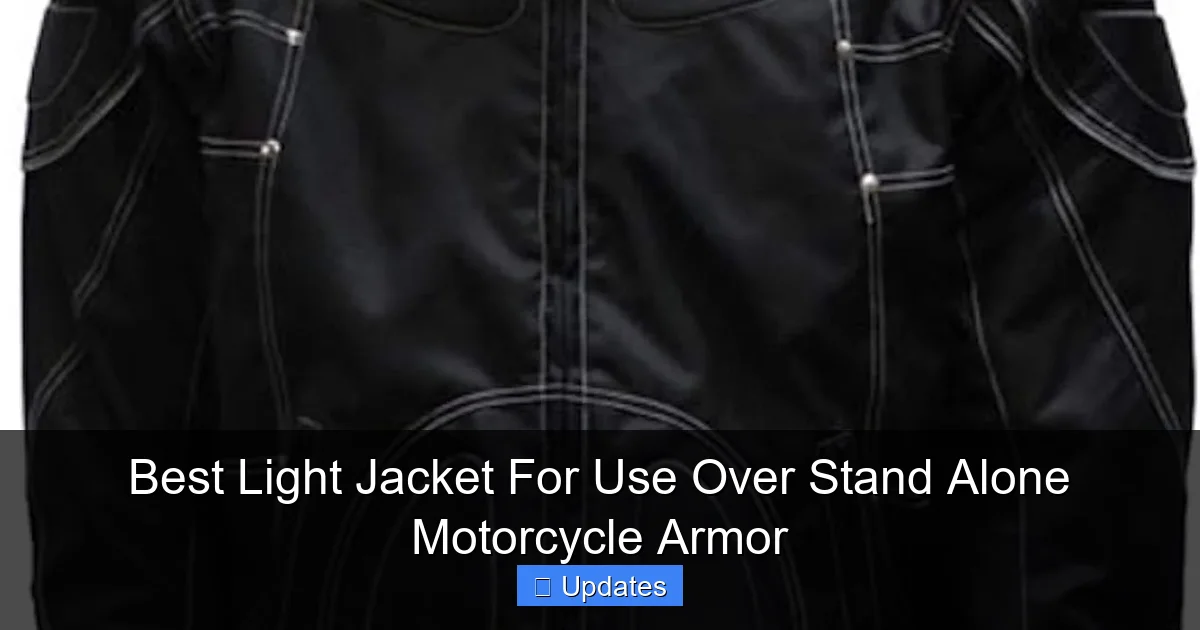
Featured image for Light Jacket For Motorcycle Armor
Image source: m.media-amazon.com
Finding the ideal light jacket to wear over standalone motorcycle armor is crucial, demanding a perfect balance of comfortable fit and superior protection. Prioritize options designed with enough room to accommodate your armor without restricting movement, alongside robust abrasion-resistant materials for critical crash slide protection. Look for adjustable features and effective ventilation to ensure comfort and seamless integration with your safety gear on every ride.
<h1>Best Light Jacket For Use Over Stand Alone Motorcycle Armor</h1>
<p>The rumble of an engine, the open road stretching ahead, the wind rushing past – few experiences rival the freedom of motorcycling. Yet, with this exhilarating freedom comes the inherent responsibility of ensuring your safety. Modern motorcycle gear has evolved dramatically, offering riders unprecedented levels of protection without sacrificing comfort or style. Among the most significant advancements is the rise of <strong>stand-alone motorcycle armor</strong> – specialized protective garments, often worn as a base layer, that provide superior impact protection for your shoulders, elbows, back, and chest.</p>
<p>While <strong>stand-alone armor</strong> excels in impact absorption and often provides fantastic airflow due to its open construction, it lacks a critical component: abrasion resistance. This is where the quest for the <strong>best light jacket for use over stand-alone motorcycle armor</strong> begins. You need an outer shell that complements your internal protection – a jacket that can withstand a slide on asphalt, offer protection from wind and light rain, carry your essentials, and crucially, fit comfortably <em>over</em> your armor without compromising its effectiveness or your mobility. This comprehensive guide will delve deep into the world of over-armor jackets, helping you make an informed decision to stay safe, comfortable, and stylish on every ride.</p>
<h2>Understanding the Appeal of Stand-Alone Motorcycle Armor</h2>
&p>Before we explore the ideal outer layers, let’s briefly underscore why so many riders are opting for <strong>stand-alone motorcycle armor</strong> as their primary form of impact protection. Its popularity is not just a trend; it’s a testament to its effectiveness and adaptability.</p>
<h3>Why Riders Choose Stand-Alone Protection</h3>
&p>Riders often choose <strong>stand-alone armor</strong> for several compelling reasons, which highlight its distinct advantages over traditional armored jackets:</p>
<ul>
<li><strong>Superior Impact Protection:</strong> Many <strong>stand-alone armor</strong> systems, like armored shirts or full body protectors, integrate high-quality CE Level 2 rated armor for critical areas such as the back, shoulders, elbows, and chest. This level of protection often surpasses what’s found in many integrated armored jackets, particularly at certain price points. Because the armor is held close to the body, it’s less likely to shift during an impact.</li>
<li><strong>Enhanced Airflow and Comfort:</strong> One of the biggest draws is the ability to achieve excellent ventilation. <strong>Stand-alone armor</strong> is typically designed with breathable mesh or perforated materials, allowing air to circulate directly against your skin. When paired with a <strong>light jacket for use over stand-alone motorcycle armor</strong> that also prioritizes airflow, this combination offers superior comfort in hot weather compared to traditional heavily armored jackets.</li>
<li><strong>Modularity and Versatility:</strong> This system offers incredible adaptability. You can pair your <strong>stand-alone armor</strong> with various outer layers depending on the weather, riding style, or destination. A <strong>light jacket</strong> for summer, a waterproof shell for rain, or a heavier textile jacket for cooler weather – all while retaining the same core impact protection. This makes it a truly versatile jacket solution.</li>
<li><strong>Under-the-Radar Protection:</strong> For some riders, the ability to wear their protection discreetly under a casual-looking <strong>light jacket</strong>, technical hoodie, or even a denim shirt is a significant advantage, particularly for urban commuting or when stopping at non-motorcycle destinations.</li>
</ul>
<h3>The Gap: Why a Dedicated Over-Armor Jacket is Essential</h3>
&p>Despite its numerous benefits, <strong>stand-alone motorcycle armor</strong> alone is incomplete. It’s designed primarily for impact absorption, not for sliding down the road. This is where the chosen <strong>light jacket</strong> becomes critically important. The outer layer must provide:</p>
<ul>
<li><strong>Abrasion Resistance:</strong> In a slide, it’s the outer layer that takes the brunt of the road. Without sufficient abrasion resistance, even the best impact armor won’t prevent severe skin injuries. This <strong>protective jacket</strong> acts as your second skin.</li>
<li><strong>Weather Protection:</strong> <strong>Stand-alone armor</strong> offers no protection from wind, rain, or cold. A <strong>light jacket for use over stand-alone motorcycle armor</strong> can provide wind-blocking capabilities and, in some cases, water resistance for unexpected showers.</li>
<li><strong>Storage and Functionality:</strong> Pockets for keys, wallet, phone, and other small essentials are often absent on <strong>stand-alone armor</strong>. The outer jacket provides this crucial utility.</li>
<li><strong>Aesthetics:</strong> Let’s face it, riding in just <strong>motorcycle armor</strong> isn’t a universally appealing look. A well-chosen <strong>over armor jacket</strong> completes your riding ensemble, providing style and a more finished appearance.</li>
</ul>
<h2>Key Characteristics of an Ideal Light Jacket for Over-Armor Use</h2>
&p>Selecting the right <strong>light jacket for use over stand-alone motorcycle armor</strong> requires careful consideration of several factors. It’s not just about finding any jacket; it’s about finding one specifically designed to complement and enhance your existing protective system.</p>
<h3>Fit and Sizing: The Paramount Concern</h3>
&p>This is arguably the most critical factor. An <strong>over-armor jacket</strong> needs to accommodate the bulk of your <strong>motorcycle armor</strong> without compressing it or restricting your movement. </p>
<ul>
<li><strong>Room to Move:</strong> The jacket should be loose enough to fit comfortably over your armored shirt or separate pads. Trying it on with your armor is non-negotiable. Look for extra room in the shoulders, chest, and bicep areas.</li>
<li><strong>No Compression:</strong> The armor itself needs space to perform its job effectively. A jacket that’s too tight can compress the armor, potentially reducing its ability to disperse impact energy.</li>
<li><strong>Articulation:</strong> Good <strong>over-armor jackets</strong> often feature articulated sleeves or stretch panels in key areas to ensure a full range of motion while riding, preventing arm pump or discomfort.</li>
<li><strong>Sizing Up:</strong> Often, you’ll need to size up one or even two sizes from your usual street jacket size to achieve the correct fit over <strong>stand-alone motorcycle armor</strong>. Always check manufacturer sizing charts and rider reviews for specific models.</li>
</ul>
<h3>Abrasion Resistance: The Outer Defense</h3>
&p>This <strong>protective jacket</strong> is your primary shield against road rash. Don’t compromise here.</p>
<ul>
<li><strong>Material Matters:</strong> Look for high-denier textiles like Cordura (e.g., 600D, 840D, 1000D), proprietary abrasion-resistant fabrics like Armacor, Superfabric, or advanced blends incorporating Kevlar or Dyneema. These materials offer significantly better slide protection than regular street wear.</li>
<li><strong>Strategic Reinforcement:</strong> Critical impact zones such as the shoulders, elbows, and outer arms should have additional layers of robust material or highly abrasion-resistant panels. Even if the jacket is generally lightweight, these areas need to be tough.</li>
<li><strong>Construction Quality:</strong> Double or triple-stitched seams are essential, as weak seams can fail quickly in a slide.</li>
</ul>
<h3>Airflow and Ventilation: Keeping Cool</h3>
&p>One of the main reasons for choosing <strong>stand-alone armor</strong> is its inherent breathability. Your <strong>light jacket</strong> should complement this, not negate it.</p>
<ul>
<li><strong>Mesh Panels:</strong> Large mesh panels on the chest, back, and inner arms allow for maximum airflow, making it an ideal <strong>airflow jacket</strong> for hot weather.</li>
<li><strong>Zippered Vents:</strong> Strategically placed zippered vents (intake on the front/arms, exhaust on the back) allow you to control airflow. This is especially useful for varying temperatures.</li>
<li><strong>”Flow-Through” Design:</strong> Some jackets are designed with a loose enough fit and material to allow air to pass directly over the armor, enhancing cooling.</li>
</ul>
<h3>Weather Resistance: Unexpected Showers</h3>
&p>While a <strong>light jacket</strong> won’t offer full waterproof protection like a dedicated rain suit, some level of water resistance is a significant bonus.</p>
<ul>
<li><strong>DWR Coating:</strong> A Durable Water Repellent (DWR) coating will cause light rain to bead up and roll off, keeping you drier in brief showers.</li>
<li><strong>Packable Rain Layer Compatibility:</strong> The best <strong>light jacket for use over stand-alone motorcycle armor</strong> often works well with a thin, packable waterproof shell worn over it when heavy rain is expected.</li>
</ul>
<h3>Functionality and Features</h3>
&p>Practicality on the road cannot be overlooked.</p>
<ul>
<li><strong>Pockets:</strong> Multiple pockets – internal, external, and ideally one or two waterproof pockets – are essential for carrying your essentials securely.</li>
<li><strong>Adjustability:</strong> Cuffs, waist, and collar adjusters (Velcro, snaps, or drawstrings) help fine-tune the fit, especially important over bulky armor, preventing flapping at speed.</li>
<li><strong>Reflective Elements:</strong> Integrated reflective piping or panels significantly enhance your visibility to other road users, especially in low-light conditions. This is a crucial safety feature for any <strong>motorcycle jacket</strong>.</li>
<li><strong>Collar Design:</strong> A comfortable collar that doesn’t chafe or flap, especially important when wearing a helmet, makes a big difference on long rides.</li>
</ul>
<h2>Types of Light Jackets Best Suited for Over-Armor Applications</h2>
&p>The market offers several categories of <strong>light jackets</strong> that can excel as an <strong>over-armor jacket</strong>, each with its own strengths.</p>
<h3>Mesh/Textile Jackets (Unarmored Shells)</h3<
&p>These are perhaps the most common and obvious choice for hot weather riding over <strong>stand-alone motorcycle armor</strong>.</p>
<ul>
<li><strong>Pros:</strong> Unparalleled airflow, extremely lightweight, often highly affordable. Designed to be motorcycle-specific. Excellent <strong>airflow jacket</strong> capability.</li>
<li><strong>Cons:</strong> Limited weather resistance (primarily for wind), abrasion resistance can vary (look for high-quality mesh and reinforced impact zones).</li>
<li><strong>Ideal for:</strong> Hot weather street riding, urban commuting, casual touring where maximum ventilation is key. These are often labeled as “mesh jackets” or “air jackets” and are perfect for an <strong>over-armor jacket</strong>.</li>
</ul>
<h3>Adventure/Dual-Sport Jackets (Shell Only)</h3>
&p>These jackets are designed for the rigors of adventure riding, often intended to be worn with layering.</p>
<ul>
<li><strong>Pros:</strong> Extremely durable materials (often high-denier Cordura), numerous large vents for adaptable airflow, ample pockets, and often some level of DWR or water resistance. Built for versatility and rough use, making them an excellent <strong>protective jacket</strong>.</li>
<li><strong>Cons:</strong> Can be bulkier and heavier than pure mesh jackets, sometimes more expensive. May offer more features than needed for purely street use.</li>
<li><strong>Ideal for:</strong> Off-road riding, long-distance touring with variable conditions, riders who need ruggedness and extensive storage. Their design for layering makes them a natural fit as an <strong>over armor jacket</strong>.</li>
</ul>
<h3>Technical Abrasion-Resistant Hoodies/Overshirts</h3>
&p>These are a growing category, offering a casual look with serious protection.</p>
<ul>
<li><strong>Pros:</strong> Casual, comfortable, and discreet aesthetics that blend in off the bike. Often made with innovative abrasion-resistant materials like Kevlar or Dyneema blended fabrics. Many are designed with a generous fit specifically to be worn as an <strong>over-armor jacket</strong> or <strong>motorcycle jacket</strong> shell.</li>
<li><strong>Cons:</strong> Airflow varies greatly by model and material; some can be quite warm. Limited weather protection. Pockets might be fewer than on dedicated textile jackets.</li>
<li><strong>Ideal for:</strong> Urban commuting, short rides, riders who prioritize a casual look without compromising on abrasion resistance. This is an excellent <strong>protective jacket</strong> for street riders.</li>
</ul>
<h3>High-Performance Technical Rain Shells/Windbreakers (Motorcycle Specific)</h3>
&p>While not a primary abrasion layer, some heavy-duty rain shells designed for motorcycling can work in a pinch or as an additional layer for weather protection.</p>
<ul>
<li><strong>Pros:</strong> Extremely lightweight, packable, and offer excellent wind and rain protection. Can be worn over your primary <strong>light jacket</strong> if it lacks weatherproofing.</li>
<li><strong>Cons:</strong> Most general rain shells lack significant abrasion resistance. You need to seek out motorcycle-specific ones that offer some durability. Not typically a standalone <strong>protective jacket</strong> for abrasion.</li>
<li><strong>Ideal for:</strong> Emergency rain protection, supplementing an already abrasion-resistant <strong>light jacket</strong>.</li>
</ul>
<h2>Top Brands and Models to Consider</h2>
&p>Several manufacturers have recognized the demand for effective <strong>light jackets for use over stand-alone motorcycle armor</strong> and offer excellent solutions. Here are some of the standout brands and models that frequently receive high praise from riders.</p>
<h3>Klim</h3>
&p>Known for its dedication to adventure and off-road riding, Klim produces gear that is robust, well-ventilated, and designed for serious protection and layering.</p>
<ul>
<li><strong>Klim Marrakesh Jacket:</strong> This is a standout. It’s constructed from a proprietary Karbonite™ Micromesh Cordura fabric that offers exceptional abrasion resistance, incredible airflow, and a comfortable stretch fit. It’s often recommended as an ideal <strong>over-armor jacket</strong> due to its stretch and breathability.</li>
<li><strong>Klim Induction Jacket:</strong> Another popular choice, the Induction offers even more airflow with larger mesh panels. It’s a true <strong>airflow jacket</strong> and a superb option for very hot climates, providing excellent abrasion protection for a <strong>light jacket</strong>.</li>
<li><strong>Klim Baja S4/Dakar Jackets:</strong> These are more rugged adventure shells, often unarmored, and built to withstand abuse. They offer great ventilation and durability, making them suitable <strong>over armor jacket</strong> choices for dual-sport or off-road riders.</li>
</ul>
<h3>Revit</h3>
&p>Revit combines European styling with advanced textile technology, offering versatile jackets that perform well.</p>
<ul>
<li><strong>Revit Eclipse Jacket:</strong> A classic mesh <strong>motorcycle jacket</strong> that comes unarmored (or with very basic armor which can be removed). It’s designed for maximum airflow and would be an excellent <strong>over armor jacket</strong> for hot weather.</li>
<li><strong>Revit Mantis/Ignition Series:</strong> While often coming with integrated armor, some Revit jackets (especially in their touring or adventure lines) have designs that can accommodate an armored undershirt if you size up. Look for their “Air” models that prioritize ventilation for an ideal <strong>airflow jacket</strong>.</li>
</ul>
<h3>Alpinestars/Dainese</h3>
&p>These Italian giants offer a wide range of <strong>motorcycle jackets</strong>, including many unarmored or lightly armored mesh shells perfect for <strong>over-armor</strong> use.</p>
<ul>
<li><strong>Alpinestars Air Series Jackets:</strong> Models like the T-GP Plus R v3 Air or T-Faster Air are mesh-heavy textile jackets that are often designed with a performance fit that can work over <strong>stand-alone armor</strong> if sized correctly. They provide great airflow and adequate abrasion resistance for street riding.</li>
<li><strong>Dainese Air Frame D1 Jacket:</strong> Similar to Alpinestars, Dainese offers a popular mesh <strong>protective jacket</strong>. While it often comes with light armor, it can be removed for <strong>over-armor</strong> layering, providing a stylish and high-airflow shell.</li>
</ul>
<h3>Icon</h3>
&p>Icon is known for its aggressive styling and urban-focused gear, often with a unique take on protection.</p>
<ul>
<li><strong>Icon Airform Series:</strong> Many of Icon’s mesh jackets, especially the Airform series, are designed to be quite roomy and can work well as an <strong>over armor jacket</strong>. They prioritize airflow and provide a distinct aesthetic.</li>
</ul>
<h3>Other Notable Mentions</h3>
<ul>
<li><strong>Mosko Moto Basilisk Jacket:</strong> A premium adventure shell designed from the ground up to be worn over <strong>stand-alone armor</strong>. It’s packed with features, highly durable, and excellent for all conditions.</li>
<li><strong>Pando Moto/Rokker (Technical Overshirts/Denim Jackets):</strong> These brands offer stylish, highly abrasion-resistant textile or denim “overshirts” or jackets made with materials like Dyneema or Cordura that are unarmored but designed as an <strong>over armor jacket</strong>. They excel in casual aesthetics and offer good <strong>protective jacket</strong> qualities.</li>
</ul>
<h2>Practical Tips for Choosing and Using Your Over-Armor Light Jacket</h2>
&p>Making the right choice for your <strong>light jacket for use over stand-alone motorcycle armor</strong> involves more than just picking a brand. Here are some actionable tips to ensure you get the perfect fit and functionality.</p>
<h3>Sizing is Key: Try Before You Buy (or Measure Meticulously)</h3>
&p>We can’t stress this enough. The biggest mistake riders make is buying a jacket without trying it on <em>over their actual <strong>stand-alone armor</strong></em>.</p>
<ul>
<li><strong>Wear Your Armor:</strong> When trying on jackets, always wear your armored base layer. This is the only way to accurately assess fit.</li>
<li><strong>Measure Yourself (with armor):</strong> If buying online, take your chest, waist, and sleeve measurements while wearing your armor. Compare these to the manufacturer’s sizing chart. Don’t rely on your usual street clothing size.</li>
<li><strong>Simulate Riding Position:</strong> Sit on your motorcycle (or mimic the riding posture) while wearing the jacket and armor. Check for binding, discomfort, or excessive bunching around the neck, shoulders, and elbows. Ensure you have full range of motion for controls.</li>
<li><strong>Check Sleeve Length:</strong> Ensure sleeves are long enough to cover your wrists in a riding position. This is crucial for seamless glove integration and preventing skin exposure.</li>
</ul>
<h3>Consider Your Riding Environment</h3>
&p>Your typical riding conditions should heavily influence your choice of <strong>light jacket</strong>.</p>
<ul>
<li><strong>Hot Weather/Urban:</strong> Prioritize maximum airflow with a mesh <strong>motorcycle jacket</strong> or a highly breathable technical overshirt. Abrasion resistance is still vital, so don’t opt for just any mesh.</li>
<li><strong>Variable Weather/Touring:</strong> An adventure-style shell with robust construction, multiple vents, and a DWR coating will offer the best <strong>versatile jacket</strong> solution. Carry a separate packable rain layer for heavy downpours.</li>
<li><strong>Cooler Weather:</strong> While the focus is on a <strong>light jacket</strong>, consider one with room for a thermal mid-layer underneath your <strong>stand-alone armor</strong> for added warmth if you frequently ride in cooler temps.</li>
</ul>
<h3>Don’t Compromise on Abrasion Resistance</h3>
&p>Remember, the <strong>light jacket</strong> is your primary line of defense against road rash. While <strong>stand-alone armor</strong> handles impacts, the jacket handles the slide. Invest in quality materials and construction. Look for jackets with good CE EN 17092 ratings for the garment itself, even if it’s an unarmored shell, as this indicates its overall protective performance. This is essential for a true <strong>protective jacket</strong>.</p>
<h3>Layering Strategy for Versatility</h3>
&p>The beauty of <strong>stand-alone motorcycle armor</strong> is its adaptability. Plan your entire layering system:</p>
<ul>
<li><strong>Base Layer:</strong> Moisture-wicking material directly against your skin.</li>
<li><strong>Armor Layer:</strong> Your <strong>stand-alone motorcycle armor</strong>.</li>
<li><strong>Mid-Layer (Optional):</strong> A fleece or technical mid-layer for warmth, if needed.</li>
<li><strong>Outer Layer:</strong> Your chosen <strong>light jacket for use over stand-alone motorcycle armor</strong>.</li>
<li><strong>Rain Layer (Optional):</strong> A packable waterproof shell over everything for heavy rain.</li>
</ul>
&p>This systematic approach ensures you’re prepared for any weather condition without sacrificing protection.</p>
<h3>Maintenance and Care</h3>
&p>Proper care extends the life and performance of your <strong>protective gear</strong>. Follow manufacturer instructions for cleaning. Reapply DWR coatings periodically to maintain water resistance.</p>
<h2>Comparative Features of Over-Armor Light Jackets</h2>
&p>To further assist your decision-making, here’s a comparative overview of the primary features you can expect from different types of <strong>light jackets</strong> suitable for wearing <strong>over stand-alone motorcycle armor</strong>.</p>
<table border=”1″ style=”width:100%; border-collapse: collapse; margin-top: 20px; margin-bottom: 20px;”>
<thead>
<tr>
<th style=”padding: 10px; border: 1px solid #ddd; background-color: #f2f2f2; text-align: left;”><strong>Feature Category</strong></th>
<th style=”padding: 10px; border: 1px solid #ddd; background-color: #f2f2f2; text-align: left;”><strong>Mesh/Light Textile Jacket</strong></th>
<th style=”padding: 10px; border: 1px solid #ddd; background-color: #f2f2f2; text-align: left;”><strong>Adventure/Dual-Sport Shell</strong></th>
<th style=”padding: 10px; border: 1px solid #ddd; background-color: #f2f2f2; text-align: left;”><strong>Technical Abrasion-Resistant Hoodie/Shirt</strong></th>
</tr>
</thead>
<tbody>
<tr>
<td style=”padding: 8px; border: 1px solid #ddd;”><strong>Primary Benefit</strong></td>
<td style=”padding: 8px; border: 1px solid #ddd;”>Maximum Airflow, Lightweight</td>
<td style=”padding: 8px; border: 1px solid #ddd;”>Versatility, Durability, Pockets</td>
<td style=”padding: 8px; border: 1px solid #ddd;”>Casual Aesthetics, Comfort</td>
</tr>
<tr>
<td style=”padding: 8px; border: 1px solid #ddd;”><strong>Abrasion Resistance</strong></td>
<td style=”padding: 8px; border: 1px solid #ddd;”>Moderate (e.g., 600D textile, proprietary mesh)</td>
<td style=”padding: 8px; border: 1px solid #ddd;”>High (e.g., Cordura 840D+, Superfabric, Armacor)</td>
<td style=”padding: 8px; border: 1px solid #ddd;”>Variable (e.g., Kevlar, Dyneema blends, Cordura)</td>
</tr>
<tr>
<td style=”padding: 8px; border: 1px solid #ddd;”><strong>Airflow/Ventilation</strong></td>
<td style=”padding: 8px; border: 1px solid #ddd;”>Excellent (full mesh panels, optimal <strong>airflow jacket</strong>)</td>
<td style=”padding: 8px; border: 1px solid #ddd;”>Good (large zippered vents, sometimes mesh)</td>
<td style=”padding: 8px; border: 1px solid #ddd;”>Moderate to Good (depending on material/design)</td>
</tr>
<tr>
<td style=”padding: 8px; border: 1px solid #ddd;”><strong>Weather Resistance</strong></td>
<td style=”padding: 8px; border: 1px solid #ddd;”>Minimal (wind barrier only, no rain)</td>
<td style=”padding: 8px; border: 1px solid #ddd;”>Good (DWR, some are waterproof/resistant)</td>
<td style=”padding: 8px; border: 1px solid #ddd;”>Minimal to Moderate (DWR possible)</td>
</tr>
<tr>
<td style=”padding: 8px; border: 1px solid #ddd;”><strong>Fit Over Armor</strong></td>
<td style=”padding: 8px; border: 1px solid #ddd;”>Often generous, designed for layering</td>
<td style=”padding: 8px; border: 1px solid #ddd;”>Designed for layering, adjustable</td>
<td style=”padding: 8px; border: 1px solid #ddd;”>Often stretchy, specific over-armor sizing</td>
</tr>
<tr>
<td style=”padding: 8px; border: 1px solid #ddd;”><strong>Typical Use Case</strong></td>
<td style=”padding: 8px; border: 1px solid #ddd;”>Hot weather street, light touring, excellent <strong>over armor jacket</strong></td>
<td style=”padding: 8px; border: 1px solid #ddd;”>Adventure riding, touring, varied conditions, <strong>versatile jacket</strong></td>
<td style=”padding: 8px; border: 1px solid #ddd;”>Urban commuting, casual rides, street, stylish <strong>protective jacket</strong></td>
</tr>
</tbody>
</table>
<h2>Conclusion</h2>
<p>Choosing the <strong>best light jacket for use over stand-alone motorcycle armor</strong> is a decision that significantly impacts your safety, comfort, and overall enjoyment of motorcycling. By combining the superior impact protection and airflow of <strong>stand-alone armor</strong> with a high-quality, abrasion-resistant outer shell, you create a highly effective and adaptable <strong>protective gear</strong> system.</p>
<p>Remember to prioritize fit above all else, ensuring your chosen <strong>over-armor jacket</strong> accommodates your <strong>motorcycle armor</strong> without restriction. Look for robust abrasion-resistant materials, effective ventilation, and practical features that enhance your riding experience. Whether you opt for a dedicated mesh <strong>airflow jacket</strong> for scorching summers, a rugged adventure shell for diverse terrain, or a technical abrasion-resistant hoodie for urban adventures, the right <strong>light jacket</strong> completes your protective ensemble.</p>
<p>Investing wisely in your <strong>protective jacket</strong> means investing in your peace of mind on two wheels. Ride safe, ride smart, and enjoy the journey with the confidence that you’re well-protected against whatever the road throws your way.</p&
In This Article
- 1 Key Takeaways
- 2 Frequently Asked Questions
- 2.1 Why should I consider a light jacket for use over stand-alone motorcycle armor?
- 2.2 What key features should I look for in the best light jacket for use over stand-alone motorcycle armor?
- 2.3 How should a light jacket fit when worn over stand-alone motorcycle armor?
- 2.4 What are the best materials for a light jacket designed to be worn over motorcycle armor?
- 2.5 Is ventilation important for a light jacket worn over stand-alone motorcycle armor, especially in warmer weather?
- 2.6 Does a light jacket add significant protection when worn over stand-alone motorcycle armor?
Key Takeaways
- Prioritize proper fit: Ensure the jacket comfortably layers over your armor.
- Seek weather protection: Choose windproof, water-resistant fabrics for versatility.
- Opt for generous sizing: Avoid restricting armor movement or ventilation.
- Look for ample ventilation: Crucial for comfort over protective gear.
- Consider zippered pockets: Essential for securing items while riding.
- Evaluate durability and abrasion: The outer shell still needs to be robust.
- Prioritize flexibility and mobility: Don’t let the jacket hinder your movement.
Frequently Asked Questions
Why should I consider a light jacket for use over stand-alone motorcycle armor?
A light jacket provides an essential layer of abrasion resistance, which stand-alone armor typically lacks. It also helps keep your armor securely in place during a ride and offers a more complete, stylish look over your protective gear.
What key features should I look for in the best light jacket for use over stand-alone motorcycle armor?
Prioritize abrasion-resistant materials like high-denier textiles, adjustable cuffs and waist for a custom fit over armor, and excellent ventilation for comfort. Look for jackets specifically designed with a roomier cut to accommodate the bulk of under-armor.
How should a light jacket fit when worn over stand-alone motorcycle armor?
The light jacket should fit snugly but not restrictively over your stand-alone armor, allowing for a full range of motion without compressing the armor. Ensure there’s no excessive flapping at speed, and that all armor pieces remain correctly positioned.
What are the best materials for a light jacket designed to be worn over motorcycle armor?
Optimal materials include high-denier textile fabrics like Cordura for abrasion resistance, often combined with mesh panels for airflow and stretch materials in key areas for flexibility. This blend ensures both protection and comfort when worn over robust armor.
Is ventilation important for a light jacket worn over stand-alone motorcycle armor, especially in warmer weather?
Absolutely, ventilation is crucial for a light jacket used over stand-alone motorcycle armor. The additional layers can quickly lead to overheating, so look for jackets with large mesh panels, zippered vents, or breathable fabrics to maximize airflow and comfort.
Does a light jacket add significant protection when worn over stand-alone motorcycle armor?
Yes, a light jacket significantly enhances protection by providing a critical layer of abrasion resistance against road rash in a slide. While your stand-alone armor handles impact protection, the jacket ensures your skin is shielded from friction and tearing.

At CarLegit, we believe information should be clear, factual, and genuinely helpful. That’s why every guide, review, and update on our website is created with care, research, and a strong focus on user experience.