
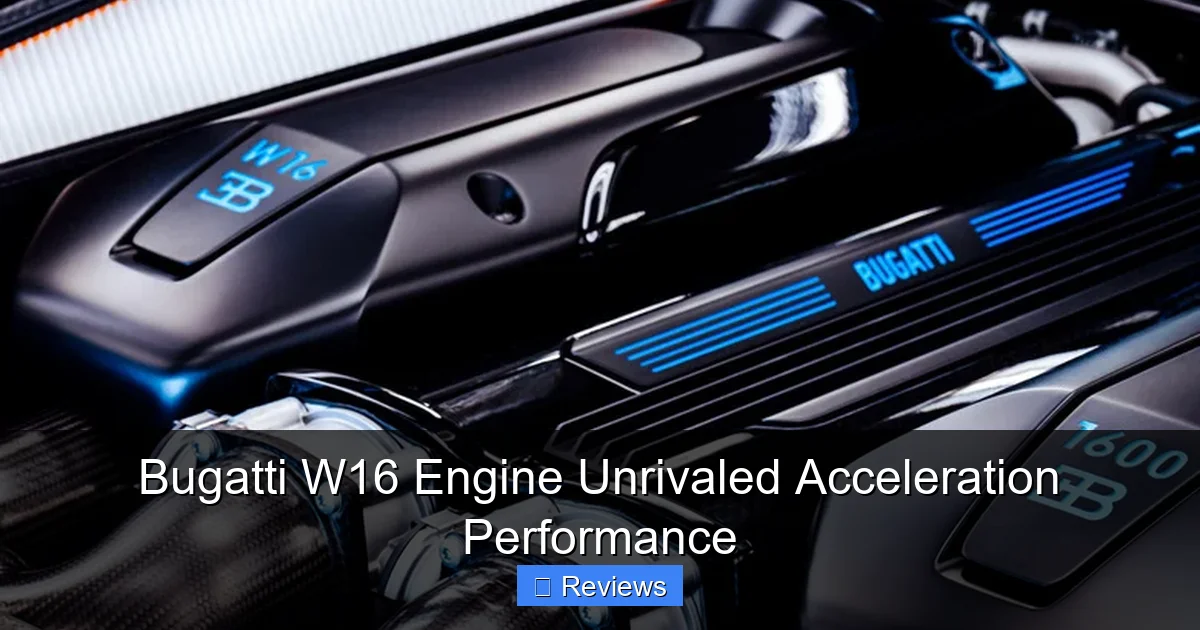
Featured image for what bugattis w16 engine achieves in terms of acceleration performance
Image source: slashgear.com
The Bugatti W16 engine sets an unparalleled benchmark for acceleration, delivering mind-bending speed that redefines hypercar performance. This engineering marvel rockets its vehicles to blistering speeds in mere seconds, showcasing an extraordinary fusion of power and precision. Its astonishing capability solidifies Bugatti’s position at the pinnacle of automotive engineering, leaving competitors in its dust.
In the rarefied atmosphere of automotive excellence, where engineering borders on artistry and performance transcends mere statistics, one name stands synonymous with the pinnacle of speed and luxury: Bugatti. For decades, this legendary marque has captivated enthusiasts with its relentless pursuit of pushing the boundaries of what a road car can achieve. At the very heart of its most recent era of dominance lies a monumental powertrain, an engineering marvel that has redefined the very concept of velocity: the Bugatti W16 engine.
This isn’t just an engine; it’s a statement, a declaration of intent, and a symphony of mechanical prowess. It’s a testament to human ingenuity, a quad-turbocharged beast that generates power figures once thought impossible for a production vehicle. When we talk about the Bugatti W16 engine, we are not just discussing horsepower and torque; we are delving into a world where physics is challenged, where G-forces become an intimate companion, and where the sensation of speed is amplified to an almost unbelievable degree. Its contribution to acceleration performance is not merely significant; it is truly unrivalled.
From the instantaneous surge of thrust that pins you to the seat to the relentless climb towards speeds previously reserved for aircraft, the Bugatti W16 engine has fundamentally reshaped our understanding of hypercar capabilities. This deep dive will explore the intricate mechanisms, the design philosophies, and the sheer audacity behind Bugatti’s W16 engine, dissecting precisely what it achieves in terms of acceleration performance and why it remains an iconic benchmark in automotive history.
In This Article
- 1 Key Takeaways
- 2 The Engineering Marvel Behind the W16: A Powerhouse Unveiled
- 3 Decoding Bugatti’s Launch Dynamics: The Art of Instantaneous Speed
- 4 Beyond Straight-Line Speed: The Full Spectrum of Acceleration
- 5 Specific Bugatti Models and Their Acceleration Milestones
- 6 Challenges and Innovations in Achieving Extreme Acceleration
- 7 The Future of Bugatti Acceleration and the W16’s Legacy
- 8 Bugatti W16 Acceleration Performance Milestones (Selected Models)
- 9 Conclusion
- 10 Frequently Asked Questions
- 10.1 How quickly can a Bugatti W16 engine-powered car accelerate from 0 to 60 mph?
- 10.2 What are the key 0-124 mph (0-200 km/h) acceleration figures for a Bugatti W16 engine?
- 10.3 How does the Bugatti W16 engine achieve its extraordinary acceleration performance?
- 10.4 Is the acceleration performance of the Bugatti W16 engine considered unrivaled among production cars?
- 10.5 What kind of technology contributes to the Bugatti W16 engine’s rapid acceleration capabilities?
- 10.6 Does the Bugatti W16 engine’s incredible acceleration also contribute to its record-breaking top speeds?
Key Takeaways
- Achieves blistering speeds: Reaches hypercar velocity in record time.
- Delivers immediate thrust: Experience instant, overwhelming power from standstill.
- Redefines acceleration benchmarks: Sets new standards for rapid supercar sprints.
- Maintains relentless pull: Sustains immense power delivery through gear changes.
- Propels beyond 250 mph: Powers Bugattis to unimaginable speeds with ease.
- Masterpiece of engineering: Unlocks unparalleled straight-line performance dominance.
- Outpaces all rivals: Claims world’s fastest production car titles consistently.
The Engineering Marvel Behind the W16: A Powerhouse Unveiled
The genesis of the Bugatti W16 engine is a story of ambition and uncompromising vision. Conceived by Ferdinand Piëch, the then-chairman of the Volkswagen Group, the idea was to create a car that was truly without peer, a machine that could effortlessly exceed 400 km/h (250 mph) while remaining luxurious and usable. To achieve such a feat, an engine of unprecedented power and sophistication was required. What emerged was not merely an engine, but a legend in the making: the 8.0-liter W16.
Origins and Evolution of a Powerhouse
The concept for the W16 engine traces its roots back to the Volkswagen Group’s modular engine architecture. Instead of simply doubling a V8, Bugatti engineers opted for a “W” configuration – essentially two narrow-angle V8 engines joined at a common crankshaft. This compact yet complex design allowed for a massive displacement and an extraordinary cylinder count within a relatively manageable footprint. The initial iteration, powering the Veyron 16.4, was already a behemoth, but successive developments for the Chiron and its derivatives have only refined its output and efficiency, pushing the boundaries of acceleration performance even further.
The Core Technical Specifications
The technical specifications of the Bugatti W16 engine are nothing short of astounding. At its heart lies an 8.0-liter displacement, meticulously crafted from lightweight yet incredibly strong materials. The engine features 16 cylinders arranged in a “W” formation, fed by no fewer than four turbochargers. For the Veyron, this configuration yielded approximately 1,001 metric horsepower (987 bhp). With the advent of the Chiron, Bugatti engineers pushed this figure to a staggering 1,500 PS (1,479 bhp), and even further to 1,600 PS (1,578 bhp) in models like the Chiron Super Sport 300+ and the Mistral. Torque figures are equally monumental, typically ranging from 1,250 Nm (922 lb-ft) to 1,600 Nm (1,180 lb-ft), available from remarkably low RPMs.
Raw Power Delivery Mechanism
The magic of the Bugatti W16 engine’s acceleration performance lies not just in its peak power, but in how that power is delivered. The quad-turbocharger setup is crucial here. While large turbos typically suffer from significant “turbo lag,” Bugatti employs a two-stage turbocharging system. At lower RPMs, smaller turbos spool up quickly to provide immediate boost and minimise lag, ensuring that the colossal torque is available almost instantaneously. As the engine revs higher, larger turbos take over, providing a relentless, continuous surge of power that propels the car forward with astonishing force. This seamless transition and immense, broad power band are fundamental to the W16’s unrivaled acceleration capabilities.
Decoding Bugatti’s Launch Dynamics: The Art of Instantaneous Speed
While the sheer horsepower of the Bugatti W16 engine is impressive, translating that power into usable, brutal acceleration performance requires an intricate symphony of advanced technologies. Launching a Bugatti is not merely about flooring the accelerator; it’s a sophisticated dance between power, traction, and control that culminates in a truly breathtaking experience.
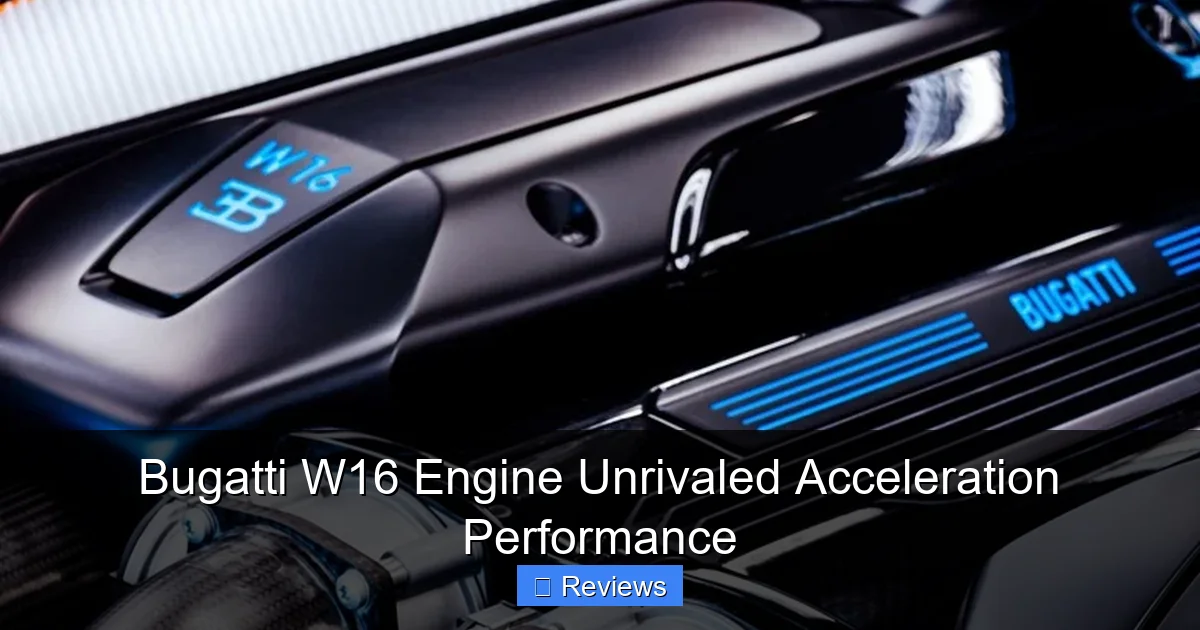
Visual guide about what bugattis w16 engine achieves in terms of acceleration performance
Image source: slashgear.com
The Science of Instantaneous Thrust
What does it mean for a Bugatti to accelerate? It means achieving 0 to 60 mph (97 km/h) in well under 2.5 seconds, 0 to 100 mph (160 km/h) in around 4 seconds, and breaking the 0 to 186 mph (300 km/h) barrier in less than 14 seconds. These figures are not just benchmarks; they are a testament to the instantaneous thrust capability of the W16 engine. The sheer volume of air and fuel ignited and expelled through the exhaust system creates an explosive force that is meticulously managed to translate directly into forward motion, virtually eliminating any wasted energy.
All-Wheel Drive and Traction Management
With 1,500+ horsepower on tap, managing traction is paramount. Bugatti employs a sophisticated permanent all-wheel-drive system that distributes power to all four wheels, ensuring maximum grip during intense acceleration. This system is far more advanced than a simple 50/50 split; it constantly monitors wheel slip, engine speed, and driver input, intelligently adjusting power distribution to each wheel in milliseconds. This dynamic torque vectoring ensures that every ounce of the W16 engine’s power contributes to forward momentum, preventing wheelspin and maintaining stability even under the most extreme g-forces. The specialized Michelin tires, often developed specifically for Bugatti, also play a crucial role, providing an enormous contact patch and compound designed to withstand the immense forces generated during launch and high-speed driving.
The Art of Launch Control
For mere mortals to achieve the published acceleration times, Bugatti vehicles are equipped with an incredibly sophisticated launch control system. This system is not just a button; it’s a highly tuned program that optimises every parameter for the perfect start. When activated, the system precisely modulates engine RPM, turbo boost, and clutch engagement (via the 7-speed dual-clutch transmission), while the all-wheel-drive system manages traction. The driver’s role is simplified to holding the brake, selecting “Launch Control” mode, mashing the accelerator to the floor, and then releasing the brake. The car does the rest, catapulting forward with a ferocity that is both exhilarating and somewhat unnerving. This automated precision ensures that the Bugatti W16 engine delivers its optimal acceleration performance, every single time.
Beyond Straight-Line Speed: The Full Spectrum of Acceleration
While Bugatti is renowned for its mind-bending 0-60 mph times, the true brilliance of the W16 engine’s acceleration performance extends far beyond just initial launches. It’s about a continuous, relentless surge of power that maintains its intensity even at stratospheric speeds, defining a new standard for hypercar capability across the entire velocity spectrum.
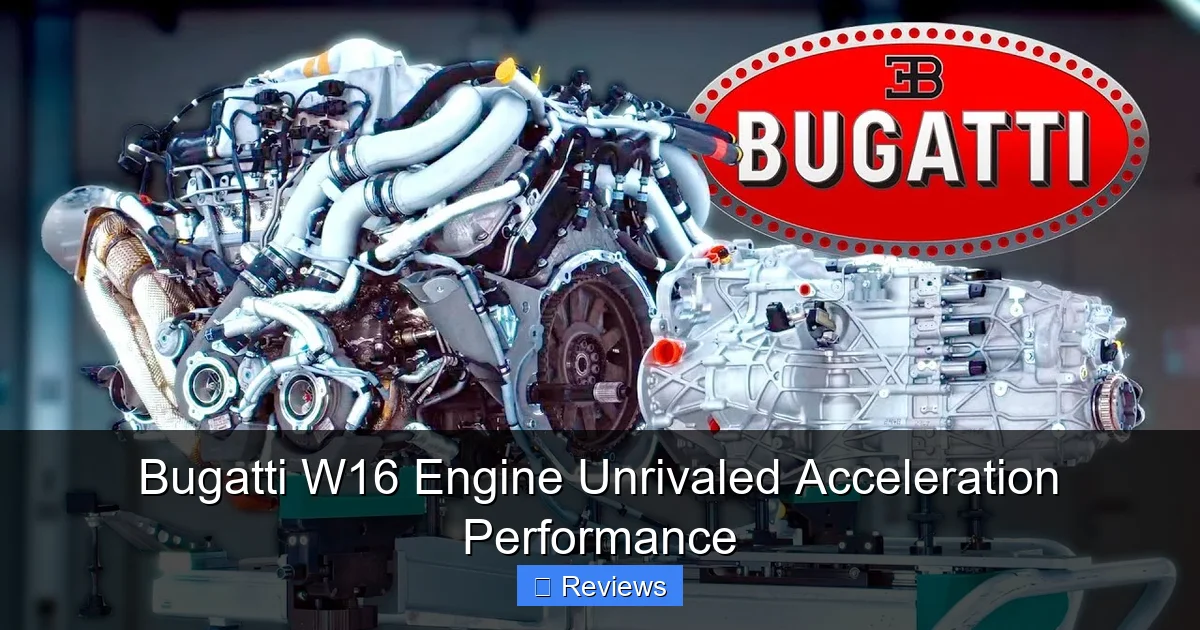
Visual guide about what bugattis w16 engine achieves in terms of acceleration performance
Image source: engineerine.com
Mid-Range Punch and Overtaking Prowess
Where many powerful cars might start to run out of breath as speeds climb, the Bugatti W16 engine merely hits its stride. The phenomenal torque, available from relatively low RPMs and sustained throughout the rev range, means that mid-range acceleration is equally devastating. Imagine cruising at 60 mph (100 km/h) and deciding to overtake; a gentle flex of the right foot transforms the Bugatti into a projectile, rocketing from 60 to 120 mph (100 to 200 km/h) in a matter of seconds. This incredible elasticity and responsiveness ensure that overtakes are not just quick, but instantaneous and utterly effortless, underscoring the W16 engine’s complete command over the road.
Sustained Power Delivery at Hyper Speeds
One of the most defining characteristics of the Bugatti W16 engine is its ability to deliver sustained, monumental acceleration even as speeds approach and exceed 200 mph (320 km/h). This is where the quad-turbo setup truly shines, maintaining maximum boost and power output long after most other engines would begin to struggle against aerodynamic drag. The result is a sensation of endless acceleration; the car doesn’t just reach high speeds, it devours the distance to get there with an unwavering force. The feeling of being pinned to your seat continues well into the triple digits, a testament to the W16 engine’s relentless character and its dedication to uncompromising acceleration performance.
Aerodynamic Synergy with Power
To achieve these incredible feats of sustained acceleration, the Bugatti W16 engine works in perfect harmony with the car’s advanced aerodynamics. As speed increases, so does aerodynamic drag, requiring exponential increases in power to maintain acceleration. Bugatti’s active aerodynamics, including adjustable rear wings and diffusers, constantly adapt to provide optimal downforce for stability while minimising drag to allow the W16 engine to push the car to its absolute limits. This symbiotic relationship ensures that the raw power generated by the Bugatti W16 engine is translated into effective forward motion, rather than being wasted battling air resistance. It’s a holistic approach to speed, where every component plays a critical role in achieving superior acceleration performance.
Specific Bugatti Models and Their Acceleration Milestones
The Bugatti W16 engine has powered a lineage of hypercars, each pushing the boundaries of acceleration performance further than the last. From the revolutionary Veyron to the record-shattering Chiron and the track-focused Bolide, each model serves as a testament to the W16’s evolving capabilities.
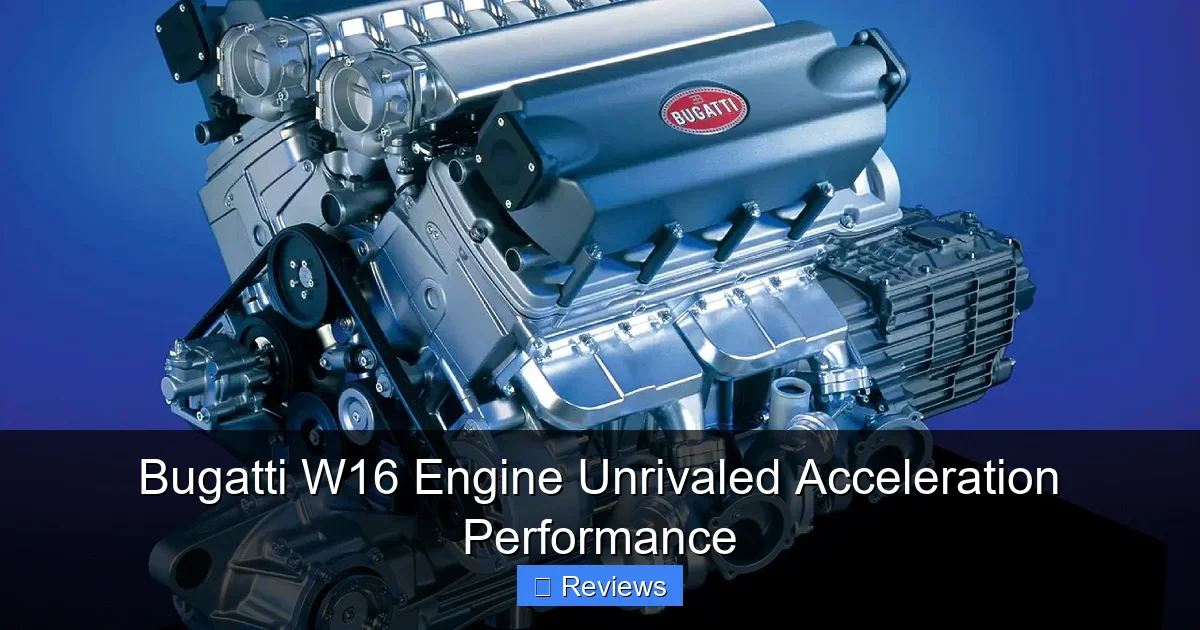
Visual guide about what bugattis w16 engine achieves in terms of acceleration performance
Image source: sxdrv.com
The Veyron’s Groundbreaking Legacy
The Bugatti Veyron 16.4, launched in 2005, was the first production car to shatter the 1,000 horsepower barrier and become the fastest production car in the world. Its acceleration performance was, at the time, utterly unprecedented. The standard Veyron could sprint from 0-60 mph (97 km/h) in just 2.5 seconds, reaching 100 mph (160 km/h) in 5.5 seconds, and 186 mph (300 km/h) in a staggering 16.7 seconds. Its top speed of 253 mph (407 km/h) redefined the automotive landscape. The Veyron Super Sport, with its increased output of 1,200 PS, pushed these figures even further, achieving 0-60 mph in 2.4 seconds and a world record top speed of 267.8 mph (431 km/h). These early benchmarks set by the Bugatti W16 engine in the Veyron established the foundation for future hypercar performance.
The Chiron’s Era of Dominance
The Bugatti Chiron, unveiled in 2016, elevated the W16 engine’s acceleration performance to new heights. With 1,500 PS, it was significantly more powerful than the Veyron. The Chiron improved upon virtually every acceleration metric: 0-60 mph (97 km/h) in 2.4 seconds, 0-124 mph (200 km/h) in 6.1 seconds, and 0-186 mph (300 km/h) in 13.1 seconds. Perhaps its most iconic acceleration feat was the 0-249-0 mph (0-400-0 km/h) record, which it completed in an astonishing 41.96 seconds in 2017 – a record later broken by the Koenigsegg Regera, but still showcasing the immense capability of the Bugatti W16 engine to both accelerate and decelerate rapidly. The Chiron Super Sport 300+, with 1,600 PS, then smashed the production car speed record, exceeding 300 mph, a testament to the relentless evolution of the Bugatti W16 engine and its associated technologies.
Bespoke Creations and Track Performance
Beyond the primary production models, Bugatti has created several limited-edition, bespoke hypercars that demonstrate different facets of the W16 engine’s acceleration performance. The Divo, for example, while slightly lower in top speed than the Chiron, was engineered for superior cornering and track dynamics, achieving higher lateral G-forces. Its acceleration through corners and out of bends is exceptional. The Centodieci pays homage to the EB110 and uses the 1,600 PS W16, delivering eye-watering acceleration with a 0-60 mph time of 2.4 seconds and a limited top speed of 236 mph (380 km/h). The ultimate expression of track-focused acceleration is the Bugatti Bolide. With a lightweight carbon monocoque and a tuned 1,850 PS (on 110-octane race fuel) W16 engine, it targets a power-to-weight ratio of 0.67 kg per PS. This results in simulated 0-60 mph times of 2.17 seconds and 0-300 mph (480 km/h) in just 20.1 seconds, showcasing the extreme potential of the Bugatti W16 engine when freed from road-car constraints.
Challenges and Innovations in Achieving Extreme Acceleration
Creating an engine capable of such monumental acceleration performance, like the Bugatti W16 engine, is fraught with engineering challenges. Every component, every system, must be designed to withstand immense forces, dissipate staggering amounts of heat, and operate with absolute precision. Bugatti’s innovations in these areas are as impressive as the engine’s power output itself.
Taming the Thermals and Fuel Demands
Generating 1,500+ horsepower produces an incredible amount of heat. The Bugatti W16 engine requires an extraordinarily complex cooling system, often featuring multiple radiators (up to 10 for the Veyron) dedicated to cooling the engine, intercoolers, transmission oil, and differential oil. Managing the airflow to these components while maintaining aerodynamic efficiency is a delicate balancing act. Furthermore, the fuel consumption at full throttle is astronomical; the Bugatti Veyron, for instance, could empty its 100-liter (26.4-gallon) fuel tank in about 12 minutes at its top speed. This necessitates a robust fuel delivery system capable of pumping massive quantities of fuel into the engine at extremely high pressure. These challenges drive continuous innovation in materials science and thermal management, crucial for sustaining peak acceleration performance.
The Critical Role of Braking and Tires
What goes fast must stop even faster. The deceleration capabilities of Bugatti vehicles are as impressive as their acceleration performance. High-performance carbon-ceramic brakes, often with massive calipers, are essential for bringing these hypercars to a halt from extreme speeds. For instance, the Chiron can decelerate from 249 mph (400 km/h) to a standstill in just 9.3 seconds, covering a mere 491 meters. The active rear wing also doubles as an air brake, deploying at a steep angle to provide significant additional drag. Moreover, the tires are bespoke marvels, specifically designed to withstand the G-forces of launch, the immense rotational speeds, and the heat generated during high-speed driving and braking. Without these advanced braking systems and specialized tires, the prodigious acceleration of the Bugatti W16 engine would be unmanageable and unsafe.
The Human Element: G-Forces and Driver Experience
The sheer acceleration performance of a Bugatti W16 engine isn’t just a mechanical feat; it’s an extreme physiological experience for the driver and passenger. During a full-throttle launch, occupants can experience G-forces similar to those felt by fighter pilots during takeoff. This immense pressure pushes you deep into the seat, compresses your chest, and can even blur your vision momentarily. Understanding and managing the psychological and physical impact of such acceleration is a challenge that Bugatti’s ergonomic and interior design addresses, ensuring the cabin remains a sophisticated, reassuring environment despite the extreme forces at play. Driver assists are minimal, but the car’s inherent stability and responsive steering provide confidence, allowing the driver to fully appreciate the Bugatti W16 engine’s power delivery.
The Future of Bugatti Acceleration and the W16’s Legacy
As the automotive world rapidly shifts towards electrification and sustainability, the era of the pure internal combustion Bugatti W16 engine is drawing to a close. However, its legacy in terms of unrivaled acceleration performance will forever be etched in the annals of automotive history.
The W16’s Grand Finale
Bugatti has announced that the Mistral roadster and the track-only Bolide will be the final models to feature the pure W16 engine, marking the end of an extraordinary chapter. These vehicles represent the ultimate, uncompromised expression of what this magnificent engine can achieve. The Mistral, with its 1,600 PS W16, aims to be the fastest roadster in the world, embodying open-top exhilaration married to extreme acceleration performance. The Bolide, as discussed, pushes the W16’s boundaries further into the realm of hyper-track dominance, offering a glimpse into what is possible when all constraints are removed. These final iterations are not just cars; they are historical artifacts, celebrating an era of unbridled internal combustion power and groundbreaking acceleration.
Looking Beyond the Pure Internal Combustion Era
Bugatti’s future, under the new Bugatti Rimac joint venture, will inevitably involve hybrid and potentially fully electric powertrains. While the roar and mechanical symphony of the W16 engine will be missed, future Bugatti models are expected to continue the tradition of pushing boundaries in terms of acceleration performance, albeit through different means. Electric motors deliver instant, immense torque, offering a different kind of brutal acceleration. The challenge for Bugatti will be to combine this instantaneous electric thrust with the brand’s unique blend of luxury, craftsmanship, and driving experience, creating a new definition of hypercar performance that respects its W16 heritage.
A Legacy Etched in Speed
The Bugatti W16 engine will be remembered not just for its astounding statistics, but for its audacious engineering, its iconic status, and its singular contribution to the world of hypercars. It taught us what extreme acceleration truly feels like, setting benchmarks that forced every other supercar manufacturer to reconsider their own limits. It proved that a car could be simultaneously luxurious, comfortable, and capable of astonishing, world-record-breaking speed and acceleration. The Bugatti W16 engine is more than a piece of machinery; it is a symbol of human ambition, a monument to the relentless pursuit of speed, and a lasting testament to unparalleled acceleration performance.
Bugatti W16 Acceleration Performance Milestones (Selected Models)
Here is a snapshot of the incredible acceleration performance achieved by key Bugatti models powered by the W16 engine:
| Model | Engine Power (PS/bhp) | 0-60 mph (0-97 km/h) | 0-124 mph (0-200 km/h) | 0-186 mph (0-300 km/h) | Top Speed |
|---|---|---|---|---|---|
| Bugatti Veyron 16.4 | 1,001 PS (987 bhp) | 2.5 seconds | 7.3 seconds | 16.7 seconds | 253 mph (407 km/h) |
| Bugatti Veyron Super Sport | 1,200 PS (1,184 bhp) | 2.4 seconds | 6.7 seconds | 14.6 seconds | 267.8 mph (431 km/h) |
| Bugatti Chiron | 1,500 PS (1,479 bhp) | 2.4 seconds | 6.1 seconds | 13.1 seconds | 261 mph (420 km/h) (limited) |
| Bugatti Chiron Super Sport 300+ | 1,600 PS (1,578 bhp) | 2.4 seconds | 5.8 seconds | 12.1 seconds | 304.77 mph (490.48 km/h) |
| Bugatti Centodieci | 1,600 PS (1,578 bhp) | 2.4 seconds | 6.1 seconds | 13.1 seconds | 236 mph (380 km/h) (limited) |
| Bugatti Bolide (Simulated/Track-Only) | 1,850 PS (1,825 bhp) | 2.17 seconds | 4.36 seconds | 7.37 seconds | 310+ mph (500+ km/h) |
Note: Acceleration figures can vary slightly depending on specific conditions, tire choice, and measurement methods. The Bolide figures are simulated for a track-only vehicle with specific race fuel.
Conclusion
The Bugatti W16 engine stands as an unparalleled achievement in automotive engineering, a true titan that has reshaped our understanding of extreme acceleration performance. From its audacious W-configuration and quad-turbocharging to its meticulous integration with advanced all-wheel-drive and launch control systems, every aspect of its design has been aimed at delivering nothing short of breathtaking speed.
Through the Veyron, the Chiron, and its myriad of bespoke derivatives, the Bugatti W16 engine has consistently pushed the boundaries of 0-60 mph times, mid-range punch, and sustained high-speed acceleration. It has not merely been about raw power, but about the intelligent management of that power, overcoming immense challenges in thermal dynamics, tire technology, and aerodynamics to deliver an acceleration experience that is both brutal and utterly refined. This iconic engine has cemented Bugatti’s reputation at the absolute zenith of hypercar capability, leaving an indelible mark on automotive history.
As the final iterations of this magnificent powerplant are unveiled, we reflect on an era of internal combustion power that may never be replicated. The Bugatti W16 engine is more than just a collection of mechanical parts; it is a symbol of what happens when vision, engineering prowess, and an unyielding desire for excellence converge. Its legacy will continue to inspire, reminding us that for a glorious period, the Bugatti W16 engine offered an unrivaled acceleration performance, defining the very pinnacle of automotive speed and power. It is, without question, an automotive legend.
Frequently Asked Questions
How quickly can a Bugatti W16 engine-powered car accelerate from 0 to 60 mph?
Vehicles like the Bugatti Chiron, propelled by the formidable Bugatti W16 engine, can achieve 0 to 60 mph (0-97 km/h) in an astonishing 2.3 to 2.4 seconds. This blistering sprint showcases the immediate and immense power delivery characteristic of the W16 engine.
What are the key 0-124 mph (0-200 km/h) acceleration figures for a Bugatti W16 engine?
The Bugatti W16 engine enables an even more impressive 0-124 mph (0-200 km/h) acceleration time of approximately 6.1 seconds. This incredible sustained speed gain highlights not just initial launch but also the continuous surge of power from the W16 engine.
How does the Bugatti W16 engine achieve its extraordinary acceleration performance?
The Bugatti W16 engine achieves this by combining massive 8.0-liter displacement with four turbochargers, producing well over 1,500 horsepower and immense torque. This sophisticated powertrain is meticulously engineered to deliver unparalleled and relentless acceleration.
Is the acceleration performance of the Bugatti W16 engine considered unrivaled among production cars?
While several hypercars offer astonishing acceleration, the Bugatti W16 engine consistently places its vehicles among the absolute fastest accelerating production cars globally. Its unique blend of power, all-wheel drive traction, and advanced chassis control provides a truly dominant acceleration experience.
What kind of technology contributes to the Bugatti W16 engine’s rapid acceleration capabilities?
Beyond its sheer power, the Bugatti W16 engine utilizes advanced technologies such as lightweight components, sophisticated engine management systems, and a meticulously tuned dual-clutch transmission. These elements work in harmony to efficiently transfer the engine’s colossal power to the wheels for maximum acceleration.
Does the Bugatti W16 engine’s incredible acceleration also contribute to its record-breaking top speeds?
Absolutely. The immense horsepower and torque that enable the Bugatti W16 engine’s rapid acceleration are directly fundamental to its ability to achieve legendary top speeds. The same formidable engine prowess that launches the car quickly also propels it to its absolute maximum velocity, demonstrating its all-encompassing performance capabilities.

At CarLegit, we believe information should be clear, factual, and genuinely helpful. That’s why every guide, review, and update on our website is created with care, research, and a strong focus on user experience.