
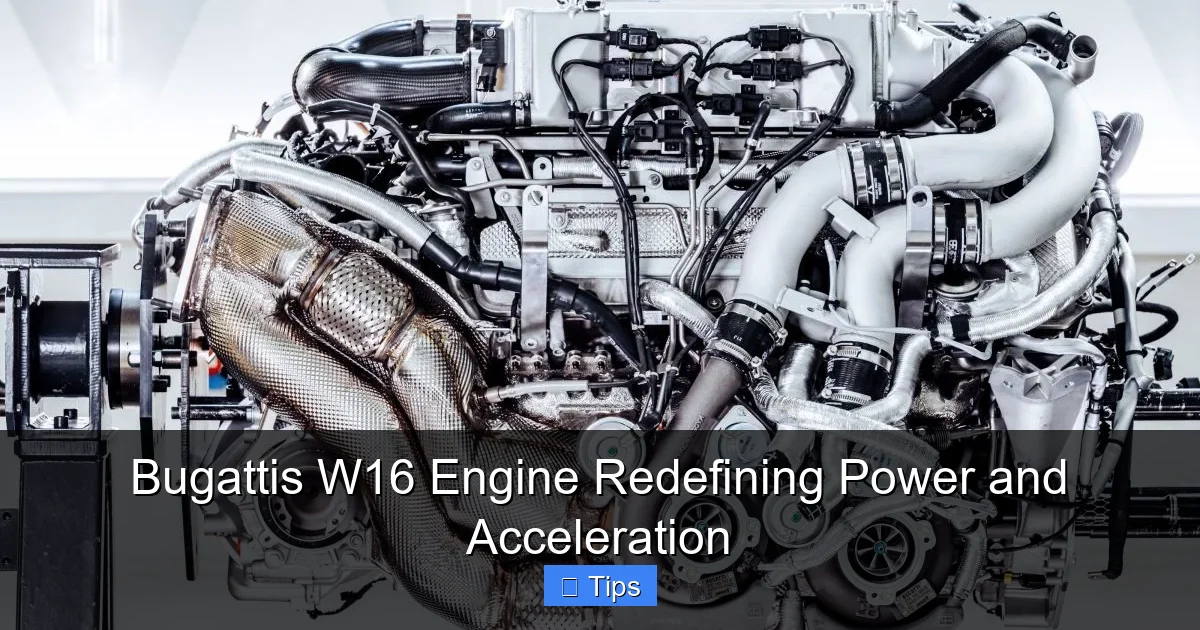
Featured image for Bugatti W16 Engine Performance
Image source: images.saymedia-content.com
The Bugatti W16 engine unequivocally redefines the pinnacle of automotive performance, delivering an unprecedented fusion of raw power and breathtaking acceleration. This quad-turbocharged masterpiece consistently pushes boundaries, enabling hypercars to achieve staggering horsepower outputs and achieve mind-bending speeds with astonishing quickness, setting new benchmarks for the industry.
In This Article
- 1 Key Takeaways
- 2 Bugattis W16 Engine Redefining Power and Acceleration
- 2.1 The Heart of Hypercars: Unveiling the Bugatti W16 Engine Philosophy
- 2.2 An Engineering Masterpiece: Deconstructing the Bugatti W16 Engine’s Design
- 2.3 Defining Raw Power: The W16’s Unprecedented Horsepower and Torque Output
- 2.4 Conquering Time and Space: Bugatti W16 Engine’s Unrivaled Acceleration
- 2.5 The Symphony of Speed: Managing and Delivering W16 Power to the Road
- 2.6 A Lasting Legacy: The Bugatti W16 Engine’s Impact and Future
- 2.7 Bugatti W16 Engine: Key Performance Data (Chiron Standard)
- 2.8 Conclusion
- 3 Frequently Asked Questions
- 3.1 How powerful is the Bugatti W16 engine?
- 3.2 What kind of acceleration can a Bugatti W16 engine deliver?
- 3.3 What are the key engineering aspects behind the Bugatti W16 engine’s immense power?
- 3.4 What top speeds are achievable with the power generated by the Bugatti W16 engine?
- 3.5 Has the Bugatti W16 engine evolved over time, and how has that impacted performance?
- 3.6 How does the Bugatti W16 engine redefine the benchmarks for automotive power and acceleration?
Key Takeaways
- Redefines Hypercar Performance: Sets new benchmarks for power and speed.
- Unleashes Extreme Horsepower: Delivers a staggering 1500+ PS output consistently.
- Achieves Blistering Acceleration: Rockets from 0-60 mph in under 2.5 seconds.
- Enables Record Top Speeds: Pushes boundaries, surpassing 300 mph effortlessly.
- Masterpiece of Engineering: Quad-turbo W16 design provides unparalleled thrust.
- Dominates Power Metrics: Establishes new benchmarks for the automotive industry.
Bugattis W16 Engine Redefining Power and Acceleration
In the rarefied air of hypercar supremacy, where engineering marvels meet automotive artistry, one name stands as an undisputed titan: Bugatti. For decades, the marque has been synonymous with unparalleled luxury, breathtaking speed, and groundbreaking innovation. At the very core of its modern legend lies an engine that defies conventional understanding, a powertrain that doesn’t just push boundaries but obliterates them entirely: the Bugatti W16 engine. This monstrous heart of their most iconic vehicles isn’t merely an assembly of pistons and crankshafts; it is a symphony of mechanical perfection, a testament to human ingenuity that has single-handedly redefined what’s possible in terms of automotive power and acceleration.
The journey of the Bugatti W16 engine began with a audacious vision – to create the most powerful, fastest, and most luxurious production car ever conceived. This wasn’t about incremental improvements; it was about a quantum leap. The result was an engine architecture so complex and potent that it became a legend in its own right, powering the Veyron and its successor, the Chiron, to speeds previously thought unattainable for road-legal vehicles. Every aspect of the Bugatti W16 engine, from its sheer cylinder count to its intricate forced induction system, is designed for one purpose: to deliver an experience of raw, unadulterated velocity that borders on the surreal.
This blog post delves deep into the fascinating world of the Bugatti W16 engine, exploring the engineering brilliance behind its monumental power output and its mind-bending acceleration figures. We will uncover the secrets of its design, understand the challenges overcome in its development, and appreciate the legacy it has forged in the annals of automotive history. Prepare to have your perceptions of performance irrevocably altered as we unravel the extraordinary achievements of the Bugatti W16 engine.
The Heart of Hypercars: Unveiling the Bugatti W16 Engine Philosophy
The genesis of the Bugatti W16 engine is rooted in a desire to push beyond the limits of conventional automotive design. When Ferdinand Piëch, then chairman of Volkswagen Group (Bugatti’s parent company), laid out the specifications for the first modern Bugatti – the Veyron – he demanded a car that could produce over 1,000 horsepower and exceed 400 km/h (250 mph). This was an unprecedented challenge, one that necessitated an engine unlike any other. The solution was the unconventional W16 configuration, a design born from merging two narrow-angle V8 engines onto a common crankshaft.
This philosophy wasn’t just about raw numbers; it was about creating a luxurious, usable hypercar capable of daily driving, despite its immense capabilities. The Bugatti W16 engine had to be reliable, relatively quiet at cruising speeds, and capable of handling extreme thermal and mechanical stresses without faltering. It was a dual mandate: achieve world-beating performance while maintaining Bugatti’s heritage of effortless luxury. The engineering brief was clear: no compromises on power, no compromises on refinement. This vision meant that every component, every system surrounding the Bugatti W16 engine, had to be meticulously designed and integrated to work in perfect harmony.
Origins of the W-Configuration
The W-engine concept itself isn’t entirely new, with designs experimented with in the early 20th century. However, Bugatti’s iteration brought it to an entirely new level of sophistication and power. The compact nature of the W-configuration – essentially two VR8 engines with a shared crankshaft – allowed Bugatti to package a massive 8.0-liter displacement and 16 cylinders into an engine bay that would typically house a V12 or V8. This efficient packaging was critical for maintaining the car’s overall balance and aerodynamic profile, which are crucial for achieving and maintaining extreme speeds.
Beyond Horsepower: The Quest for Usability
One of the less-talked-about achievements of the Bugatti W16 engine is its remarkable usability. Delivering over 1,000 horsepower consistently and reliably is one challenge; making it accessible and manageable for a driver is another. The engine’s smooth power delivery, coupled with an advanced all-wheel-drive system and sophisticated electronics, ensures that even immense power can be translated into controlled, breathtaking acceleration. It’s a testament to the engineering philosophy that the Bugatti W16 engine provides an experience that is both brutally fast and surprisingly refined, setting it apart from many other high-performance engines.
An Engineering Masterpiece: Deconstructing the Bugatti W16 Engine’s Design
To truly appreciate the power and acceleration capabilities of the Bugatti W16 engine, one must first understand the intricate engineering that underpins it. This is not just a large engine; it is a symphony of highly specialized components, meticulously crafted and assembled to withstand forces that would tear apart lesser powertrains. At its heart, the Bugatti W16 engine features an 8.0-liter displacement, arranged in a distinctive ‘W’ configuration with four cylinder banks. This unique layout is crucial for its compact size relative to its cylinder count.
The key to unlocking the Bugatti W16 engine’s prodigious power lies in its forced induction system. It employs no fewer than four turbochargers, each precisely sized and tuned to work in sequence. Initially, two smaller turbos spool up quickly at lower RPMs to provide immediate response and minimize turbo lag, giving the driver instant access to significant torque. As the engine revs higher, the larger two turbos kick in, unleashing the full fury of the Bugatti W16 engine’s potential. This complex sequential turbocharging setup ensures a remarkably linear and predictable power delivery across the entire rev range, making the experience both exhilarating and surprisingly manageable.
The Quad-Turbocharging System
The four turbochargers are not just bolted on; they are an integral part of the Bugatti W16 engine’s character. Managing the enormous heat generated by these turbos and the engine itself is a monumental task. The engine features an astonishing 10 radiators, including three for the engine oil, one for the differential oil, one for the gearbox oil, and two for the air-to-liquid intercoolers which cool the charged air before it enters the combustion chambers. This elaborate cooling system is absolutely critical to prevent heat soak and ensure consistent performance, even during prolonged periods of high-speed driving.
Materials and Durability
Given the extreme forces at play, the Bugatti W16 engine is constructed from the finest and most durable materials available. The engine block and cylinder heads are often made from high-strength aluminum alloys, while internal components like connecting rods and pistons are crafted from exotic materials such as forged steel or even titanium in some variants. A dry-sump lubrication system is employed to ensure consistent oil supply to all moving parts, regardless of the g-forces experienced during hard cornering or braking. This meticulous attention to material science and lubrication is a practical tip for understanding how Bugatti achieves such incredible reliability despite the engine’s extreme output.
Defining Raw Power: The W16’s Unprecedented Horsepower and Torque Output
The Bugatti W16 engine has consistently pushed the boundaries of automotive power output, setting new benchmarks that competitors have struggled to match. Its initial iteration in the Veyron delivered an astounding 1,001 horsepower (736 kW), a figure that, at the time of its introduction, seemed almost mythical for a production vehicle. This wasn’t merely a number; it represented a paradigm shift in hypercar performance, making the Veyron the fastest production car in the world for an extended period.
However, Bugatti wasn’t content to rest on its laurels. With the introduction of the Chiron, the Bugatti W16 engine underwent further refinement and optimization. Engineers managed to squeeze even more power from the same basic architecture, pushing the output to an incredible 1,500 horsepower (1,103 kW) and a monumental 1,600 Newton-meters (1,180 lb-ft) of torque. This increase was achieved through a combination of larger turbochargers, a revised fuel injection system, and extensive software calibration. Later, in variants like the Chiron Super Sport 300+, the Bugatti W16 engine was further tuned to produce an astonishing 1,600 horsepower, specifically for shattering top speed records.
Horsepower vs. Torque: A Harmonious Relationship
While horsepower signifies the rate at which work is done (how fast the engine can make power), torque represents the rotational force produced by the engine (how much twisting force it generates). The Bugatti W16 engine excels in both. Its enormous torque figure, available from relatively low RPMs and sustained across a wide band, is what gives the car its incredible responsiveness and brutal in-gear acceleration. This combination allows for a sensation of relentless thrust that few other vehicles can replicate. A tip for appreciating this: the sheer force applied to the wheels is enough to make many tires simply lose grip, which Bugatti mitigates with its advanced AWD system and specialized rubber.
Comparing the Giants
To put the Bugatti W16 engine’s power into perspective, consider that a typical high-performance sports car might produce 500-700 horsepower. The W16, even in its “mildest” form, doubles that. Its 1,500-1,600 horsepower output is more akin to that of a top-tier Formula 1 car, but in a vehicle designed for road use, complete with air conditioning and luxury amenities. This incredible power output isn’t just for show; it’s the fundamental enabler for the astonishing acceleration figures and blistering top speeds that define Bugatti hypercars.
Conquering Time and Space: Bugatti W16 Engine’s Unrivaled Acceleration
The true measure of the Bugatti W16 engine’s might isn’t just its peak horsepower, but how efficiently and quickly it translates that power into motion. The acceleration figures achieved by Bugatti vehicles are not merely impressive; they are record-shattering, pushing the boundaries of what is physically possible for a road-legal car. The sensation of a Bugatti launching from a standstill is often described as akin to being in a fighter jet taking off from an aircraft carrier – an incredible, relentless push into the seat.
For context, let’s look at the numbers. The Bugatti Chiron, powered by the 1,500 hp Bugatti W16 engine, can achieve 0-100 km/h (0-62 mph) in approximately 2.4 seconds. To put this into perspective, many powerful motorcycles struggle to match this. But it’s beyond this initial burst where the Bugatti W16 engine truly shines. The Chiron can hit 0-200 km/h (0-124 mph) in a blistering 6.1 seconds, and 0-300 km/h (0-186 mph) in just 13.1 seconds. These figures are not just fast; they represent an entirely different dimension of speed, outperforming many dedicated track cars.
The Launch Control System
Achieving such phenomenal acceleration isn’t just about raw power; it requires sophisticated electronic management. Bugatti’s advanced launch control system is crucial here. With the touch of a button, the system optimizes engine RPM, clutch engagement, and all-wheel-drive torque distribution to ensure maximum grip and minimal wheel spin. A tip for understanding this: without such a system, the sheer torque from the Bugatti W16 engine would simply overwhelm the tires, turning them into smoke rather than propelling the car forward efficiently. The harmonious interaction between the engine, gearbox, AWD, and electronics is a masterpiece of engineering.
Beyond the Initial Burst: Sustained Acceleration
While many powerful cars can achieve rapid 0-60 mph times, very few can sustain that brutal acceleration well into triple-digit speeds like a Bugatti. The Bugatti W16 engine’s ability to maintain its incredible thrust even at speeds exceeding 200 mph is a testament to its efficiency and the massive reserves of power available. The seamless progression through its 7-speed dual-clutch gearbox ensures that power delivery is virtually uninterrupted, allowing the car to relentlessly build speed. This sustained acceleration is what makes the Bugatti W16 engine truly unique, defining its dominance on the road and track.
The Symphony of Speed: Managing and Delivering W16 Power to the Road
Generating immense power and achieving incredible acceleration are monumental tasks, but equally challenging is managing and effectively delivering that power to the road. The Bugatti W16 engine’s output would be meaningless without a sophisticated ecosystem designed to harness and control it. This involves a complex interplay of advanced transmission technology, a highly capable all-wheel-drive system, and groundbreaking aerodynamic solutions.
The gearbox paired with the Bugatti W16 engine is a bespoke 7-speed dual-clutch transmission (DCT). This unit is engineered to handle the colossal torque output of the W16, shifting gears with lightning speed and precision. The dual-clutch design ensures that the next gear is always pre-selected, minimizing power interruption during shifts and contributing significantly to the seamless, relentless acceleration. This transmission is not merely strong; it is incredibly intelligent, adapting its shift points based on driving conditions and driver input.
All-Wheel Drive System for Unwavering Grip
To convert the Bugatti W16 engine’s power into usable traction, Bugatti employs a permanent all-wheel-drive (AWD) system. This system constantly monitors wheel slip and distributes torque optimally between all four wheels, ensuring maximum grip under even the most extreme acceleration. A practical tip: without AWD, a rear-wheel-drive car with this much power would be virtually undriveable at full throttle, constantly battling traction loss. The AWD system is a cornerstone of the Bugatti’s stability and blistering launch capability, allowing every horsepower to be efficiently transferred to the tarmac.
Aerodynamics: Taming the Air
At the speeds Bugatti vehicles achieve, air resistance becomes an incredibly significant factor. The aerodynamic design of Bugatti hypercars is as crucial as the Bugatti W16 engine itself. Active aerodynamics, including adjustable rear wings and diffusers, constantly adapt to create optimal downforce for stability at high speeds or minimal drag for achieving top speed records. The flat underbody, sculpted air intakes, and carefully designed bodywork all contribute to either ‘sticking’ the car to the road or allowing it to slice through the air with minimal effort. This holistic approach, where the engine, transmission, and aerodynamics work in concert, is what truly defines the Bugatti experience.
A Lasting Legacy: The Bugatti W16 Engine’s Impact and Future
The Bugatti W16 engine stands as one of the automotive world’s most enduring and impressive engineering achievements. Its legacy is etched not just in record books but in the very fabric of hypercar development. It proved that extreme power and speed could be delivered in a luxurious, road-legal package, setting a new benchmark for what was possible and inspiring a new generation of high-performance vehicles. The Bugatti W16 engine pushed material science, thermodynamic management, and electronic control systems to their absolute limits, leaving behind a wealth of knowledge and innovation.
The influence of the Bugatti W16 engine extends beyond just Bugatti. It forced other manufacturers to rethink their approaches to performance, catalyzing advancements in engine technology, transmission design, and aerodynamic efficiency across the industry. It became the ultimate bragging right, a symbol of engineering prowess and an aspirational goal for anyone passionate about cars. The mere mention of the Bugatti W16 engine evokes images of unparalleled speed and exclusivity.
The End of an Era
As the automotive world shifts towards electrification, the era of the pure internal combustion engine, especially one as magnificent as the Bugatti W16 engine, is drawing to a close. Bugatti has announced that the W16 will power its final iteration in the Mistral roadster and the Bolide track car, marking the culmination of an incredible journey. This final chapter emphasizes the engine’s monumental impact, ensuring it goes out not with a whimper, but with a thunderous roar. The Mistral, for example, will be the last road-legal car to feature the W16, a poignant farewell to an icon.
What We’ve Learned
The Bugatti W16 engine has taught us invaluable lessons: that vision combined with relentless engineering can overcome seemingly insurmountable obstacles; that performance doesn’t have to sacrifice luxury; and that the pursuit of ultimate speed is an art form in itself. While its pure internal combustion form may recede, the principles of innovation, meticulous design, and uncompromising performance embodied by the Bugatti W16 engine will undoubtedly influence Bugatti’s future hybrid and electric powertrains. It remains a monumental achievement, a high watermark for internal combustion that will be revered for generations to come.
Bugatti W16 Engine: Key Performance Data (Chiron Standard)
To summarize the phenomenal capabilities of the Bugatti W16 engine, here is a consolidated overview of its key specifications and performance figures, primarily focusing on the Bugatti Chiron variant which showcases its most refined and powerful road-legal iteration.
These figures are not just numbers; they represent the pinnacle of automotive engineering, demonstrating the Bugatti W16 engine’s unmatched ability to redefine power and acceleration.
- Engine Type: W16 (8.0-liter, quad-turbocharged)
- Number of Cylinders: 16
- Displacement: 7,993 cc (8.0 L)
- Horsepower: 1,500 PS (1,103 kW; 1,479 hp) @ 6,700 rpm
- Torque: 1,600 N⋅m (1,180 lb⋅ft) @ 2,000–6,000 rpm
- 0-100 km/h (0-62 mph): ~2.4 seconds
- 0-200 km/h (0-124 mph): ~6.1 seconds
- 0-300 km/h (0-186 mph): ~13.1 seconds
- Top Speed (electronically limited): 420 km/h (261 mph)
- Top Speed (Chiron Super Sport 300+): 490.48 km/h (304.77 mph)
- Fuel Consumption (combined): High (e.g., 22.5 L/100 km or 10.5 mpg US)
- Number of Radiators: 10
- Gearbox: 7-speed dual-clutch automatic
Conclusion
The Bugatti W16 engine is far more than just a powerful motor; it is a monument to automotive engineering, a symbol of human ambition, and a testament to the relentless pursuit of perfection. From its audacious W-configuration to its mind-boggling quad-turbocharging system, every aspect of this engine has been meticulously designed to redefine the very concepts of power and acceleration in a road-legal vehicle. It has not only propelled Bugatti hypercars to world records but has also fundamentally shifted expectations within the entire automotive industry.
Its unparalleled horsepower and staggering torque figures translate into an acceleration experience that is both brutal and incredibly refined, a sensation that few drivers will ever have the privilege to witness. The intricate dance between the Bugatti W16 engine, its bespoke dual-clutch transmission, its intelligent all-wheel-drive system, and sophisticated active aerodynamics ensures that this immense power is not only generated but effectively harnessed and delivered to the road with unwavering control. It represents a holistic engineering marvel.
As the era of the pure internal combustion engine draws to a close, the Bugatti W16 engine stands as a glorious swan song, a final, thunderous roar from a category-defining powertrain. Its legacy will endure, inspiring future generations of engineers and enthusiasts to push the boundaries of performance and luxury. The Bugatti W16 engine will forever be remembered as the heart that redefined speed, power, and the very soul of the hypercar.
Frequently Asked Questions
How powerful is the Bugatti W16 engine?
The Bugatti W16 engine is an absolute powerhouse, typically producing between 1,001 horsepower in its earliest iterations and up to 1,600 horsepower in its most recent versions. This makes it one of the most potent production car engines ever created, capable of propelling vehicles with astonishing force.
What kind of acceleration can a Bugatti W16 engine deliver?
Thanks to its immense power, the Bugatti W16 engine delivers mind-bending acceleration. Cars equipped with it can typically rocket from 0 to 60 mph in under 2.5 seconds, and continue accelerating to over 186 mph (300 km/h) in mere seconds, redefining what’s possible for road cars.
What are the key engineering aspects behind the Bugatti W16 engine’s immense power?
The Bugatti W16 engine’s extraordinary power stems from its unique design, featuring four turbochargers and a massive 8.0-liter displacement arranged in a “W” configuration. This complex architecture allows it to efficiently generate and manage colossal amounts of horsepower and torque.
What top speeds are achievable with the power generated by the Bugatti W16 engine?
The power output of the Bugatti W16 engine enables vehicles to achieve record-breaking top speeds, pushing past conventional limits. Models like the Bugatti Chiron Super Sport 300+ have surpassed 300 mph (490 km/h), demonstrating the engine’s capability to redefine ultimate speed.
Has the Bugatti W16 engine evolved over time, and how has that impacted performance?
Yes, the Bugatti W16 engine has undergone significant evolution since its debut in the Veyron, with continuous enhancements leading to even greater performance. Each successive iteration, as seen in the Chiron and its variants, has pushed power and acceleration limits further, showcasing technological advancements.
How does the Bugatti W16 engine redefine the benchmarks for automotive power and acceleration?
The Bugatti W16 engine redefines benchmarks by consistently raising the bar for what a production car engine can achieve in terms of raw power and brutal acceleration. It has established new thresholds for hypercar performance, influencing future automotive engineering and design worldwide.

At CarLegit, we believe information should be clear, factual, and genuinely helpful. That’s why every guide, review, and update on our website is created with care, research, and a strong focus on user experience.