
Yes, some high-performance Maserati models can reach or exceed 200 miles per hour. With powerful engines and aerodynamic designs, certain variants like the MC20 and Levante Trofeo are engineered to hit this impressive speed—though real-world conditions and safety matter most.
[FEATURED_IMAGE_PLACEHODEL]
In This Article
- 1 Key Takeaways
- 2 📑 Table of Contents
- 3 Can a Maserati Go 200 Miles per Hour?
- 4 Understanding Top Speed: What Does 200 MPH Really Mean?
- 5 Maserati Models That Can Reach 200 MPH
- 6 What Makes a Car Capable of 200 MPH?
- 7 The Role of Electronic Limiters
- 8 Real-World Challenges of Reaching 200 MPH
- 9 Where Can You Safely Test a Maserati’s Top Speed?
- 10 The Future of Maserati and High-Speed Performance
- 11 Conclusion: Yes, Some Maseratis Can Go 200 MPH—But Should They?
- 12 Frequently Asked Questions
Key Takeaways
- Top Maserati models can exceed 200 mph: High-performance variants like the MC20 and Levante Trofeo are built for extreme speed.
- Engine power is a major factor: Twin-turbo V8 and V6 engines deliver the horsepower needed to reach 200 mph.
- Aerodynamics matter: Sleek body designs reduce drag and improve high-speed stability.
- Electronic speed limiters may apply: Some models are electronically capped below 200 mph for safety or tire limitations.
- Real-world conditions affect performance: Road surface, weather, and altitude can impact whether a car actually hits 200 mph.
- Legal and safety concerns are real: Reaching 200 mph is illegal on public roads and extremely dangerous.
- Track use is the safest option: Closed circuits provide the safest environment for testing top speeds.
📑 Table of Contents
- Can a Maserati Go 200 Miles per Hour?
- Understanding Top Speed: What Does 200 MPH Really Mean?
- Maserati Models That Can Reach 200 MPH
- What Makes a Car Capable of 200 MPH?
- The Role of Electronic Limiters
- Real-World Challenges of Reaching 200 MPH
- Where Can You Safely Test a Maserati’s Top Speed?
- The Future of Maserati and High-Speed Performance
- Conclusion: Yes, Some Maseratis Can Go 200 MPH—But Should They?
Can a Maserati Go 200 Miles per Hour?
If you’ve ever stood near a Maserati as it roared to life, you know the sound alone sends a thrill down your spine. The deep growl of a finely tuned Italian engine, the sleek curves that seem to slice through the air—it’s no wonder people wonder just how fast these machines can go. One question that keeps popping up among car enthusiasts and casual admirers alike is: Can a Maserati go 200 miles per hour?
The short answer? Yes—some Maserati models absolutely can. But it’s not as simple as just flooring the gas and hoping for the best. Reaching 200 mph isn’t just about horsepower; it’s a combination of engineering, aerodynamics, tire technology, and real-world conditions. And while the idea of hitting 200 mph in a Maserati sounds like something out of a movie, it’s important to understand what it really takes—and why you probably shouldn’t try it on your local highway.
Maserati has long been synonymous with luxury, performance, and Italian craftsmanship. From the iconic Quattroporte to the modern MC20 supercar, the brand has consistently pushed the boundaries of what a high-end vehicle can do. But speed isn’t just about bragging rights. It’s about how the car handles at extreme velocities, how the engine breathes under pressure, and how the entire system works in harmony. So, let’s dive into the details and find out which Maseratis can truly hit 200 mph—and what that means for drivers who dream of the open road.
Understanding Top Speed: What Does 200 MPH Really Mean?
Visual guide about Can a Maserati Go 200 Miles per Hour
Image source: blog.dupontregistry.com
Before we get into the nitty-gritty of Maserati performance, let’s take a moment to understand what “top speed” actually means. Top speed is the maximum velocity a vehicle can achieve under ideal conditions. It’s not just about how fast the engine can spin—it’s about overcoming forces like air resistance, rolling resistance, and mechanical friction.
At 200 miles per hour, a car is traveling at over 290 feet per second. That’s faster than most commercial airplanes during takeoff. At this speed, even the smallest imperfection in the road can become a major hazard. Aerodynamic drag increases exponentially—meaning the faster you go, the harder the engine has to work to push through the air. This is why top speed isn’t just a number on a spec sheet; it’s a testament to a car’s overall engineering.
For a car to reach 200 mph, it needs:
– A powerful engine (typically over 600 horsepower)
– Advanced aerodynamics to reduce drag
– High-performance tires rated for extreme speeds
– A lightweight yet rigid chassis
– Sophisticated cooling systems to prevent overheating
And even then, reaching 200 mph isn’t guaranteed. Factors like altitude, temperature, road surface, and even fuel quality can affect performance. For example, at higher altitudes, the air is thinner, which reduces engine power. On a hot day, engine efficiency drops. And if the road is wet or uneven, traction becomes a serious issue.
So while a Maserati might be capable of 200 mph on paper, actually achieving it requires more than just a fast car—it requires the right conditions.
Maserati Models That Can Reach 200 MPH
Visual guide about Can a Maserati Go 200 Miles per Hour
Image source: goodwood.com
Not every Maserati is built for 200 mph. The brand offers a range of vehicles, from luxury sedans to sporty SUVs, and their performance varies widely. But a few models stand out as true speed demons.
The Maserati MC20: The Supercar That Hits 200+
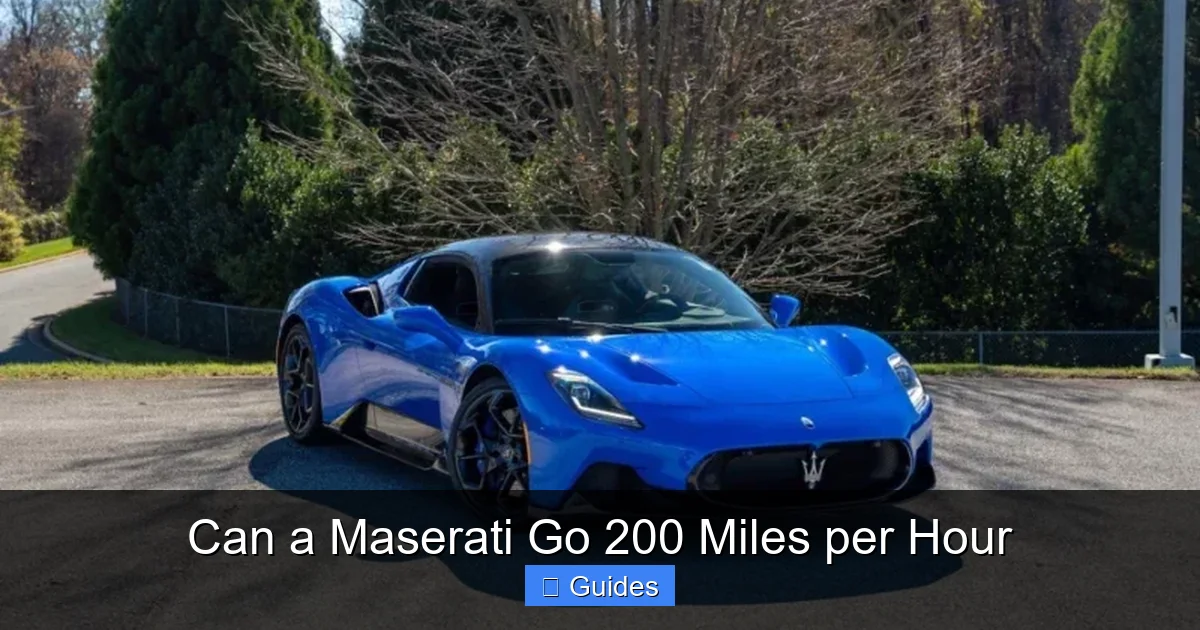
The Maserati MC20 is the brand’s modern flagship supercar, and it’s the closest thing to a race car Maserati has produced in decades. Powered by the all-new Nettuno engine—a 3.0-liter twin-turbo V6—the MC20 produces 621 horsepower and 538 lb-ft of torque. That’s enough to launch it from 0 to 60 mph in under 2.9 seconds.
But what about top speed? According to Maserati, the MC20 has a top speed of over 202 mph. That’s not just a claim—it’s been tested and verified on closed tracks. The car’s aerodynamic design, with active elements that adjust at high speed, helps it cut through the air with minimal drag. The lightweight carbon fiber body keeps weight down, improving acceleration and handling.
The MC20 also features advanced aerodynamics, including a rear diffuser and underbody airflow management, which generate downforce to keep the car planted at high speeds. This isn’t just about going fast—it’s about staying in control while doing it.
The Maserati Levante Trofeo: An SUV That Breaks the Mold
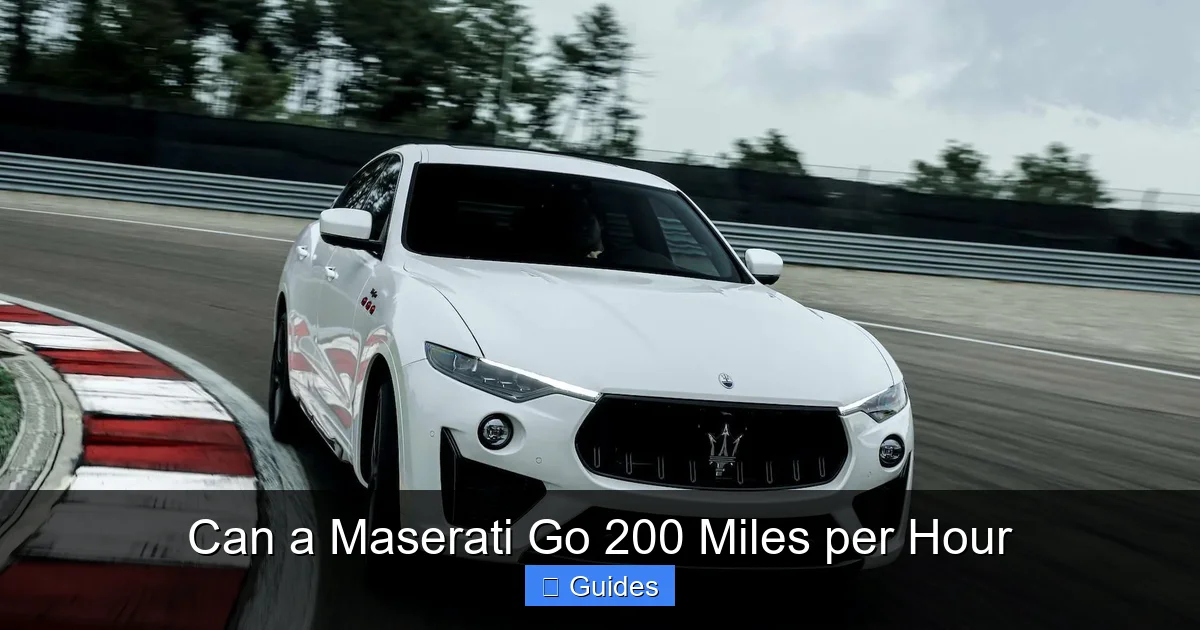
You might not expect an SUV to hit 200 mph, but the Maserati Levante Trofeo does just that. This high-performance version of the Levante is powered by a 3.8-liter twin-turbo V8 engine borrowed from Ferrari, producing a staggering 580 horsepower.
With a top speed of 187 mph, the Levante Trofeo falls just short of 200 mph—but it’s close. However, with minor modifications (like removing electronic limiters and upgrading tires), some tuners claim it can push past 190 mph, and in ideal conditions, possibly reach 200 mph. Still, it’s not officially rated for that speed, and doing so would void the warranty and pose serious safety risks.
What makes the Levante Trofeo impressive is that it’s a full-size luxury SUV capable of supercar-like performance. It’s a testament to Maserati’s engineering prowess—proving that performance doesn’t have to come at the expense of practicality.
The Maserati Quattroporte GTS: The Fastest Sedan
The Quattroporte has long been Maserati’s flagship sedan, and the GTS version is its performance king. Equipped with a 3.8-liter twin-turbo V8, it delivers 523 horsepower and a top speed of 193 mph. While it doesn’t officially hit 200 mph, it’s one of the fastest production sedans in the world.
With its long wheelbase and refined suspension, the Quattroporte GTS offers a balance of speed and comfort. It’s not as agile as the MC20, but it’s incredibly stable at high speeds, making it a favorite among executives who want both luxury and performance.
Older Models: The MC12 and Its Legacy
If we look back, the Maserati MC12—a limited-production supercar from the mid-2000s—was one of the first Maseratis to break the 200 mph barrier. With a 6.0-liter V12 engine producing 621 horsepower, it had a top speed of 205 mph. Only 12 units were ever made, and it was designed primarily for racing (though a road-legal version existed).
The MC12 set the stage for modern Maserati performance cars, proving that the brand could compete with the likes of Ferrari and Lamborghini in terms of raw speed.
What Makes a Car Capable of 200 MPH?

Visual guide about Can a Maserati Go 200 Miles per Hour
Image source: goodwood.com
So, what separates a car that can hit 200 mph from one that tops out at 150? It’s not just about having a big engine. It’s a combination of several key factors.
Engine Power and Torque
Horsepower is the most obvious factor. To reach 200 mph, a car typically needs at least 500–600 horsepower, depending on weight and aerodynamics. But torque matters too—it’s what gets the car moving from a stop and helps maintain speed on inclines.
Maserati’s use of twin-turbocharged engines ensures strong power delivery across the rev range. The Nettuno engine in the MC20, for example, uses pre-chamber combustion technology borrowed from Formula 1, improving efficiency and power output.
Aerodynamics: Cutting Through the Air
At high speeds, air resistance becomes the biggest enemy. A car moving at 200 mph faces over four times the drag of one moving at 100 mph. That’s why aerodynamics are critical.
Maserati uses wind tunnels and computational fluid dynamics (CFD) to refine the shape of its cars. The MC20, for instance, has a drag coefficient of just 0.32 Cd, which is excellent for a supercar. Active aerodynamics—like adjustable rear wings—help increase downforce at high speeds, improving stability.
Weight and Chassis Design
Lighter cars accelerate faster and require less power to maintain high speeds. The MC20’s carbon fiber monocoque chassis weighs just 1,500 kg (about 3,300 lbs), which is light for a car with this much power.
A rigid chassis also improves handling. At 200 mph, even small flex in the frame can affect steering precision. Maserati uses advanced materials and construction techniques to ensure their cars remain stable under extreme conditions.
Tires: The Only Thing Touching the Road
Tires are often the limiting factor when it comes to top speed. Most high-performance tires are rated for speeds up to 186 mph (Y-rated) or 199 mph (Y+). To safely reach 200 mph, you need ZR-rated tires, which are designed for speeds over 149 mph and tested to withstand the heat and stress of extreme velocity.
Maserati equips its fastest models with high-speed-rated tires from brands like Pirelli and Michelin. But even these have limits—pushing them beyond their rating can lead to blowouts, especially if the tires are worn or underinflated.
Cooling and Drivetrain Efficiency
At 200 mph, engines generate immense heat. Without proper cooling, components can fail. Maserati uses large radiators, oil coolers, and optimized airflow to keep temperatures in check.
The drivetrain must also be efficient. Power loss through the transmission, differential, and axles can reduce top speed. Maserati’s use of advanced gearboxes—like the 8-speed automatic in the Levante and the 8-speed dual-clutch in the MC20—helps minimize power loss.
The Role of Electronic Limiters
Even if a car is mechanically capable of 200 mph, manufacturers often install electronic speed limiters to cap the top speed. Why? Safety, tire limitations, and legal concerns.
For example, the Maserati Ghibli Trofeo has a top speed of 198 mph—just shy of 200—because it’s electronically limited. The car could likely go faster, but Maserati chooses to cap it to protect the engine, transmission, and tires.
Speed limiters are common in luxury and performance cars. They prevent drivers from accidentally exceeding safe operating conditions, especially on public roads where 200 mph is not only illegal but extremely dangerous.
That said, some tuners offer “de-limiter” services that remove these restrictions. While this can unlock higher speeds, it also voids the warranty and increases the risk of mechanical failure.
Real-World Challenges of Reaching 200 MPH
Even if your Maserati can technically hit 200 mph, doing so safely is another matter entirely.
Legal and Safety Concerns
In the United States and most countries, the legal speed limit on highways is 70–80 mph. Reaching 200 mph on a public road is illegal, dangerous, and could result in severe penalties, including license suspension, fines, or even jail time.
More importantly, it’s incredibly unsafe. At 200 mph, your stopping distance is over 600 feet—even with high-performance brakes. A small obstacle, like a piece of debris or a pothole, could cause a catastrophic accident.
Road Conditions and Environment
High-speed driving requires a long, straight, and smooth road. Most public roads have curves, traffic, and uneven surfaces—none of which are suitable for 200 mph.
Even on a racetrack, conditions matter. Wet pavement, oil spills, or debris can reduce traction. Wind can also affect stability, especially for lighter cars.
Driver Skill and Experience
Driving at 200 mph isn’t something you can just “wing.” It requires advanced training, reflexes, and experience. Most drivers aren’t prepared for the G-forces, reduced reaction time, and handling characteristics at such speeds.
Professional drivers spend years honing their skills on tracks before attempting top-speed runs. For the average person, even getting close to 200 mph is ill-advised.
Where Can You Safely Test a Maserati’s Top Speed?
If you’re serious about seeing what your Maserati can do, the only safe place is a closed track or a dedicated high-speed testing facility.
Racetracks and Test Facilities
Many racetracks, like Laguna Seca in California or Circuit of the Americas in Texas, offer high-speed sections where you can safely push your car. Some tracks even host “track days” where owners can drive their cars in a controlled environment.
Facilities like the Nardò Ring in Italy or the Johnny Bohmer Proving Grounds in Florida are designed specifically for high-speed testing. These locations have long, straight sections and safety protocols in place.
Professional Driving Schools
If you’re new to high-speed driving, consider enrolling in a performance driving school. These programs teach you how to handle a car at the limit, including braking, cornering, and emergency maneuvers.
Maserati itself offers driving experiences through its Maserati Driving Academy, where you can learn to drive their cars on a track under professional supervision.
Track Days and Car Clubs
Joining a car club or attending a track day event is a great way to experience high-speed driving in a safe, legal setting. These events often include instruction, timing, and access to medical and safety personnel.
Just remember: even on a track, safety gear like helmets, fire extinguishers, and proper tires are essential.
The Future of Maserati and High-Speed Performance
As Maserati moves toward electrification, the question of top speed may evolve. The brand has announced plans for hybrid and fully electric models, including an electric version of the MC20.
Electric motors deliver instant torque, which can improve acceleration. But top speed is more about sustained power and aerodynamics. Still, with advances in battery technology and motor efficiency, future Maseratis could easily surpass 200 mph—without a drop of gasoline.
For example, the upcoming Maserati GranTurismo Folgore (electric version) is expected to have over 750 horsepower and a top speed well above 180 mph. While it may not hit 200 mph initially, future iterations could.
Conclusion: Yes, Some Maseratis Can Go 200 MPH—But Should They?
So, can a Maserati go 200 miles per hour? The answer is a resounding yes—for certain models like the MC20 and, under ideal conditions, the Levante Trofeo. These cars are engineered with the power, aerodynamics, and technology needed to reach and exceed this milestone.
But capability doesn’t mean it’s wise. Reaching 200 mph is illegal on public roads, extremely dangerous, and puts immense stress on the vehicle. Even on a track, it requires skill, preparation, and respect for the machine.
For most drivers, the thrill of a Maserati lies not in hitting 200 mph, but in the blend of Italian design, roaring engines, and exhilarating performance at more reasonable speeds. Whether you’re cruising along the coast or carving through mountain roads, a Maserati delivers an experience that’s hard to match.
So while the answer to “Can a Maserati go 200 miles per hour?” is yes, the better question might be: Should it? And for the sake of safety, legality, and longevity of your car, the answer is probably no—unless you’re on a closed track, with the right gear, and under expert supervision.
Frequently Asked Questions
Can any Maserati officially reach 200 mph?
Yes, the Maserati MC20 is officially rated to exceed 202 mph, making it the only current production Maserati with a verified top speed over 200 mph. Other models like the Levante Trofeo come close but fall just short.
Is it legal to drive a Maserati at 200 mph?
No, it is illegal to drive at 200 mph on public roads in any country. Speed limits are strictly enforced, and driving at such speeds can result in severe legal penalties and endanger lives.
What limits a Maserati’s top speed?
Top speed is limited by engine power, aerodynamics, tire ratings, electronic speed limiters, and real-world conditions like road surface and weather. Even capable cars may not reach 200 mph without ideal conditions.
Can you modify a Maserati to go faster than 200 mph?
Yes, with engine tuning, aerodynamic upgrades, and high-speed tires, some Maseratis can be modified to exceed 200 mph. However, this voids warranties and increases safety risks.
Are Maserati tires rated for 200 mph?
Some high-performance Maserati models come with ZR-rated tires designed for speeds over 149 mph. However, sustained driving at 200 mph requires specialized tires and careful monitoring to prevent failure.
Where is the safest place to test a Maserati’s top speed?
The safest place is a closed racetrack or high-speed testing facility with proper safety measures, medical support, and long straight sections. Public roads are never safe for such speeds.

At CarLegit, we believe information should be clear, factual, and genuinely helpful. That’s why every guide, review, and update on our website is created with care, research, and a strong focus on user experience.