
Yes, you can put 88 gas in most cars, but it’s not always necessary. This mid-grade fuel offers a balance between regular and premium, but only certain engines benefit from it. Always check your owner’s manual before switching.
In This Article
- 1 Key Takeaways
- 2 📑 Table of Contents
- 3 Can I Put 88 Gas in My Car? A Complete Guide
- 4 What Is 88-Octane Gasoline?
- 5 Is It Safe to Put 88 Gas in My Car?
- 6 When Should You Use 88 Gas?
- 7 Does 88 Gas Improve Fuel Economy or Performance?
- 8 Cost Considerations: Is 88 Gas Worth the Extra Money?
- 9 How to Choose the Right Fuel for Your Car
- 10 Conclusion: Should You Put 88 Gas in Your Car?
- 11 Frequently Asked Questions
Key Takeaways
- 88-octane gas is safe for most vehicles: Modern cars are designed to adjust to different fuel types, so using 88 gas won’t harm your engine.
- Only high-compression or turbocharged engines need higher octane: If your car doesn’t require premium fuel, 88 gas won’t improve performance or fuel economy.
- Check your owner’s manual first: The manufacturer’s recommendation is the best guide for choosing the right fuel.
- 88 gas may cost more than regular with little benefit: Unless your car specifically calls for mid-grade or premium, you’re likely paying extra for no real gain.
- Using 88 gas occasionally is fine: Filling up with 88 octane once in a while won’t damage your engine, even if your car runs on regular.
- Higher octane doesn’t mean cleaner fuel: Octane rating measures knock resistance, not fuel quality or detergent additives.
- Some states offer 88 gas as an ethanol blend: E15 (15% ethanol) is common in 88-octane fuel, which may affect older or small engines.
📑 Table of Contents
- Can I Put 88 Gas in My Car? A Complete Guide
- What Is 88-Octane Gasoline?
- Is It Safe to Put 88 Gas in My Car?
- When Should You Use 88 Gas?
- Does 88 Gas Improve Fuel Economy or Performance?
- Cost Considerations: Is 88 Gas Worth the Extra Money?
- How to Choose the Right Fuel for Your Car
- Conclusion: Should You Put 88 Gas in Your Car?
Can I Put 88 Gas in My Car? A Complete Guide
You’re at the gas station, staring at the pump labels: Regular (87), Mid-Grade (88 or 89), and Premium (91–93). Your car’s manual says “regular unleaded recommended,” but you’ve heard that higher octane fuel can make your engine run smoother or even save gas. So, can you put 88 gas in your car? Is it safe? Will it help?
The short answer is: yes, you can. But whether you should is a different story.
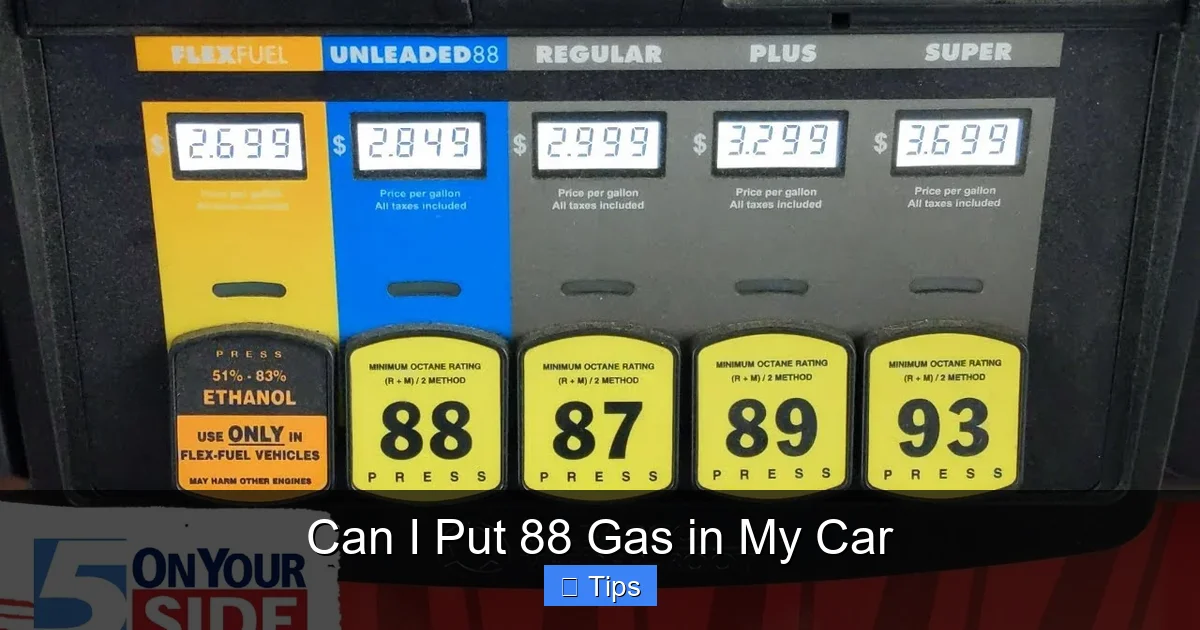
Most modern vehicles are built to run efficiently on regular 87-octane gasoline. However, mid-grade fuels like 88 octane are becoming more common, especially in regions where E15 (a blend of 15% ethanol and 85% gasoline) is marketed as “Unleaded 88.” This fuel is often cheaper than premium but slightly more expensive than regular. It’s designed to offer a middle ground—better knock resistance than 87, but not as high as 91 or 93.
But here’s the catch: unless your car specifically recommends or requires mid-grade or premium fuel, using 88 octane likely won’t give you any noticeable benefits. In fact, you might just be spending more money for no real gain.
In this guide, we’ll break down everything you need to know about 88-octane gasoline—what it is, how it works, when it’s useful, and whether it’s worth putting in your tank. Whether you drive a compact sedan, a turbocharged sports car, or a trusty old pickup, this article will help you make an informed decision.
What Is 88-Octane Gasoline?
Visual guide about Can I Put 88 Gas in My Car
Image source: i.ytimg.com
Before we dive into whether you should use 88 gas, let’s clarify what it actually is.
Octane rating measures a fuel’s ability to resist “knocking” or “pinging” during combustion. Knocking happens when fuel ignites too early in the engine’s cylinders, causing a knocking sound and potentially damaging engine components over time. Higher octane fuels are more resistant to this premature ignition.
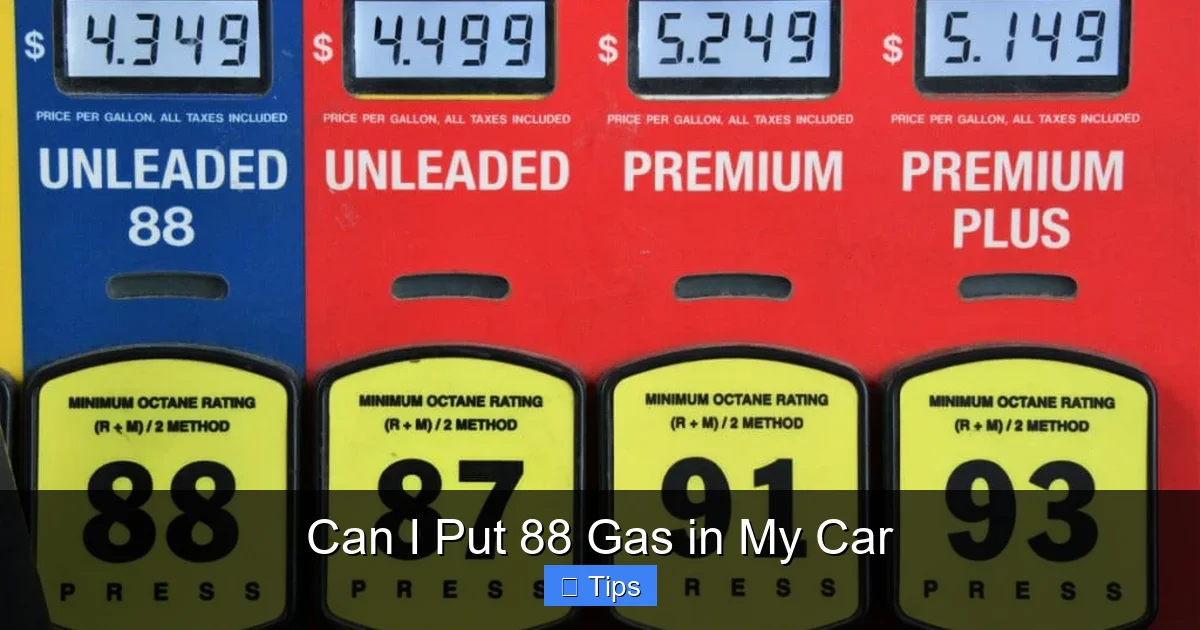
In the U.S., gasoline is labeled by its octane rating using the (R+M)/2 method—the average of Research Octane Number (RON) and Motor Octane Number (MON). Regular gas is typically 87, mid-grade ranges from 88 to 89, and premium is 91 or higher, depending on the region.
So, 88-octane gas sits right between regular and premium. It’s not a high-performance fuel, but it’s also not the lowest grade available. In some areas, especially in the Midwest and parts of the South, 88-octane fuel is actually E15—a blend containing up to 15% ethanol. This is different from the standard E10 (10% ethanol) found in most regular gasoline.
Ethanol has a higher octane rating than pure gasoline, which is why E15 can achieve an 88-octane rating even though it contains less pure gasoline. The ethanol boosts the overall octane number, making it suitable for labeling as mid-grade.
But here’s something important: not all 88-octane gas is the same. Some stations sell 88 as a true mid-grade blend of 87 and 91 fuel, while others sell it as E15. The labeling can be confusing, so always check the pump for details.
How Is 88 Gas Different from Regular and Premium?
Let’s compare the three main fuel grades:
– Regular (87 octane): The standard fuel for most cars. It’s the most widely available and usually the cheapest. Designed for engines with lower compression ratios.
– Mid-Grade (88–89 octane): A blend or ethanol-enhanced fuel that offers slightly better knock resistance. Often used in vehicles that recommend but don’t require premium.
– Premium (91–93 octane): Required or recommended for high-performance, turbocharged, or high-compression engines. More expensive but necessary for optimal performance in certain vehicles.
The key difference isn’t cleanliness or energy content—it’s knock resistance. Higher octane fuels can withstand higher pressures and temperatures before igniting, which is crucial in high-performance engines.
But for the average driver with a standard engine, 87 octane is perfectly adequate. Using 88 or 91 won’t make your car faster, cleaner, or more efficient—unless your engine is designed to take advantage of it.
Is 88 Gas the Same as E15?
This is a common point of confusion. In many parts of the U.S., especially where ethanol production is high, 88-octane fuel is actually E15—gasoline blended with 15% ethanol.
E15 is approved by the EPA for use in vehicles made in 2001 or later. However, not all manufacturers recommend it. Some carmakers, including Ford, GM, and Toyota, say E15 is acceptable for their newer models, while others, like Honda and Hyundai, warn against it due to potential long-term effects on fuel systems and engines.
Ethanol is hygroscopic, meaning it attracts water. Over time, this can lead to phase separation in the fuel tank, where water and ethanol separate from gasoline, potentially causing corrosion or starting issues. Ethanol also has less energy per gallon than gasoline, which means E15 can slightly reduce fuel economy—typically by 3–5%.
So, if you’re filling up with 88-octane gas, check the pump. If it says “E15” or “Contains up to 15% ethanol,” you’re not just buying mid-grade fuel—you’re buying a higher-ethanol blend. This may affect older cars, motorcycles, boats, or small engines like lawnmowers and chainsaws, which aren’t designed for ethanol blends above 10%.
Is It Safe to Put 88 Gas in My Car?
Visual guide about Can I Put 88 Gas in My Car
Image source: d2j6dbq0eux0bg.cloudfront.net
Now for the big question: is it safe?
The answer is generally yes—putting 88-octane gas in your car won’t damage your engine, even if your vehicle is designed for regular fuel.
Modern engines are equipped with knock sensors and engine control units (ECUs) that adjust ignition timing based on the fuel being used. If you put in higher-octane gas, the ECU may advance timing slightly to take advantage of the fuel’s resistance to knocking. But if your engine doesn’t need it, those adjustments will be minimal, and you won’t notice any real difference in performance or efficiency.
In other words, your car won’t “know” the difference unless it’s specifically tuned for higher-octane fuel.
What Happens If You Use 88 Gas in a Car That Takes Regular?
Let’s say your car’s manual says “regular unleaded gasoline recommended.” You fill up with 88 octane instead. What happens?
Nothing bad. Your engine will run just fine. You might not even notice a difference in how the car drives.
Some people believe that higher-octane fuel makes the engine run smoother or quieter, but this is usually psychological. Unless your engine is prone to knocking on regular fuel (which is rare in modern cars), you won’t hear or feel a difference.
In fact, using higher-octane fuel than recommended is sometimes called “over-fueling.” It’s like wearing a winter coat in spring—it won’t hurt you, but it’s unnecessary and might cost more.
Can 88 Gas Harm My Engine?
No, 88-octane gas will not harm your engine—even if used regularly.
Engines are designed to run on a range of fuels, and the ECU constantly monitors combustion to prevent knocking. If the fuel is too high-octane, the engine simply won’t take full advantage of it. There’s no risk of damage from using 88 gas in a car that takes regular.
However, there are two caveats:
1. If the 88 gas is E15: As mentioned earlier, ethanol blends can cause issues in older vehicles or small engines not designed for them. Check your owner’s manual to see if E15 is approved.
2. If you have a high-performance engine that requires premium: Using 88 octane in a car that needs 91 or higher can cause knocking, reduced performance, and long-term engine damage. This is rare, but it does happen in turbocharged or high-compression engines.
For the vast majority of drivers, though, 88 gas is safe to use—even if it’s not necessary.
When Should You Use 88 Gas?
Visual guide about Can I Put 88 Gas in My Car
Image source: mechanicbase.com
So, if 88 gas is safe but not always beneficial, when should you actually use it?
There are a few scenarios where mid-grade fuel makes sense:
Your Car Recommends Mid-Grade Fuel
Some vehicles fall into a gray area—they don’t require premium, but they perform better with mid-grade. For example, certain SUVs, trucks, or performance-oriented sedans may list “87 octane minimum, 89 recommended” in the owner’s manual.
In these cases, using 88 or 89 octane can help prevent knocking under heavy load, such as towing, climbing hills, or driving in hot weather. It’s not required, but it can improve engine smoothness and longevity.
If your manual says “mid-grade fuel recommended,” then yes—using 88 gas is a good idea, especially during demanding driving conditions.
You’re Towing or Carrying Heavy Loads
Even if your car normally runs on regular, using 88 octane during heavy-duty tasks can be beneficial.
When you’re towing a trailer, hauling a full load, or driving in mountainous terrain, your engine works harder. This increases cylinder pressure and temperature, raising the risk of knocking. Higher-octane fuel resists this better, so switching to 88 can help protect your engine during these times.
It’s like giving your car a little extra support when it needs it most.
You Live in a Hot Climate
High temperatures can increase the risk of engine knocking. In hot weather, air is less dense, and engines run hotter. This can cause fuel to ignite prematurely, especially in older or high-mileage vehicles.
If you live in a region with consistently high temperatures—like Arizona, Texas, or Florida—using 88 octane occasionally might help reduce knocking and keep your engine running smoothly.
Again, this is more of a precaution than a necessity, but it’s a smart move if you notice pinging or rough idling in the heat.
You Want to Experiment (Safely)
Some drivers like to try different fuels to see if they notice a difference. If you’re curious about whether 88 gas improves your car’s performance, go ahead and try it—just don’t expect miracles.
Keep a fuel log: note your mileage, driving conditions, and how the car feels. Compare it to regular fill-ups. You might find that 88 gas gives you slightly better throttle response or smoother acceleration, but it’s unlikely to boost your MPG significantly.
Remember, any improvements will be subtle, if noticeable at all.
Does 88 Gas Improve Fuel Economy or Performance?
This is where myths often overshadow facts.
Many people believe that higher-octane fuel equals better gas mileage or more horsepower. But that’s only true if your engine is designed to take advantage of it.
Fuel Economy: What the Data Says
Studies by the Department of Energy and independent researchers have shown that using higher-octane fuel in a car that doesn’t require it does not improve fuel economy.
For example, a 2019 study by AAA found that using premium fuel in vehicles designed for regular gas resulted in no significant improvement in fuel efficiency, performance, or emissions. In fact, drivers spent an average of $200 more per year for no real benefit.
The same logic applies to 88 gas. Unless your engine is tuned for higher octane, you won’t see better MPG.
Ethanol-blended 88 gas (like E15) may actually reduce fuel economy slightly due to ethanol’s lower energy content. You’ll burn more fuel to go the same distance, which could offset any potential savings.
Performance: When Higher Octane Helps
Performance gains only occur when the engine is designed to use higher-octane fuel.
High-compression engines, turbochargers, and superchargers create more pressure and heat in the cylinders. These engines need fuel that won’t ignite prematurely. That’s why sports cars, luxury vehicles, and performance trucks often require premium fuel.
In these cases, using 88 or 87 octane can cause knocking, reduced power, and even engine damage over time.
But for a standard 4-cylinder or V6 engine in a family sedan, 88 gas won’t make it faster or more responsive. The engine simply doesn’t have the compression ratio or tuning to benefit from it.
The Myth of “Cleaner” Fuel
Another common misconception is that higher-octane fuel is “cleaner” or contains more detergents.
In reality, octane rating has nothing to do with fuel cleanliness. All gasoline sold in the U.S. must meet minimum detergent standards set by the EPA. Top-tier gasoline brands (like Shell, Chevron, and Exxon) go beyond these standards, but they’re available in all octane grades—regular, mid-grade, and premium.
So, you don’t need 88 gas to get a cleaner burn. A high-quality 87-octane fuel from a reputable station will keep your engine just as clean.
Cost Considerations: Is 88 Gas Worth the Extra Money?
Let’s talk dollars and cents.
In most areas, 88-octane gas costs more than regular but less than premium. The price difference varies, but it’s typically $0.10 to $0.25 more per gallon than 87.
If you drive 15,000 miles a year and your car gets 25 MPG, you’ll use about 600 gallons of fuel annually. At a $0.15 per gallon premium, that’s an extra $90 per year just for using 88 gas.
Now, ask yourself: is that $90 worth it?
If your car doesn’t require mid-grade fuel, the answer is probably no. You’re paying more for no measurable benefit.
However, if you’re towing frequently, live in a hot climate, or your manual recommends mid-grade, then the extra cost might be justified. It’s a small price to pay for peace of mind and potentially longer engine life.
But for everyday commuting and light driving, regular 87 octane is almost always the better value.
When the Extra Cost Makes Sense
There are a few situations where spending more on 88 gas is reasonable:
– Your owner’s manual recommends mid-grade fuel.
– You’re driving in extreme heat or high altitudes.
– You’re towing or hauling heavy loads regularly.
– You notice knocking or pinging with regular gas.
In these cases, the added protection and smoother operation may be worth the cost.
But if none of these apply, you’re likely better off sticking with regular and saving the difference.
How to Choose the Right Fuel for Your Car
With so many options at the pump, how do you decide?
The best place to start is your owner’s manual. It will tell you exactly what fuel your car is designed to use.
Look for phrases like:
– “Regular unleaded gasoline recommended”
– “Premium fuel required”
– “Mid-grade fuel recommended for optimal performance”
If it says “recommended,” you have a choice. If it says “required,” don’t deviate.
Here’s a quick decision guide:
– Regular (87) recommended: Use 87. 88 is safe but unnecessary.
– Mid-grade (88–89) recommended: Use 88, especially under heavy load or in hot weather.
– Premium (91+) required: Use premium. Do not use 88 or 87.
– No specification: Default to regular unless you notice knocking.
Also, check for ethanol content. If you have an older car, motorcycle, or small engine, avoid E15 unless it’s approved.
What If You’re Not Sure?
If you’ve lost your manual or bought a used car, you can usually find the fuel recommendation online. Search for your make, model, and year, or check the fuel door—sometimes the info is printed inside.
You can also call the dealership or check the manufacturer’s website.
When in doubt, stick with regular. It’s the safest and most cost-effective choice for most vehicles.
Conclusion: Should You Put 88 Gas in Your Car?
So, can you put 88 gas in your car? Absolutely. Is it always a good idea? Not necessarily.
For most drivers, regular 87-octane gasoline is perfectly fine—and often the best choice. Using 88 gas won’t harm your engine, but it likely won’t improve performance or fuel economy either.
The only times 88 octane makes sense are when your car recommends it, you’re driving under demanding conditions, or you live in a hot climate. Otherwise, you’re probably just spending extra money for no real benefit.
Always consult your owner’s manual, pay attention to ethanol content, and listen to your engine. If it runs smoothly on regular, there’s no need to upgrade.
At the end of the day, the best fuel for your car is the one it was designed to use. Stick with the manufacturer’s recommendation, and you’ll keep your engine happy, your wallet full, and your rides smooth.
Frequently Asked Questions
Can I mix 88 gas with regular gas?
Yes, you can safely mix 88-octane gas with regular 87-octane fuel. Your engine’s computer will adjust to the blend, and there’s no risk of damage. This is common when topping off or switching fuel types.
Will 88 gas clean my engine?
No, octane rating doesn’t affect fuel cleanliness. All gasoline contains detergents, and higher octane doesn’t mean better cleaning. Use a top-tier fuel brand for optimal engine cleanliness, regardless of octane.
Is 88 gas bad for older cars?
Not necessarily, but check if it’s E15. Older vehicles (pre-2001) may not be approved for ethanol blends above 10%. Using E15 in these cars can damage fuel lines and seals over time.
Can I use 88 gas in a motorcycle?
It depends on the model. Most modern motorcycles can handle 88 octane, but avoid E15 unless the manufacturer approves it. Ethanol can harm small engines and fuel systems.
Does 88 gas give better mileage?
Not in cars designed for regular fuel. Studies show no significant MPG improvement. In fact, E15 blends may slightly reduce fuel economy due to ethanol’s lower energy content.
What if my car knocks on regular gas?
If you hear knocking or pinging, try switching to 88 or 91 octane. Knocking indicates premature ignition, and higher-octane fuel can help. If the problem persists, have your engine checked by a mechanic.

At CarLegit, we believe information should be clear, factual, and genuinely helpful. That’s why every guide, review, and update on our website is created with care, research, and a strong focus on user experience.