
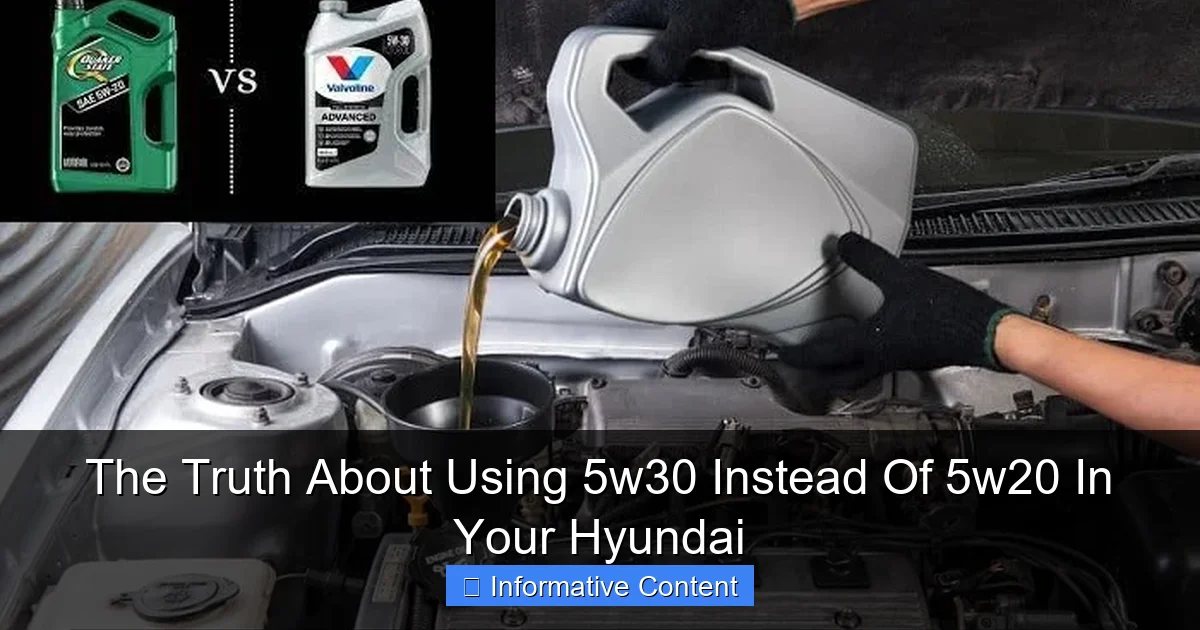
Using 5w30 instead of the manufacturer-recommended 5w20 in your Hyundai is not advised and can risk voiding your warranty or causing engine damage. Stick with 5w20 to ensure optimal fuel efficiency, engine protection, and performance as designed by Hyundai engineers.
In This Article
- 1 The Truth About Using 5w30 Instead Of 5w20 In Your Hyundai
- 1.1 Key Takeaways
- 1.2 📑 Table of Contents
- 1.3 Understanding the Code: What 5w20 and 5w30 Really Mean
- 1.4 Why Your Hyundai’s Manual Says 5w20: The Engineer’s Logic
- 1.5 The Potential Risks of Using 5w30 in a 5w20 Hyundai Engine
- 1.6 Are There Any Scenarios Where 5w30 Might Be Acceptable?
- 1.7 5w20 vs. 5w30: A Side-by-Side Data Comparison
- 1.8 Your Action Plan: What You Should Do for Your Hyundai
- 1.9 Conclusion: The Simple, Honest Verdict
- 1.10 Frequently Asked Questions
- 1.10.1 What happens if I use 5w30 instead of 5w20 in my Hyundai?
- 1.10.2 Is it safe to use 5w30 oil in a Hyundai that recommends 5w20?
- 1.10.3 Will using 5w30 instead of 5w20 affect my Hyundai’s fuel economy?
- 1.10.4 Can switching to 5w30 void my Hyundai’s warranty?
- 1.10.5 What are the pros and cons of using 5w30 over 5w20 in my Hyundai?
- 1.10.6 When should I consider using 5w30 instead of 5w20 in my Hyundai?
The Truth About Using 5w30 Instead Of 5w20 In Your Hyundai
Have you ever stood in the oil aisle at the auto parts store, holding two bottles and feeling utterly confused? One says 5w20. The other says 5w30. Your Hyundai’s manual clearly calls for 5w20. But maybe the 5w30 is on sale. Or your neighbor swears by it. Or you simply wonder, “What’s the real difference? Will my engine care?”
It’s a common question that pops up in online forums and between friends. I’ve been there too, staring at those labels, wondering if the little number switch is a secret hack or a highway to an expensive repair. The truth is, motor oil is your engine’s lifeblood, and using the wrong type isn’t a decision to make lightly.
In this post, we’re going to cut through the confusion and get to the heart of the matter. We’ll explore what those numbers mean, why Hyundai is so specific, and what really happens if you pour 5w30 into an engine designed for 5w20. By the end, you’ll have the clear, honest information you need to make the best choice for your car’s health and your wallet. Let’s dive in.
Key Takeaways
- Consult your owner’s manual: It lists the correct oil for your Hyundai.
- Using 5w30 may void warranty: Straying from specs can invalidate engine coverage.
- Expect reduced fuel efficiency: Thicker 5w30 oil increases friction and fuel use.
- Consider climate and driving conditions: 5w30 may be better for heat or heavy loads.
- Risk engine damage over time: Wrong viscosity can cause lubrication issues and wear.
- Consult a Hyundai dealer: They offer expert advice on oil specifications.
📑 Table of Contents
- Understanding the Code: What 5w20 and 5w30 Really Mean
- Why Your Hyundai’s Manual Says 5w20: The Engineer’s Logic
- The Potential Risks of Using 5w30 in a 5w20 Hyundai Engine
- Are There Any Scenarios Where 5w30 Might Be Acceptable?
- 5w20 vs. 5w30: A Side-by-Side Data Comparison
- Your Action Plan: What You Should Do for Your Hyundai
- Conclusion: The Simple, Honest Verdict
Understanding the Code: What 5w20 and 5w30 Really Mean
Before we can talk about swapping oils, we need to crack the code on the bottle. Those numbers aren’t just marketing; they’re a precise scientific grading system from the Society of Automotive Engineers (SAE). Think of it as the oil’s personality profile.
The “W” is for Winter (Not Weight)
The “W” stands for Winter. This tells you the oil’s viscosity, or thickness, when the engine is cold. The number before the W (the 5 in both 5w20 and 5w30) indicates how easily the oil flows at low temperatures. A lower number means thinner, faster-flowing oil when you start your car on a chilly morning. Both 5w20 and 5w30 have the same winter rating of “5”, meaning they should perform similarly during cold starts.
The Second Number is the Key Difference
This is where 5w20 and 5w30 part ways. The number after the “W” (the 20 and the 30) refers to the oil’s viscosity at the engine’s normal operating temperature, which is typically around 212°F (100°C). A higher number means the oil is thicker, or more resistant to flow, when hot. So, 5w30 oil is thicker at high temperatures than 5w20 oil.
In simple terms: Both oils start thin when cold (5w), but 5w30 “grows up” to be a thicker, more syrupy fluid in the heat of your engine compared to 5w20. This thickness creates the oil film that keeps metal parts from grinding together.
Why Your Hyundai’s Manual Says 5w20: The Engineer’s Logic
Hyundai (and Kia) engineers didn’t pick 5w20 out of a hat. Modern Hyundai engines, especially the fuel-efficient Gamma, Nu, Theta, and Smartstream families, are marvels of precision engineering. They’re built to incredibly tight tolerances—meaning the spaces between moving parts like pistons and bearings are microscopic.

Designed for Efficiency and Protection
These engines are optimized for two main things: fuel economy and emissions control. A thinner oil like 5w20 creates less internal drag (friction) as it splashes and circulates. Less drag means the engine doesn’t have to work as hard, which translates directly into better gas mileage at the pump. It also allows the engine to reach optimal operating temperature faster, which helps the catalytic converter work efficiently to reduce emissions.
A Delicate Balance of Flow and Film
The engineers calculate the perfect balance. The 5w20 oil is thin enough to quickly flow into all those tiny spaces during a cold start, providing instant lubrication. Yet, it’s still robust enough to maintain a protective film under normal hot running conditions. Using the specified oil ensures the engine performs exactly as designed, for years on end.
Deviating from this specification is like wearing thick winter gloves to do delicate watch repair. You might get the job done, but it’s not ideal, and you risk damaging the delicate mechanisms.
The Potential Risks of Using 5w30 in a 5w20 Hyundai Engine
So, you’ve decided to try 5w30. The engine won’t seize up immediately—it’s still oil, after all. But you are introducing several potential risks that can slowly but surely affect your car’s health and your finances.

Visual guide about Can I Use 5w30 Instead Of 5w20 In My Hyundai
Image source: autocareaids.com
Reduced Fuel Economy: The Silent Cost
This is the most immediate and measurable effect. Thicker oil (5w30) causes more rotational resistance inside the engine. Your engine has to use more energy (fuel) to overcome this drag. We’re not talking about dropping from 30 MPG to 15 MPG, but a consistent 1-3% decrease is very plausible. Over a year of driving, that adds up to a significant amount of money wasted on extra fuel.
Increased Wear During Cold Starts
Remember, both oils have the same “5w” cold rating. However, because 5w30 is formulated to be thicker when hot, its additives and base stock composition are different. In very cold climates, it may not flow quite as readily as 5w20 on that first critical start. The majority of engine wear happens in the first few seconds before oil pressure builds. Using anything other than the recommended oil slightly increases this risk.
Potential Strain on Oil-Dependent Systems
Modern engines use oil for more than just lubrication. Systems like the Variable Valve Timing (VVT) use oil pressure to operate precisely. These systems are calibrated for the flow characteristics of 5w20. A thicker oil like 5w30 can lead to slightly slower VVT response, potentially impacting performance, efficiency, and even triggering a check engine light in sensitive engines.
The Warranty Void Danger Zone
This is the big one. If your Hyundai is under its 5-year/60,000-mile powertrain warranty (or 10-year/100,000-mile original owner warranty), using an oil viscosity not recommended in the manual can be used by the dealer to deny a warranty claim. If you have an engine failure and they find 5w30 in the crankcase, they could reasonably argue that the incorrect oil contributed to the problem. The cost of an engine repair is far greater than any perceived benefit of using a different oil.
Are There Any Scenarios Where 5w30 Might Be Acceptable?
The rule is clear: use 5w20. But the real world isn’t always black and white. Let’s talk about some gray areas and practical exceptions, always with a giant asterisk.
Visual guide about Can I Use 5w30 Instead Of 5w20 In My Hyundai
Image source: autocareaids.com
The “Emergency Top-Off” Scenario
You’re on a road trip, your oil light comes on, and the only gas station for 50 miles only has 5w30. What do you do? In this genuine emergency, adding a quart of 5w30 to get you to a proper service station is absolutely acceptable. It’s far better than running the engine low on oil. Once you reach your destination, have the oil and filter changed back to the correct 5w20.
Older High-Mileage Hyundais: A Considered Compromise
For a Hyundai with over 150,000 miles, engine wear has naturally occurred. Bearings have minor wear, and piston rings may not seal as perfectly. In some cases, a slightly thicker oil like 5w30 can help by providing a thicker film to fill larger gaps and may reduce oil consumption (burning) and noise. However, this is a band-aid, not a cure. Important: Always consult a trusted mechanic before making this switch on an older vehicle. The potential downsides (like reduced flow to the VVT system) still exist.
Extreme, Sustained Heat Conditions
If you live in a place like the Arizona desert and are constantly towing a heavy trailer up mountains in 115°F heat, your engine oil is under extreme stress. In these very specific, severe-service conditions, some mechanics might suggest a slightly thicker oil. But for 99% of daily drivers, even in hot climates, the 5w20 designed for your engine is perfectly adequate, as it’s tested for these conditions.
5w20 vs. 5w30: A Side-by-Side Data Comparison
Let’s visualize the key differences in a simple table. This should help solidify the “why” behind the recommendation.
| Characteristic | 5w20 Oil | 5w30 Oil | Impact on Your Hyundai |
|---|---|---|---|
| Viscosity at 212°F (100°C) | Thinner | Thicker | 5w30 creates more internal engine friction. |
| Cold Start Flow (5w Rating) | Good | Good | Similar performance on cold mornings. |
| Engine Protection | Optimized for tight-tolerance engines | General protection for wider tolerances | 5w20 is the precise film strength your engine was designed for. |
| Fuel Economy | Maximized | Potentially Reduced | Using 5w30 can lower your MPG. |
| Best For | Modern, fuel-efficient engines (like most Hyundais) | Older engines or some specified for thicker oil | Stick with what the manufacturer specifies. |
Your Action Plan: What You Should Do for Your Hyundai
By now, the path forward should be pretty clear. But let’s wrap it all up into a simple, actionable plan to keep your Hyundai running smoothly for the long haul.
First and Foremost: Check Your Owner’s Manual
This is your car’s bible. Open it up to the lubricants section. It will state the recommended oil viscosity grade (almost certainly 5w20 for models from the last 15+ years) and the performance standard (like API SP). This is the only source of truth that matters for your specific vehicle.
Prioritize Quality Over Viscosity Debates
Whether you choose conventional, synthetic blend, or full synthetic, using a high-quality oil that meets the specification in your manual is more important than obsessing over a slight viscosity change. A premium full synthetic 5w20 will offer better protection and longevity than a cheap conventional 5w30.
Follow a Rigorous Oil Change Schedule
Oil breaks down over time. The single best thing you can do for your engine is to change the oil and filter regularly. Follow the “Severe Service” schedule in your manual if you do lots of short trips, idling, or driving in dusty conditions. Fresh, clean oil of the correct grade is unbeatable.
- Stick with 5w20: For all normal driving in a Hyundai under warranty or with moderate mileage.
- Consider a switch only after expert advice: For very high-mileage vehicles, talk to a mechanic you trust.
- In an emergency, any oil is better than no oil: But correct it as soon as possible.
Conclusion: The Simple, Honest Verdict
So, can you use 5w30 instead of 5w20 in your Hyundai? Technically, the engine will run. But you definitely should not make it a regular practice. The risks to your fuel economy, potential long-term wear, and most critically, your warranty coverage, are real and not worth the gamble.
Your Hyundai’s engineers are incredibly smart. They designed a fantastic engine and specified the 5w20 oil to make it perform at its absolute best—giving you great gas mileage, low emissions, and long-term reliability. Deviating from their blueprint might not cause a catastrophe tomorrow, but it’s like navigating with a slightly incorrect map; you might eventually get where you’re going, but the journey will be less efficient and more fraught with risk.
My final, friendly advice? Trust the manual. Pour in the recommended 5w20, change it on time, and drive with confidence. Your Hyundai—and your wallet—will thank you for miles and miles to come.
Frequently Asked Questions
What happens if I use 5w30 instead of 5w20 in my Hyundai?
Using 5w30 instead of 5w20 results in slightly thicker oil at operating temperature, which can enhance engine protection under high stress but may reduce fuel efficiency. For most Hyundais, this swap is acceptable temporarily or in extreme conditions, but always refer to your owner’s manual for the manufacturer’s specific advice to avoid potential issues.
Is it safe to use 5w30 oil in a Hyundai that recommends 5w20?
While generally safe for short-term or emergency use, consistently using 5w30 in a Hyundai designed for 5w20 is not recommended for long-term health. The engine is calibrated for 5w20 to optimize performance and fuel economy, so deviating could lead to increased wear or efficiency losses over time. Consult a professional mechanic or your dealership if you’re considering a permanent switch.
Will using 5w30 instead of 5w20 affect my Hyundai’s fuel economy?
Yes, using 5w30 can slightly lower fuel economy because its higher viscosity creates more internal engine resistance compared to 5w20. The difference is often minimal in daily driving, but over thousands of miles, it might result in a noticeable drop in miles per gallon, impacting overall running costs.
Can switching to 5w30 void my Hyundai’s warranty?
Switching to 5w30 could void your warranty if it contributes to engine damage and is identified as the cause during a claim. To protect your warranty, always use the oil grade specified in your Hyundai’s owner’s manual. If you must use 5w30, document the reason and seek approval from your dealership to avoid disputes.
What are the pros and cons of using 5w30 over 5w20 in my Hyundai?
The primary advantage of using 5w30 is improved engine protection in high-temperature or heavy-load scenarios due to its thicker film strength. However, drawbacks include reduced fuel efficiency and potentially harder cold starts, which might strain the engine in colder climates. Evaluate these factors based on your driving conditions and vehicle age.
When should I consider using 5w30 instead of 5w20 in my Hyundai?
Consider using 5w30 in your Hyundai if you frequently drive in very hot climates, tow trailers, or have an older engine with wider tolerances that benefits from thicker oil. For normal daily use, sticking with 5w20 is best to maintain the engineered balance of performance, efficiency, and longevity recommended by Hyundai.

At CarLegit, we believe information should be clear, factual, and genuinely helpful. That’s why every guide, review, and update on our website is created with care, research, and a strong focus on user experience.