
You can technically drive a car without a catalytic converter, but it’s not advisable. Doing so is illegal in most places, increases harmful emissions, and can trigger check engine lights or damage your vehicle over time.
In This Article
- 1 Key Takeaways
- 2 📑 Table of Contents
- 3 Can You Drive a Car Without a Catalytic Converter?
- 4 What Is a Catalytic Converter and Why Does It Matter?
- 5 Is It Legal to Drive Without a Catalytic Converter?
- 6 What Happens When You Drive Without a Catalytic Converter?
- 7 Environmental and Health Impacts
- 8 Myths vs. Reality: Common Misconceptions
- 9 What to Do If Your Catalytic Converter Is Stolen
- 10 Alternatives and Legal Modifications
- 11 Conclusion
- 12 Frequently Asked Questions
- 12.1 Is it illegal to drive without a catalytic converter?
- 12.2 Will my car run better without a catalytic converter?
- 12.3 Can I pass emissions testing without a catalytic converter?
- 12.4 What happens if I drive long-term without a catalytic converter?
- 12.5 How much does it cost to replace a catalytic converter?
- 12.6 What should I do if my catalytic converter is stolen?
Key Takeaways
- Legality: Driving without a catalytic converter is illegal in most U.S. states and many countries due to emissions laws.
- Environmental Impact: Removing the catalytic converter increases harmful pollutants like carbon monoxide and nitrogen oxides.
- Check Engine Light: Most modern cars will trigger a check engine light and fail emissions tests without a functioning catalytic converter.
- Performance Myths: Contrary to popular belief, removing the catalytic converter rarely improves performance and may reduce fuel efficiency.
- Vehicle Damage Risk: Long-term driving without a catalytic converter can damage oxygen sensors and the engine control unit.
- Insurance and Resale: Tampering with emissions systems can void warranties, affect insurance claims, and lower resale value.
- Legal Penalties: Fines, registration issues, and failed inspections are common consequences of driving without a catalytic converter.
📑 Table of Contents
- Can You Drive a Car Without a Catalytic Converter?
- What Is a Catalytic Converter and Why Does It Matter?
- Is It Legal to Drive Without a Catalytic Converter?
- What Happens When You Drive Without a Catalytic Converter?
- Environmental and Health Impacts
- Myths vs. Reality: Common Misconceptions
- What to Do If Your Catalytic Converter Is Stolen
- Alternatives and Legal Modifications
- Conclusion
Can You Drive a Car Without a Catalytic Converter?
So, you’re wondering: *Can you drive a car without a catalytic converter?* The short answer is yes—your car will likely still start and run. But just because you *can* do something doesn’t mean you *should*. Removing or driving without a catalytic converter comes with serious legal, environmental, and mechanical consequences.
The catalytic converter is a critical part of your vehicle’s exhaust system. It’s designed to reduce harmful emissions by converting toxic gases like carbon monoxide, hydrocarbons, and nitrogen oxides into less harmful substances such as carbon dioxide and water vapor. Since its mandatory inclusion in vehicles starting in the 1970s (thanks to the Clean Air Act), it’s become a cornerstone of automotive environmental responsibility.
But over the years, myths have spread—especially in car enthusiast circles—that removing the catalytic converter improves performance, increases horsepower, or boosts fuel economy. Some people also remove it to save money on repairs or because their car was stolen and the converter was ripped off. While it’s true that your car might run without it, the reality is far more complicated—and risky—than many realize.
What Is a Catalytic Converter and Why Does It Matter?
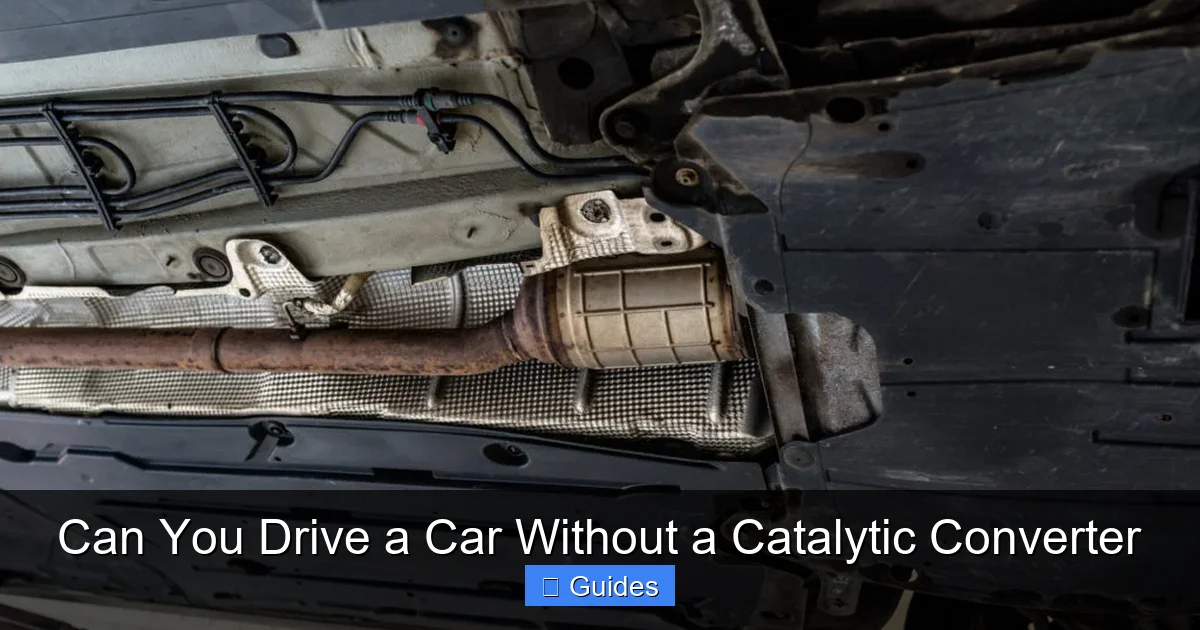
Visual guide about Can You Drive a Car Without a Catalytic Converter
Image source: mycarmakesnoise.com
Before diving into whether you can drive without one, let’s understand what a catalytic converter actually does.
A catalytic converter is a stainless steel canister located between the engine and the muffler in the exhaust system. Inside, it contains a ceramic honeycomb structure coated with precious metals like platinum, palladium, and rhodium. These metals act as catalysts—hence the name—to speed up chemical reactions that convert harmful exhaust gases into safer ones.
For example:
– Carbon monoxide (CO) is converted into carbon dioxide (CO₂).
– Unburned hydrocarbons (HC) are turned into water (H₂O) and CO₂.
– Nitrogen oxides (NOx) are broken down into nitrogen (N₂) and oxygen (O₂).
Without this device, your car would spew out dangerous levels of pollutants—levels that were common in vehicles before the 1970s. In fact, studies show that a properly functioning catalytic converter can reduce harmful emissions by up to 90%.
How It Works
The process happens in two stages:
1. **Reduction Catalyst:** The first stage reduces nitrogen oxides into nitrogen and oxygen.
2. **Oxidation Catalyst:** The second stage burns off unburned hydrocarbons and carbon monoxide by turning them into carbon dioxide and water.
Modern vehicles often use a three-way catalytic converter, which handles all three major pollutants in one unit. The system relies on precise air-fuel ratios and feedback from oxygen sensors to work efficiently.
Why It’s Required by Law
In the United States, the Environmental Protection Agency (EPA) mandates that all gasoline-powered vehicles manufactured after 1975 must have a catalytic converter. This rule is part of the Clean Air Act, which aims to reduce air pollution and protect public health.
Most states also require vehicles to pass emissions inspections before they can be registered or renewed. A missing or tampered catalytic converter will almost always cause a vehicle to fail these tests.
Is It Legal to Drive Without a Catalytic Converter?
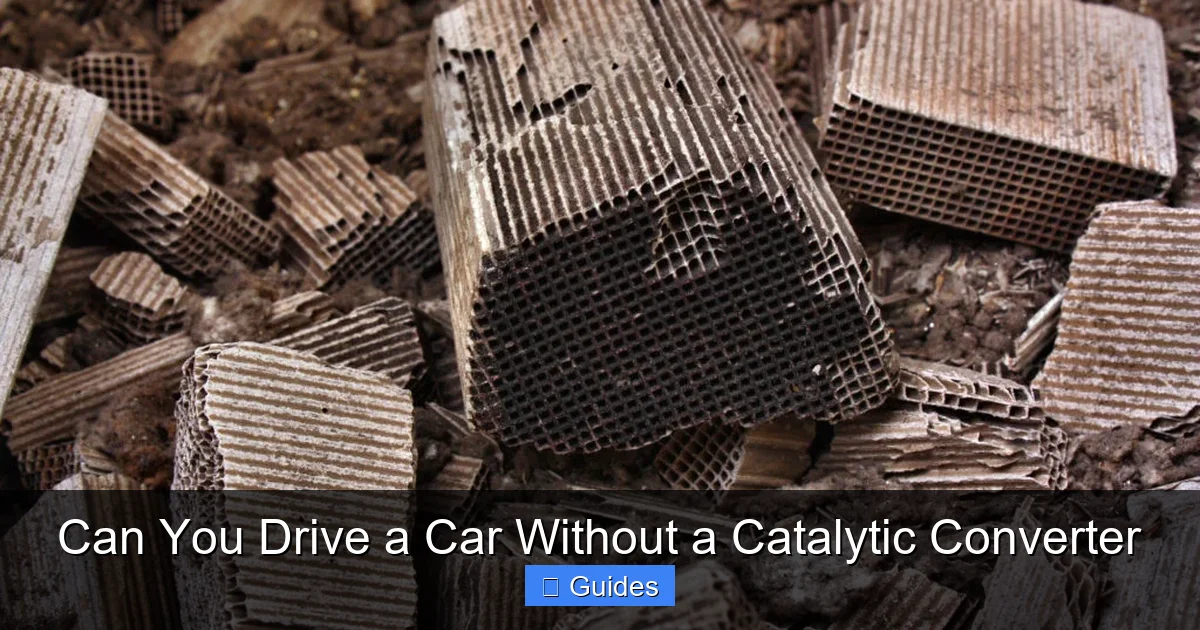
Visual guide about Can You Drive a Car Without a Catalytic Converter
Image source: mycarmakesnoise.com
Now, let’s get to the heart of the matter: *Is it legal to drive without a catalytic converter?*
The answer is a firm **no**—in most places.
Federal law prohibits the removal or modification of emissions control devices, including catalytic converters, on vehicles used on public roads. This applies even if you’re not currently undergoing an emissions test. The EPA enforces these rules, and violations can result in hefty fines.
State Laws and Emissions Testing
While federal law sets the baseline, individual states have their own regulations. For example:
– **California** has some of the strictest emissions laws in the country. Vehicles must meet California Air Resources Board (CARB) standards, and removing a catalytic converter is a clear violation.
– **Texas** requires emissions testing in major metropolitan areas like Houston and Dallas. A missing converter will cause an automatic fail.
– **New York** and **Colorado** also have rigorous testing programs.
Even in states without mandatory emissions testing, tampering with a catalytic converter can still be illegal under federal law. Law enforcement and DMV officials can flag your vehicle during routine inspections or traffic stops.
Penalties for Non-Compliance
If you’re caught driving without a catalytic converter, you could face:
– Fines ranging from $100 to $1,000 or more, depending on the state.
– Inability to renew your vehicle registration.
– Points on your driving record in some jurisdictions.
– Mandatory repairs and re-inspection.
In extreme cases—especially if the vehicle is used commercially or involved in an accident—insurance companies may deny claims if they discover emissions tampering.
What Happens When You Drive Without a Catalytic Converter?
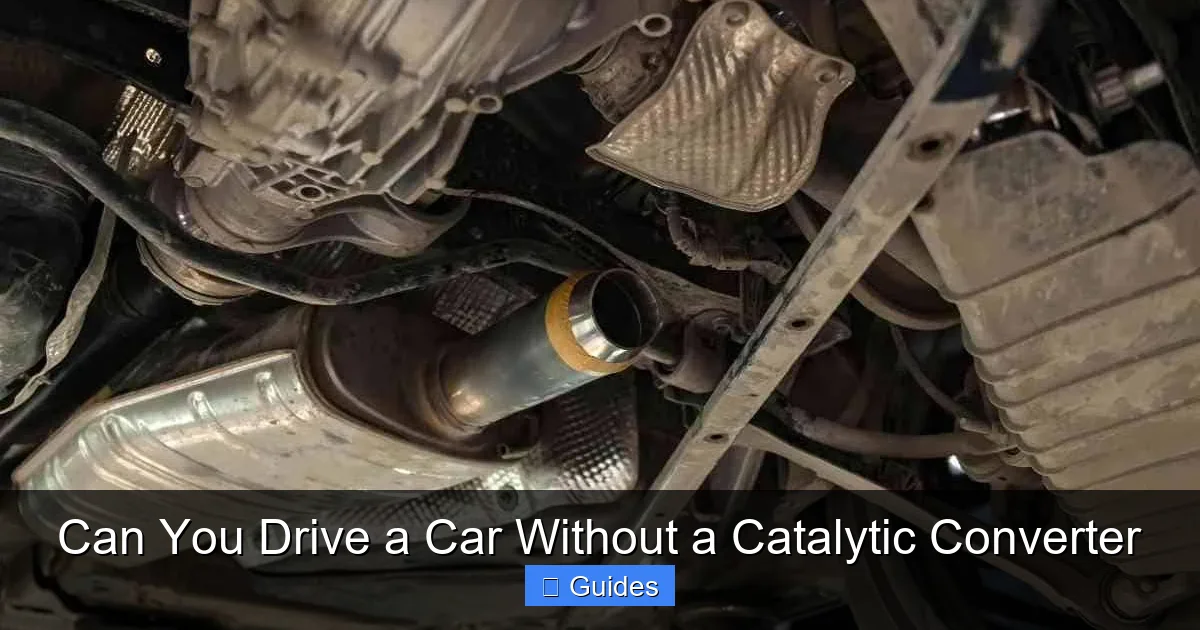
Visual guide about Can You Drive a Car Without a Catalytic Converter
Image source: autocareaids.com
So, your car might still run without a catalytic converter—but what exactly happens when you drive it?
Let’s break it down.
Engine Performance and Behavior
Many people believe that removing the catalytic converter will make their car faster or more powerful. The idea is that the converter creates backpressure, which restricts exhaust flow and reduces performance.
While it’s true that a clogged or failing catalytic converter can restrict exhaust flow and hurt performance, a properly functioning one has minimal impact on horsepower. In fact, modern catalytic converters are designed to be highly efficient with little to no restriction.
If you remove the converter, you might notice:
– A louder exhaust note (often described as “raspy” or “boomy”).
– A slight increase in engine noise.
– No significant gain in horsepower or torque.
In some cases, performance may actually *decrease*. Why? Because modern engines rely on precise feedback from oxygen sensors to maintain the correct air-fuel ratio. Removing the catalytic converter can disrupt this feedback loop, causing the engine control unit (ECU) to run the engine too rich or too lean.
Check Engine Light and Error Codes
One of the most immediate consequences of driving without a catalytic converter is the dreaded check engine light.
Modern vehicles are equipped with oxygen sensors before and after the catalytic converter. These sensors monitor the levels of oxygen in the exhaust to determine how well the converter is working.
When the catalytic converter is missing, the downstream oxygen sensor detects abnormal oxygen levels and sends a signal to the ECU. This triggers a diagnostic trouble code (DTC), such as:
– P0420: Catalyst System Efficiency Below Threshold (Bank 1)
– P0430: Catalyst System Efficiency Below Threshold (Bank 2)
These codes will illuminate the check engine light and may cause the vehicle to enter “limp mode” in some cases, reducing power to protect the engine.
Fuel Efficiency and Engine Health
Contrary to popular belief, removing the catalytic converter does not improve fuel economy. In fact, it can make things worse.
When the ECU detects a problem with the emissions system, it may adjust fuel delivery to compensate. This can lead to:
– Poor fuel economy
– Rough idling
– Hesitation during acceleration
– Increased emissions
Over time, driving without a catalytic converter can also damage other components. For example:
– **Oxygen sensors** may fail prematurely due to increased exposure to raw exhaust gases.
– **The ECU** may struggle to maintain optimal performance, leading to long-term engine wear.
– **The exhaust system** may corrode faster without the heat-retaining properties of the converter.
Environmental and Health Impacts
Beyond the legal and mechanical issues, driving without a catalytic converter has serious environmental and health consequences.
Increased Air Pollution
Without a catalytic converter, your vehicle emits significantly higher levels of:
– **Carbon monoxide (CO):** A colorless, odorless gas that can be deadly in high concentrations. It reduces the blood’s ability to carry oxygen.
– **Hydrocarbons (HC):** Contribute to smog and ground-level ozone, which can trigger asthma and other respiratory issues.
– **Nitrogen oxides (NOx):** Linked to acid rain, smog, and respiratory problems.
According to the EPA, motor vehicles are a major source of air pollution. A single car without a catalytic converter can emit as much pollution as dozens of properly equipped vehicles.
Impact on Public Health
Air pollution from vehicles contributes to:
– Respiratory diseases like asthma and bronchitis
– Cardiovascular problems
– Increased risk of lung cancer
– Premature death, especially in children and the elderly
Communities near highways and urban areas are particularly vulnerable. Removing catalytic converters not only harms the environment but also puts public health at risk.
Climate Change Considerations
While catalytic converters don’t directly reduce carbon dioxide (CO₂)—the primary greenhouse gas—they do help reduce other pollutants that contribute to climate change and environmental degradation. By ensuring your vehicle meets emissions standards, you’re doing your part to reduce your carbon footprint.
Myths vs. Reality: Common Misconceptions
Let’s clear up some of the most common myths about driving without a catalytic converter.
Myth 1: “It Gives You More Horsepower”
Reality: Any performance gain is minimal—if it exists at all. Modern engines are tuned to work with catalytic converters. Removing one may actually hurt performance due to disrupted sensor feedback.
Myth 2: “It Saves Money on Repairs”
Reality: While replacing a catalytic converter can be expensive ($1,000–$3,000), driving without one can lead to other costly repairs—like replacing oxygen sensors or fixing engine issues caused by poor fuel management.
Myth 3: “It’s Fine If You Don’t Get Caught”
Reality: Emissions inspections, traffic stops, and resale checks can all reveal tampering. Plus, you’re contributing to pollution and breaking the law.
Myth 4: “Diesel Cars Don’t Need Catalytic Converters”
Reality: Many diesel vehicles use diesel oxidation catalysts (DOCs) or selective catalytic reduction (SCR) systems. Removing these is also illegal and harmful.
What to Do If Your Catalytic Converter Is Stolen
Unfortunately, catalytic converter theft has become a growing problem. Thieves target them because of the valuable metals inside—especially rhodium, which can be worth more than gold.
If your catalytic converter is stolen, here’s what you should do:
Step 1: Report the Theft
Contact your local police immediately. File a report and get a copy for your insurance company.
Step 2: Contact Your Insurance
Comprehensive auto insurance typically covers catalytic converter theft. Check your policy and file a claim.
Step 3: Get It Replaced
Have a qualified mechanic install a new catalytic converter. Make sure it’s CARB-compliant if you live in California or another strict state.
Step 4: Prevent Future Theft
– Park in well-lit, secure areas.
– Install a catalytic converter anti-theft device.
– Engrave your VIN on the converter to deter thieves.
Alternatives and Legal Modifications
If you’re looking to improve performance or sound, there are legal alternatives to removing your catalytic converter.
High-Flow Catalytic Converters
These are performance-oriented converters that reduce backpressure while still meeting emissions standards. They’re legal in most states and can improve exhaust flow without sacrificing compliance.
Cat-Back Exhaust Systems
These systems replace the exhaust from the catalytic converter back to the tailpipe. They can enhance sound and performance without removing emissions components.
Tuning and ECU Remapping
A professional tune can optimize your engine’s performance while keeping emissions systems intact. This is a legal and effective way to get more power.
Conclusion
So, can you drive a car without a catalytic converter? Technically, yes—but it’s a bad idea for many reasons.
You’ll be breaking the law, harming the environment, risking engine damage, and likely seeing no real performance benefits. The check engine light will probably come on, your car may fail emissions tests, and you could face fines or registration issues.
Instead of removing your catalytic converter, consider legal upgrades like high-flow converters or performance exhaust systems. If your converter is damaged or stolen, get it replaced as soon as possible.
Your car, your community, and the planet will thank you.
Frequently Asked Questions
Is it illegal to drive without a catalytic converter?
Yes, it’s illegal in most U.S. states and many countries. Federal and state emissions laws require catalytic converters on gasoline-powered vehicles. Driving without one can result in fines and registration issues.
Will my car run better without a catalytic converter?
Not really. While some believe it increases horsepower, modern engines are designed to work with catalytic converters. Removing one often causes check engine lights and may reduce performance due to disrupted sensor feedback.
Can I pass emissions testing without a catalytic converter?
No. Most states require emissions tests, and a missing or tampered catalytic converter will cause an automatic failure. You’ll need to reinstall a compliant converter to pass.
What happens if I drive long-term without a catalytic converter?
Long-term driving without a catalytic converter can damage oxygen sensors, harm engine performance, increase emissions, and lead to costly repairs. It also violates environmental laws.
How much does it cost to replace a catalytic converter?
Replacement costs vary from $1,000 to $3,000 or more, depending on the vehicle and whether you use OEM or aftermarket parts. High-flow or performance converters may cost extra.
What should I do if my catalytic converter is stolen?
Report the theft to police, contact your insurance company, and have a certified mechanic install a new, compliant catalytic converter. Consider anti-theft measures to prevent future thefts.

At CarLegit, we believe information should be clear, factual, and genuinely helpful. That’s why every guide, review, and update on our website is created with care, research, and a strong focus on user experience.