

Technically, yes, you can install a Maserati front end on a Dodge Viper, but it requires extensive custom fabrication and is far from a simple bolt-on operation. This radical swap demands significant metalwork, custom mounting solutions, and a hefty budget, making it a project only for experienced fabricators. The result is a unique hybrid that blends Italian styling with American muscle, but it’s a monumental undertaking that challenges both engineering and aesthetics.
In This Article
- 1 Key Takeaways
- 2 📑 Table of Contents
- 3 The Truth About Swapping a Maserati Front End Onto a Viper
- 4 The Origin of the Idea: Where Did This Come From?
- 5 The Mountain of Technical Challenges
- 6 Cost Analysis: What’s the Financial Reality?
- 7 Performance and Safety Implications
- 8 Legal and Insurance Roadblocks
- 9 A More Practical Alternative: The Widebody and Custom Front Fascia Route
- 10 Data Table: Viper vs. Maserati GranTurismo – Key Specs at a Glance
- 11 Conclusion: So, Should You Attempt This Swap?
- 12 Frequently Asked Questions
- 12.1 Is it physically possible to install a Maserati front end on a Viper?
- 12.2 What are the biggest challenges of swapping a Maserati front end onto a Viper?
- 12.3 How much would it cost to put a Maserati front end on a Viper?
- 12.4 Why would someone want to install a Maserati front end on a Viper?
- 12.5 Will this modification affect the Viper’s handling and performance?
- 12.6 Are there legal or insurance issues with a Maserati front end on a Viper?
Key Takeaways
- Technical Feasibility: Possible with extensive custom fabrication and engineering.
- High Cost: Expect significant expenses for parts and skilled labor.
- Major Compatibility Issues: Mounting points and structural frames differ radically.
- Requires Expert Fabrication: Not a DIY project; seek professional help.
- Check Legal Regulations: Modifications may affect safety and registration compliance.
- Aesthetic Outcome Uncertain: Achieving a seamless, factory look is challenging.
- Resale Value Impact: This swap likely decreases the Viper’s market value.
📑 Table of Contents
- The Truth About Swapping a Maserati Front End Onto a Viper
- The Origin of the Idea: Where Did This Come From?
- The Mountain of Technical Challenges
- Cost Analysis: What’s the Financial Reality?
- Performance and Safety Implications
- Legal and Insurance Roadblocks
- A More Practical Alternative: The Widebody and Custom Front Fascia Route
- Data Table: Viper vs. Maserati GranTurismo – Key Specs at a Glance
- Conclusion: So, Should You Attempt This Swap?
The Truth About Swapping a Maserati Front End Onto a Viper
Let’s be honest for a second. If you’re reading this, you’ve probably had one of those late-night, “what if” car thoughts. You were scrolling through images of a sleek Maserati GranTurismo, then swiped over to a raw, menacing Dodge Viper, and a crazy idea popped into your head: What if you could combine them? Specifically, what if you could take the elegant, trident-bearing face of a Maserati and graft it onto the brutal, no-nonsense body of a Viper?
It’s the kind of project that sounds equal parts awesome and absurd. On one hand, you’d have a machine with the soul of an American V10 supercar and the sophisticated looks of an Italian GT. On the other, you’d be staring down a mountain of fabrication, engineering headaches, and a budget that could make your eyes water. So, can you actually install a Maserati front end on a Viper? The short, technical answer is: with enough time, money, and skill, you can do almost anything. But should you?
This isn’t just a simple bolt-on affair. It’s a deep dive into the world of extreme automotive customization. We’re going to unpack the reality of this wild swap, moving beyond forum rumors and Photoshop renders to look at the real engineering, cost, and practicality involved. Whether you’re a curious enthusiast or a budding fabricator with a death wish, buckle up. We’re getting into the truth about this iconic, if unlikely, hybrid.
The Origin of the Idea: Where Did This Come From?
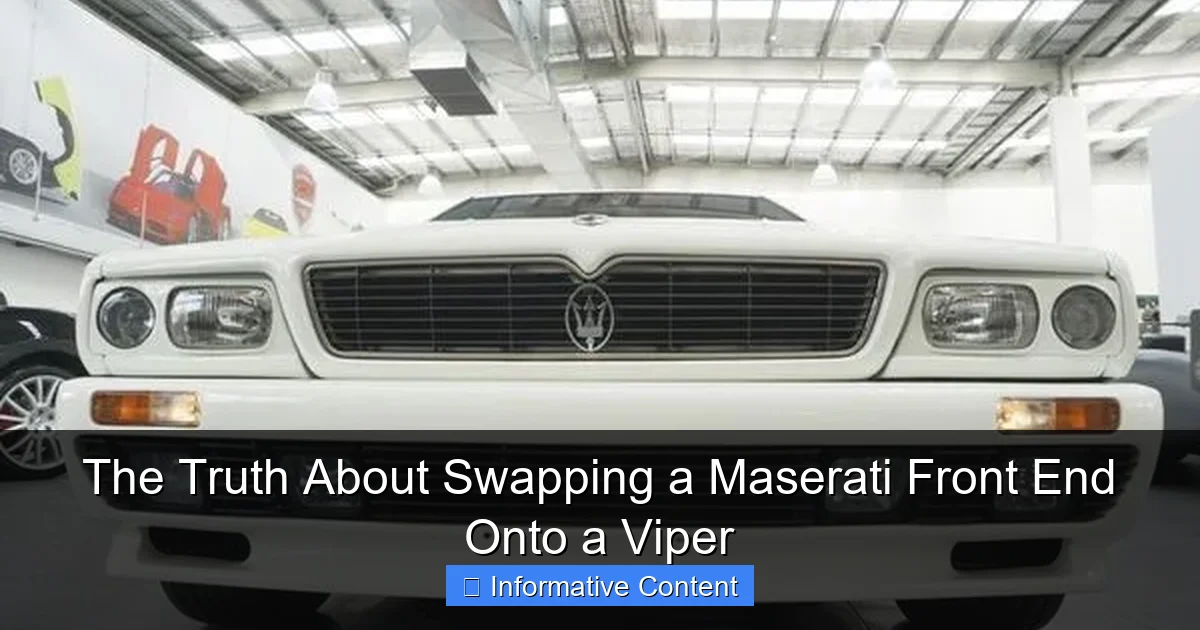
Before we get our hands dirty with wrenches and welders, it’s worth asking: why would anyone even think of this? The Maserati front end on a Viper isn’t a common idea, but it taps into a universal car enthusiast desire—creating something utterly unique.
Visual guide about Can You Install A Maserati Front End On A Viper
Image source: i.pinimg.com
The Allure of the “Frankenstein” Build
Car culture has always celebrated the outlier. From resto-mods to engine swaps, the drive to personalize is powerful. The concept of putting a Maserati front end on a Viper is the ultimate expression of this. It’s about merging two diametrically opposed philosophies: Italian luxury and grace with American horsepower and aggression. The visual clash is the entire point. It’s a statement build, meant to turn heads and spark debates at every cars and coffee.
Inspiration from Other Wild Swaps
This idea doesn’t exist in a vacuum. The automotive world has seen its share of famous front-end swaps. Remember the “Ferrari” Fieros of the 80s and 90s? Or the countless Porsche 911-front-ended Volkswagen Beetles? These projects prove that with enough determination, you can make disparate car parts fit together. They set a precedent, showing enthusiasts that such a transformation is possible, even if it’s immensely challenging.
The Mountain of Technical Challenges
This is where the rubber meets the road, or more accurately, where the Maserati fascia doesn’t meet the Viper frame. The technical hurdles are monumental, and they go far beyond just making something “look like it fits.”

Visual guide about Can You Install A Maserati Front End On A Viper
Image source: 4.bp.blogspot.com
Fundamental Dimensions and Architecture
A Dodge Viper and a Maserati GranTurismo (the most likely donor for such a swap) are built on completely different scales and principles. The Viper is a front-engined, rear-wheel-drive sports car with a massive hood to accommodate its V10. The GranTurismo is a front-engined GT, but its proportions, wheelbase, and overall width are different. The first and biggest wall you hit is the core structure. The Maserati’s front clip, including its bumper support, radiator core support, and fender attachment points, is designed for its own aluminum spaceframe or unibody. The Viper has its own unique tubular steel frame. Nothing will bolt up.
The Fabrication Reality
This means you’re entering the realm of full custom fabrication. You would need to:
- Create a completely new subframe or adapter to position the Maserati bumper and fenders correctly in relation to the Viper’s wheels and suspension.
- Re-engineer the mounting points for the hood, headlights, and fenders. This isn’t just drilling new holes; it’s building new structural brackets from scratch.
- Handle panel gaps with extreme precision. Italian body panels are known for their tight, exact gaps. Matching that on a hand-fabricated American chassis is a master-level skill.
Essentially, you’re not installing a front end; you’re sculpting a new one inspired by a Maserati, using some of its original parts.
Integrating Electrical and Cooling Systems
Let’s say you miraculously get the bodywork to fit. Now you have to make it function. The Maserati’s complex headlights, daytime running lights, and sensors would need to be integrated into the Viper’s vastly different electrical system. This likely requires custom wiring harnesses, controllers, and possibly a standalone module just for the lights.
Then there’s cooling. The Viper’s radiator and cooling ducting are designed for its specific aerodynamic profile. Blocking or altering that airflow with a differently shaped Maserati bumper could lead to overheating that mighty V10—a catastrophic and expensive failure.
Cost Analysis: What’s the Financial Reality?
Dreams are free, but metal, labor, and parts are not. Let’s break down the potential costs of such an endeavor. Remember, these are estimates for a professional-level job, not a backyard hack.
Parts Acquisition
First, you need a Maserati front end. This isn’t a catalog item. You’d need to source a wrecked or donor Maserati GranTurismo (2007-2019) to get the bumper, fenders, hood, headlights, grille, and all underlying supports and brackets. Even from a salvage yard, this collection of parts could easily run $5,000 to $10,000+, depending on condition and color.
The Fabrication Labor
This is the budget killer. Skilled metal fabricators and automotive engineers charge premium rates. Designing, fabricating, test-fitting, and finishing a custom front-end subframe and all mounting hardware is a project that could take hundreds of hours. A conservative estimate for professional labor alone could be $15,000 to $30,000, if not more.
Paint, Finish, and Contingency
Once everything is physically attached, it all needs to be painted to match perfectly. A high-quality, multi-stage paint job on a modified front end is another $3,000 to $8,000. And you must have a contingency fund. In projects this complex, something always goes wrong or requires a re-design. A $5,000 buffer is a bare minimum.
Performance and Safety Implications
Modifying a car this radically isn’t just about looks; it has real-world consequences for how the car drives and, most importantly, protects you.
Aerodynamics and Handling
The Dodge Viper’s front end is designed for high-speed stability and brake cooling. Its shape channels air in specific ways. A Maserati bumper has a different aerodynamic profile. This swap could introduce unwanted lift, drag, or turbulence at high speeds, making the car feel nervous or unstable. It could also disrupt airflow to the brakes, leading to premature fade on a track or during spirited driving.
Safety and Structural Integrity
This is the most critical consideration. Modern car front ends are engineered as crumple zones to absorb impact energy in a crash. By removing the factory-designed Viper front structure and replacing it with a custom one not tested for crash dynamics, you are potentially compromising the car’s entire safety system. In an accident, the energy might not dissipate correctly, leading to greater injury for the occupants. This also has serious implications for insurance and legality.
Legal and Insurance Roadblocks
Even if you conquer the build, you might not be able to legally drive it.
Insurance Challenges
Insuring a heavily modified car is difficult. Most standard insurers will either refuse coverage or offer a policy that excludes coverage for the custom parts and their installation. You would likely need to seek out a specialty insurer (like Hagerty or Grundy) for an agreed-value policy. They will require documentation and professional appraisals, and your premium will reflect the unique and high-risk nature of the vehicle.
Registration and Inspection
Laws vary by state and country, but major structural modifications often trigger scrutiny. Your vehicle may need a “reconstructed” or “specially constructed” title. It will almost certainly need to pass a safety inspection, where an inspector could fail the car due to non-standard lighting, altered crumple zones, or questionable modification practices. Passing emissions might also be an issue if the modification affects the engine computer or airflow sensors.
A More Practical Alternative: The Widebody and Custom Front Fascia Route
If the dream is a Viper with more exotic, Italianate styling, there is a far more achievable path that avoids the nightmare of a full front-end swap.
Commissioning a Custom Viper Front Fascia
Instead of trying to force a Maserati part to fit, work with a skilled automotive designer or a company that makes aftermarket Viper body kits. You can have a brand new, one-off front bumper and fenders designed from scratch that incorporate design cues from Maserati—the shape of the grille, the curve of the intake, the style of the headlights—while being engineered specifically for the Viper’s chassis. This solves the mounting, safety, and aerodynamic issues from the start.
High-Quality Widebody Kits and Styling
The aftermarket for Vipers is vast. Consider pairing a custom front fascia with a reputable widebody kit from a company like Prior Design or Adv.1. This approach gives you a cohesive, professionally engineered look that enhances the Viper’s aggression while injecting new style. The cost, while still significant, will be lower and more predictable than a Frankenstein swap, and the final product will be more reliable and safer.
Data Table: Viper vs. Maserati GranTurismo – Key Specs at a Glance
This table highlights the fundamental differences between the two potential donors, illustrating why a swap is so complex.
| Specification | Dodge Viper (5th Gen, 2013-2017) | Maserati GranTurismo (2007-2019) |
|---|---|---|
| Engine | 8.4L V10 (645-650 hp) | 4.2L or 4.7L V8 (395-454 hp) |
| Layout | Front-engine, RWD | Front-engine, RWD |
| Chassis | Tubular steel frame | Aluminum spaceframe/unibody |
| Wheelbase | ~98.8 in | ~115.8 in |
| Overall Width | ~76.4 in | ~75.6 in |
| Front Track Width | ~62.6 in | ~63.1 in |
| Primary Material | Fiberglass/Carbon Composite | Steel/Aluminum |
Conclusion: So, Should You Attempt This Swap?
After dissecting the idea from every angle, the truth about swapping a Maserati front end onto a Viper is clear. It is a prohibitively difficult, expensive, and impractical endeavor for all but the most skilled, well-funded, and determined fabricators. The challenges are not merely cosmetic; they are deeply rooted in fundamental automotive engineering, safety, and cost.
For 99.9% of enthusiasts, the answer is a resounding no. The risks to the car’s dynamics, your safety, and your bank account are simply too high. However, the spirit of the idea—creating a uniquely styled, head-turning Viper—is absolutely valid.
If you are captivated by the vision of a Viper with Italian flair, channel that energy into a more sensible path. Explore the world of custom-fabricated fascia designs or high-end widebody kits tailored for the Viper platform. You’ll end up with a car that is stunning, reliable, and truly your own, without the sleepless nights and empty wallet of a near-impossible swap. In the end, the best project car is the one you can actually finish and enjoy on the road.
Frequently Asked Questions
Is it physically possible to install a Maserati front end on a Viper?
Technically, yes, but it requires extensive custom fabrication due to major differences in chassis dimensions and mounting points. This is not a bolt-on operation and involves cutting, welding, and bodywork to achieve even a basic fit.
What are the biggest challenges of swapping a Maserati front end onto a Viper?
The primary hurdles are aligning the radically different front-end structures and ensuring proper suspension and steering geometry. You’ll also face significant work integrating cooling systems, electronics, and maintaining crash safety integrity.
How much would it cost to put a Maserati front end on a Viper?
Costs can easily exceed $20,000 to $50,000 for parts, professional fabrication, and paint. This high price reflects the immense custom work needed, as there are no pre-made kits for this specific swap.
Why would someone want to install a Maserati front end on a Viper?
Some enthusiasts are drawn to the unique, hybrid aesthetics for a one-of-a-kind custom car. However, it’s generally considered a highly impractical project that compromises the Viper’s original design and performance intent.
Will this modification affect the Viper’s handling and performance?
Yes, significantly. Altering the front-end geometry and weight distribution can negatively impact the Viper’s legendary handling and aerodynamics. Correcting these issues would require additional, extensive engineering and testing.
Are there legal or insurance issues with a Maserati front end on a Viper?
Yes, such a major alteration likely voids the factory warranty and must meet local safety regulations for lights and bumpers. It’s crucial to inform your insurance company, as coverage may be denied or premiums increased for this radical modification.

At CarLegit, we believe information should be clear, factual, and genuinely helpful. That’s why every guide, review, and update on our website is created with care, research, and a strong focus on user experience.