
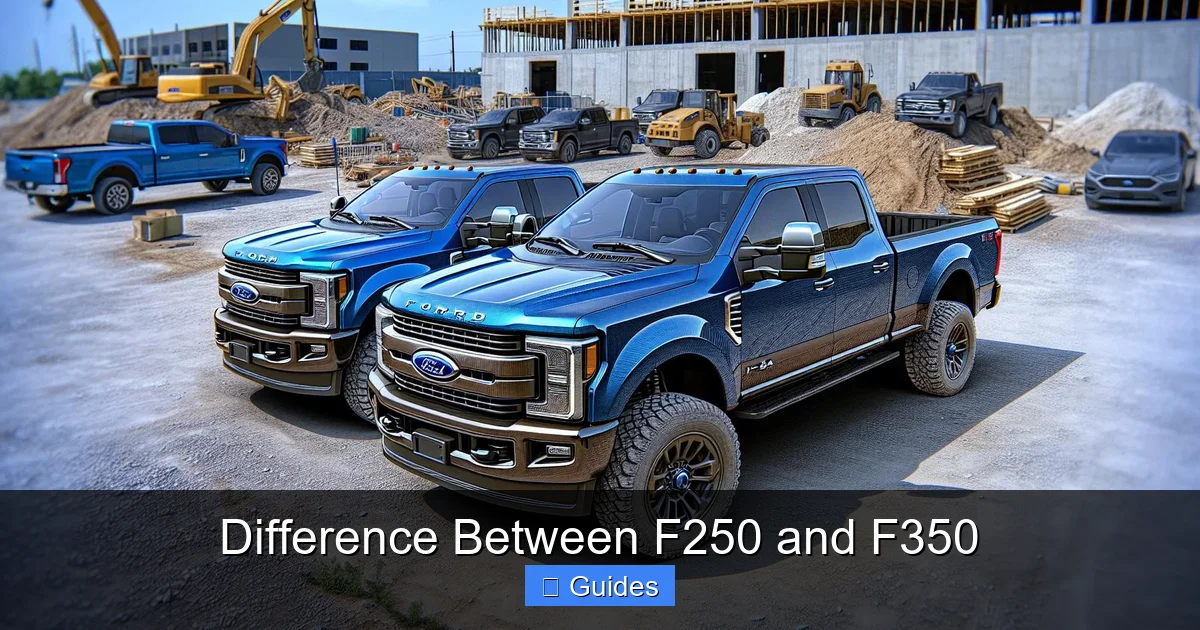
The difference between F250 and F350 comes down to capability, durability, and intended use. While both are part of Ford’s Super Duty lineup, the F350 offers higher towing and payload ratings, a stronger frame, and better performance for heavy-duty tasks. The F250 is ideal for most work and towing needs, but the F350 steps up when you need maximum strength and reliability.
In This Article
- 1 Key Takeaways
- 2 📑 Table of Contents
- 3 Introduction: Choosing the Right Ford Super Duty
- 4 Understanding the Ford Super Duty Lineup
- 5 Towing Capacity: F250 vs F350
- 6 Payload Capacity and Hauling Strength
- 7 Frame, Axles, and Structural Durability
- 8 Fuel Economy and Operating Costs
- 9 Choosing the Right Truck for Your Needs
- 10 Conclusion: Making the Smart Choice
- 11 Frequently Asked Questions
Key Takeaways
- Towing Capacity: The F350 generally offers higher towing capacity than the F250, especially when equipped with the high-output diesel engine and gooseneck/fifth-wheel setup.
- Payload Strength: The F350 has a stronger suspension and frame, allowing it to carry heavier loads in the bed compared to the F250.
- Frame and Suspension: The F350 features a heavier-duty frame, larger axles, and upgraded suspension components designed for extreme workloads.
- Rear Axle Options: The F350 often comes with a dual rear wheel (DRW) option, increasing stability and load distribution for heavy hauling.
- Intended Use: The F250 suits most contractors, RV owners, and weekend warriors, while the F350 is built for commercial use, heavy equipment transport, and extreme towing.
- Fuel Economy: The F250 typically gets slightly better fuel economy due to lighter weight and less robust components.
- Price Difference: The F350 usually costs more upfront and may have higher maintenance costs due to its heavy-duty design.
📑 Table of Contents
- Introduction: Choosing the Right Ford Super Duty
- Understanding the Ford Super Duty Lineup
- Towing Capacity: F250 vs F350
- Payload Capacity and Hauling Strength
- Frame, Axles, and Structural Durability
- Fuel Economy and Operating Costs
- Choosing the Right Truck for Your Needs
- Conclusion: Making the Smart Choice
Introduction: Choosing the Right Ford Super Duty
When it comes to heavy-duty trucks, Ford’s Super Duty lineup stands out as one of the most trusted names in the industry. Whether you’re hauling a trailer across state lines, towing a massive RV, or carrying construction materials to a job site, Ford offers two of the most popular options: the F250 and the F350. But how do you decide which one is right for you? The difference between F250 and F350 isn’t just a number—it’s a reflection of capability, durability, and intended use.
Many buyers assume the F350 is just a “bigger” version of the F250, but the truth is more nuanced. While both trucks share similar designs, engines, and technology, the F350 is engineered for heavier workloads and more extreme conditions. Understanding the difference between F250 and F350 can save you money, prevent overbuying, or ensure you don’t end up with a truck that can’t handle your needs. Whether you’re a contractor, farmer, or outdoor enthusiast, this guide will help you make an informed decision.
Understanding the Ford Super Duty Lineup
Before diving into the specifics, it’s important to understand where the F250 and F350 fit within Ford’s Super Duty family. The Super Duty series includes the F250, F350, and F450, each designed for increasingly demanding tasks. These trucks are built on a separate, heavier platform than Ford’s light-duty F150, meaning they’re purpose-built for work, not just weekend adventures.

Visual guide about Difference Between F250 and F350
Image source: allinthedifference.com
What Defines a Super Duty Truck?
Super Duty trucks are engineered with reinforced frames, heavy-duty suspensions, and high-torque engines. They’re designed to handle towing and hauling tasks that would overwhelm most pickup trucks. The F250 and F350 are the most common models, offering a balance of power, comfort, and capability. While they look similar on the outside, their internal components and structural strength vary significantly.
Despite their differences, the F250 and F350 share many features. Both are available with Ford’s powerful 6.7L Power Stroke V8 turbo diesel engine, which delivers up to 475 horsepower and 1,050 lb-ft of torque. They also offer the 7.3L Godzilla V8 gasoline engine and the high-output diesel variant for even more towing power. Inside, you’ll find similar technology packages, including the SYNC 4 infotainment system, available 12-inch touchscreen, and advanced driver-assist features like adaptive cruise control and blind-spot monitoring.
Both trucks come in multiple cab configurations (Regular Cab, SuperCab, and Crew Cab) and bed lengths (6.75 ft and 8 ft). They also offer a range of trim levels, from the work-focused XL to the luxurious Limited. This shared DNA makes the difference between F250 and F350 less about features and more about strength and capacity.
Towing Capacity: F250 vs F350
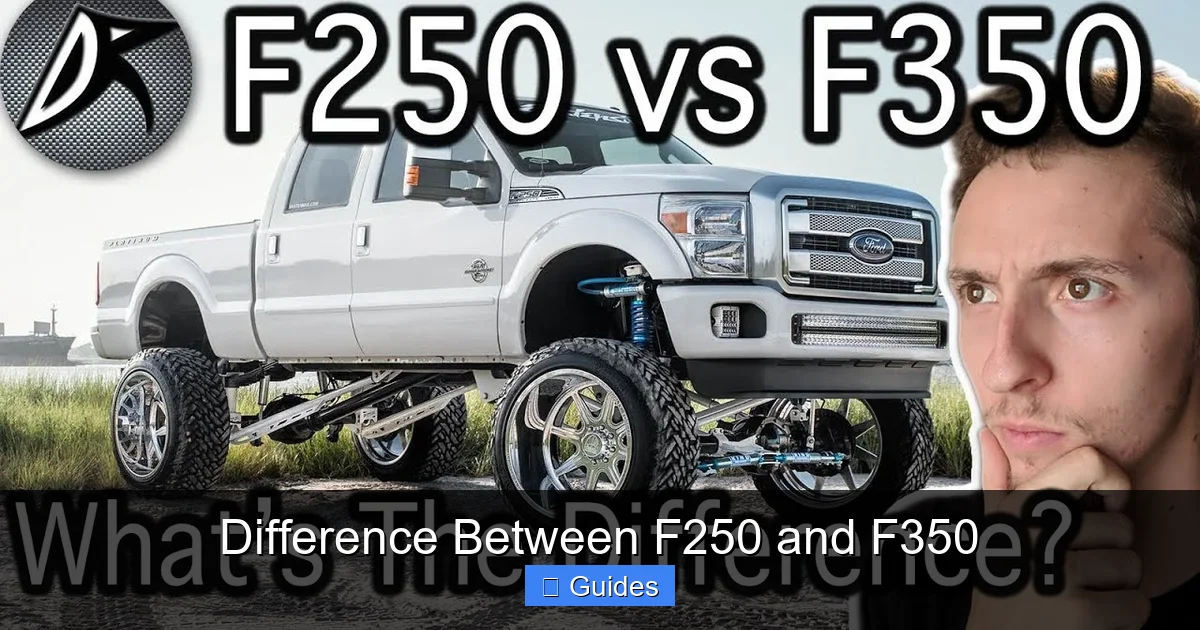
One of the most significant difference between F250 and F350 is towing capacity. If you plan to tow heavy trailers, RVs, or equipment, this is a critical factor. The F350 generally outperforms the F250, especially when equipped with the right options.
Visual guide about Difference Between F250 and F350
Image source: i.ytimg.com
Standard Towing Ratings
The F250 has a maximum towing capacity of around 15,000 to 18,000 pounds, depending on configuration. This is more than enough for most travel trailers, horse trailers, and small construction equipment. The F350, on the other hand, can tow up to 21,000 pounds in its standard configuration. With the high-output diesel engine and gooseneck or fifth-wheel setup, the F350 can reach an impressive 37,000 pounds—nearly double the F250’s maximum.
Real-World Towing Examples
Let’s say you’re towing a 12,000-pound fifth-wheel RV. The F250 can handle this with ease, especially with the diesel engine and proper hitch setup. But if you upgrade to a 20,000-pound toy hauler or a large horse trailer with living quarters, the F350 becomes the better choice. The F350’s stronger frame and suspension reduce sway and improve control, making long-distance towing safer and more comfortable.
Gooseneck and Fifth-Wheel Towing
For maximum towing performance, both trucks support gooseneck and fifth-wheel hitches. However, the F350’s dual rear wheel (DRW) option provides better weight distribution and stability when towing extremely heavy loads. This is especially important for commercial users or those towing large RVs over long distances. The F250 can also use these hitches, but it may struggle with the heaviest loads, particularly on inclines or in windy conditions.
Payload Capacity and Hauling Strength
While towing gets a lot of attention, payload capacity is equally important—especially if you’re carrying heavy materials in the truck bed. The difference between F250 and F350 in payload is substantial and often overlooked.

Visual guide about Difference Between F250 and F350
Image source: allinthedifference.com
Payload Ratings Compared
The F250 has a maximum payload of around 4,000 to 4,500 pounds, depending on cab size and engine. This is suitable for most contractors carrying tools, lumber, or equipment. The F350, however, can handle up to 7,850 pounds in its heaviest configuration. That’s nearly double the F250’s capacity, making the F350 ideal for industries like landscaping, construction, and agriculture.
Why Payload Matters
Imagine you’re a contractor who needs to transport 5,000 pounds of concrete bags, tools, and machinery to a job site. The F250 might struggle with this load, especially if you’re also towing a trailer. The F350, with its reinforced suspension and heavier-duty axles, can handle this with ease. Overloading a truck not only risks damage to the suspension and brakes but can also be a safety hazard.
Suspension and Frame Differences
The F350’s suspension system includes heavier leaf springs, larger shock absorbers, and a thicker frame. These components are designed to withstand constant heavy loads without sagging or losing performance. The F250’s suspension is still robust, but it’s tuned more for a balance of comfort and capability. If you frequently carry heavy loads, the F350’s durability will pay off in the long run.
Frame, Axles, and Structural Durability
The backbone of any heavy-duty truck is its frame. The difference between F250 and F350 becomes most apparent when you look under the truck. The F350 is built to handle extreme stress, making it the go-to choice for commercial and industrial use.
Frame Thickness and Design
The F350 features a fully boxed, high-strength steel frame that’s thicker and more rigid than the F250’s. This added strength allows the F350 to handle heavier loads and more demanding towing conditions without flexing or warping. The F250’s frame is still strong, but it’s designed for lighter-duty applications.
Rear Axle Options
One of the most visible difference between F250 and F350 is the rear axle. The F350 is available with a dual rear wheel (DRW) setup, often called “dually.” This configuration uses two wheels on each side of the rear axle, increasing stability and load distribution. The F250 typically comes with a single rear wheel (SRW), though some heavy-duty versions may offer DRW.
The DRW setup is especially useful for towing large fifth-wheel trailers or carrying heavy payloads. It reduces tire scrub, improves traction, and minimizes the risk of rollover. However, it also makes the truck wider and less maneuverable in tight spaces. If you don’t need the extra stability, the F250’s SRW setup may be more practical.
Front and Rear Axle Ratings
The F350 uses heavier-duty front and rear axles with higher weight ratings. For example, the F350’s rear axle can handle up to 9,750 pounds, compared to the F250’s 6,500-pound rating. This means the F350 can safely carry and tow more weight without risking axle failure. These components are built to last under constant stress, making the F350 a better long-term investment for heavy users.
Fuel Economy and Operating Costs
While capability is important, operating costs matter too. The difference between F250 and F350 in fuel economy and maintenance can influence your decision, especially if you plan to use the truck daily.
Fuel Efficiency Comparison
The F250 generally gets better fuel economy than the F350 due to its lighter weight and less robust components. On average, the F250 diesel achieves around 18–22 miles per gallon (mpg) on the highway, while the F350 diesel gets 16–20 mpg. The gasoline models are less efficient, with both trucks averaging 12–15 mpg depending on driving conditions.
Maintenance and Repair Costs
The F350’s heavy-duty components are more expensive to repair and maintain. Larger brakes, heavier suspension parts, and dual rear wheels mean higher replacement costs. However, these parts are also built to last longer under extreme conditions. The F250, while cheaper to maintain, may require more frequent repairs if consistently overloaded.
Resale Value
Both trucks hold their value well, but the F350 often has a higher resale value due to its commercial appeal. Buyers in industries like construction, farming, and towing services prefer the F350 for its proven durability. The F250 also retains value, especially in well-maintained condition, but may not command the same premium.
Choosing the Right Truck for Your Needs
So, how do you decide which truck is right for you? The difference between F250 and F350 ultimately comes down to your specific needs, budget, and usage patterns.
When to Choose the F250
The F250 is ideal if you need a capable truck for everyday use, weekend adventures, or moderate towing and hauling. It’s perfect for:
- Towing travel trailers up to 15,000 pounds
- Carrying tools, equipment, or materials under 4,500 pounds
- Daily driving with better fuel economy
- Contractors, landscapers, and outdoor enthusiasts
The F250 offers a great balance of power, comfort, and affordability. It’s easier to maneuver in cities and parking lots, and it won’t break the bank at the pump or repair shop.
When to Choose the F350
The F350 is the better choice if you need maximum capability and durability. Consider the F350 if you:
- Tow fifth-wheel RVs, large horse trailers, or heavy equipment
- Carry payloads over 5,000 pounds regularly
- Work in commercial or industrial settings
- Need a truck that can handle extreme conditions and long-term heavy use
The F350 is built for those who demand the best. It’s more expensive upfront and costs more to operate, but it delivers unmatched strength and reliability.
Test Drive and Configuration Tips
Before making a decision, test drive both trucks with a similar load or trailer. Pay attention to how each handles, especially under braking and acceleration. Also, consider your typical usage—don’t overbuy if you don’t need the extra capacity. Work with a Ford dealer to configure the right engine, axle ratio, and towing package for your needs.
Conclusion: Making the Smart Choice
The difference between F250 and F350 is clear: the F250 is a versatile, capable truck for most users, while the F350 is a powerhouse built for extreme workloads. Both are excellent choices, but the right one depends on your specific needs. If you’re towing heavy trailers or carrying large payloads, the F350’s added strength and durability are worth the investment. For everyday use and moderate tasks, the F250 offers great value and efficiency.
Ultimately, choosing between the F250 and F350 isn’t about which truck is “better”—it’s about which one is better for you. Take the time to evaluate your towing and hauling needs, consider your budget, and test drive both models. With the right information, you can confidently choose the Ford Super Duty that will serve you well for years to come.
Frequently Asked Questions
What is the main difference between F250 and F350?
The main difference between F250 and F350 is capability. The F350 has a stronger frame, heavier-duty suspension, and higher towing and payload ratings, making it better for extreme workloads. The F250 is lighter and more fuel-efficient, ideal for moderate use.
Can the F250 tow a fifth-wheel trailer?
Yes, the F250 can tow a fifth-wheel trailer, but its maximum capacity is lower than the F350’s. It’s suitable for trailers up to 15,000–18,000 pounds, depending on configuration. For heavier trailers, the F350 is recommended.
Is the F350 worth the extra cost?
The F350 is worth the extra cost if you need maximum towing and payload capacity. For commercial use or heavy-duty tasks, the added strength and durability justify the higher price. For lighter use, the F250 offers better value.
Does the F350 have worse fuel economy than the F250?
Yes, the F350 typically gets slightly worse fuel economy due to its heavier weight and more robust components. The difference is usually 1–3 mpg, depending on engine and driving conditions.
Can I upgrade my F250 to match F350 performance?
While you can add aftermarket parts like suspension upgrades or hitches, you cannot fully match the F350’s factory-built strength. The frame, axles, and suspension are fundamentally different and not easily upgraded.
Which truck is better for daily driving?
The F250 is generally better for daily driving due to its lighter weight, better fuel economy, and easier maneuverability. The F350, especially in DRW configuration, is wider and less agile in city traffic.

At CarLegit, we believe information should be clear, factual, and genuinely helpful. That’s why every guide, review, and update on our website is created with care, research, and a strong focus on user experience.