
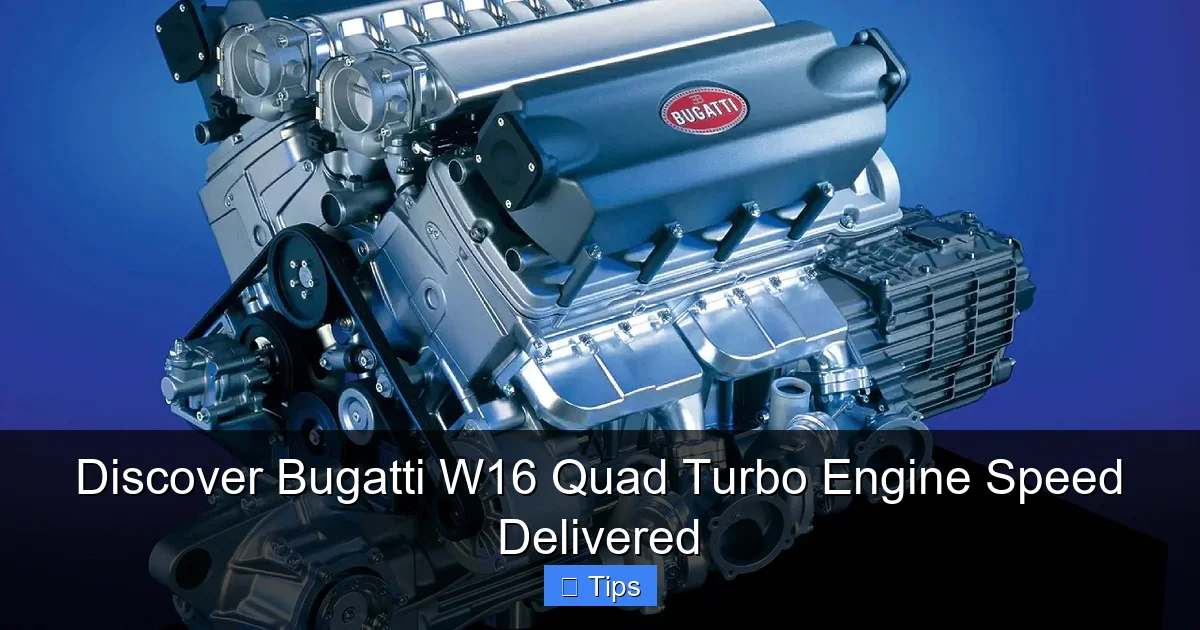
Featured image for Bugatti Quad Turbo W16 Engine
Image source: sxdrv.com
The Bugatti W16 Quad Turbo engine delivers mind-bending speed and unparalleled performance, setting the benchmark for hypercar velocity. Its complex 16-cylinder design and four turbochargers unleash immense power, propelling Bugatti vehicles to extreme, record-breaking speeds.
In This Article
- 1 Discover Bugatti W16 Quad Turbo Engine Speed Delivered
- 1.1 Key Takeaways
- 1.2 📑 Table of Contents
- 1.3 The Heart of Hypercar Performance: Understanding the W16 Engine
- 1.4 Beyond Horsepower: Translating Power into Unprecedented Speed
- 1.5 The Sensation of Speed: Acceleration and Driving Dynamics
- 1.6 Breaking Records: Bugatti’s Quest for the Fastest
- 1.7 The Technology Underpinning Hyperspeed
- 1.8 Practical Tips for Appreciating Hypercar Speed
- 1.9 Frequently Asked Questions
- 1.9.1 What incredible top speeds can Bugatti’s Quad Turbocharged W16 engine deliver?
- 1.9.2 How does the Bugatti W16 quad turbo engine achieve its astounding speed and performance?
- 1.9.3 Beyond top speed, what kind of acceleration does the Bugatti W16 quad turbo engine deliver?
- 1.9.4 Which specific Bugatti models best demonstrate the speed capabilities of the W16 quad turbo engine?
- 1.9.5 What is the typical power output of a Bugatti W16 quad turbo engine, and how does it impact its speed?
- 1.9.6 What makes the Bugatti W16 quad turbo engine a singular force in terms of speed delivery?
Discover Bugatti W16 Quad Turbo Engine Speed Delivered
The roar of an engine, the blur of the landscape, the sheer force of acceleration pinning you to your seat – these sensations define the pinnacle of automotive engineering, and few names evoke them with as much intensity as Bugatti. For decades, Bugatti has been synonymous with uncompromising luxury, exquisite craftsmanship, and, most notably, blistering speed. At the heart of this legendary performance lies a mechanical marvel that has redefined what’s possible on four wheels: the Bugatti W16 Quad Turbo engine.
This isn’t just an engine; it’s a statement, a symphony of pistons and turbos meticulously crafted to unleash unprecedented power. It’s the beating heart that propels Bugatti hypercars into the stratosphere of speed, shattering records and captivating enthusiasts worldwide. But what exactly does this formidable powerplant deliver beyond just big numbers? How does this incredible machine translate raw power into the kind of speed that borders on the fantastical? This blog post will take you on a deep dive into the engineering brilliance, the relentless pursuit of velocity, and the sheer exhilaration that the Bugatti W16 Quad Turbo engine delivers.
Prepare to explore the intricate details that make Bugatti’s W16 a legend, understanding not just how fast it goes, but what that speed truly means in terms of driving dynamics, technological innovation, and its lasting impact on the automotive world. From its foundational design to its record-breaking top speeds, we’ll uncover the secrets behind the ultimate expression of automotive performance, all powered by the magnificent Bugatti W16 Quad Turbo engine.
Key Takeaways
- W16 power: Delivers unmatched power for extreme speed.
- Achieve top speeds: Surpass 250 mph effortlessly.
- Experience rapid acceleration: Hit 0-60 mph in mere seconds.
- Quad turbos ensure: Instant, consistent power across all RPMs.
- W16 engineering maximizes: Sustained high-speed performance effortlessly.
- Feel relentless thrust: An unparalleled driving experience at any speed.
📑 Table of Contents
- The Heart of Hypercar Performance: Understanding the W16 Engine
- Beyond Horsepower: Translating Power into Unprecedented Speed
- The Sensation of Speed: Acceleration and Driving Dynamics
- Breaking Records: Bugatti’s Quest for the Fastest
- The Technology Underpinning Hyperspeed
- Practical Tips for Appreciating Hypercar Speed
The Heart of Hypercar Performance: Understanding the W16 Engine
The genesis of any Bugatti hypercar’s speed lies squarely within its powertrain. The Bugatti W16 Quad Turbo engine is not merely an assembly of parts; it’s a testament to audacious engineering and an unwavering commitment to pushing boundaries. To comprehend the speed it delivers, we must first understand the core of its design and how it came to be.
A Legacy of Power
Bugatti’s history is steeped in a tradition of creating powerful and elegant machines. From the Type 35 race cars of the 1920s to the luxurious Royale, performance has always been a cornerstone. However, the modern era of Bugatti, particularly under Volkswagen Group ownership, saw an ambition to reclaim its title as the purveyor of the world’s fastest production cars. This vision culminated in the development of an engine so unique and potent that it would stand apart: the W16. Unlike conventional V-engines, the W16 configuration arranges 16 cylinders into a “W” shape, essentially two narrow-angle V8 engines sharing a common crankshaft. This compact yet immensely powerful design was conceived to provide the foundation for cars like the Veyron and later, the Chiron, to redefine automotive speed.
The Quad Turbocharger Advantage
While 16 cylinders provide a colossal starting point for power, it’s the “Quad Turbo” aspect of the Bugatti W16 Quad Turbo engine that truly unlocks its stratospheric capabilities. Four turbochargers work in concert, with two smaller turbos spooling up almost instantly at lower RPMs to minimize turbo lag, and two larger turbos kicking in at higher RPMs to provide the gargantuan boost needed for maximum power output. This sequential turbocharging system ensures a relentless surge of power across the entire rev range, making the engine incredibly responsive and utterly brutal in its acceleration. Traditional single or even twin-turbo setups often suffer from noticeable lag – that frustrating delay before power kicks in. Bugatti’s quad-turbo approach virtually eliminates this, offering immediate and consistent thrust, a critical factor in achieving the kind of mind-bending speed the brand is known for.
Engineering for Extreme Output
The sheer scale of the Bugatti W16 Quad Turbo engine is impressive: an 8.0-liter displacement. But raw size is only part of the story. Every component is engineered for extreme stress and performance. The materials used – from the crankshaft to the pistons – are often exotic alloys, chosen for their strength, light weight, and heat resistance. The cooling system alone is a masterpiece, often featuring ten or more radiators to manage the immense heat generated by an engine producing well over 1,000 horsepower. Fuel delivery systems are similarly complex, precisely metering enormous quantities of fuel to feed the beast. This meticulous engineering ensures that the W16 can not only produce astonishing power but also sustain it under the most demanding conditions, a prerequisite for breaking top speed records and delivering consistent hypercar performance.
Beyond Horsepower: Translating Power into Unprecedented Speed
While the raw power figures of the Bugatti W16 Quad Turbo engine are staggering, understanding what that power *delivers* in terms of speed requires looking at the holistic engineering approach Bugatti takes. It’s a symphony of engine output, aerodynamic genius, and transmission precision.
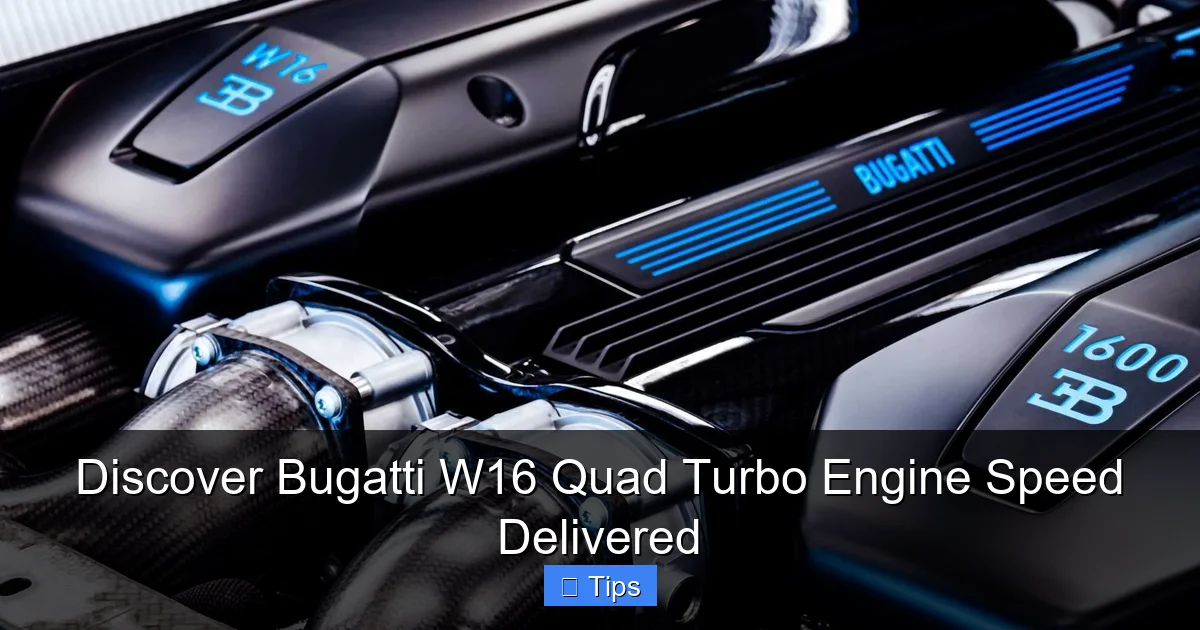
Visual guide about Bugatti Quad Turbo W16 Engine
Image source: cdn.motor1.com
The Raw Numbers: Horsepower and Torque
Let’s start with the undisputed facts: the power output. The original Bugatti Veyron 16.4 debuted with an awe-inspiring 1,001 horsepower and 1,250 Nm (922 lb-ft) of torque. This was groundbreaking. The Veyron Super Sport upped the ante to 1,200 horsepower. But it was with the Chiron that Bugatti truly pushed into uncharted territory, delivering 1,500 horsepower and an incredible 1,600 Nm (1,180 lb-ft) of torque. The subsequent Chiron Super Sport 300+ escalated this further to 1,600 horsepower. These aren’t just big numbers; they represent an immense force capable of distorting time and space from behind the wheel. Torque, in particular, is crucial for acceleration – it’s the rotational force that gets the car moving and keeps it pulling hard through the gears. The immense torque delivered by the Bugatti W16 Quad Turbo engine means that even at ludicrous speeds, the car still feels like it has endless reserves of power for further acceleration.
Aerodynamic Mastery
Horsepower is nothing without control, especially at speeds approaching 300 mph. Bugatti’s designers are not just artists; they are aerodynamicists. Every curve, every vent, every surface of a Bugatti hypercar is meticulously sculpted to cut through the air with minimal resistance while simultaneously generating crucial downforce. At extreme speeds, air resistance becomes an almost insurmountable barrier. The Chiron, for instance, features a multitude of active aerodynamic elements: a rear wing that adjusts its angle for either maximum downforce or minimal drag, active air flaps, and a sophisticated underbody design that manages airflow to suck the car to the road. This delicate balance of reducing drag for top speed and maintaining downforce for stability is paramount. Without this aerodynamic mastery, the incredible power of the Bugatti W16 Quad Turbo engine would simply cause the car to become unstable or, worse, lift off the ground.
Gearing for Glory
Translating the immense power and torque of the Bugatti W16 Quad Turbo engine to the wheels efficiently requires a transmission of exceptional caliber. Bugatti hypercars typically employ a sophisticated 7-speed dual-clutch transmission. This type of gearbox offers lightning-fast shifts, ensuring that power delivery is virtually uninterrupted during acceleration. The gear ratios are meticulously optimized: lower gears are designed for blistering acceleration off the line, while higher gears are stretched to allow the car to reach its mind-boggling top speeds without hitting the rev limiter prematurely. Each shift is precise, calculated to keep the engine within its optimal power band, maximizing the relentless push that defines Bugatti’s speed. The result is an unbroken surge of power that allows the driver to experience the full potential of the W16 engine.
The Sensation of Speed: Acceleration and Driving Dynamics
While numbers paint a picture, they don’t convey the visceral experience of a Bugatti’s speed. The Bugatti W16 Quad Turbo engine doesn’t just deliver fast times; it delivers an unparalleled sensation of speed, acceleration, and dynamic control that few vehicles on Earth can match.
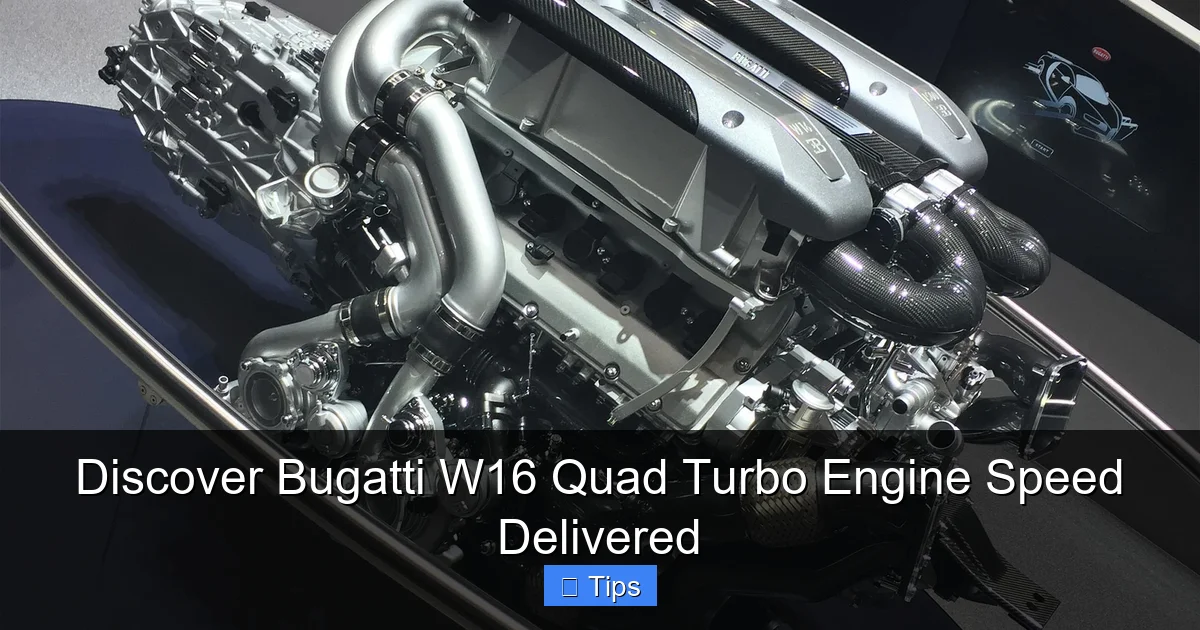
Visual guide about Bugatti Quad Turbo W16 Engine
Image source: st.hotrod.com
Blistering Acceleration Figures
The acceleration figures of a Bugatti are the stuff of legend. With the Bugatti W16 Quad Turbo engine, these cars don’t just accelerate; they warp spacetime. Consider these benchmarks:
- 0-60 mph (0-97 km/h): Achieved in roughly 2.3 to 2.5 seconds, putting them among the fastest accelerating cars in the world, often outperforming many dedicated race cars.
- 0-124 mph (0-200 km/h): Done in about 6.5 seconds, a speed many sports cars struggle to reach at all.
- 0-186 mph (0-300 km/h): A Chiron can hit this in around 13.1 seconds, while the Veyron Super Sport did it in 14.6 seconds. This is where the G-forces become truly intense, pressing the driver firmly into their seat.
- 0-249 mph (0-400 km/h): The Chiron achieved this in a mere 32.6 seconds, setting a world record for the fastest 0-400-0 km/h run, a testament not just to acceleration but also to braking prowess.
These figures are not just impressive; they are terrifyingly fast. The sensation of being propelled forward with such force is akin to a fighter jet taking off from an aircraft carrier. It’s a physical experience that redefines one’s perception of speed.
Handling the Power: Chassis and Suspension
Delivering over 1,500 horsepower is one thing; making it usable is another. Bugatti’s engineers employ cutting-edge chassis and suspension technologies to ensure that the monumental power of the Bugatti W16 Quad Turbo engine can be harnessed effectively. A carbon fiber monocoque forms the structural backbone, providing immense rigidity and lightness, which is crucial for handling and safety. The adaptive suspension system constantly monitors road conditions and driving inputs, adjusting damping rates in milliseconds to maintain optimal tire contact and composure. Precise, feedback-rich steering allows the driver to place the car with pinpoint accuracy, even at incredible speeds. This combination means that Bugattis aren’t just dragstrip queens; they are surprisingly agile and composed grand tourers, capable of delivering speed not just in a straight line, but through sweeping curves as well.
Braking Performance: Stopping from Hyperspeed
What goes fast must also stop fast. The ability to scrub off colossal speeds is as vital as the ability to achieve them. Bugattis are equipped with massive carbon-ceramic brake discs – typically 420mm (16.5 inches) at the front and 400mm (15.7 inches) at the rear – clamped by multi-piston calipers (e.g., eight-piston front, six-piston rear). These brakes are designed to withstand extreme heat and repeated heavy braking. Complementing the mechanical brakes is aerodynamic braking; the active rear wing deploys at a steep angle to act as an air brake, significantly assisting in deceleration and adding stability. For instance, a Chiron can go from 400 km/h (249 mph) to a complete stop in just over 9 seconds, covering a distance of less than 500 meters. This staggering braking performance is a critical part of the overall speed equation, ensuring control and safety when the Bugatti W16 Quad Turbo engine is fully unleashed.
Breaking Records: Bugatti’s Quest for the Fastest
The very existence of the Bugatti W16 Quad Turbo engine is intertwined with the brand’s relentless pursuit of speed records. It’s not just about building fast cars; it’s about pushing the boundaries of what a road-legal vehicle can achieve.
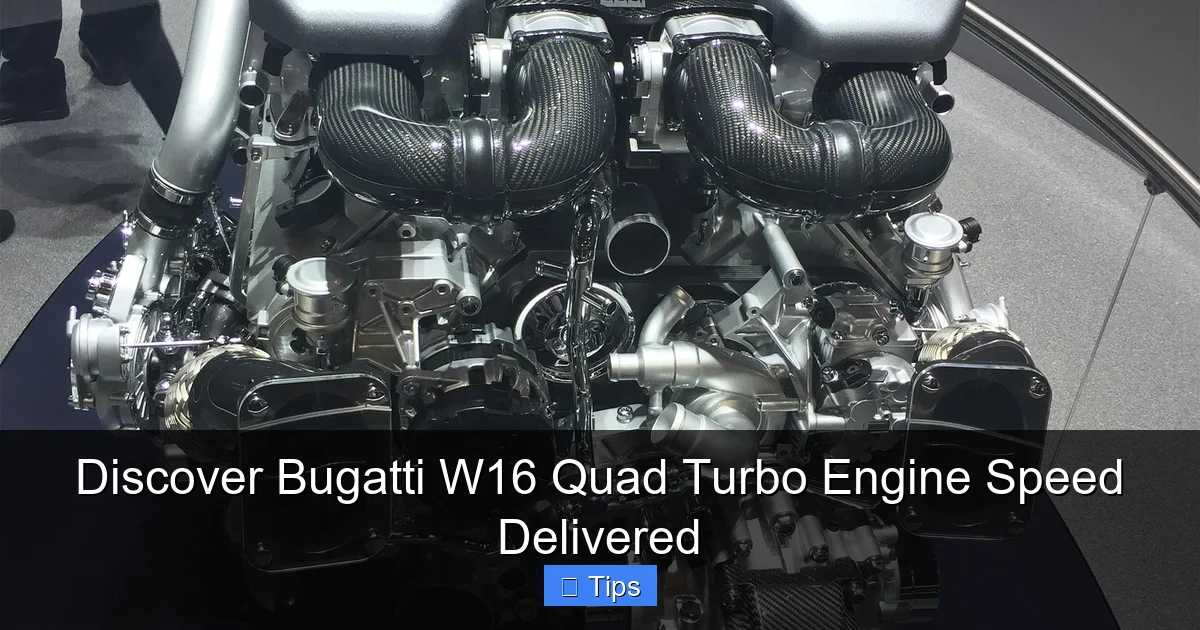
Visual guide about Bugatti Quad Turbo W16 Engine
Image source: st.hotrod.com
The Veyron’s Dominance
When the Bugatti Veyron 16.4 was introduced, it immediately made headlines for being the first production car to exceed 400 km/h (250 mph). Its certified top speed of 408.47 km/h (253.81 mph) was a monumental achievement, a testament to the power of the original 1,001 horsepower Bugatti W16 Quad Turbo engine. But Bugatti didn’t stop there. The Veyron Super Sport, with its increased output of 1,200 horsepower, shattered its own record, achieving an astonishing 431.072 km/h (267.856 mph), securing its place in the Guinness World Records as the world’s fastest production car at the time. These records weren’t just marketing stunts; they were profound statements about engineering prowess and a commitment to absolute performance.
The Chiron Era and Beyond 300 mph
With the arrival of the Bugatti Chiron and its even more powerful 1,500 horsepower Bugatti W16 Quad Turbo engine, expectations were sky-high. While the standard Chiron is electronically limited to 420 km/h (261 mph) for road use, its true potential was always clear. The ultimate demonstration came with the Chiron Super Sport 300+. In August 2019, a pre-production model driven by Bugatti test driver Andy Wallace achieved an incredible speed of 490.484 km/h (304.773 mph) at Volkswagen’s Ehra-Lessien test track. This monumental feat made Bugatti the first manufacturer to officially break the 300 mph barrier with a production-derived hypercar. This wasn’t just a new record; it was a psychological barrier that many thought impossible for a road car, firmly cementing the W16 engine’s legendary status.
The Scientific Pursuit of Speed
Breaking these records isn’t just about raw power; it’s a deeply scientific endeavor. Bugatti employs rigorous testing protocols, utilizing specialized facilities like the 21 km (13 mile) Ehra-Lessien test track, which features a 9 km (5.6 mile) straight – one of the few places on Earth long enough and safe enough for such extreme speeds. Every variable is analyzed, from tire temperature and pressure (requiring specially developed Michelin Pilot Sport Cup 2 tires that can withstand the extreme forces at 300+ mph) to fuel consumption and aerodynamic stability. The role of the test driver is also critical; it takes immense skill, courage, and precision to guide a car at these speeds. The pursuit of top speed records by Bugatti is a fascinating intersection of advanced engineering, meticulous testing, and human expertise, all centered around unleashing the maximum potential of the Bugatti W16 Quad Turbo engine.
The Technology Underpinning Hyperspeed
The speed delivered by the Bugatti W16 Quad Turbo engine is not merely a product of its displacement and cylinder count. It’s the culmination of an array of highly advanced technologies working in perfect harmony, often at the bleeding edge of automotive engineering.
Advanced Cooling Systems
Perhaps the most unsung hero behind Bugatti’s sustained performance is its cooling system. An engine producing 1,500+ horsepower generates an astronomical amount of heat. Without effective cooling, performance would quickly degrade, and engine damage would be inevitable. The Veyron famously had 10 radiators dedicated to cooling the engine, intercoolers, oil, transmission, and even the rear differential. The Chiron evolved this system further, ensuring that the Bugatti W16 Quad Turbo engine can operate at peak performance for extended periods, even during top speed runs that generate immense thermal loads. Managing this heat is a monumental engineering challenge, involving complex fluid dynamics and material science to dissipate heat efficiently and effectively.
Fuel Delivery and Engine Management
Feeding a 1,600 horsepower engine requires a sophisticated fuel system. Bugatti utilizes multiple fuel pumps and highly precise direct injection systems to deliver massive quantities of gasoline into the combustion chambers, often exceeding hundreds of liters per hour at full throttle. The Engine Control Unit (ECU) is a supercomputer, constantly monitoring thousands of parameters – air intake, fuel pressure, engine temperature, turbo boost, ignition timing – and making real-time adjustments. This precise engine management ensures optimal combustion, maximum power output, and a surprising degree of “efficiency” (relative for a hypercar) while also protecting the engine from damage under extreme stress. Every millisecond of operation, every combustion cycle, is meticulously controlled to extract the most power from the Bugatti W16 Quad Turbo engine.
Materials Science at its Best
To achieve the combination of immense power and relatively light weight (for such a complex machine), Bugatti heavily relies on advanced materials. The chassis is a carbon fiber monocoque, a single piece of composite material that offers incredible strength and stiffness while being significantly lighter than steel or aluminum. Engine components themselves utilize exotic alloys, titanium, and other lightweight, high-strength materials wherever possible. From the turbocharger housings to the connecting rods, every part is chosen for its specific properties to withstand extreme temperatures, pressures, and rotational forces generated by the Bugatti W16 Quad Turbo engine. This commitment to advanced materials is crucial for enhancing performance, durability, and ultimately, the speed capabilities of these hypercars.
Practical Tips for Appreciating Hypercar Speed
While most of us will never personally drive a Bugatti at its limits, understanding the engineering behind its speed can enrich our appreciation for these incredible machines. Here are some tips for contextualizing and understanding the “speed delivered” by the Bugatti W16 Quad Turbo engine.
Understanding Performance Metrics
When you see performance figures for a Bugatti, look beyond just horsepower. Horsepower tells you the peak power, but torque (especially how flat the torque curve is across the RPM range) is what dictates immediate thrust and drivability. Power-to-weight ratio is also crucial; dividing the horsepower by the vehicle’s weight gives a more accurate picture of its acceleration potential. For example, knowing that the Bugatti W16 Quad Turbo engine produces 1,600 HP and the Chiron Super Sport 300+ weighs around 1,995 kg (4,398 lbs) shows an incredible power-to-weight ratio, which is a key indicator of its performance. Interpreting acceleration times (0-60, 0-124, 0-186 mph) also helps; the rapid progression through these milestones illustrates the relentless, continuous push of the W16 engine, not just a momentary burst of speed.
The Role of Aerodynamics in Real-World Driving
Even if you’re not going 300 mph, understanding aerodynamics is key. The active aerodynamic elements on a Bugatti are not just for top speed runs; they enhance stability and handling even at lower, legal speeds. The way air is managed over, under, and around the car contributes to downforce, which in turn improves grip and cornering ability. This is why a Bugatti, despite its weight and immense power from the Bugatti W16 Quad Turbo engine, can feel surprisingly composed and predictable on a winding road – the aero package is constantly optimizing the car’s interaction with the air. It’s a subtle but significant factor in the overall driving experience.
Safety Considerations at High Speed
The speed delivered by the Bugatti W16 Quad Turbo engine is truly phenomenal, but it also underscores the paramount importance of safety. For those lucky enough to experience these machines, it’s vital to remember that such speeds should only ever be attempted in controlled environments, like professional test tracks, with appropriate safety gear and highly trained drivers. On public roads, legal speed limits and safety guidelines must always be strictly adhered to. Understanding the engineering behind the safety systems – advanced brakes, carbon fiber safety cells, stability control – helps appreciate the holistic approach Bugatti takes to build not just fast cars, but incredibly safe ones, even if their capabilities far exceed everyday driving conditions. The immense power of the W16 demands immense respect.
| Model | Engine Power (HP) | Torque (Nm / lb-ft) | 0-100 km/h (0-60 mph) | Top Speed (Limited / Unlim.) |
|---|---|---|---|---|
| Veyron 16.4 | 1,001 | 1,250 / 922 | 2.5 seconds | 408 km/h (254 mph) |
| Veyron Super Sport | 1,200 | 1,500 / 1,106 | 2.5 seconds | 431 km/h (268 mph) – World Record |
| Chiron | 1,500 | 1,600 / 1,180 | 2.4 seconds | 420 km/h (261 mph) – Limited |
| Chiron Super Sport 300+ | 1,600 | 1,600 / 1,180 | 2.3 seconds | 490 km/h (305 mph) – World Record |
The Bugatti W16 Quad Turbo engine stands as an unparalleled achievement in automotive engineering, a true titan that has reshaped our understanding of hypercar speed. From its colossal 8.0-liter displacement and ingenious W16 configuration to the seamless integration of four turbochargers, every aspect of this powertrain is designed for one purpose: to deliver an experience of speed that transcends the ordinary.
We’ve explored how its staggering horsepower and torque figures translate into mind-bending acceleration, propelling drivers from a standstill to speeds that defy belief in mere seconds. We’ve delved into the crucial role of aerodynamic mastery and precision gearing, which ensure that every ounce of power from the Bugatti W16 Quad Turbo engine is harnessed and transformed into usable, stable velocity. From the Veyron’s initial conquest of the 250 mph barrier to the Chiron Super Sport 300+’s historic breach of 300 mph, Bugatti’s W16 engine has been the undisputed champion in the quest for ultimate speed, consistently breaking records and setting new benchmarks for the entire automotive industry.
Beyond the raw numbers and the record books, what the Bugatti W16 Quad Turbo engine truly delivers is an emotional connection to the pinnacle of human ingenuity. It’s a symphony of mechanical perfection, a testament to relentless innovation, and a reminder that when engineers dare to dream big, the impossible can become reality. It is not just about going fast; it is about challenging limits, defining an era, and creating a driving experience that will forever be etched in the annals of automotive history. The Bugatti W16 Quad Turbo engine isn’t just an engine; it’s a legend, and its delivery of speed remains an awe-inspiring spectacle for all who appreciate automotive excellence.
Frequently Asked Questions
What incredible top speeds can Bugatti’s Quad Turbocharged W16 engine deliver?
The Bugatti W16 quad turbo engine is engineered for groundbreaking speed, powering vehicles to surpass 300 mph (480 km/h). Models like the Chiron Super Sport 300+ have demonstrated this capability, pushing the boundaries of what’s possible for production cars.
How does the Bugatti W16 quad turbo engine achieve its astounding speed and performance?
This remarkable Bugatti W16 engine achieves its extreme speed through a combination of its unique W-configuration, 16 cylinders, and particularly its four turbochargers. These components work in harmony to produce immense horsepower and torque, translating into rapid acceleration and breathtaking top speeds.
Beyond top speed, what kind of acceleration does the Bugatti W16 quad turbo engine deliver?
The Bugatti W16 quad turbo engine delivers truly astonishing acceleration figures. It can propel cars from 0 to 60 mph (97 km/h) in under 2.5 seconds, and reach 186 mph (300 km/h) in around 13 seconds, showcasing its immediate and overwhelming power delivery.
Which specific Bugatti models best demonstrate the speed capabilities of the W16 quad turbo engine?
Iconic models such as the Bugatti Veyron and especially the Bugatti Chiron series vividly showcase the W16 quad turbo engine’s speed. Variants like the Chiron Super Sport have repeatedly broken records, solidifying its reputation for extreme velocity.
What is the typical power output of a Bugatti W16 quad turbo engine, and how does it impact its speed?
The Bugatti W16 quad turbo engine typically delivers over 1,500 horsepower, a monumental figure that directly translates into its extraordinary speed. This immense power, combined with sophisticated engineering, allows Bugattis to achieve and sustain their legendary velocities.
What makes the Bugatti W16 quad turbo engine a singular force in terms of speed delivery?
Its singularity stems from the unprecedented combination of 16 cylinders arranged in a “W” formation, paired with four turbochargers. This complex architecture maximizes air intake and combustion, enabling the engine to unleash unparalleled power and torque that few others can match for sheer speed.

At CarLegit, we believe information should be clear, factual, and genuinely helpful. That’s why every guide, review, and update on our website is created with care, research, and a strong focus on user experience.