
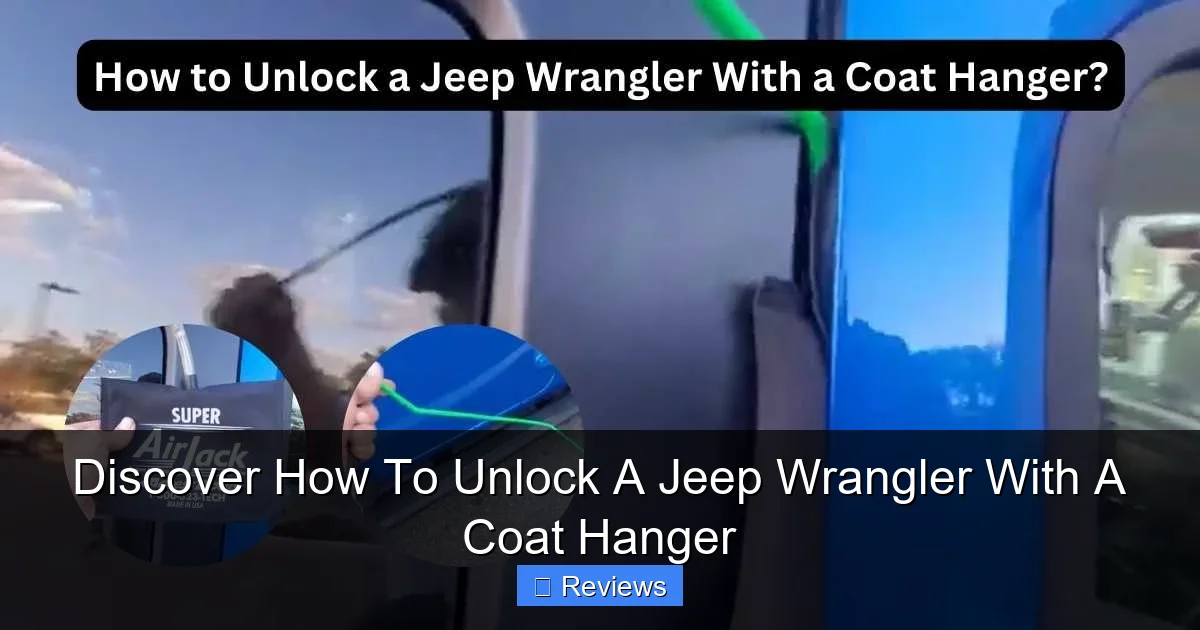
Featured image for how to unlock a jeep wrangler with a coat hanger
Image source: psychoautos.com
Locked out of your Jeep Wrangler? This article reveals an ingenious method to regain access using nothing more than a simple coat hanger. Discover the specific technique for manipulating the door lock mechanism, proving invaluable in an emergency situation, and providing a practical, DIY solution every Wrangler owner should know.
<h1>Discover How To Unlock A Jeep Wrangler With A Coat Hanger</h1>
<p>Picture this: you’re out on an adventure, perhaps deep in the wilderness, or maybe just rushing out of the grocery store, and suddenly, that gut-wrenching realization hits you. Your keys are dangling mockingly from the ignition, or perhaps sitting innocently on the seat, while you’re standing on the wrong side of a locked <strong>Jeep Wrangler</strong> door. It’s a moment that can instantly turn a good day sour, leaving you feeling helpless and frustrated. In these moments of desperation, many people cast their minds back to old movies or urban legends, wondering about the age-old trick: can you <strong>unlock a Jeep Wrangler with a coat hanger</strong>?</p>
<p>The idea of using a simple household item like a <strong>coat hanger</strong> to bypass a car’s security system seems almost too good to be true, especially for a vehicle as rugged and robust as a <strong>Jeep Wrangler</strong>. While this method might conjure images of resourceful adventurers or even skilled delinquents from classic films, the reality of modern vehicle security is far more complex. Over the decades, automotive manufacturers, including Jeep, have significantly advanced their locking mechanisms, making unauthorized entry increasingly difficult. This comprehensive guide will delve deep into the theory, practical application, and stark realities of attempting to <strong>unlock a Jeep Wrangler with a coat hanger</strong>, distinguishing between older models and the sophisticated security of today.</p>
<p>Our goal here isn’t to promote illicit activities, but rather to provide an informative and educational review for those curious about the method’s feasibility, or perhaps facing a genuine lockout emergency. We’ll explore the internal workings of <strong>Jeep Wrangler</strong> lock systems across different generations, evaluate the effectiveness and risks of the <strong>coat hanger</strong> trick, and critically, offer safer, more reliable alternatives should you ever find yourself in this predicament. Understanding how to <strong>unlock a Jeep Wrangler with a coat hanger</strong> is less about practical application today and more about appreciating the evolution of automotive security. Let’s embark on this journey to separate fact from fiction and empower you with knowledge about your beloved <strong>Jeep Wrangler</strong>.</p>
<h2>The Anatomy of a Jeep Wrangler Lock System: A Brief Overview</h2>
<p>Before even contemplating how to <strong>unlock a Jeep Wrangler with a coat hanger</strong>, it’s crucial to understand what you’re up against: the vehicle’s locking mechanism. <strong>Jeep Wranglers</strong>, like most vehicles, have evolved significantly over their production runs, and so have their door and lock designs. What might have worked on a vintage model is highly unlikely to be effective on a brand-new one.</p>
<h3>Understanding Door Mechanisms Across Generations</h3>
<ul>
<li><strong>Older YJ/TJ Models (1987-2006):</strong> These generations are often considered simpler in their mechanical design. Their door panels and internal mechanisms were less complex, frequently featuring direct mechanical linkages. A rod, often visible or easily accessible with minimal prying, connects the manual lock plunger (the button you push down) to the latch assembly within the door. The weather stripping might also be less robust, offering a slightly larger gap for tool insertion. This exposed simplicity is what made the “coat hanger” method somewhat viable in the past.</li>
<li><strong>Newer JK/JL Models (2007-Present):</strong> With the introduction of the JK series in 2007, and further refined in the JL series from 2018, <strong>Jeep Wranglers</strong> adopted significantly more sophisticated security measures. These models feature integrated electronic locking systems, anti-tamper shields, and tighter, multi-layered weather stripping. The internal door cavity is often a maze of wiring, airbags, and complex electronic modules, making it nearly impossible to visually locate or mechanically manipulate the lock rod with a simple tool like a <strong>coat hanger</strong>. Even if you could reach a rod, it might not be the primary locking mechanism.</li>
</ul>
<h3>Types of Locking Mechanisms</h3>
<ul>
<li><strong>Manual Lock Plungers/Buttons:</strong> Found prominently in older models, these are the physical buttons on the top of the door panel that you push down to lock and pull up to unlock. These directly connect to the latch via a rod. Attempting to <strong>unlock a Jeep Wrangler with a coat hanger</strong> traditionally targets these rods.</li>
<li><strong>Electronic Central Locking:</strong> Modern <strong>Jeep Wranglers</strong> primarily use electronic central locking. When you press the lock/unlock button on your key fob or inside the car, an electronic signal is sent to actuators in each door that engage or disengage the lock. While there’s usually a manual override inside (the lock plunger still moves), the primary mechanism is electronic. Manipulating a rod might disengage a physical part, but the electronic lock could remain engaged, or the action might not even be registered by the vehicle’s computer.</li>
<li><strong>Internal Latch Mechanisms:</strong> Beyond the lock button, the actual latch that holds the door shut is also part of the security system. Modern latches are designed to resist prying and tampering from the outside. They are often encased within the door frame, making them hard to access directly.</li>
</ul>
<h3>Security Features That Complicate Matters</h3>
<p>Modern <strong>Jeep Wranglers</strong> are not just bigger and more powerful; they are also far more secure. This makes the classic <strong>coat hanger</strong> trick mostly obsolete:</p>
<ul>
<li><strong>Anti-Tamper Plates:</strong> Inside the door, metal or plastic shields often protect the critical rods and wiring from direct access. These are specifically designed to prevent tools like a <strong>coat hanger</strong> from reaching the locking mechanism.</li>
<li><strong>Tighter Weather Stripping:</strong> Modern vehicles have much tighter and more resilient weather stripping around the door frame. This is excellent for keeping out water, wind, and noise, but it also makes it incredibly difficult to create a gap large enough to insert a <strong>coat hanger</strong> or similar tool without causing significant damage.</li>
<li><strong>Alarm Systems:</strong> Many <strong>Jeep Wranglers</strong> are equipped with sophisticated alarm systems. Attempting to pry the door or manipulate the lock mechanism from the outside can trigger the alarm, drawing unwanted attention and potentially draining the battery.</li>
<li><strong>Integrated Wiring & Electronics:</strong> The door cavity of a modern <strong>Jeep Wrangler</strong> is packed with wiring for power windows, mirrors, speakers, and electronic lock actuators. Probing blindly with a <strong>coat hanger</strong> significantly increases the risk of damaging these delicate components, leading to much more expensive repairs than a simple lockout service.</li>
</ul>
<p>In summary, while the idea of a simple <strong>coat hanger</strong> bypass is appealing, the reality for contemporary <strong>Jeep Wranglers</strong> is that their advanced security systems have largely rendered this method ineffective and risky. For older models, however, there’s a different story.</p>
<h2>The Classic Coat Hanger Method: Theory vs. Reality for Older Wranglers (YJ/TJ)</h2>
<p>For owners of vintage <strong>Jeep Wranglers</strong> (YJ and TJ series), the concept of using a <strong>coat hanger</strong> to <strong>unlock a Jeep Wrangler</strong> isn’t entirely a myth. These models, produced up until the mid-2000s, generally feature simpler mechanical locking systems that <em>could</em> theoretically be manipulated with a bent piece of wire. However, even with these older models, success is far from guaranteed and requires significant patience, a delicate touch, and a bit of luck.</p>
<h3>What Makes Older Wranglers Potentially Susceptible?</h3>
<p>The susceptibility of older <strong>Jeep Wranglers</strong> to the <strong>coat hanger</strong> method stems from several design characteristics:</p>
<ul>
<li><strong>Exposed Linkages:</strong> In many YJ and TJ models, the rod connecting the interior lock button to the door latch mechanism is relatively exposed within the door cavity. Unlike newer vehicles with protective anti-tamper shields, these rods were often directly accessible from the top of the door frame once a gap was created.</li>
<li><strong>Looser Weather Stripping:</strong> The weather stripping on older <strong>Jeep Wrangler</strong> doors, while effective for its time, was not as tight or multi-layered as on modern vehicles. This made it easier to gently pry open a small gap at the top of the door frame without causing permanent damage.</li>
<li><strong>Simpler Mechanical Locks:</strong> These vehicles relied almost entirely on mechanical interaction. Disengaging the rod directly led to the lock disengaging, without the interference of electronic safeties or alarms (unless separately installed).</li>
</ul>
<h3>Preparing Your Coat Hanger for the Task</h3>
<p>If you are attempting to <strong>unlock a Jeep Wrangler with a coat hanger</strong> (specifically an older model) in an emergency, proper preparation of your tool is critical to minimize potential damage and maximize your chances of success.</p>
<ul>
<li><strong>Choosing the Right Hanger:</strong> Opt for a sturdy metal <strong>coat hanger</strong>. Thin, flimsy plastic hangers will break or bend uselessly. A dry cleaning hanger made of thicker gauge wire is ideal.</li>
<li><strong>Straightening and Bending:</strong> Unwind the hanger completely to form a long, straight piece of wire. Then, at one end, create a small hook or a very tight loop, roughly an inch long. This hook will be your tool to grab or push the locking rod. Practice bending it to ensure it holds its shape.</li>
<li><strong>Protective Measures:</strong> <em>Crucially</em>, wrap the working end of your bent <strong>coat hanger</strong> with electrical tape, duct tape, or even a cloth. This will help prevent scratching the paint on your <strong>Jeep Wrangler</strong>’s door frame, window, or interior components as you insert and maneuver the wire. Scratches can lead to rust and significantly devalue your vehicle.</li>
</ul>
<h3>Step-by-Step Guide (Theoretical for Older Models)</h3>
<p>This procedure is purely theoretical for instructional purposes and should only be attempted on older <strong>Jeep Wranglers</strong> as a last resort in a genuine emergency. <strong>Attempting to unlock a Jeep Wrangler with a coat hanger</strong> always carries risks.</p>
<ol>
<li><strong>Assess the Situation:</strong> Identify which door is best suited for this. The passenger door is often preferred as it’s less critical than the driver’s door and often has fewer complex controls.</li>
<li><strong>Create a Gap:</strong> Gently but firmly, try to pry open a small gap at the top of the door frame, near the B-pillar (the pillar between the front and rear doors on a 4-door, or simply the rear edge of the door on a 2-door). You might use a plastic wedge, a wooden shim, or even your fingers if the weather stripping is loose. The goal is to create just enough space to insert the <strong>coat hanger</strong> without bending the metal frame of your <strong>Jeep Wrangler</strong>.</li>
<li><strong>Insert the Hanger:</strong> Carefully slide the taped, hooked end of your <strong>coat hanger</strong> through the created gap and down into the door cavity. Guide it slowly and avoid forcing it.</li>
<li><strong>Locate the Rod:</strong> This is the most challenging part. You need to feel around for the thin metal rod that connects the manual lock button to the latch mechanism. It’s usually located directly below the interior lock button. You might need to move the <strong>coat hanger</strong> back and forth, up and down, feeling for a solid, movable piece of metal.</li>
<li><strong>Hook and Pull/Push:</strong> Once you’ve successfully hooked onto the rod, the next step is to manipulate it. Depending on the design, you might need to pull the rod upwards (to simulate pulling the lock button up) or push it downwards. This requires a delicate touch and a good feel for the mechanism. Listen for a click, and if you hear it, try the door handle.</li>
<li><strong>Practical Tip:</strong> <em>Patience is key.</em> This isn’t a quick fix. It can take many attempts and a lot of frustration. If it’s not working after a considerable amount of time, or if you feel you might be causing damage, stop immediately.</li>
</ol>
<p>While theoretically possible on older <strong>Jeep Wranglers</strong>, the <strong>coat hanger</strong> method is inefficient and carries a risk of scratching paint or bending the door frame. For modern <strong>Jeep Wranglers</strong>, the efficacy drops to near zero, while the risk of damage skyrockets.</p>
<h2>Why the Coat Hanger Method is Largely Ineffective for Modern Jeep Wranglers (JK/JL)</h2>
<p>The myth of easily being able to <strong>unlock a Jeep Wrangler with a coat hanger</strong> truly ends with the advent of the JK and especially the JL generations. Modern automotive engineering prioritizes security, and <strong>Jeep Wranglers</strong> are no exception. The advancements in design and technology have rendered the traditional <strong>coat hanger</strong> technique largely obsolete and, more importantly, highly risky for newer models.</p>
<h3>Increased Security and Complex Door Design</h3>
<p>When trying to <strong>unlock a Jeep Wrangler with a coat hanger</strong>, you’re essentially attempting to circumvent a sophisticated system. Here’s why it’s so difficult for newer models:</p>
<ul>
<li><strong>Integrated Anti-Tamper Shields:</strong> Unlike older models, the internal door panels of JK and JL <strong>Wranglers</strong> are designed with protective barriers. These metal or hard plastic shields are strategically placed to block direct access to the lock rods, wiring, and sensitive electronic components. A <strong>coat hanger</strong> simply cannot navigate around these obstacles to reach the intended target.</li>
<li><strong>Thicker, Tighter Weather Stripping:</strong> Modern <strong>Jeep Wranglers</strong> feature advanced, multi-layered weather stripping that forms a much tighter seal around the door. This improved design is fantastic for insulation and noise reduction but makes it exceedingly difficult, if not impossible, to create a gap large enough to insert a <strong>coat hanger</strong> without bending the door frame or severely damaging the weather stripping itself. Forcing a tool into this tight seal will almost certainly cause visible and potentially costly damage.</li>
<li><strong>Sophisticated Electronic Locking Systems:</ khoảngModern <strong>Jeep Wranglers</strong> rely heavily on electronic locking actuators. Even if, by some miracle, you manage to mechanically manipulate an internal rod with a <strong>coat hanger</strong>, it might not disengage the electronic lock. The system might remain engaged, or even trigger the alarm, as the physical action isn’t recognized by the vehicle’s computer as a legitimate unlock command.</li>
</ul>
<h3>Risk of Damage to Newer Vehicles</h3>
<p>The consequences of attempting to <strong>unlock a Jeep Wrangler with a coat hanger</strong> on a modern model extend far beyond mere frustration. The risks of irreversible and expensive damage are incredibly high:</p>
<ul>
<li><strong>Scratched Paint & Bent Door Frames:</strong> Forcing a metal <strong>coat hanger</strong> into a tight door jamb will inevitably scratch the paintwork, leading to unsightly marks and potential rust spots. Aggressive prying to create a gap can permanently bend the door frame, affecting the door’s seal, alignment, and appearance.</li>
<li><strong>Damaged Weather Stripping:</ strong> The tight seals of modern <strong>Jeep Wranglers</strong> are easily torn or dislodged by tools like a <strong>coat hanger</strong>. Damaged weather stripping compromises the vehicle’s ability to keep out water, wind, and road noise, potentially leading to leaks and interior water damage.</li>
<li><strong>Broken Internal Wiring or Components:</strong> The door cavity of a modern <strong>Jeep Wrangler</strong> is a densely packed space containing wires for power windows, mirrors, speakers, and electronic lock actuators. Blindly poking around with a <strong>coat hanger</strong> can easily sever wires, dislodge connectors, or even damage the airbag sensors located within the door panel, leading to costly electrical repairs that far outweigh the price of a professional lockout service.</li>
<li><strong>Triggering the Alarm:</strong> Modern <strong>Jeep Wranglers</strong> are equipped with sophisticated alarm systems that can be triggered by unauthorized entry attempts or tampering with the door mechanisms, further complicating the situation.</li>
</ul>
<h3>The Evolution of Vehicle Security</h3>
<p>Automotive manufacturers have invested heavily in enhancing vehicle security. This evolution is driven by the need to combat vehicle theft and comply with stricter safety standards. Modern cars, including <strong>Jeep Wranglers</strong>, are designed with multiple layers of defense:</p>
<ul>
<li><strong>Layered Protection:</strong> From robust door designs to hidden linkages and electronic safeguards, modern vehicles present a formidable challenge to rudimentary intrusion methods.</li>
<li><strong>Electronic Integration:</strong> Key fobs with encrypted signals, engine immobilizers, and integrated computer systems mean that purely mechanical manipulation is often insufficient to <strong>unlock a Jeep Wrangler</strong>. The vehicle’s brain needs to authorize the unlock command.</li>
</ul>
<p>Given these factors, attempting to <strong>unlock a Jeep Wrangler with a coat hanger</strong> on a JK or JL model is not only highly improbable to succeed but also poses a significant risk of causing expensive and easily avoidable damage. It is a gamble with very poor odds.</p>
<h2>Alternative (Safer) Methods When You’re Locked Out of Your Jeep Wrangler</h2>
<p>When you find yourself locked out of your <strong>Jeep Wrangler</strong>, the frustration can be immense. While the idea of using a <strong>coat hanger</strong> might seem like a quick, free solution, for modern <strong>Jeep Wranglers</strong>, it’s almost certainly a recipe for disaster. Fortunately, there are several far safer, more effective, and often surprisingly affordable alternatives that should always be considered before resorting to desperate, damaging DIY methods.</p>
<h3>Calling a Professional Locksmith</h3>
<p>This is, by far, the most recommended and safest option for any vehicle lockout, especially for newer <strong>Jeep Wranglers</strong>.</p>
<ul>
<li><strong>Equipped with Specialized Tools:</strong> Professional automotive locksmiths carry a range of specialized tools designed specifically for vehicle entry. These include air wedges (inflatable bags that create a safe gap without bending metal), long-reach tools (flexible rods with various attachments to manipulate interior locks or handles), and sophisticated lock-picking kits.</li>
<li><strong>Expertise in Various Vehicle Lock Systems:</strong> Locksmiths are trained to understand the intricate designs of various car locks, including those in <strong>Jeep Wranglers</strong>. They know where the vulnerable points are and how to access them without causing damage.</li>
<li><strong>Minimizes Risk of Damage:</strong> A professional’s expertise and specialized tools mean they can often <strong>unlock a Jeep Wrangler</strong> quickly and efficiently, leaving no trace of their work and, most importantly, no damage to your vehicle’s paint, frame, weather stripping, or internal wiring. The cost of a locksmith is almost always less than the cost of repairing damage caused by amateur attempts to <strong>unlock a Jeep Wrangler with a coat hanger</strong>.</li>
</ul>
<h3>Using a Slim Jim (With Caution)</h3>
<p>The “slim jim” is a tool specifically designed for vehicle entry, typically for older models. It’s a thin, flat piece of metal with various notches and hooks. While it’s more refined than a <strong>coat hanger</strong>, its use is still largely discouraged for modern <strong>Jeep Wranglers</strong> due to similar risks as the <strong>coat hanger</strong>.</p>
<ul>
<li><strong>Designed for Car Locks, but Risky:</strong> A slim jim works by sliding down between the window and the weather stripping to engage internal lock linkages. It’s best suited for older vehicles with simpler rod-based locking systems.</li>
<li><strong>Requires Knowledge of Internal Mechanisms:</ strong> To use a slim jim effectively, you need to have a precise understanding of the specific vehicle’s door mechanism. Blind probing can easily damage wires, especially for power windows, or even trigger airbags in modern cars. </li>
<li><strong>Disclaimer:</strong> <em>Even for older models, using a slim jim incorrectly can still cause significant damage to wiring, linkages, or the weather stripping.</em> For modern <strong>Jeep Wranglers</strong>, it’s almost certainly ineffective and highly likely to cause damage, as the internal anti-tamper shields and complex wiring prevent its proper use.</li>
</ul>
<h3>Utilizing Roadside Assistance or Manufacturer Services</h3>
<p>Many drivers overlook the resources they already have at their disposal.</p>
<ul>
<li><strong>Insurance Policies:</strong> Check your auto insurance policy. Many comprehensive policies include roadside assistance, which often covers lockout services. A quick call to your insurer could dispatch a professional to <strong>unlock your Jeep Wrangler</strong> at no additional cost.</li>
<li><strong>Vehicle Manufacturer Services:</strong> For newer <strong>Jeep Wranglers</strong> (JK and especially JL models), services like <em>Jeep Uconnect</em> offer remote access features. If you have an active Uconnect subscription, you might be able to use the mobile app or call Uconnect support to remotely <strong>unlock your Jeep Wrangler</strong>. This is the safest and most convenient option for eligible vehicles, as it requires no physical intervention.</li>
<li><strong>Credit Card Benefits:</strong> Some credit card companies offer roadside assistance as a perk to their cardholders. It’s worth checking if your primary credit card provides this service.</li>
</ul>
<h3>The “Hidden Spare Key” Strategy</h3>
<p>Prevention is always better than cure. This simple strategy can save you immense trouble and avoid the need to ever contemplate how to <strong>unlock a Jeep Wrangler with a coat hanger</strong>.</p>
<ul>
<li><strong>Secure, Inconspicuous Storage:</strong> Obtain a spare key for your <strong>Jeep Wrangler</strong> (ensure it’s a full key, not just a transponder if it’s a modern vehicle) and store it in a secure, inconspicuous place outside the vehicle. Common options include a magnetic key holder hidden in a difficult-to-reach spot under the chassis (ensure it’s strongly magnetic and waterproof) or within a dummy item in your camping gear that you carry separately.</li>
<li><strong>Warning:</strong> <em>Never</em> store your spare key in an obvious or easily accessible location, such as under a floor mat, in the glove box, or taped to the visible underside of the vehicle. This defeats the purpose of vehicle security and could lead to theft.</li>
</ul>
<p>By utilizing these safer alternatives, you can efficiently and effectively resolve a lockout situation without risking damage to your valuable <strong>Jeep Wrangler</strong>.</p>
<h2>The “Reviews” Aspect: Evaluating Methods and Risks</h2>
<p>In this review section, we critically evaluate the various methods discussed for addressing a <strong>Jeep Wrangler</strong> lockout, weighing their effectiveness, associated risks, and potential costs. Understanding these factors is crucial for making an informed decision when faced with the frustrating situation of being locked out.</p>
<h3>Effectiveness Review</h3>
<ul>
<li><strong>Coat Hanger:</strong>
<ul>
<li><em>Older Wranglers (YJ/TJ):</em> <strong>Medium (with skill and luck).</strong> While theoretically possible, success rates are highly variable and depend on the user’s patience, skill, and the specific design of the individual <strong>Jeep Wrangler</strong> in question. It’s a tedious, hit-or-miss method.</li>
<li><em>Modern Wranglers (JK/JL):</em> <strong>Very Low.</strong> Practically ineffective due to advanced security features, tighter seals, and electronic lock systems. Chances of success are negligible.</li>
</ul>
</li>
<li><strong>Slim Jim:</strong>
<ul>
<li><em>Older Wranglers (YJ/TJ):</em> <strong>Medium.</strong> Potentially more effective than a <strong>coat hanger</strong> if one knows the exact internal mechanism, but still requires skill and carries risks.</li>
<li><em>Modern Wranglers (JK/JL):</em> <strong>Very Low.</strong> Similar to the <strong>coat hanger</strong>, modern anti-tamper designs and electronics render it largely useless and dangerous.</li>
</ul>
</li>
<li><strong>Professional Locksmith:</strong> <strong>High for all generations.</strong> Possess the right tools and expertise to <strong>unlock a Jeep Wrangler</strong> efficiently and without damage.</li>
<li><strong>Roadside Assistance/Manufacturer Services (e.g., Uconnect):</strong>
<ul>
<li><em>Older Wranglers (YJ/TJ):</em> <strong>High</strong> (for roadside assistance).</li>
<li><em>Modern Wranglers (JK/JL):</em> <strong>Very High.</strong> Uconnect offers remote unlocking capabilities, and dedicated roadside services are equipped for modern vehicle entry.</li>
</ul>
</li>
<li><strong>Hidden Spare Key:</strong> <strong>Highest for all generations.</strong> The most foolproof and zero-risk solution, assuming you’ve prepared in advance.</li>
</ul>
<h3>Risk Assessment</h3>
<ul>
<li><strong>Coat Hanger:</strong>
<ul>
<li><em>Older Wranglers (YJ/TJ):</em> <strong>Moderate risk.</strong> Potential for minor scratches, bent door frame, or damaged weather stripping. Lower risk of internal electronic damage due to simpler systems.</li>
<li><em>Modern Wranglers (JK/JL):</em> <strong>Very High risk.</strong> High likelihood of severe damage to paint, door frame, weather stripping, internal wiring, electrical components, and potentially triggering airbags or the alarm system.</li>
</ul>
</li>
<li><strong>Slim Jim:</strong> <strong>High risk for all generations.</strong> Even with some knowledge, it’s easy to damage internal components, wiring, and even trigger airbags in modern vehicles.</li>
<li><strong>Professional Locksmith:</strong> <strong>Very Low risk.</strong> Professionals are trained to avoid damage and carry insurance in case of an unforeseen incident.</li>
<li><strong>Roadside Assistance/Manufacturer Services:</strong> <strong>Zero risk.</strong> These services ensure a non-damaging entry method, or in the case of remote unlocking, no physical interaction at all.</li>
<li><strong>Hidden Spare Key:</strong> <strong>Zero risk.</strong> The ultimate damage-free solution.</li>
</ul>
<h3>Cost-Benefit Analysis</h3>
<ul>
<li><strong>DIY (Coat Hanger/Slim Jim):</strong>
<ul>
<li><em>Upfront Cost:</em> Potentially free (if you have a hanger).</li>
<li><em>Hidden Cost:</em> Extremely high risk of costly repairs. A bent door frame could require body shop work costing hundreds, if not thousands, of dollars. Damaged electronics or wiring could also be very expensive. The time and frustration factor are also significant.</li>
<li><em>Benefit:</em> Minimal, especially for modern vehicles. The slim chance of a free, immediate unlock often doesn’t outweigh the substantial risks.</li>
</ul>
</li>
<li><strong>Professional Locksmith:</strong>
<ul>
<li;><em>Upfront Cost:</em> Typically $50-$150, depending on location, time of day, and complexity. This is a one-time fee.</li>
<li><em>Hidden Cost:</em> None, as damage is avoided.</li>
<li><em>Benefit:</em> High. Guaranteed successful, damage-free entry, peace of mind, and time saved.</li>
</ul>
</li>
<li><strong>Roadside Assistance/Manufacturer Services:</strong>
<ul>
<li><em>Upfront Cost:</em> Often included in insurance, vehicle warranty, or Uconnect subscription (which has its own annual fee). May be free or a small co-pay.</li>
<li><em>Hidden Cost:</em> None.</li>
<li><em>Benefit:</em> Very High. Convenient, free or low-cost, and damage-free. Uconnect offers immediate remote access.</li>
</ul>
</li>
<li><strong>Hidden Spare Key:</strong>
<ul>
<li><em>Upfront Cost:</em> Cost of cutting a spare key (typically $5-$20 for basic, $50-$200+ for transponder/fob keys).</li>
<li><em>Hidden Cost:</em> None.</li>
<li;><em>Benefit:</em> Maximum. Solves the problem instantly, for free, and with zero risk of damage, preventing the need for any other method.</li>
</ul>
</li>
</ul>
<p>The analysis clearly shows that while the thought of attempting to <strong>unlock a Jeep Wrangler with a coat hanger</strong> might be tempting in a moment of panic, the potential for severe, costly damage far outweighs the slim chance of success, especially for modern <strong>Jeep Wranglers</strong>. Prioritizing professional help or preventative measures like a spare key is always the wiser choice.</p>
<h2>Comparison of Jeep Wrangler Lockout Methods</h2>
<p>To provide a clear and concise summary of the options available when you’re locked out of your <strong>Jeep Wrangler</strong>, the following data table reviews the key aspects of each method. This will help illustrate why attempting to <strong>unlock a Jeep Wrangler with a coat hanger</strong> is rarely the best course of action, especially for newer models.</p>
<table border=”1″ style=”width:100%; border-collapse: collapse;”>
<thead>
<tr>
<th style=”padding: 8px; border: 1px solid #ddd; text-align: left;”>Method</th>
<th style=”padding: 8px; border: 1px solid #ddd; text-align: left;”>Target Wrangler Generation</th>
<th style=”padding: 8px; border: 1px solid #ddd; text-align: left;”>Effectiveness</th>
<th style=”padding: 8px; border: 1px solid #ddd; text-align: left;”>Risk of Damage</th>
<th style=”padding: 8px; border: 1px solid #ddd; text-align: left;”>Estimated Cost (initial)</th>
</tr>
</thead>
<tbody>
<tr>
<td style=”padding: 8px; border: 1px solid #ddd;”><strong>Coat Hanger</strong></td>
<td style=”padding: 8px; border: 1px solid #ddd;”>YJ/TJ (Older)<br>JK/JL (Modern)</td>
<td style=”padding: 8px; border: 1px solid #ddd;”>Medium (skill/luck dependent)<br>Very Low (highly unlikely)</td>
<td style=”padding: 8px; border: 1px solid #ddd;”>Moderate (scratches, bends)<br>Very High (paint, frame, wiring, electronics)</td>
<td style=”padding: 8px; border: 1px solid #ddd;”>$0 (potential for high repair costs)</td>
</tr>
<tr>
<td style=”padding: 8px; border: 1px solid #ddd;”><strong>Slim Jim</strong></td>
<td style=”padding: 8px; border: 1px solid #ddd;”>YJ/TJ (Older)<br>JK/JL (Modern)</td>
<td style=”padding: 8px; border: 1px solid #ddd;”>Medium (requires knowledge)<br>Very Low (highly unlikely)</td>
<td style=”padding: 8px; border: 1px solid #ddd;”>High (wiring, linkages)<br>Very High (wiring, airbags, electronics)</td>
<td style=”padding: 8px; border: 1px solid #ddd;”>$10-30 (tool cost, high repair costs possible)</td>
</tr>
<tr>
<td style=”padding: 8px; border: 1px solid #ddd;”><strong>Professional Locksmith</strong></td>
<td style=”padding: 8px; border: 1px solid #ddd;”>All Generations</td>
<td style=”padding: 8px; border: 1px solid #ddd;”>High (highly effective)</td>
<td style=”padding: 8px; border: 1px solid #ddd;”>Very Low</td>
<td style=”padding: 8px; border: 1px solid #ddd;”>$50-150</td>
</tr>
<tr>
<td style=”padding: 8px; border: 1px solid #ddd;”><strong>Roadside Assistance / Manufacturer Services (e.g., Uconnect)</strong></td>
<td style=”padding: 8px; border: 1px solid #ddd;”>All Generations (Roadside)<br>JK/JL (Uconnect)</td>
<td style=”padding: 8px; border: 1px solid #ddd;”>High (reliable)<br>Very High (remote unlock)</td>
<td style=”padding: 8px; border: 1px solid #ddd;”>Zero</td>
<td style=”padding: 8px; border: 1px solid #ddd;”>$0 (often included in insurance/subscription)</td>
</tr>
<tr>
<td style=”padding: 8px; border: 1px solid #ddd;”><strong>Hidden Spare Key</strong></td>
<td style=”padding: 8px; border: 1px solid #ddd;”>All Generations</td>
<td style=”padding: 8px; border: 1px solid #ddd;”>Highest (instant, guaranteed)</td>
<td style=”padding: 8px; border: 1px solid #ddd;”>Zero</td>
<td style=”padding: 8px; border: 1px solid #ddd;”>$5-200 (one-time key duplication cost)</td>
</tr>
</tbody>
</table>
<h2>Conclusion</h2>
<p>The journey to <strong>unlock a Jeep Wrangler with a coat hanger</strong> is one steeped in a mix of historical possibility and modern-day impracticality. Our comprehensive review has aimed to dissect this enduring urban legend, providing a clear distinction between the feasibility for older YJ/TJ models and the near impossibility for contemporary JK/JL <strong>Jeep Wranglers</strong>. While the <strong>coat hanger</strong> might have offered a slim chance of success on simpler, older vehicles, the rapid evolution of automotive security means that for modern <strong>Jeep Wranglers</strong>, this method is not only largely ineffective but also fraught with significant risks of costly and irreparable damage.</p>
<p>We’ve established that the romanticized image of a quick, free fix with a bent piece of wire simply doesn’t align with the reality of today’s vehicles. The intricate electronic locking systems, robust anti-tamper shields, and tightly sealed door mechanisms of modern <strong>Jeep Wranglers</strong> are specifically designed to thwart such rudimentary attempts at entry. Trying to force a <strong>coat hanger</strong> into these sophisticated systems almost guarantees damage to paint, weather stripping, door frames, and critical internal electronics, far outweighing any perceived initial savings.</p>
<p>When faced with the inconvenient and frustrating situation of a locked <strong>Jeep Wrangler</strong>, the prudent and responsible course of action is to opt for safer, more reliable solutions. Professional locksmiths, armed with specialized tools and expertise, offer a damage-free and efficient resolution. Leveraging roadside assistance programs, often included in insurance policies or through manufacturer services like Jeep Uconnect, provides convenient and cost-effective alternatives. Ultimately, the most foolproof method remains the simple, proactive step of having a securely hidden spare key. This eliminates the stress, time, and potential expense associated with any lockout scenario.</p>
<p>In conclusion, while the idea of how to <strong>unlock a Jeep Wrangler with a coat hanger</strong> persists in popular culture, it is a method best left in the past, especially concerning modern vehicles. Prioritize the safety and integrity of your <strong>Jeep Wrangler</strong> by choosing professional assistance or preventative measures. Your vehicle is a significant investment; protect it from unnecessary damage and ensure your adventures remain hassle-free.</p>
In This Article
- 1 Key Takeaways
- 2 Frequently Asked Questions
- 2.1 Is it actually possible to unlock a Jeep Wrangler with a coat hanger?
- 2.2 What kind of coat hanger do I need and how do I prepare it to unlock my Jeep?
- 2.3 Will using a coat hanger damage my Jeep Wrangler’s door or lock system?
- 2.4 What is the general process to unlock a Jeep Wrangler with a coat hanger?
- 2.5 How long does it typically take to unlock a Jeep Wrangler with a coat hanger?
- 2.6 Are there alternative methods if I can’t unlock my Jeep Wrangler with a coat hanger?
Key Takeaways
- Prepare Hanger: Straighten and hook a sturdy metal coat hanger.
- Insert Carefully: Slide the hanger down the window seal near the lock.
- Target Rod: Feel for and hook the vertical door lock rod inside.
- Lift Gently: Pull the internal rod upward to unlock the door.
- Avoid Damage: Exercise extreme caution to prevent paint or weather-strip damage.
- Emergency Use: This technique is for emergency key lockouts only.
- Older Models: This method is generally more effective on older Wrangler models.
Frequently Asked Questions
Is it actually possible to unlock a Jeep Wrangler with a coat hanger?
Yes, in many situations, it is indeed possible to manually unlock a Jeep Wrangler using a modified coat hanger. This method typically works by manipulating the internal locking mechanism through a small gap in the window seal.
What kind of coat hanger do I need and how do I prepare it to unlock my Jeep?
You’ll generally need a sturdy metal coat hanger that can be bent without easily breaking. Straighten out most of the hanger, leaving a small hook at one end and potentially a handle at the other to effectively reach and snag the lock mechanism inside the door.
Will using a coat hanger damage my Jeep Wrangler’s door or lock system?
While possible, there is a risk of minor damage if not done carefully. Potential issues include scratching the paint or window tint, bending the window seal, or even slightly stressing internal wiring or the lock mechanism itself. Always proceed with caution to minimize any adverse effects.
What is the general process to unlock a Jeep Wrangler with a coat hanger?
The general process involves carefully inserting the prepared coat hanger into the door frame, usually near the back edge of the window. You then need to feel around for the internal door lock rod or lever and gently pull or push it to disengage the lock. Patience and a good feel for the mechanism are key.
How long does it typically take to unlock a Jeep Wrangler with a coat hanger?
The time it takes can vary significantly based on your experience and the specific Jeep model. For a first-timer, it might take anywhere from 15 minutes to over an hour of careful maneuvering. With practice, some people can achieve it in just a few minutes.
Are there alternative methods if I can’t unlock my Jeep Wrangler with a coat hanger?
Yes, if the coat hanger method proves too difficult, consider other options. These include calling roadside assistance, a locksmith, or using a slim jim tool if you have access to one and know how to use it safely. Always prioritize avoiding further damage to your vehicle.

At CarLegit, we believe information should be clear, factual, and genuinely helpful. That’s why every guide, review, and update on our website is created with care, research, and a strong focus on user experience.