
The Nissan Frontier does not come equipped with a CVT (Continuously Variable Transmission). Instead, it uses a traditional 6-speed manual or a 9-speed automatic transmission, offering better towing, durability, and off-road performance. This choice aligns with the truck’s rugged design and driver-focused engineering.
If you’re shopping for a midsize pickup truck and have your eye on the Nissan Frontier, you might be wondering: Does the Nissan Frontier have a CVT transmission? It’s a fair question—CVTs are increasingly common in modern vehicles, especially in cars and crossovers, thanks to their ability to improve fuel efficiency. But when it comes to trucks, especially those built for tough jobs and off-road adventures, the answer isn’t always straightforward.
The short answer? No, the Nissan Frontier does not have a CVT transmission. Instead, it relies on more traditional and robust transmission systems—specifically, a 6-speed manual or a 9-speed automatic. This choice reflects Nissan’s commitment to building a truck that prioritizes durability, towing capacity, and driver engagement over the fuel-saving benefits of a CVT. In this guide, we’ll dive deep into why the Frontier skips the CVT, what transmission options it actually offers, and how those choices impact performance, reliability, and real-world usability.
Whether you’re a weekend warrior hauling gear to the campsite, a contractor needing a dependable work truck, or just someone who values mechanical simplicity, understanding the Frontier’s transmission setup is key to making an informed decision. Let’s break it all down.
In This Article
- 1 Key Takeaways
- 2 📑 Table of Contents
- 3 What Is a CVT Transmission?
- 4 Transmission Options in the Nissan Frontier
- 5 Performance and Driving Experience
- 6 Reliability and Long-Term Durability
- 7 Why Nissan Chose Tradition Over Trend
- 8 Conclusion: The Right Choice for the Right Truck
- 9 Frequently Asked Questions
- 9.1 Does the Nissan Frontier have a CVT transmission?
- 9.2 Why doesn’t the Nissan Frontier use a CVT?
- 9.3 What transmission does the 2024 Nissan Frontier have?
- 9.4 Is the 9-speed automatic in the Frontier reliable?
- 9.5 Can you get a manual transmission in the Nissan Frontier?
- 9.6 Does the Frontier’s transmission affect fuel economy?
Key Takeaways
- No CVT in the Nissan Frontier: The Frontier has never offered a CVT transmission, prioritizing strength and reliability over fuel economy-focused designs.
- 9-Speed Automatic Standard: Since the 2022 redesign, the Frontier comes standard with a smooth and responsive 9-speed automatic transmission.
- 6-Speed Manual Available: Enthusiasts can still opt for a 6-speed manual on select trims, appealing to drivers who enjoy more control.
- Better Towing and Off-Road Performance: The traditional automatic and manual transmissions provide superior torque delivery and durability for heavy loads and rough terrain.
- Designed for Rugged Use: Nissan chose proven transmission technology to support the Frontier’s reputation as a dependable workhorse.
- Fuel Efficiency Still Competitive: Despite not using a CVT, the Frontier achieves respectable fuel economy thanks to engine tuning and aerodynamic improvements.
- Future Transmission Plans Unlikely to Include CVT: Given the truck’s target market and usage, Nissan is expected to continue avoiding CVTs in future Frontier models.
📑 Table of Contents
What Is a CVT Transmission?
Before we get into the specifics of the Nissan Frontier, it helps to understand what a CVT actually is—and why it’s both praised and criticized in the automotive world.
A Continuously Variable Transmission (CVT) is a type of automatic transmission that doesn’t use fixed gears like traditional automatics. Instead, it uses a belt and pulley system to provide an infinite number of gear ratios. This allows the engine to operate at its most efficient RPM for a given speed, which can improve fuel economy and deliver smoother acceleration without the “shift shock” you feel in conventional automatics.
CVTs are commonly found in smaller vehicles, such as sedans, hatchbacks, and crossovers—think the Honda Civic, Toyota Corolla, or Nissan Rogue. They’re especially popular in fuel-efficient models where maximizing miles per gallon is a top priority. However, CVTs have also drawn criticism for their sometimes “rubber band” feel, where the engine revs high but the vehicle doesn’t seem to accelerate proportionally. This can make driving feel less engaging, especially for enthusiasts.
Another concern with CVTs is their durability under heavy loads. Because they rely on a belt system rather than gears, they can be more prone to wear and failure when subjected to high torque, frequent towing, or aggressive driving. That’s why you rarely see CVTs in trucks or performance vehicles.
How CVTs Work
At the heart of a CVT are two variable-width pulleys connected by a steel belt or chain. One pulley is connected to the engine (input), and the other to the wheels (output). As the pulleys change their diameter, the effective gear ratio changes seamlessly. For example, during acceleration, the input pulley becomes smaller while the output pulley becomes larger, simulating a lower gear. At cruising speeds, the pulleys reverse, mimicking a high gear for better efficiency.
This system eliminates the need for fixed gear steps, allowing the engine to stay in its optimal power band. The result is smoother acceleration and, in theory, better fuel economy. However, because there are no actual “gears,” drivers sometimes report a lack of feedback or a disconnected feeling—especially when merging onto highways or climbing hills.
Pros and Cons of CVTs
- Pros: Improved fuel efficiency, smoother acceleration, lighter weight, and fewer moving parts than traditional automatics.
- Cons: Can feel unresponsive or “rubbery,” less durable under heavy loads, higher repair costs if they fail, and limited towing capacity.
Given these trade-offs, it’s no surprise that truck manufacturers—especially those targeting work-oriented buyers—are hesitant to adopt CVTs. And Nissan, with the Frontier, is no exception.
Transmission Options in the Nissan Frontier
So if the Nissan Frontier doesn’t have a CVT, what does it use? Let’s take a closer look at the transmission options available across the current Frontier lineup.
Since the major redesign in 2022, the Nissan Frontier has been offered with two transmission choices: a 6-speed manual and a 9-speed automatic. Both are designed to handle the truck’s 3.8-liter V6 engine, which produces 310 horsepower and 281 lb-ft of torque. This powertrain is shared with the larger Nissan Titan, giving the Frontier impressive capability in a midsize package.
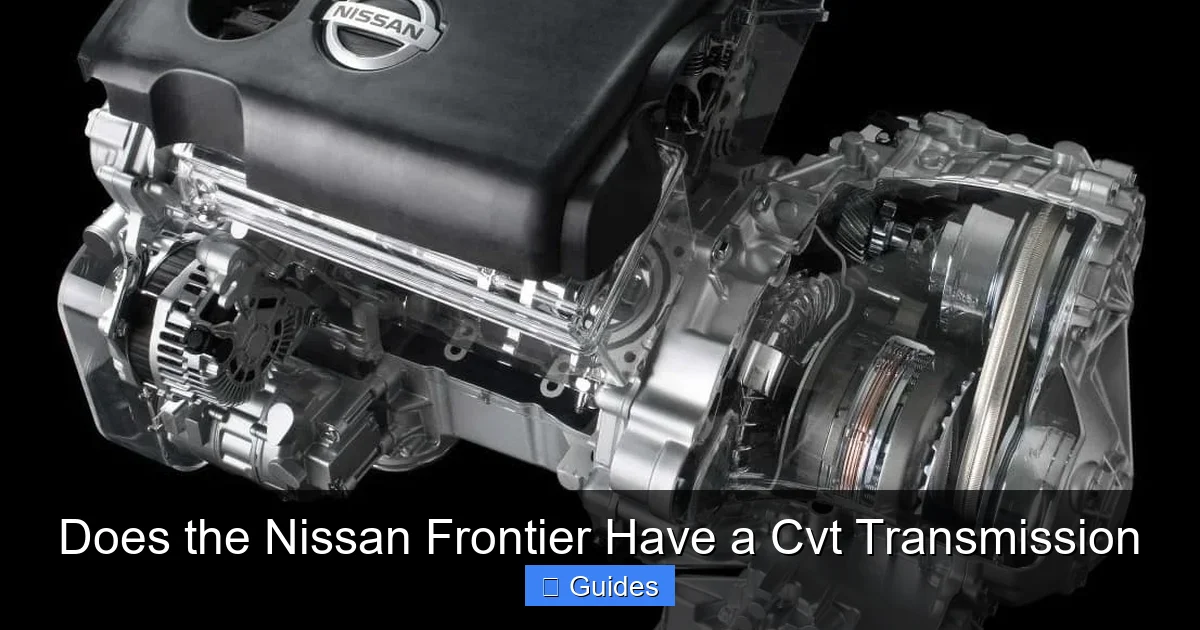
The 9-Speed Automatic Transmission
The 9-speed automatic is now the standard transmission on most Frontier trims, including the S, SV, and PRO-4X. This transmission was developed in partnership with ZF Friedrichshafen, a renowned German engineering company known for high-quality gearboxes. The 9-speed unit is smooth, responsive, and well-suited to both city driving and heavy-duty tasks.
Visual guide about Does the Nissan Frontier Have a Cvt Transmission
Image source: s3.amazonaws.com
One of the biggest advantages of this transmission is its wide gear ratio spread. With nine forward gears, it can keep the engine in its sweet spot whether you’re idling in traffic or cruising at highway speeds. The lower gears provide strong acceleration and improved off-the-line performance, while the higher gears reduce engine RPMs for better fuel economy and quieter operation.
Drivers will appreciate the transmission’s quick shift logic, which adapts to driving style. In normal mode, shifts are smooth and unobtrusive. In Sport mode, the transmission holds gears longer for more responsive throttle input. When towing or driving off-road, the transmission downshifts confidently to provide maximum torque when needed.
The 6-Speed Manual Transmission
For those who enjoy a more hands-on driving experience, the 6-speed manual is available on the base S and mid-level SV trims (though availability may vary by region and model year). This transmission gives drivers full control over gear selection, which can be especially useful when off-roading or towing.
The manual gearbox is known for its solid, mechanical feel. The clutch is well-weighted, and the shifter has a precise, notchy action that enthusiasts love. While manual transmissions are becoming rarer in modern trucks, their presence in the Frontier speaks to Nissan’s respect for traditional truck values—simplicity, control, and driver engagement.
It’s worth noting that the manual transmission is typically paired with rear-wheel drive (RWD), though four-wheel drive (4WD) may be available on certain configurations. However, due to declining demand, Nissan has limited the manual option in recent years, so buyers should check with local dealers for availability.
Why No CVT?
Given that Nissan uses CVTs in many of its other vehicles—like the Altima, Rogue, and Sentra—why not offer one in the Frontier? The answer lies in the truck’s intended use.
Trucks like the Frontier are often used for towing trailers, hauling heavy loads, and driving on rough terrain. These tasks demand a transmission that can handle high torque and sustained stress without overheating or failing. CVTs, while efficient, are generally not built for such demanding conditions. Their belt-and-pulley design is more vulnerable to wear under heavy loads, and repairs can be costly.
Additionally, many truck buyers—especially in the midsize segment—value mechanical simplicity and long-term reliability. A traditional automatic or manual transmission is easier to service, more durable, and often preferred by those who use their trucks for work or recreation.
Performance and Driving Experience
Now that we know the Frontier uses a 9-speed automatic or 6-speed manual, how does that translate to real-world performance?
In a word: excellent.
The 9-speed automatic, in particular, has received praise from critics and owners alike for its smoothness and intelligence. It’s not just about having more gears—it’s about how those gears are used. The transmission’s software is tuned to anticipate driver needs, whether you’re merging onto a highway, climbing a steep grade, or towing a boat.
Acceleration and Responsiveness
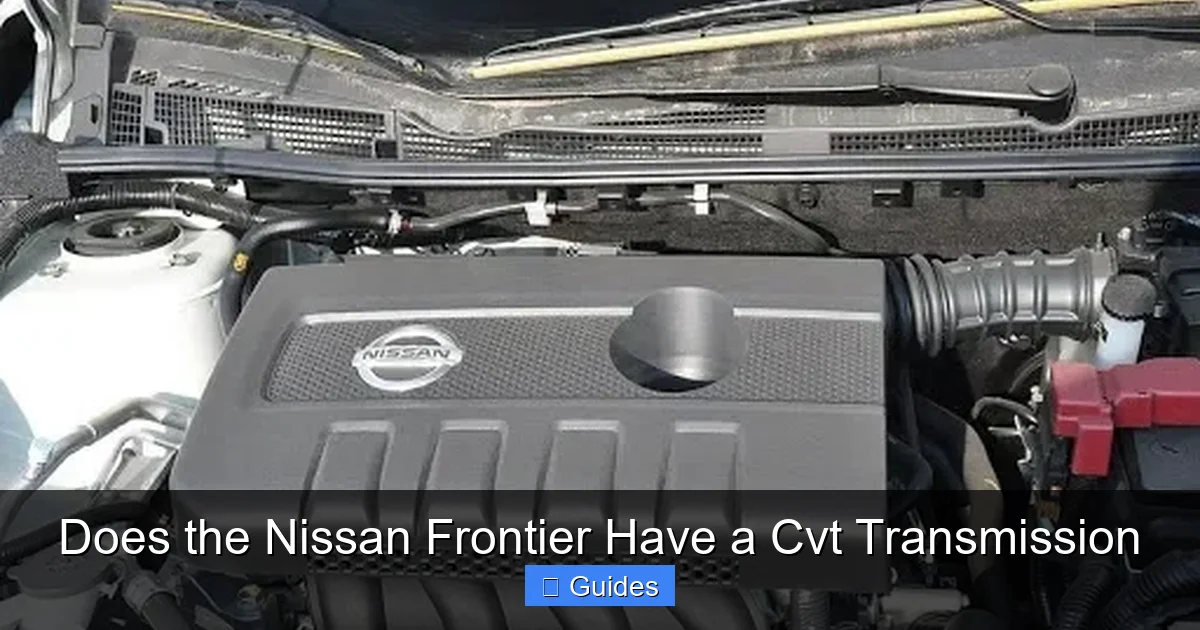
With 310 horsepower on tap, the Frontier feels strong off the line. The 9-speed automatic delivers power seamlessly, with minimal lag between shifts. There’s no “rubber band” effect here—just direct, linear acceleration that makes the truck feel confident in everyday driving.
Visual guide about Does the Nissan Frontier Have a Cvt Transmission
Image source: i0.wp.com
Even when fully loaded or towing up to 6,720 pounds (on 4WD models), the transmission manages power delivery effectively. It downshifts promptly when needed and holds lower gears during climbs to maintain momentum. This is a big advantage over CVTs, which can struggle to provide consistent torque under load.
Off-Road Capability
The Frontier PRO-4X trim, designed for off-road adventures, benefits greatly from its traditional transmission. The 9-speed automatic includes features like a rear differential lock, hill descent control, and multiple drive modes (including Off-Road and Rock). These systems work in harmony with the transmission to provide maximum traction and control.
When navigating rocky trails or muddy paths, the ability to manually select lower gears (via the shift lever or paddle shifters on some trims) gives drivers precise control over speed and torque. This level of control is difficult to achieve with a CVT, which tends to prioritize efficiency over driver input.
Fuel Economy Considerations
One common misconception is that skipping the CVT means sacrificing fuel economy. While CVTs can offer slight efficiency gains in some scenarios, the Frontier’s 9-speed automatic is surprisingly efficient. EPA estimates for the 2024 Frontier range from 18 mpg city / 24 mpg highway for RWD models to 17/22 for 4WD versions.
These numbers are competitive with other midsize trucks, many of which also avoid CVTs. For example, the Toyota Tacoma and Ford Ranger use traditional automatics, and the Chevrolet Colorado offers an 8-speed automatic. The Frontier’s efficiency is further enhanced by features like engine start-stop technology and aerodynamic improvements.
In real-world driving, many owners report achieving 20–22 mpg on the highway, especially with RWD and careful driving habits. While not class-leading, it’s more than acceptable for a truck with this level of capability.
Reliability and Long-Term Durability
When it comes to trucks, reliability isn’t just a nice-to-have—it’s essential. Whether you’re using your Frontier for daily commuting, weekend adventures, or heavy-duty work, you need a vehicle that won’t let you down.
The absence of a CVT in the Frontier is a major plus for long-term durability. Traditional automatic and manual transmissions are proven technologies with decades of refinement. They’re built to handle stress, heat, and heavy use—exactly what you’d expect from a truck.
Proven Track Record
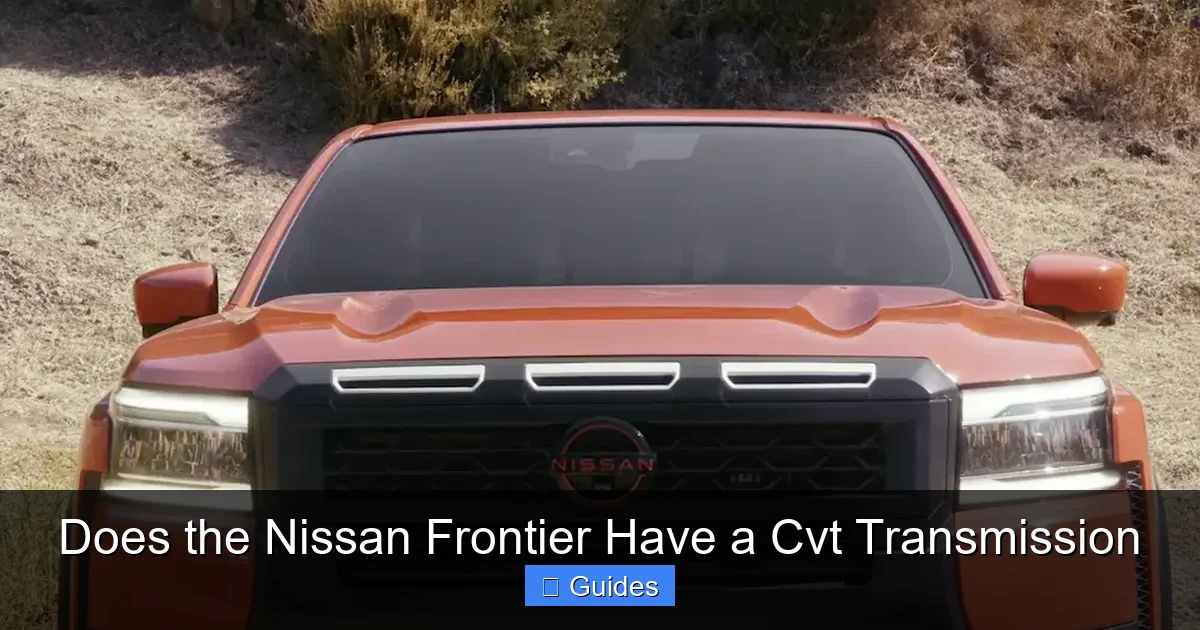
The 9-speed automatic used in the Frontier has been tested extensively in real-world conditions. It’s the same transmission used in the Nissan Titan and other global vehicles, giving it a solid reputation for reliability. Owners report smooth operation even after tens of thousands of miles, with minimal issues.
Visual guide about Does the Nissan Frontier Have a Cvt Transmission
Image source: cdn.cartipsdaily.com
The 6-speed manual, while less common, is equally dependable. Manual transmissions have fewer electronic components and no torque converter, making them simpler and often more durable over time. With regular maintenance—like clutch inspections and fluid changes—they can last well over 200,000 miles.
Maintenance and Repair Costs
Another advantage of traditional transmissions is lower repair costs compared to CVTs. When a CVT fails, it often requires a complete replacement, which can cost $3,000 or more. In contrast, automatic and manual transmissions can often be rebuilt or repaired at a fraction of the cost.
Routine maintenance for the Frontier’s transmission includes fluid changes every 60,000 to 100,000 miles, depending on driving conditions. This is in line with most modern trucks and helps ensure smooth operation and longevity.
Owner Feedback and Reliability Ratings
Consumer reviews and third-party reliability studies consistently rate the Frontier highly. J.D. Power and RepairPal both give the Frontier above-average reliability scores, with transmission issues being rare. Many owners cite the truck’s “no-nonsense” engineering as a key reason for their satisfaction.
For example, one owner from Texas reported using his Frontier to tow a 5,000-pound trailer across mountainous terrain for over 50,000 miles without any transmission problems. Another from Colorado praised the manual transmission for its reliability during winter off-roading.
Why Nissan Chose Tradition Over Trend
At a time when many automakers are embracing CVTs for their efficiency benefits, Nissan’s decision to stick with traditional transmissions in the Frontier is both bold and logical.
Understanding the Target Market
The Frontier is marketed as a “no-compromise” midsize truck—built for work, play, and everything in between. Its core buyers include contractors, outdoor enthusiasts, and drivers who value capability over cutting-edge tech. For this audience, reliability and performance trump fuel economy.
Nissan recognized that offering a CVT could alienate these buyers. A CVT might save a few tenths of a mile per gallon, but it could also raise concerns about durability and resale value. By choosing a proven 9-speed automatic, Nissan reinforces the Frontier’s image as a tough, dependable truck.
Competitive Positioning
The Frontier competes directly with the Toyota Tacoma, Ford Ranger, and Chevrolet Colorado—none of which use CVTs. In fact, the Tacoma has faced criticism in the past for its older 6-speed automatic, pushing Toyota to improve its transmission technology. Nissan’s use of a modern 9-speed automatic gives the Frontier a competitive edge in smoothness and responsiveness.
By avoiding the CVT, Nissan also differentiates the Frontier from some crossover-based trucks (like the Honda Ridgeline, which uses a 9-speed automatic but is built on a car platform). The Frontier’s body-on-frame construction and traditional transmission reinforce its identity as a true truck.
Future-Proofing the Frontier
Looking ahead, it’s unlikely that Nissan will introduce a CVT in the Frontier—even as emissions standards tighten. Instead, the company is focusing on improving the existing powertrain through better engine tuning, lightweight materials, and aerodynamic design.
Rumors of a hybrid or electric Frontier have circulated, but even in those scenarios, Nissan would likely use a traditional automatic or a dedicated hybrid transmission—not a CVT. The brand’s commitment to ruggedness and reliability suggests that the Frontier will continue to prioritize strength over trends.
Conclusion: The Right Choice for the Right Truck
So, does the Nissan Frontier have a CVT transmission? The answer is a clear and confident no—and that’s a good thing.
By opting for a 9-speed automatic or 6-speed manual, Nissan has built a truck that delivers the performance, durability, and driver engagement that midsize truck buyers demand. The Frontier may not have the latest transmission technology, but it has something better: proven reliability and real-world capability.
Whether you’re towing a trailer, exploring backcountry trails, or just cruising down the highway, the Frontier’s transmission is designed to keep up—without compromise. It’s a reminder that sometimes, the best choice isn’t the newest one, but the one that’s been tested by time and terrain.
If you’re in the market for a midsize truck that values strength over sophistication, the Nissan Frontier is a standout option. And knowing it doesn’t come with a CVT? That’s just one more reason to consider it.
Frequently Asked Questions
Does the Nissan Frontier have a CVT transmission?
No, the Nissan Frontier does not have a CVT transmission. It is equipped with either a 6-speed manual or a 9-speed automatic transmission, depending on the trim and configuration.
Why doesn’t the Nissan Frontier use a CVT?
Nissan chose not to use a CVT because traditional transmissions offer better durability, towing capacity, and performance under heavy loads—key factors for a work-oriented truck like the Frontier.
What transmission does the 2024 Nissan Frontier have?
The 2024 Nissan Frontier comes standard with a 9-speed automatic transmission. A 6-speed manual is available on select trims, though availability may be limited.
Is the 9-speed automatic in the Frontier reliable?
Yes, the 9-speed automatic is highly reliable and has been used in other Nissan vehicles like the Titan. It’s designed to handle heavy use and has received positive feedback from owners and critics.
Can you get a manual transmission in the Nissan Frontier?
Yes, a 6-speed manual transmission is available on the S and SV trims, typically with rear-wheel drive. However, it’s becoming less common, so check with your dealer for current availability.
Does the Frontier’s transmission affect fuel economy?
While the Frontier doesn’t use a CVT, its 9-speed automatic is efficient, delivering EPA-estimated 18–24 mpg depending on drivetrain. This is competitive with other midsize trucks.

At CarLegit, we believe information should be clear, factual, and genuinely helpful. That’s why every guide, review, and update on our website is created with care, research, and a strong focus on user experience.