
Bugatti’s quad turbocharged engine layout is a masterpiece of engineering that delivers unmatched power, responsiveness, and top-end speed. By using four turbochargers working in harmony, Bugatti eliminates turbo lag and maximizes airflow, enabling hypercars like the Chiron to break speed records while maintaining smooth, controllable power delivery.
In This Article
- 1 Key Takeaways
- 2 📑 Table of Contents
- 3 Introduction: The Heart of a Hypercar
- 4 Understanding Turbocharging: The Basics
- 5 The Bugatti W16 Engine: A Mechanical Marvel
- 6 How the Quad Turbo System Works
- 7 Performance Benefits of the Quad Turbo Layout
- 8 Thermal Management and Reliability
- 9 The Future of Quad Turbo Engines
- 10 Conclusion: Engineering Excellence in Motion
- 11 Frequently Asked Questions
- 11.1 How many turbochargers does a Bugatti Chiron have?
- 11.2 What engine does Bugatti use in its hypercars?
- 11.3 Does the quad turbo system eliminate turbo lag?
- 11.4 How much horsepower does a Bugatti with quad turbos produce?
- 11.5 How does Bugatti manage heat from four turbochargers?
- 11.6 Will Bugatti continue using quad turbo engines in the future?
Key Takeaways
- Eliminates Turbo Lag: The quad turbo setup uses sequential and parallel turbocharging to ensure instant throttle response across the entire RPM range.
- Massive Power Output: Bugatti’s W16 engine with four turbos produces over 1,500 horsepower, making it one of the most powerful production engines ever built.
- Enhanced Airflow Efficiency: Multiple turbos allow for optimized air intake at different engine speeds, improving combustion efficiency and performance.
- Superior High-Speed Stability: The engine’s design supports extreme speeds by maintaining consistent power delivery and thermal management.
- Innovative Cooling Systems: Quad turbos generate intense heat, so Bugatti uses advanced cooling solutions to protect engine longevity and performance.
- Precision Engineering: Every component is hand-built and tuned to work seamlessly with the turbo system, ensuring reliability at extreme outputs.
- Sets Industry Benchmarks: Bugatti’s quad turbo layout has redefined what’s possible in hypercar performance, influencing future high-performance engine designs.
📑 Table of Contents
- Introduction: The Heart of a Hypercar
- Understanding Turbocharging: The Basics
- The Bugatti W16 Engine: A Mechanical Marvel
- How the Quad Turbo System Works
- Performance Benefits of the Quad Turbo Layout
- Thermal Management and Reliability
- The Future of Quad Turbo Engines
- Conclusion: Engineering Excellence in Motion
Introduction: The Heart of a Hypercar
When you think of Bugatti, you don’t just think of luxury—you think of raw, unfiltered performance. The brand has long been synonymous with pushing the boundaries of what a car can do, and at the core of that reputation lies its revolutionary quad turbocharged engine layout. From the legendary Veyron to the earth-shattering Chiron, Bugatti’s W16 engine, paired with four turbochargers, has redefined automotive excellence. But what makes this setup so special? Why use four turbos when most high-performance cars get by with one or two?
The answer lies in the relentless pursuit of perfection. Bugatti doesn’t just want fast cars—they want the fastest, most responsive, and most refined machines on the planet. The quad turbocharged engine layout is the result of decades of engineering innovation, designed to overcome the traditional limitations of turbocharging: lag, heat, and inconsistent power delivery. By mastering these challenges, Bugatti has created an engine that doesn’t just perform—it dominates.
Understanding Turbocharging: The Basics
Before diving into the complexities of Bugatti’s quad turbo system, it’s important to understand how turbocharging works in the first place. At its core, a turbocharger is a device that forces more air into the engine’s combustion chambers. More air means more fuel can be burned, which translates to more power. Turbochargers are powered by exhaust gases—instead of using a belt or engine power like a supercharger, they spin using the flow of hot exhaust exiting the engine.

Visual guide about How Bugattis Quad Turbocharged Engine Layout Impacts Performance
Image source: en.arabgt.com
How a Single Turbo Works
A traditional single turbo setup uses one large turbocharger to compress intake air. While effective, this design has a major drawback: turbo lag. This is the delay between pressing the accelerator and feeling the surge of power. At low RPMs, exhaust flow isn’t strong enough to spin the turbo quickly, so the engine feels sluggish until the turbo “spools up.” Once it does, power delivery can be abrupt and overwhelming.
Dual Turbo Solutions
To combat lag, many performance cars use twin turbo systems. These come in two main forms: parallel and sequential. In a parallel setup, two smaller turbos work simultaneously, each feeding half the engine’s cylinders. This reduces lag because smaller turbos spool faster. In a sequential system, one small turbo handles low RPMs, and a larger one kicks in at higher speeds. Both approaches improve responsiveness, but they still have limitations at extreme power levels.
The Need for More: Enter Quad Turbos
Bugatti’s engineers realized that even twin turbos weren’t enough for their ambitions. The W16 engine—a 16-cylinder powerhouse arranged in a “W” configuration—demands immense airflow to reach its full potential. A single or dual turbo system would either suffer from lag or require such large turbos that they’d be inefficient at lower speeds. The solution? Four turbochargers, working in a carefully orchestrated dance to deliver seamless power across the entire RPM range.
The Bugatti W16 Engine: A Mechanical Marvel
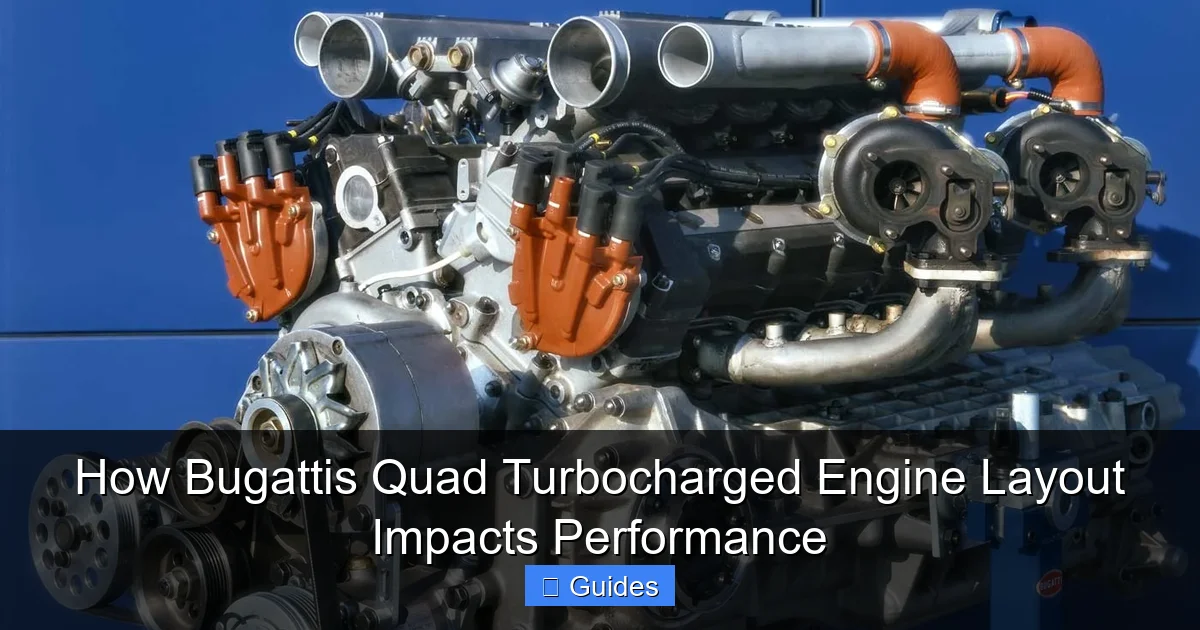
At the heart of every modern Bugatti hypercar is the W16 engine—a configuration so rare it’s found in only a handful of vehicles worldwide. Unlike a traditional V8 or V12, the W16 combines four banks of four cylinders arranged in a “W” shape, essentially merging two V8 engines into one compact block. This design allows for a high cylinder count without an excessively long engine, making it ideal for mid-engine hypercars.
Visual guide about How Bugattis Quad Turbocharged Engine Layout Impacts Performance
Image source: d192n709vt6a6d.cloudfront.net
Why a W16?
The W16 layout offers several advantages. First, it provides a massive displacement—8.0 liters in the Chiron—while maintaining a relatively compact size. This allows Bugatti to fit the engine low and central in the chassis, improving weight distribution and handling. Second, the high cylinder count enables smooth power delivery and reduces vibrations, contributing to the car’s refined driving experience. Finally, the W16’s design leaves ample space for turbocharging, with each cylinder bank able to feed into its own turbo system.
Power Numbers That Defy Belief
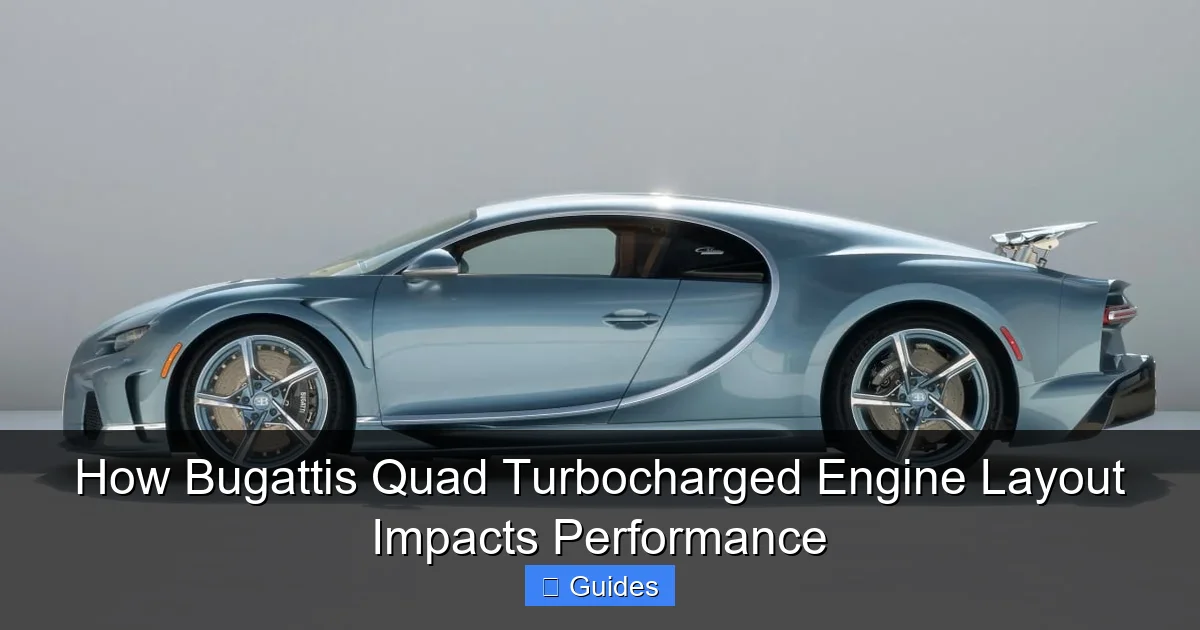
With four turbochargers forcing air into the W16, the results are staggering. The Bugatti Chiron produces 1,500 horsepower and 1,180 lb-ft of torque—enough to rocket from 0 to 60 mph in under 2.4 seconds and reach a top speed of over 260 mph (electronically limited). The Chiron Super Sport 300+ even broke the 300 mph barrier, a feat made possible by the engine’s relentless power and aerodynamic efficiency. These numbers aren’t just impressive—they’re a testament to the effectiveness of the quad turbo layout.
Hand-Built Precision
Every W16 engine is assembled by hand in Bugatti’s Molsheim, France facility by a team of master craftsmen. Each component is meticulously inspected and tuned to work in harmony with the turbo system. This level of attention ensures not only peak performance but also long-term reliability, even under extreme stress. It’s this blend of artistry and engineering that sets Bugatti apart from other manufacturers.
How the Quad Turbo System Works
Now, let’s get into the nitty-gritty: how exactly do four turbochargers work together to create such incredible performance? The quad turbo system in Bugatti’s W16 is a masterpiece of coordination, using a combination of sequential and parallel operation to eliminate lag and maximize efficiency.
Visual guide about How Bugattis Quad Turbocharged Engine Layout Impacts Performance
Image source: thestreet.com
Sequential and Parallel Operation
At low engine speeds, only two of the four turbos are active. These smaller turbos spool up quickly, providing immediate boost and eliminating the dreaded turbo lag. As engine RPM increases and exhaust flow builds, the other two turbos kick in, joining the first pair to deliver full boost. This staged approach ensures that the engine always has the right amount of forced induction, whether you’re cruising at 2,000 RPM or pushing toward redline at 7,000 RPM.
Turbo Sizing and Placement
Each turbocharger is precisely sized and positioned to match the airflow demands of its respective cylinder bank. The turbos are mounted close to the exhaust manifolds, minimizing pressure loss and heat buildup. This proximity also allows for faster spooling, as exhaust gases reach the turbines almost instantly. The result is a system that responds like a naturally aspirated engine but delivers the power of a heavily boosted one.
Wastegate and Boost Control
To prevent over-boosting and protect the engine, Bugatti uses electronically controlled wastegates. These valves regulate the amount of exhaust gas flowing into the turbos, ensuring that boost pressure stays within safe limits. The engine management system constantly monitors throttle position, RPM, and load to adjust boost levels in real time. This precision control allows for smooth power delivery and prevents sudden surges that could destabilize the car at high speeds.
Airflow and Intercooling
With four turbos compressing massive amounts of air, managing temperature is critical. Compressed air heats up, and hot air is less dense, reducing engine efficiency. To combat this, Bugatti uses large intercoolers to cool the intake air before it enters the engine. The Chiron, for example, features a complex system of air ducts and radiators that channel cool air from the front intakes to the intercoolers, ensuring optimal combustion conditions even at full throttle.
Performance Benefits of the Quad Turbo Layout
The quad turbocharged engine layout isn’t just about raw power—it’s about how that power is delivered. Bugatti’s system offers several key performance advantages that make their hypercars not only fast but also controllable and enjoyable to drive.
Instant Throttle Response
One of the biggest complaints about turbocharged engines is lag—the delay between pressing the gas and feeling the surge. Bugatti’s quad turbo system virtually eliminates this issue. Thanks to the use of smaller turbos at low RPMs, the engine responds immediately to throttle input. Whether you’re accelerating from a stop or overtaking on the highway, the power comes on smoothly and predictably, giving the driver complete confidence.
Flat Torque Curve
Unlike many high-performance engines that deliver peak torque only in a narrow RPM band, the Bugatti W16 produces maximum torque from as low as 2,000 RPM and holds it all the way to 6,000 RPM. This flat torque curve means the car feels incredibly strong across the entire rev range. You don’t need to rev the engine to access its full potential—just press the accelerator and go. This makes the Chiron not only fast in a straight line but also agile and responsive in real-world driving conditions.
High-Speed Stability
At speeds over 250 mph, even small inconsistencies in power delivery can be dangerous. The quad turbo system ensures that boost pressure remains stable, even under extreme loads. This consistency allows Bugatti to fine-tune the car’s aerodynamics and suspension for maximum stability at high speeds. The result is a car that feels planted and predictable, even when pushing the limits of physics.
Improved Fuel Efficiency (Relatively Speaking)
While no Bugatti is what you’d call fuel-efficient, the quad turbo system does offer some efficiency benefits. By using smaller turbos at low speeds, the engine doesn’t waste energy spinning oversized turbos unnecessarily. Additionally, the precise boost control allows for optimal air-fuel ratios, reducing fuel consumption during normal driving. Of course, when you unleash the full 1,500 horsepower, efficiency goes out the window—but that’s part of the fun.
Thermal Management and Reliability
With four turbochargers generating intense heat, thermal management is one of the biggest challenges in Bugatti’s engine design. If not properly controlled, excessive heat can lead to engine knock, reduced performance, and even catastrophic failure.
Advanced Cooling Systems
Bugatti employs a multi-layered cooling strategy to keep temperatures in check. The Chiron, for example, features 10 radiators—yes, ten—dedicated to cooling the engine, turbos, transmission, and differential. Air is channeled through carefully designed ducts to maximize airflow over these radiators, even at high speeds. Additionally, the engine uses a dry-sump lubrication system, which keeps oil cool and ensures consistent lubrication under extreme G-forces.
Heat-Resistant Materials
The turbochargers and exhaust manifolds are made from high-temperature alloys that can withstand continuous exposure to exhaust gases exceeding 1,000°F. These materials not only improve durability but also allow the turbos to operate efficiently without warping or degrading over time. Every component is designed with thermal expansion in mind, ensuring a perfect fit even under extreme conditions.
Engine Longevity
Despite the immense power output, Bugatti engines are built to last. The combination of precision engineering, high-quality materials, and advanced cooling ensures that the W16 can endure years of hard driving. Regular maintenance and careful operation are still required, but the engine’s design minimizes wear and tear, even under stress. This reliability is a key reason why Bugatti owners can enjoy their cars on track days or high-speed runs without constant fear of mechanical failure.
The Future of Quad Turbo Engines
As the automotive world shifts toward electrification, some may wonder if the era of quad turbocharged engines is coming to an end. While hybrid and electric powertrains are gaining ground, Bugatti’s approach shows that internal combustion engines still have a place in high-performance applications—especially when paired with innovative technology.
Hybrid Integration
In fact, Bugatti has already embraced electrification with the Chiron’s successor, the Mistral, and future models are expected to incorporate hybrid systems. However, the quad turbo W16 will likely remain at the core, with electric motors providing additional torque and filling in any gaps in power delivery. This hybrid approach could further enhance performance while reducing emissions—a win-win for speed and sustainability.
Inspiring the Next Generation
Bugatti’s quad turbo layout has set a new benchmark for what’s possible in engine design. Other manufacturers are taking note, experimenting with multi-turbo systems and advanced forced induction techniques. While few will match Bugatti’s level of power, the principles of eliminating lag, optimizing airflow, and managing heat are being applied across the industry.
A Legacy of Innovation
Ultimately, the quad turbocharged engine is more than just a performance enhancer—it’s a symbol of Bugatti’s commitment to pushing boundaries. From the Veyron to the Chiron and beyond, this layout has enabled some of the most iconic hypercars in history. As long as there are drivers who crave speed, power, and precision, the legacy of Bugatti’s engineering will continue to inspire.
Conclusion: Engineering Excellence in Motion
Bugatti’s quad turbocharged engine layout is a triumph of automotive engineering. By combining a massive W16 engine with four precisely tuned turbochargers, Bugatti has created a powertrain that delivers unrivaled performance, responsiveness, and reliability. The system eliminates turbo lag, maximizes airflow, and maintains stability at speeds that would destroy lesser engines.
But beyond the numbers and the technology, what makes this layout truly special is how it feels to drive. The instant throttle response, the surge of torque, the roar of the exhaust—it’s an experience that goes beyond transportation and becomes something almost spiritual. For those lucky enough to sit behind the wheel of a Bugatti, the quad turbo engine isn’t just a component—it’s the heartbeat of a legend.
Frequently Asked Questions
How many turbochargers does a Bugatti Chiron have?
The Bugatti Chiron is equipped with four turbochargers, working in a sequential and parallel layout to deliver maximum power and responsiveness across the entire RPM range.
What engine does Bugatti use in its hypercars?
Bugatti uses an 8.0-liter W16 engine, a rare 16-cylinder configuration that combines power, smoothness, and compact size, making it ideal for high-performance applications.
Does the quad turbo system eliminate turbo lag?
Yes, the quad turbo setup uses smaller turbos at low RPMs to provide instant boost, effectively eliminating turbo lag and ensuring immediate throttle response.
How much horsepower does a Bugatti with quad turbos produce?
The Bugatti Chiron produces 1,500 horsepower, while special editions like the Super Sport 300+ can exceed 1,600 horsepower, thanks to the quad turbocharged W16 engine.
How does Bugatti manage heat from four turbochargers?
Bugatti uses advanced cooling systems, including 10 radiators, intercoolers, and heat-resistant materials, to manage the intense heat generated by the quad turbo setup.
Will Bugatti continue using quad turbo engines in the future?
While future models may incorporate hybrid technology, the quad turbo W16 is expected to remain a core part of Bugatti’s performance identity for years to come.

At CarLegit, we believe information should be clear, factual, and genuinely helpful. That’s why every guide, review, and update on our website is created with care, research, and a strong focus on user experience.