
Most cars can travel between 30 and 50 miles after the low fuel warning light comes on, but this varies widely by make, model, and driving conditions. Relying on this reserve is risky—running out of gas can damage your engine and leave you stranded. Always refuel when the tank is near empty to stay safe and avoid costly repairs.
In This Article
- 1 Key Takeaways
- 2 📑 Table of Contents
- 3 How Far Can a Car Go on Empty? The Real Answer
- 4 Understanding Your Car’s Fuel Reserve
- 5 Real-World Examples: How Far Can Different Cars Go?
- 6 Factors That Reduce How Far You Can Go
- 7 Risks of Driving on Empty
- 8 How to Avoid Running Out of Gas
- 9 What to Do If You Run Out of Gas
- 10 Final Thoughts: Don’t Test Your Luck
- 11 Frequently Asked Questions
- 11.1 How many miles can you drive after the gas light comes on?
- 11.2 Is it bad to drive with the gas light on?
- 11.3 Can running out of gas damage your car?
- 11.4 Do all cars have the same reserve fuel amount?
- 11.5 Can hybrids go farther on empty than regular cars?
- 11.6 What should I do if I run out of gas on the highway?
Key Takeaways
- Reserve fuel varies by vehicle: The amount of gas left after the low fuel light comes on depends on your car’s make, model, and fuel tank size—typically between 1 to 2 gallons.
- Average range is 30–50 miles: Most modern cars can go about 30 to 50 miles on empty, but aggressive driving, hills, or cold weather can reduce this significantly.
- Running out of gas is avoidable: Planning ahead, using fuel apps, and refueling at ¼ tank can prevent you from ever hitting empty.
- It can damage your car: Driving on fumes may suck debris into the fuel pump, overheat components, and cause engine stalling or failure.
- Safety risks increase: Being stranded on a busy highway or in bad weather is dangerous—always prioritize filling up before it’s too late.
- Hybrid and electric vehicles differ: Hybrids may switch to electric mode when gas runs low, while EVs show precise range estimates—don’t ignore warnings.
- Keep an emergency kit: Include a gas can, roadside assistance info, and a phone charger in case you do run out unexpectedly.
📑 Table of Contents
- How Far Can a Car Go on Empty? The Real Answer
- Understanding Your Car’s Fuel Reserve
- Real-World Examples: How Far Can Different Cars Go?
- Factors That Reduce How Far You Can Go
- Risks of Driving on Empty
- How to Avoid Running Out of Gas
- What to Do If You Run Out of Gas
- Final Thoughts: Don’t Test Your Luck
How Far Can a Car Go on Empty? The Real Answer
Picture this: You’re cruising down the highway, music playing, windows down—then suddenly, a little orange light pops up on your dashboard. The low fuel warning. Your heart skips a beat. How far can your car go on empty? Can you make it to the next gas station 20 miles away? Or are you about to be stranded on the shoulder?
It’s a question every driver has asked at some point. And while it might seem simple, the answer isn’t one-size-fits-all. The distance your car can travel after the fuel light comes on depends on a mix of factors—your vehicle’s design, driving habits, road conditions, and even the weather. But one thing is certain: relying on that “empty” reserve is a gamble you don’t want to take.
In this guide, we’ll break down exactly how far most cars can go on fumes, why it’s risky to push your luck, and what you can do to avoid running out of gas altogether. Whether you drive a fuel-efficient compact, a rugged SUV, or a hybrid, understanding your car’s fuel system and planning ahead can save you time, money, and stress.
Understanding Your Car’s Fuel Reserve
Visual guide about How Far Can a Car Go on Empty
Image source: autozonic.com
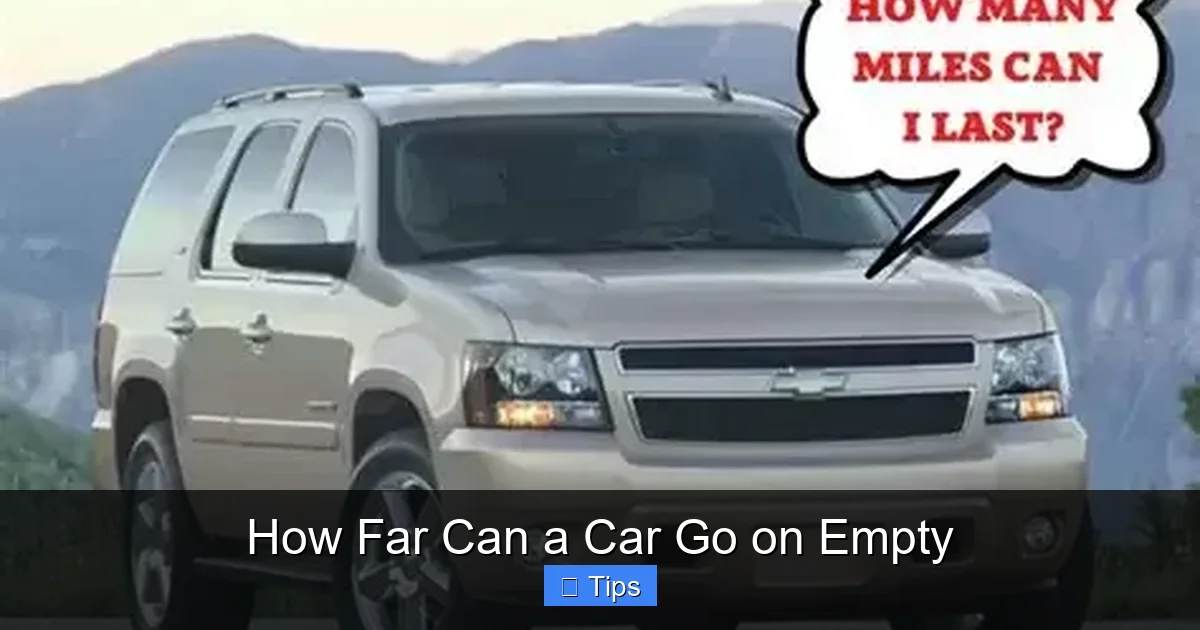
Every gasoline-powered car has a small amount of fuel reserved after the low fuel warning light appears. This isn’t just a random buffer—it’s built into the fuel system to give drivers a final chance to refuel before the tank is truly empty. But how much is actually left?
Most vehicles are designed with a reserve capacity of about 1 to 2 gallons (3.8 to 7.6 liters) after the warning light comes on. This reserve exists because the fuel pump sits at the bottom of the tank and needs to stay submerged to function properly. If the pump runs dry, it can overheat and fail, leading to expensive repairs.
The exact amount of reserve fuel varies by manufacturer and model. For example:
– A Honda Civic might have about 1.2 gallons left when the light comes on.
– A Ford F-150 could have closer to 2 gallons in reserve.
– A Toyota Prius, being highly fuel-efficient, may stretch that reserve further due to its smaller engine and optimized fuel use.
But here’s the catch: that reserve doesn’t translate into a fixed number of miles. Your actual range depends on how efficiently your car uses fuel—and that changes based on how you drive.
How Fuel Efficiency Affects Range on Empty
Fuel efficiency, measured in miles per gallon (MPG), plays a huge role in how far you can go after the light comes on. A car that gets 30 MPG on the highway will go much farther on 1.5 gallons than one that only gets 18 MPG in the city.
Let’s do the math:
– At 30 MPG, 1.5 gallons = 45 miles of range.
– At 18 MPG, 1.5 gallons = only 27 miles.
So even if two cars have the same reserve fuel, the more efficient one will go farther. This is why highway driving often allows you to stretch your gas further than stop-and-go city traffic.
But efficiency isn’t just about the car—it’s also about your driving style. Aggressive acceleration, speeding, and frequent braking can drop your MPG by 15% to 30%. That means your 45-mile buffer could shrink to 30 miles or less if you’re driving hard.
Why the Fuel Light Comes On When It Does
You might wonder why the low fuel warning doesn’t come on when the tank is truly empty. The reason is safety and engineering. Automakers program the fuel gauge and warning system to activate when there’s still fuel left—typically when the tank is about 10% to 15% full.
This gives you time to find a gas station without risking damage to the fuel system. The sensor that triggers the light (usually a float in the fuel tank) is calibrated to alert you before the pump starts sucking air.
Some newer cars even have advanced systems that calculate remaining range based on recent driving patterns. For example, if you’ve been driving mostly on highways, the car might estimate you have 60 miles left. But if you’ve been idling in traffic, it might show only 25 miles.
These estimates are helpful, but they’re not perfect. They don’t account for sudden changes in terrain, weather, or traffic. So while they’re a good guide, don’t treat them as gospel.
Real-World Examples: How Far Can Different Cars Go?
Visual guide about How Far Can a Car Go on Empty
Image source: autozonic.com
To give you a clearer picture, let’s look at real-world examples of how far popular car models can go after the fuel light comes on. These estimates are based on average fuel efficiency and typical reserve fuel levels.
Compact Cars (e.g., Honda Civic, Toyota Corolla)
Compact cars are known for their fuel efficiency. A Honda Civic, for instance, gets around 32 MPG combined. With a reserve of about 1.2 gallons, that gives you roughly 38 miles of range after the light comes on.
The Toyota Corolla is similar—around 33 MPG and a 1.1-gallon reserve, equating to about 36 miles. These cars are great for stretching every drop of gas, especially on highways.
But in heavy city traffic, where MPG drops to 25 or lower, that range could shrink to 25 miles or less. So if you’re stuck in rush hour, don’t assume you can make it 40 miles.
SUVs and Trucks (e.g., Ford F-150, Toyota RAV4)
Larger vehicles consume more fuel, so their range on empty is shorter—even if they have bigger tanks.
Take the Ford F-150. It gets about 20 MPG combined and has a reserve of around 2 gallons. That gives you about 40 miles of range. Not bad, but still risky if the next gas station is 50 miles away.
The Toyota RAV4, a more fuel-efficient SUV, gets around 30 MPG and has a 1.5-gallon reserve. That’s about 45 miles—similar to a compact car. But again, if you’re towing a trailer or driving uphill, your MPG will drop, and so will your range.
Hybrids and Electric Vehicles (e.g., Toyota Prius, Tesla Model 3)
Hybrids and EVs handle low fuel differently. The Toyota Prius, for example, can switch to electric-only mode when the gas tank is nearly empty. This allows it to travel farther on battery power, potentially adding 10 to 20 extra miles beyond the gas reserve.
However, once the battery is depleted, the car will stop—even if there’s a tiny bit of gas left. So while hybrids offer more flexibility, they’re not immune to running out.
Electric vehicles (EVs) like the Tesla Model 3 don’t use gas at all, but they do have a “low battery” warning. Most EVs show a precise range estimate and will alert you when you have 20 to 30 miles left. Some even slow down or limit features to conserve energy.
The key with EVs is planning. Unlike gas stations, charging stations aren’t everywhere, so running low can be more stressful. Always charge when you’re at 20% to avoid getting stranded.
Factors That Reduce How Far You Can Go
Visual guide about How Far Can a Car Go on Empty
Image source: thedailyautomotive.com
Even if your car has a decent reserve, several factors can shorten how far you can go on empty. Understanding these can help you make smarter decisions when the fuel light comes on.
Driving Conditions and Terrain
Hills, mountains, and rough roads increase fuel consumption. Going uphill requires more power, which burns more gas. If you’re driving through a hilly area, your range could drop by 20% or more.
Similarly, driving on gravel or dirt roads creates more resistance, reducing efficiency. And if you’re towing a trailer or carrying heavy cargo, your MPG will take a hit.
Weather and Temperature
Cold weather is a major enemy of fuel efficiency. In winter, engines take longer to warm up, and cold air is denser, increasing drag. Heated seats, defrosters, and frequent idling also burn extra fuel.
Studies show that fuel economy can drop by 10% to 20% in cold weather. So if you’re driving in snow or freezing temperatures, your 40-mile buffer might shrink to 30 miles or less.
Hot weather isn’t much better. Running the AC at full blast can reduce MPG by 10% to 25%, especially in stop-and-go traffic. So on a 90-degree day, your range could be significantly shorter.
Traffic and Driving Style
Stop-and-go traffic is the worst for fuel efficiency. Every time you brake and accelerate, you waste energy. In heavy city driving, MPG can drop by 30% or more compared to steady highway cruising.
Aggressive driving—speeding, rapid acceleration, hard braking—also burns more fuel. The U.S. Department of Energy estimates that aggressive driving can lower gas mileage by 15% to 30% on highways and 10% to 40% in city driving.
So if you’re stuck in traffic or driving aggressively, don’t count on your reserve to get you far.
Tire Pressure and Vehicle Maintenance
Underinflated tires increase rolling resistance, which means your engine has to work harder. A tire that’s 10 PSI below the recommended level can reduce fuel economy by up to 3%.
Regular maintenance also matters. A dirty air filter, worn spark plugs, or a malfunctioning oxygen sensor can all reduce efficiency. Keeping your car well-maintained ensures it runs as efficiently as possible—especially when you’re low on gas.
Risks of Driving on Empty
It’s tempting to push your luck when the fuel light comes on—especially if the next gas station is just a few miles away. But driving on empty isn’t just inconvenient; it can be dangerous and costly.
Engine Damage and Fuel System Issues
The fuel pump relies on gasoline to stay cool and lubricated. When the tank is nearly empty, the pump can suck in air instead of fuel. This causes it to overheat, which can lead to premature failure.
Replacing a fuel pump isn’t cheap—typically $400 to $1,000, including labor. And if debris from the bottom of the tank gets pulled into the system, it can clog fuel filters and injectors, leading to even more repairs.
Running out of gas can also cause the engine to stall unexpectedly. If this happens on a busy highway or at night, it puts you and other drivers at risk.
Safety Hazards of Being Stranded
Being stranded on the side of the road is more than just annoying—it’s dangerous. You could be exposed to extreme weather, traffic hazards, or unsafe areas. If you’re in a remote location, help might be hours away.
Even if you have roadside assistance, waiting for a tow or gas delivery can take time. And if you’re in a hurry, that delay can disrupt your plans.
Environmental and Legal Concerns
Spilling gas while trying to refuel on the roadside can harm the environment. And in some areas, leaving your car unattended on the highway is illegal.
Plus, if your car stalls and causes an accident, you could be held liable—even if it was due to running out of gas.
How to Avoid Running Out of Gas
The best way to handle a low fuel warning is to not let it happen in the first place. With a little planning, you can avoid the stress and risk of running on empty.
Refuel at ¼ Tank
Make it a habit to fill up when your gas gauge hits the quarter mark. This gives you plenty of buffer and reduces the chance of the light coming on unexpectedly.
For most cars, a quarter tank is about 3 to 4 gallons—enough to go 100 miles or more, even in less efficient vehicles.
Apps like GasBuddy, Waze, and Google Maps can help you find the nearest gas stations and compare prices. Many also show real-time availability and wait times.
Some navigation systems even alert you when you’re running low and suggest nearby stations. Use these tools to stay informed and plan your stops.
Monitor Your Driving Habits
Pay attention to your fuel consumption. If you notice your MPG dropping, check your tire pressure, driving style, and maintenance needs.
Avoid aggressive driving, especially when you’re low on gas. Smooth acceleration and steady speeds will help you stretch your fuel further.
Keep an Emergency Kit
Even with the best planning, things can go wrong. Keep a small emergency kit in your car with:
– A 1- or 2-gallon gas can
– A flashlight and batteries
– A first-aid kit
– A portable phone charger
– Roadside assistance contact info
If you do run out, having a gas can means you can walk to a nearby station and bring back fuel—no tow truck needed.
Know Your Car’s Range
Check your owner’s manual to find out your car’s reserve capacity and average MPG. This will help you estimate how far you can go when the light comes on.
Some cars even have a “range” display that shows estimated miles remaining. Use this as a guide, but don’t rely on it completely.
What to Do If You Run Out of Gas
Despite your best efforts, you might still find yourself with an empty tank. Here’s what to do:
1. **Stay Calm and Pull Over Safely**
Turn on your hazard lights and move your car to the shoulder or a safe area. Don’t stop in the middle of the road.
2. **Call for Help**
Contact roadside assistance, a friend, or a family member. Many insurance policies and car warranties include free towing or fuel delivery.
3. **Use Your Emergency Gas Can**
If you have one, carefully pour gas into the tank. Never smoke or use open flames near the fuel.
4. **Wait for Professional Help**
If you’re on a highway or in an unsafe area, stay in your car with the doors locked until help arrives.
5. **Refuel as Soon as Possible**
Once you’re back on the road, fill up immediately—even if it’s just a few gallons. Don’t wait until the next warning.
Final Thoughts: Don’t Test Your Luck
So, how far can a car go on empty? The honest answer is: it depends. Most cars can go 30 to 50 miles after the fuel light comes on, but that range shrinks with poor driving conditions, bad weather, and inefficient habits.
While it’s tempting to see how far you can push it, the risks far outweigh the savings. Running out of gas can damage your car, leave you stranded, and put your safety at risk.
The smart move? Refuel early, plan your trips, and keep an eye on your fuel gauge. A little preparation goes a long way in keeping you safe, saving you money, and ensuring you never have to wonder how far your car can go on empty.
Frequently Asked Questions
How many miles can you drive after the gas light comes on?
Most cars can travel between 30 and 50 miles after the low fuel warning light appears, depending on fuel efficiency and driving conditions. However, this is not guaranteed and can vary widely.
Is it bad to drive with the gas light on?
Yes, driving with the gas light on increases the risk of running out of fuel, which can damage the fuel pump and leave you stranded. It’s best to refuel as soon as possible.
Can running out of gas damage your car?
Yes, running out of gas can cause the fuel pump to overheat and fail, and debris from the bottom of the tank may clog fuel lines. This can lead to costly repairs.
Do all cars have the same reserve fuel amount?
No, reserve fuel varies by make and model. Most cars have 1 to 2 gallons left when the light comes on, but this depends on the vehicle’s design and fuel tank size.
Can hybrids go farther on empty than regular cars?
Hybrids may switch to electric mode when gas is low, potentially adding 10 to 20 extra miles. However, once the battery is depleted, the car will stop.
What should I do if I run out of gas on the highway?
Pull over safely, turn on hazard lights, and call roadside assistance. Stay in your car if it’s unsafe to exit, and avoid attempting to refuel on busy roads.

At CarLegit, we believe information should be clear, factual, and genuinely helpful. That’s why every guide, review, and update on our website is created with care, research, and a strong focus on user experience.