
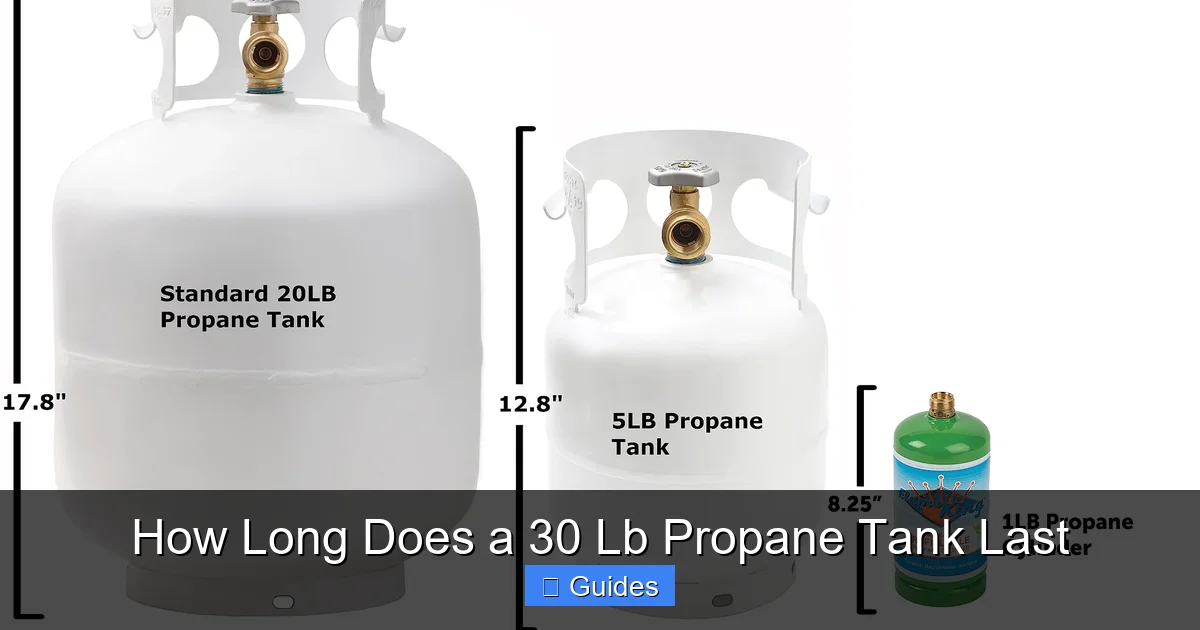
A 30 lb propane tank typically lasts between 18 to 89 hours depending on the appliance and usage. Grills may run 10–20 hours, while heaters or RVs could use it in under a week. Proper maintenance and efficient practices can extend its life significantly.
In This Article
- 1 Key Takeaways
- 2 📑 Table of Contents
- 3 How Long Does a 30 Lb Propane Tank Last? A Complete Guide
- 4 Understanding Propane Tank Basics
- 5 Calculating How Long Your Propane Will Last
- 6 How Long Does a 30 Lb Tank Last for Common Appliances?
- 7 Tips to Make Your Propane Last Longer
- 8 Safety and Maintenance for Propane Tanks
- 9 Refilling vs. Exchanging: What’s Best?
- 10 Conclusion
- 11 Frequently Asked Questions
- 11.1 How long does a 30 lb propane tank last on a gas grill?
- 11.2 Can I use a 30 lb propane tank indoors?
- 11.3 How do I know when my propane tank is empty?
- 11.4 Is it better to refill or exchange a propane tank?
- 11.5 Does cold weather affect propane tank performance?
- 11.6 How often should I inspect my propane tank?
Key Takeaways
- Usage varies by appliance: A 30 lb propane tank lasts longer on low-BTU devices like grills and shorter on high-BTU heaters or generators.
- BTU rating matters: Higher BTU appliances consume propane faster—know your device’s output to estimate runtime.
- Outdoor conditions affect burn time: Cold weather, wind, and altitude can reduce efficiency and shorten tank life.
- Efficiency tips extend usage: Using lids on grills, maintaining equipment, and insulating tanks in winter helps conserve fuel.
- Tank condition impacts performance: Old or poorly maintained tanks may leak or deliver inconsistent pressure, wasting propane.
- Refill vs. exchange considerations: Refilling is cheaper and more eco-friendly than exchanging, and lets you track actual usage.
- Safety first: Always store and handle propane tanks upright, in well-ventilated areas, and inspect for damage regularly.
📑 Table of Contents
- How Long Does a 30 Lb Propane Tank Last? A Complete Guide
- Understanding Propane Tank Basics
- Calculating How Long Your Propane Will Last
- How Long Does a 30 Lb Tank Last for Common Appliances?
- Tips to Make Your Propane Last Longer
- Safety and Maintenance for Propane Tanks
- Refilling vs. Exchanging: What’s Best?
- Conclusion
How Long Does a 30 Lb Propane Tank Last? A Complete Guide
If you’ve ever fired up your grill for a weekend barbecue or warmed your cabin with a propane heater, you’ve probably wondered: *How long does a 30 lb propane tank actually last?* It’s a common question—and for good reason. Propane is a reliable, portable fuel source used in grills, space heaters, RVs, generators, and even home appliances. But unlike gasoline or electricity, it’s not always clear how long your fuel will last before you need a refill.
The truth is, there’s no one-size-fits-all answer. A 30 lb propane tank can last anywhere from a few days to several weeks, depending on what you’re using it for, how often you use it, and even the weather. But don’t worry—we’re here to break it all down. In this guide, we’ll walk you through everything you need to know about propane tank longevity, from calculating burn time to maximizing efficiency. Whether you’re a weekend griller, a full-time RVer, or just trying to keep your home warm during a power outage, this article will help you get the most out of every pound of propane.
Understanding Propane Tank Basics
Visual guide about How Long Does a 30 Lb Propane Tank Last
Image source: learnmetrics.com
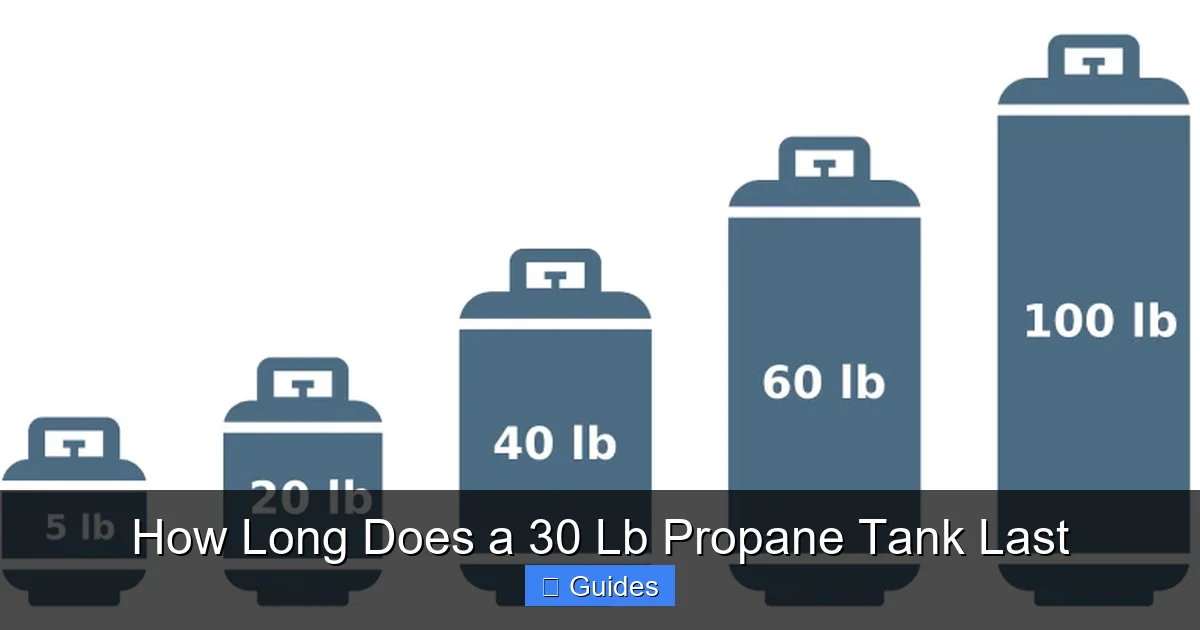
Before we dive into how long a 30 lb propane tank lasts, let’s make sure we’re on the same page about what it actually contains. A 30 lb propane tank is a standard size used across North America for everything from backyard grills to camping stoves and portable heaters. But despite the name, it doesn’t hold exactly 30 pounds of propane at all times.
What’s in a 30 lb Propane Tank?
A 30 lb propane tank is designed to hold up to 30 pounds of liquid propane when filled to 80% capacity—this is a safety standard to allow for expansion due to temperature changes. In reality, most tanks are filled to about 24 pounds of propane (80% of 30), leaving room for the liquid to expand without causing pressure issues. So when you buy or refill a “30 lb” tank, you’re typically getting around 7 gallons of propane.
Propane is stored as a liquid under pressure, but when released through a regulator, it turns into a gas that fuels your appliances. This gas is measured in BTUs (British Thermal Units), which tell us how much energy the propane can produce. One gallon of propane contains approximately 91,500 BTUs, so a full 30 lb tank holds about 640,500 BTUs of energy (7 gallons × 91,500 BTUs).
Why Tank Size Isn’t the Whole Story
It’s easy to assume that a bigger tank means longer runtime—but that’s only part of the equation. What really determines how long your propane lasts is how much energy your appliance uses per hour. For example, a small camping stove might use 5,000 BTUs per hour, while a large outdoor patio heater could burn through 40,000 BTUs in the same time. That means the same tank could last 128 hours on the stove but only 16 hours on the heater.
This is why understanding your appliance’s BTU rating is crucial. It’s the key to estimating how long your propane will last. We’ll get into that in the next section.
Calculating How Long Your Propane Will Last
Visual guide about How Long Does a 30 Lb Propane Tank Last
Image source: girlscangrill.com
Now that you know how much energy is in a 30 lb propane tank, let’s talk about how to figure out how long it will power your devices. The formula is simple:
Total BTUs in tank ÷ BTU usage per hour = Hours of operation
Let’s break that down with real-world examples.
Step-by-Step Calculation
1. **Find your tank’s total BTU capacity.** As we mentioned, a full 30 lb tank holds about 640,500 BTUs.
2. **Check your appliance’s BTU rating.** This is usually listed in the manual or on a label near the burner. Common examples:
– Gas grill: 20,000–40,000 BTUs
– Portable heater: 10,000–40,000 BTUs
– RV furnace: 20,000–40,000 BTUs
– Camping stove: 5,000–10,000 BTUs
– Generator: 5,000–15,000 BTUs (depending on load)
3. **Divide total BTUs by hourly usage.**
For example, if you have a 30,000 BTU gas grill:
640,500 ÷ 30,000 = 21.35 hours of continuous use.
That means if you grill for 2 hours a day, your tank should last about 10–11 days.
Real-World Examples
Let’s look at a few common scenarios:
– **Gas Grill (30,000 BTUs):** ~21 hours total. At 1.5 hours per use, that’s about 14 cookouts.
– **Outdoor Patio Heater (40,000 BTUs):** ~16 hours. Great for a few evening gatherings, but not for all-night use.
– **RV Furnace (25,000 BTUs):** ~25 hours. If you run it 8 hours a night, the tank lasts about 3 nights.
– **Portable Generator (10,000 BTUs under light load):** ~64 hours. Perfect for weekend power outages.
– **Camping Stove (7,000 BTUs):** ~91 hours. Ideal for long backpacking trips or off-grid cooking.
Keep in mind, these are estimates for continuous use. Most people don’t run appliances nonstop, so actual runtime will often be longer.
Factors That Affect Burn Time
Even with perfect math, real-world conditions can change how long your propane lasts. Here are a few things that can speed up or slow down consumption:
– **Wind:** Wind cools flames and reduces efficiency, making your appliance work harder and use more fuel.
– **Cold Weather:** Propane vaporizes less efficiently in cold temperatures, which can reduce output and increase consumption.
– **Altitude:** At higher elevations, lower oxygen levels can cause incomplete combustion, lowering efficiency.
– **Appliance Condition:** Dirty burners, clogged regulators, or worn-out parts can reduce fuel efficiency.
– **Usage Patterns:** Frequent on/off cycling (like grilling in bursts) uses more fuel than steady, moderate use.
How Long Does a 30 Lb Tank Last for Common Appliances?
Visual guide about How Long Does a 30 Lb Propane Tank Last
Image source: camperupgrade.com
Let’s get specific. Here’s how long a 30 lb propane tank typically lasts for the most common uses.
Gas Grills and Outdoor Cooking
Gas grills are one of the most popular uses for 30 lb propane tanks. Most home grills range from 20,000 to 40,000 BTUs, with larger models hitting 50,000+ BTUs.
– **Average grill (30,000 BTUs):** 21 hours of runtime.
– **Heavy use (2 hours/day):** ~10 days.
– **Light use (30 minutes/day):** ~6 weeks.
Tip: Use a grill cover and keep the lid closed as much as possible. This traps heat and reduces fuel use by up to 50%. Also, clean your burners regularly—clogged ports force the grill to work harder.
Space Heaters and Patio Warmers
Portable propane heaters are great for garages, patios, or emergency heating. But they burn fuel fast.
– **Small indoor heater (10,000 BTUs):** ~64 hours.
– **Large patio heater (40,000 BTUs):** ~16 hours.
– **Camping tent heater (5,000 BTUs):** ~128 hours.
Caution: Never use unvented propane heaters indoors unless they’re specifically designed for indoor use and you have proper ventilation. Carbon monoxide poisoning is a real risk.
RVs and Campers
RVs use propane for heating, cooking, and refrigeration. A typical RV furnace runs at 25,000–40,000 BTUs.
– **Furnace only (25,000 BTUs, 8 hours/night):** ~3 nights.
– **Furnace + stove + fridge:** Could drain the tank in 2–3 days.
Pro Tip: Use electric hookups when available to reduce propane use. Also, insulate your RV and use thermal curtains to retain heat.
Generators and Emergency Power
Propane generators are popular for backup power because propane stores well and burns cleanly.
– **5,000-watt generator (10,000 BTUs under load):** ~64 hours.
– **10,000-watt generator (20,000 BTUs):** ~32 hours.
Note: Generators use more fuel under heavy load. Running a fridge, lights, and a microwave will drain the tank faster than just powering a few lights.
Camping and Outdoor Adventures
For campers, a 30 lb tank is overkill—most use 1 lb or 5 lb cylinders. But if you’re base camping or hosting a group, a 30 lb tank can power multiple stoves or a small heater.
– **Two camping stoves (7,000 BTUs each):** ~45 hours combined.
– **Heater + stove combo:** ~30–40 hours depending on usage.
Tip: Bring a propane gauge or scale to monitor fuel levels. Running out mid-meal is no fun.
Tips to Make Your Propane Last Longer
Want to stretch every pound of propane? Here are practical ways to improve efficiency and extend tank life.
Use Appliances Efficiently
– **Grills:** Preheat for 10–15 minutes max. Cook with the lid closed. Use lower heat when possible.
– **Heaters:** Heat only the space you’re using. Close doors and windows to contain warmth.
– **Generators:** Turn off non-essential devices to reduce load.
Maintain Your Equipment
– Clean burners and check for blockages.
– Inspect hoses and regulators for cracks or leaks.
– Replace old or damaged parts promptly.
Protect from the Elements
– Store tanks upright in shaded, ventilated areas.
– In winter, keep tanks insulated or bring them indoors (safely) to maintain pressure.
– Use windbreaks for outdoor heaters and grills.
Monitor Fuel Levels
– Use a propane tank gauge or weigh the tank (a full 30 lb tank weighs about 55–60 lbs total).
– Refill before it’s completely empty to avoid air entering the tank.
Choose Refill Over Exchange
Refilling your tank is usually cheaper than exchanging it at a store. Plus, you know exactly how much propane you’re getting. Exchange programs often give you a partially used tank.
Safety and Maintenance for Propane Tanks
Propane is safe when handled correctly, but it’s important to follow best practices.
Safe Storage and Handling
– Always store tanks upright.
– Keep away from heat sources, sparks, and open flames.
– Never store indoors—use a well-ventilated outdoor area.
– Secure tanks during transport to prevent tipping.
Inspect for Leaks
Mix a few drops of dish soap with water and apply to connections. If bubbles form, there’s a leak. Turn off the gas, tighten connections, or replace damaged parts.
Know When to Retire a Tank
Propane tanks have a 12-year lifespan from the date of manufacture (stamped on the collar). After that, they must be recertified every 5–10 years. If your tank is rusty, dented, or damaged, replace it.
Refilling vs. Exchanging: What’s Best?
When your tank runs low, you have two options: refill it or exchange it.
Refilling
– **Pros:** Cheaper, eco-friendly (no waste), you get a full tank.
– **Cons:** Takes time, requires access to a refill station.
Exchanging
– **Pros:** Fast and convenient.
– **Cons:** More expensive, you might get a partially used tank, contributes to waste.
Recommendation: Refill whenever possible. Many gas stations, hardware stores, and farm supply centers offer refills for $2–$3 per gallon.
Conclusion
So, how long does a 30 lb propane tank last? The answer depends on what you’re using it for, how efficiently you use it, and the conditions you’re in. On average, you can expect anywhere from 18 to 89 hours of runtime—enough for weeks of weekend grilling or several nights of RV heating.
The key is understanding your appliance’s BTU rating and adjusting your habits to maximize efficiency. Simple steps like closing the grill lid, maintaining your equipment, and refilling instead of exchanging can make a big difference.
Propane is a versatile, reliable fuel—but it’s not infinite. By using it wisely, you’ll save money, reduce waste, and keep the flame burning longer. Whether you’re cooking burgers, warming your cabin, or powering through a storm, a little knowledge goes a long way.
Frequently Asked Questions
How long does a 30 lb propane tank last on a gas grill?
A 30 lb propane tank typically lasts 18 to 25 hours on a standard gas grill, depending on the BTU rating. If you grill for 1–2 hours a day, it can last 1–3 weeks.
Can I use a 30 lb propane tank indoors?
No, 30 lb propane tanks should never be used or stored indoors due to safety risks. Only use them outdoors with proper ventilation and away from ignition sources.
How do I know when my propane tank is empty?
You can weigh the tank (a full 30 lb tank weighs about 55–60 lbs), use a propane gauge, or listen for a lack of gas flow when turning on the appliance.
Is it better to refill or exchange a propane tank?
Refilling is usually better—it’s cheaper, more eco-friendly, and ensures you get a full tank. Exchanging is convenient but often costs more and may give you a partially used tank.
Does cold weather affect propane tank performance?
Yes, cold weather reduces propane vaporization, which can lower output and increase fuel consumption. Insulate the tank or keep it in a sheltered area to improve performance.
How often should I inspect my propane tank?
Inspect your tank before each use for leaks, damage, or rust. Have it professionally recertified every 5–10 years after the initial 12-year lifespan.

At CarLegit, we believe information should be clear, factual, and genuinely helpful. That’s why every guide, review, and update on our website is created with care, research, and a strong focus on user experience.