
The amperage needed to charge a Tesla varies drastically based on your charging equipment and speed goals. Using a standard 120V household outlet requires only 12-16 amps for slow, overnight charging, while a 240V Level 2 home station typically demands 32-48 amps for a much quicker charge. For the fastest possible charging, Tesla’s Supercharger network uses high-amperage DC power, where the exact current is managed by the vehicle and station for optimal safety and speed.
I still remember the first time I plugged in my Tesla. The car’s screen lit up with a flurry of numbers and estimates: miles added per hour, time to full, and… amps? I stood there in my garage, staring at the display, realizing that my journey into electric vehicle ownership was about to involve a crash course in home electrical systems. If you’ve found yourself in a similar spot, wondering just what those numbers mean, you’re in the right place.
Let’s clear up the biggest point of confusion right away. The question “How many amps does it take to charge a Tesla?” doesn’t have a single, simple answer. It’s like asking, “How fast can a car go?” Well, it depends on the car, the road, and how much you press the pedal. Charging your Tesla is the same. The amps needed depend entirely on where you’re charging and how quickly you need it done.
This guide will walk you through it all in plain English. We’ll break down the different charging levels, explain how amps, volts, and power work together, and give you practical, real-world examples. By the end, you’ll not only know how many amps your Tesla needs, but you’ll be able to confidently choose the right setup for your home and lifestyle. So, let’s plug in and get started.
In This Article
- 1 Key Takeaways
- 2 📑 Table of Contents
- 3 Understanding the Basics: Amps, Volts, and Kilowatts
- 4 The Three Levels of Charging: From Trickle to Supercharge
- 5 How Many Amps Does Your Tesla Actually Accept?
- 6 Choosing Your Home Charging Setup: A Practical Guide
- 7 Tesla Charging Amps at a Glance: A Handy Reference Chart
- 8 Final Thoughts and Actionable Tips
- 9 Frequently Asked Questions
- 9.1 How many amps does it take to charge a Tesla?
- 9.2 What is the difference between amps and volts when charging a Tesla?
- 9.3 Can I charge my Tesla using a regular household outlet?
- 9.4 How many amps are needed for fast home charging of a Tesla?
- 9.5 Does the Tesla model impact how many amps it can accept?
- 9.6 What happens if I charge my Tesla with lower amps?
Key Takeaways
- Home Charging Amps: Most home setups use 240V at 32-48 amps for optimal speed.
- Supercharger Speed: Superchargers deliver high amps, enabling rapid charging in minutes.
- Model Differences: Check your Tesla model’s max amp acceptance for efficient charging.
- Circuit Breaker Sizing: Ensure your circuit breaker matches the charger’s amp requirement.
- Charging Time Calculation: Use amps and voltage to estimate your charging time.
- Upgrade for Speed: Consider upgrading to a higher amp circuit for faster charging.
- Safety First: Always use a licensed electrician for installation to avoid hazards.
📑 Table of Contents
- Understanding the Basics: Amps, Volts, and Kilowatts
- The Three Levels of Charging: From Trickle to Supercharge
- How Many Amps Does Your Tesla Actually Accept?
- Choosing Your Home Charging Setup: A Practical Guide
- Tesla Charging Amps at a Glance: A Handy Reference Chart
- Final Thoughts and Actionable Tips
Understanding the Basics: Amps, Volts, and Kilowatts
Before we dive into Tesla specifics, we need a quick primer on the electrical trinity. Think of charging your car like filling a swimming pool with a hose.
Amps Are the Flow Rate
Amps (A) are the measure of electrical current, or the “flow” of electricity. In our hose analogy, amps are the diameter of the hose. A bigger hose (more amps) can move more water (electricity) at once.
Volts Are the Pressure
Volts (V) are the measure of electrical pressure. It’s the force pushing the electricity through the circuit. Back to the hose, this is the water pressure from your tap.
Kilowatts Are the Total Water
Kilowatts (kW) are the measure of power—the actual amount of electricity being delivered. This is the total volume of water coming out of the hose. The math is simple: Volts x Amps = Kilowatts (for DC charging, it’s a bit more complex, but this works for understanding home AC charging).
So, when you ask, “How many amps does it take to charge a Tesla?” you’re really asking about the flow rate. But the final speed (kilowatts) also depends on the pressure (volts) your circuit can provide.
The Three Levels of Charging: From Trickle to Supercharge
Teslas, and all EVs, charge at three general levels. The level determines the voltage, which in turn dictates the typical amperage range and charging speed.
Visual guide about How Many Amps Does It Take To Charge A Tesla
Image source: pluglesspower.com
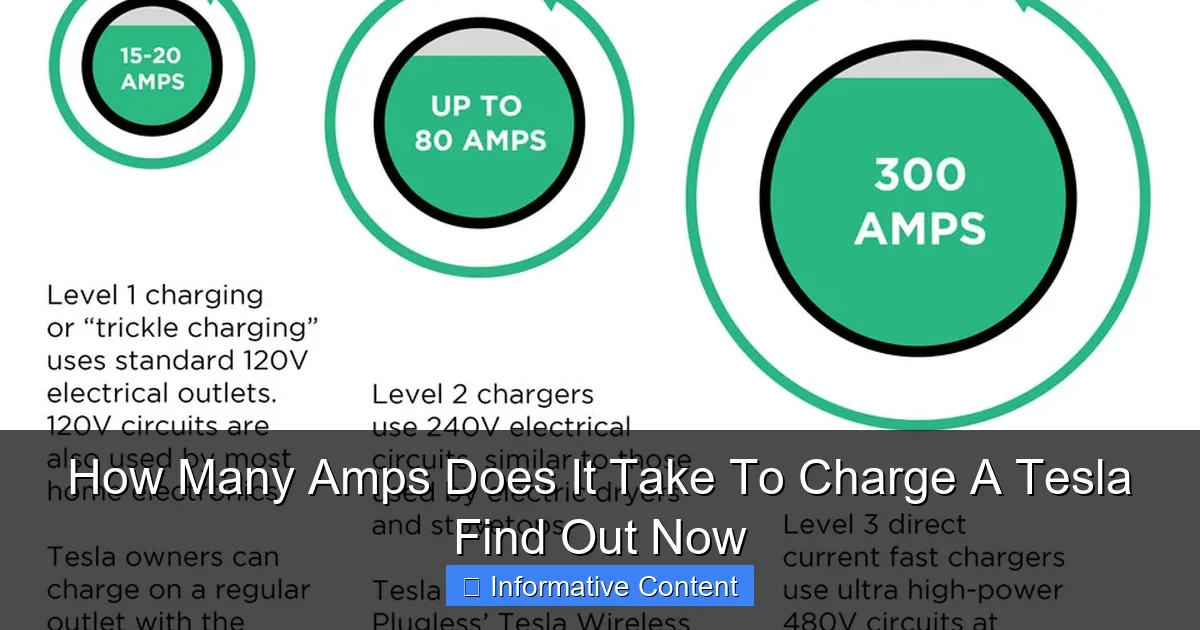
Level 1 Charging: The Standard Outlet (120V)
This is your everyday household outlet. You can plug your Tesla’s Mobile Connector into any standard 120V socket.
- Voltage: 120V
- Typical Amps: 12A (on a standard 15A circuit)
- Power: About 1.4 kW
- Real-World Speed: Adds 3-5 miles of range per hour.
I used Level 1 for a week when I first got my car. It’s perfect if you drive very little daily or as an absolute emergency backup. For most people, it’s too slow to be a primary solution.
Level 2 Charging: The Home & Public Workhorse (240V)
This is the most common and practical solution for home charging. It requires a dedicated 240V circuit, similar to what powers your oven or dryer.
- Voltage: 208V to 240V
- Typical Amps: Ranges from 16A to 48A (and sometimes higher)
- Power: From about 3.3 kW up to 11.5 kW or more.
- Real-World Speed: Adds 20-45+ miles of range per hour.
This is the sweet spot. A Level 2 charger can completely replenish your battery overnight. The exact amps for charging your Tesla at home will depend on your installed equipment and your car’s onboard charger.
Level 3 Charging: DC Fast Charging (Supercharging)
These are the Tesla Superchargers and other public DC fast chargers. They bypass your car’s onboard charger and feed DC power directly to the battery.
- Voltage: High voltage DC (400V+).
- Amps/Power: We stop talking about amps here and focus on power: from 72 kW up to 250 kW for current Superchargers, and even higher for the latest V4 stations.
- Real-World Speed: Can add up to 200 miles of range in 15 minutes.
You don’t control the amps or volts here—the car and the Supercharger communicate to deliver the fastest safe charge possible.
How Many Amps Does Your Tesla Actually Accept?
This is the core of the question. Your Tesla has a built-in piece of hardware called an onboard charger. Its maximum amperage rating is the ceiling for your Level 1 and Level 2 AC charging speed.
Visual guide about How Many Amps Does It Take To Charge A Tesla
Image source: iphonelife.com
The Onboard Charger Limitation
Most older and some standard-range Tesla models have an 11.5 kW onboard charger that can accept a maximum of 48 amps at 240V. Many newer models, particularly standard-range versions, now come with a 7.7 kW onboard charger with a max of 32 amps.
You can find your car’s maximum AC charging amperage in the charging screen on your vehicle’s touchscreen. It’s a crucial number! Even if you install a powerful 60-amp circuit, if your car’s onboard charger maxes out at 32 amps, that’s all the current it will draw.
The Circuit Breaker Rule (The 80% Rule)
This is the most important safety rule in electrical work. For continuous loads (like charging a car for more than 3 hours), you can only use 80% of a circuit’s rated capacity.
- A 50-amp circuit breaker can safely deliver a continuous 40 amps.
- A 60-amp circuit breaker can safely deliver a continuous 48 amps.
- A 40-amp circuit breaker can safely deliver a continuous 32 amps.
So, to charge at your Tesla’s maximum 48-amp capability, you must have a dedicated 60-amp circuit installed by a qualified electrician.
Choosing Your Home Charging Setup: A Practical Guide
Let’s translate this into decisions for your garage. Your goal is to match your circuit and charging equipment to your car’s ability and your driving needs.
Visual guide about How Many Amps Does It Take To Charge A Tesla
Image source: uploads-ssl.webflow.com
Option 1: The Mobile Connector (With Different Adapters)
Tesla’s Mobile Connector is a versatile tool. It comes with a standard 120V (5-15) adapter, but you can buy others.
- With a NEMA 5-15 (standard outlet): 120V, 12A. Slow, but universal.
- With a NEMA 14-50 (common dryer/RV outlet): 240V, up to 32A. This is a fantastic and cost-effective home solution if you have this outlet installed on a 40-amp or 50-amp circuit.
Option 2: A Dedicated Tesla Wall Connector
This is the premium, integrated home solution. It’s hardwired to your electrical panel.
- It can be configured on a variety of circuit breakers (15A to 60A).
- On a 60-amp circuit, it will deliver the maximum 48 amps to capable vehicles.
- It’s sleek, has a long cable, and integrates seamlessly with the Tesla app.
When I upgraded to a Wall Connector on a 60-amp circuit, the difference was night and day. Waking up to a “full tank” every single morning eliminated any last bit of range anxiety.
How to Decide What You Need
Ask yourself: How many miles do I drive on an average day? If it’s less than 30-40, a 240V/32A setup (like a Mobile Connector on a 14-50 outlet) is likely plenty. If you have a long commute or just want the absolute fastest home charging possible, spring for the Wall Connector on a 60-amp circuit.
Tesla Charging Amps at a Glance: A Handy Reference Chart
Here’s a quick-reference data table to visualize the relationship between circuit size, usable amps, power, and charging speed. Speeds are estimated for a Tesla Model Y Long Range.
| Charging Method | Circuit Breaker Size | Max Continuous Amps (80% Rule) | Voltage | Approx. Power (kW) | Miles of Range Added Per Hour* |
|---|---|---|---|---|---|
| Standard Outlet (Mobile Connector) | 15A | 12A | 120V | 1.4 kW | 3-5 miles |
| NEMA 14-50 Outlet (Mobile Connector) | 50A | 40A | 240V | 9.6 kW | 30-35 miles |
| Wall Connector (Typical Setup) | 60A | 48A | 240V | 11.5 kW | 40-45 miles |
| Wall Connector (for 32A car) | 40A | 32A | 240V | 7.7 kW | 25-30 miles |
| Tesla Supercharger V3 | N/A | N/A | High Voltage DC | Up to 250 kW | Up to 1000 miles/hr** |
*Range added per hour can vary based on battery size, model, climate, and battery state.
**Supercharger speed peaks early and tapers as the battery fills. This is a peak rate, not sustained.
Final Thoughts and Actionable Tips
So, how many amps does it take to charge a Tesla? As we’ve seen, it spans from a humble 12 amps on a household outlet to the massive, non-ampere-specific flows of a Supercharger. For daily life, the answer usually centers around a 240V Level 2 system delivering between 32 and 48 amps.
Here’s my final, hard-earned advice. First, check your car’s charging screen to see its maximum AC amp acceptance. That’s your personal charging speed limit. Second, consult with a licensed electrician before buying anything. They can tell you what your home’s electrical panel can support and give you a quote. The cost of installation can vary wildly based on the distance from your panel to your garage.
Don’t overthink it. For 90% of Tesla owners, installing a 240V outlet (like a NEMA 14-50) or a hardwired Wall Connector is a one-time expense that pays off in sheer convenience every single day. It transforms the EV ownership experience from “managing a charge” to simply plugging in when you get home, just like your phone. You stop thinking about amps and volts, and you just start enjoying the drive.
Embrace the learning curve. Understanding these basics makes you a more informed owner and takes the mystery out of that glowing screen in your garage. Now go ahead, plan your setup, and get ready for the easiest “refueling” you’ve ever experienced.
Frequently Asked Questions
How many amps does it take to charge a Tesla?
The amps required to charge a Tesla depend on the charging setup. For instance, a standard 110V outlet typically uses 12 amps, while a dedicated Level 2 home charger often operates at 32 to 48 amps for significantly faster charging speeds.
What is the difference between amps and volts when charging a Tesla?
Amps measure current flow, while volts measure electrical pressure; together they determine power in watts. Higher amps or volts increase charging power, so a 240V circuit at 32 amps delivers more energy per hour than a 110V circuit at 12 amps.
Can I charge my Tesla using a regular household outlet?
Yes, you can charge your Tesla with a standard 110V outlet using the mobile connector. However, this slow method provides only about 3-4 miles of range per hour, making it ideal for overnight top-ups or emergency use.
How many amps are needed for fast home charging of a Tesla?
For efficient fast charging at home, a Level 2 station usually requires 32 to 48 amps. This amperage can add 20-30 miles of range per hour, greatly reducing downtime compared to standard outlets.
Does the Tesla model impact how many amps it can accept?
While all Teslas can charge at various amperages, the onboard charger in each model sets a maximum limit, often up to 48 amps for Level 2. Always consult your vehicle’s manual to ensure optimal charging without exceeding its capabilities.
What happens if I charge my Tesla with lower amps?
Charging with lower amps is safe but results in slower battery replenishment. It may extend charging times significantly, which could be inconvenient if you need a quick turnaround for daily driving.

At CarLegit, we believe information should be clear, factual, and genuinely helpful. That’s why every guide, review, and update on our website is created with care, research, and a strong focus on user experience.