
The number of catalytic converters in a Toyota Tacoma varies by model year, engine size, and exhaust configuration—typically ranging from one to four. Understanding your Tacoma’s setup helps with maintenance, repairs, and protecting against catalytic converter theft, which has become increasingly common in recent years.
If you’re a Toyota Tacoma owner—or thinking about becoming one—you’ve probably heard about catalytic converters. Maybe you’ve seen news reports about thefts, received a check engine light, or wondered why your truck suddenly sounds louder than usual. One of the most common questions we hear is: “How many catalytic converters are in a Toyota Tacoma?”
The short answer? It depends. The number of catalytic converters in your Tacoma isn’t a one-size-fits-all number. It varies based on several factors, including your truck’s model year, engine type, drivetrain (2WD vs. 4WD), and even the emissions standards in your region. But don’t worry—we’re going to break it all down for you in simple terms.
Catalytic converters are essential components of your vehicle’s exhaust system. They reduce harmful emissions by converting toxic gases like carbon monoxide, nitrogen oxides, and hydrocarbons into less harmful substances like carbon dioxide and water vapor. Because they contain precious metals such as platinum, palladium, and rhodium, they’re also valuable—and unfortunately, that makes them a target for thieves.
In this guide, we’ll walk you through everything you need to know about catalytic converters in the Toyota Tacoma. From how many your specific model has, to why it matters, to how to protect them from theft and keep them running smoothly. Whether you drive a 2005 Tacoma with a 2.7L engine or a brand-new 2023 TRD Pro with a 3.5L V6, this article has you covered.
In This Article
- 1 Key Takeaways
- 2 📑 Table of Contents
- 3 Understanding Catalytic Converters: What They Do and Why They Matter
- 4 How Many Catalytic Converters Are in a Toyota Tacoma? A Year-by-Year Breakdown
- 5 Why Does the Number of Catalytic Converters Matter?
- 6 How to Identify and Protect Your Tacoma’s Catalytic Converters
- 7 Common Misconceptions About Catalytic Converters in the Tacoma
- 8 Final Thoughts: Know Your Tacoma’s Emissions System
- 9 Frequently Asked Questions
- 9.1 How many catalytic converters does a 2020 Toyota Tacoma have?
- 9.2 Can I drive my Tacoma with a bad catalytic converter?
- 9.3 Why are catalytic converters stolen from Tacomas?
- 9.4 How much does it cost to replace a catalytic converter on a Tacoma?
- 9.5 Can I install a catalytic converter shield on my Tacoma?
- 9.6 Will a missing catalytic converter cause my check engine light to come on?
Key Takeaways
- Most Toyota Tacomas have 1–4 catalytic converters: The exact number depends on the engine (2.7L, 3.5L, or 3.4L V6), model year, and whether it’s a 4WD or 2WD model.
- Newer models (2016–2023) often have two or more: Due to stricter emissions standards, newer Tacomas frequently use dual catalytic converter systems—one close to the engine (pre-cat) and one downstream.
- V6 engines typically require more converters: The 3.5L V6 and 3.4L V6 engines usually have two or three catalytic converters, while the 2.7L four-cylinder often has one or two.
- Four-wheel-drive models may have additional converters: 4WD Tacomas with dual exhaust systems can feature up to four catalytic converters—two per side.
- Catalytic converter theft is a growing concern: Tacomas are prime targets due to their high ground clearance and valuable precious metals (platinum, palladium, rhodium) inside the converters.
- Replacing a catalytic converter is expensive: OEM replacements can cost $1,500–$3,000+, making prevention and early diagnosis crucial.
- Regular maintenance helps avoid failure: Keeping your engine tuned and using quality fuel reduces the risk of catalytic converter damage from unburned fuel or oil contamination.
📑 Table of Contents
- Understanding Catalytic Converters: What They Do and Why They Matter
- How Many Catalytic Converters Are in a Toyota Tacoma? A Year-by-Year Breakdown
- Why Does the Number of Catalytic Converters Matter?
- How to Identify and Protect Your Tacoma’s Catalytic Converters
- Common Misconceptions About Catalytic Converters in the Tacoma
- Final Thoughts: Know Your Tacoma’s Emissions System
Understanding Catalytic Converters: What They Do and Why They Matter
Before diving into the specifics of the Toyota Tacoma, let’s take a moment to understand what catalytic converters actually do—and why they’re so important.
A catalytic converter is a stainless steel canister located in your vehicle’s exhaust system. Inside, it contains a honeycomb-like structure coated with precious metals that act as catalysts. As exhaust gases pass through, these metals trigger chemical reactions that convert pollutants into safer emissions.
For example, carbon monoxide (a deadly gas) is converted into carbon dioxide. Hydrocarbons (unburned fuel) become water and CO2. Nitrogen oxides (which contribute to smog) are broken down into nitrogen and oxygen. This process happens continuously while your engine is running, helping your vehicle meet environmental regulations.
In the U.S., catalytic converters became mandatory on all gasoline-powered vehicles starting in 1975. Over time, emissions standards have become stricter, especially with the introduction of Tier 2 and Tier 3 standards by the Environmental Protection Agency (EPA). This means modern vehicles—including the Toyota Tacoma—must be equipped with more advanced and often multiple catalytic converter systems to keep emissions low.
How Catalytic Converters Work
The catalytic converter operates using two types of catalysts: reduction and oxidation.
The reduction catalyst (usually platinum and rhodium) reduces nitrogen oxides into nitrogen and oxygen. The oxidation catalyst (platinum and palladium) converts carbon monoxide and hydrocarbons into carbon dioxide and water.
These reactions require high temperatures—typically between 600°F and 1,600°F—to work efficiently. That’s why catalytic converters are usually located close to the engine, where exhaust gases are hottest. However, as engines have become more efficient and exhaust temperatures have dropped in some designs, automakers have started using additional converters downstream to ensure emissions stay within legal limits.
Why the Number of Converters Varies
So why do some Tacomas have one catalytic converter while others have four? It all comes down to engineering, emissions compliance, and engine design.
For example, a 2005 Tacoma with a 2.7L four-cylinder engine might only need one converter to meet emissions standards of that era. But a 2020 Tacoma with a 3.5L V6 and dual exhaust system may require two or even three converters per side to satisfy modern regulations.
Additionally, four-wheel-drive models often have more complex exhaust systems with dual mufflers and dual tailpipes, which can mean more catalytic converters. Each exhaust path may have its own converter, leading to a total of four in some configurations.
Understanding how many your Tacoma has isn’t just academic—it affects maintenance, repair costs, and even your risk of theft.
How Many Catalytic Converters Are in a Toyota Tacoma? A Year-by-Year Breakdown
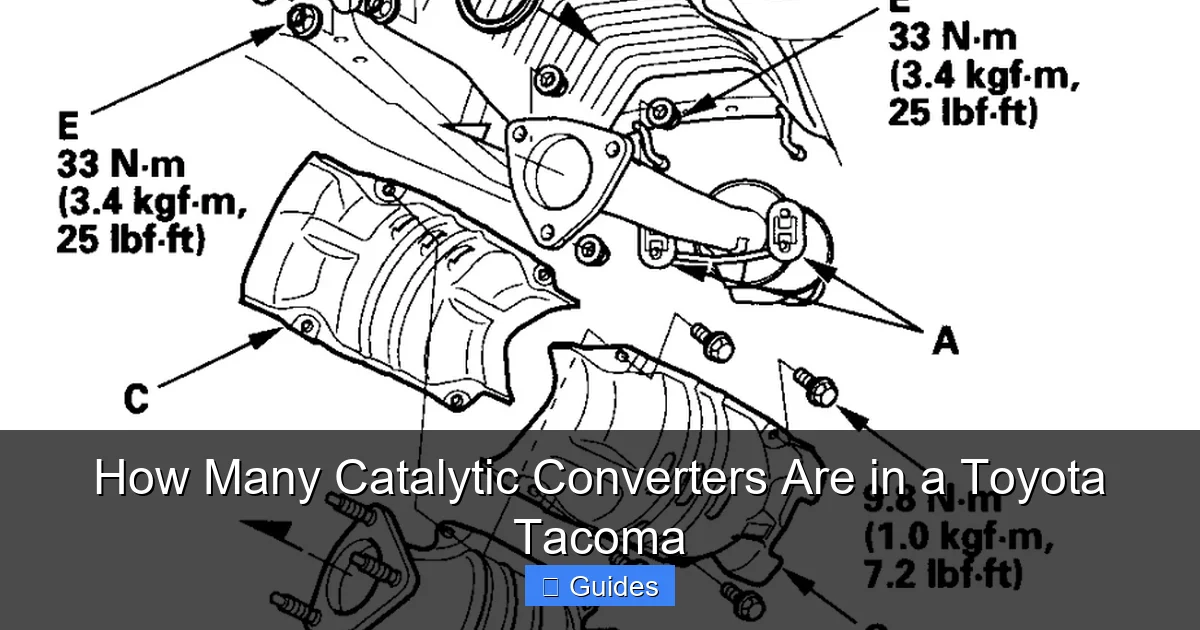
Visual guide about How Many Catalytic Converters Are in a Toyota Tacoma
Image source: 2carpros.com
Now let’s get into the nitty-gritty: how many catalytic converters does your specific Toyota Tacoma have? We’ll break it down by model year and engine type to give you the most accurate information.
Keep in mind that Toyota has made changes to the Tacoma’s engine lineup and emissions systems over the years. The Tacoma has been in production since 1995, and during that time, it’s used several different engines—each with its own exhaust and catalytic converter setup.
1995–2004 Toyota Tacoma (First Generation)
The first-generation Tacoma (1995–2004) came with two engine options: a 2.4L four-cylinder and a 3.4L V6.
– 2.4L Four-Cylinder: Most models had a single catalytic converter located near the engine manifold.
– 3.4L V6: These engines typically had two catalytic converters—one for each bank of cylinders. Since the V6 has two exhaust manifolds (one on each side), each side fed into its own converter before merging into a single exhaust pipe.
So, in this generation, you’re looking at either one or two catalytic converters, depending on the engine.
2005–2015 Toyota Tacoma (Second Generation)
The second-generation Tacoma introduced a new 2.7L four-cylinder and a more powerful 4.0L V6 (which replaced the 3.4L).
– 2.7L Four-Cylinder: Most models had a single catalytic converter. However, some later models (especially 2012–2015) began using a dual-converter setup with a pre-cat (close to the engine) and a post-cat (further downstream) to meet stricter emissions standards.
– 4.0L V6: These engines almost always had two catalytic converters—one per cylinder bank. Some 4WD models with dual exhaust systems could have up to four converters, with two on each side of the vehicle.
So, for this generation, the range is one to four catalytic converters, depending on engine and drivetrain.
2016–2023 Toyota Tacoma (Third Generation)
The current third-generation Tacoma (2016–present) uses a 2.7L four-cylinder or a 3.5L V6 engine. Emissions standards have become much stricter, leading to more complex exhaust systems.
– 2.7L Four-Cylinder: Most models have two catalytic converters—a pre-cat and a post-cat. The pre-cat is mounted directly to the exhaust manifold, while the post-cat is located further down the exhaust pipe. This dual system helps reduce cold-start emissions and improves overall efficiency.
– 3.5L V6: These engines typically have two or three catalytic converters. The standard setup includes one pre-cat per cylinder bank (two total), plus a third downstream converter. In some 4WD models with dual exhaust systems, there can be up to four converters—two per side.
For example, a 2020 Tacoma TRD Off-Road with a 3.5L V6 and 4WD may have four catalytic converters: two near the engine (one per bank) and two further back in the dual exhaust system.
2024 and Beyond: What to Expect
Toyota has not yet released major engine changes for the 2024 Tacoma, so the 2.7L and 3.5L engines remain in use. However, with increasing pressure to reduce emissions—and the possibility of hybrid or electrified Tacomas in the future—we may see even more advanced catalytic systems or alternative emissions control technologies.
For now, if you drive a 2024 Tacoma, expect the same range: one to four catalytic converters, depending on your engine and configuration.
Why Does the Number of Catalytic Converters Matter?
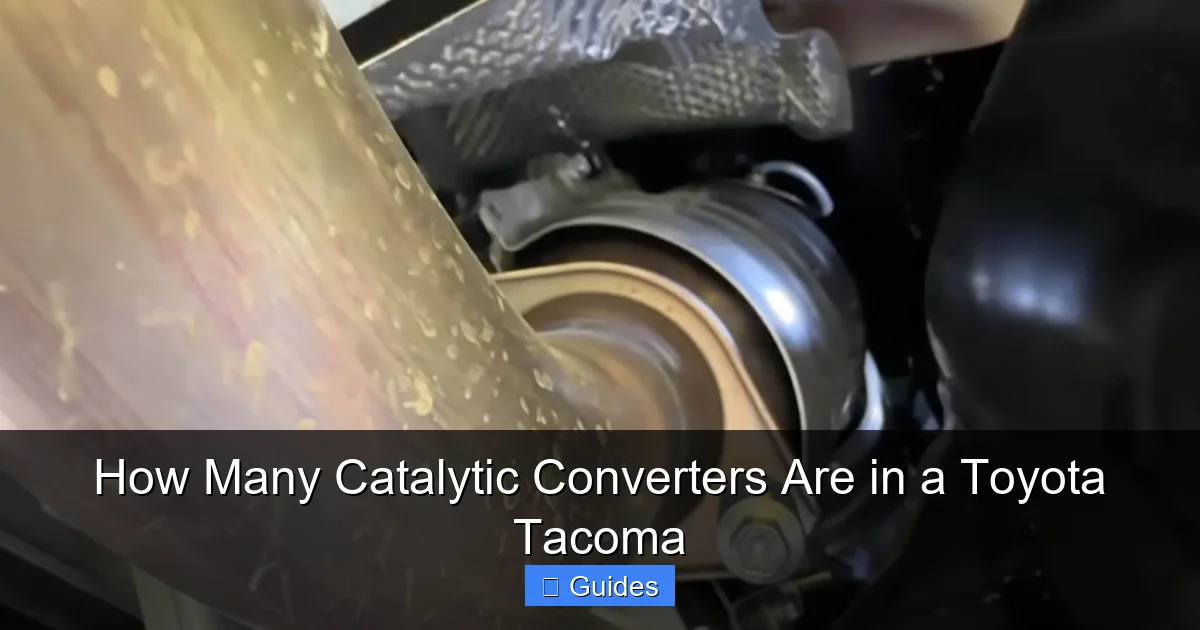
Visual guide about How Many Catalytic Converters Are in a Toyota Tacoma
Image source: tacoma4g.com
You might be thinking, “So what? It’s just a part under my truck.” But the number and location of catalytic converters in your Tacoma actually matter a lot—for several practical reasons.
1. Emissions Compliance and Inspections
If you live in a state that requires emissions testing (like California, Texas, or New York), your catalytic converters play a critical role in passing inspections. A missing or malfunctioning converter can cause your vehicle to fail.
Moreover, tampering with or removing a catalytic converter is illegal under federal law (Clean Air Act) and can result in hefty fines. Even if you’re not caught during an inspection, a missing converter will trigger a check engine light and may prevent your truck from running efficiently.
2. Performance and Fuel Economy
A clogged or failing catalytic converter can restrict exhaust flow, reducing engine performance and fuel economy. You might notice symptoms like:
– Reduced acceleration
– Poor fuel mileage
– Rattling noises (from a broken internal substrate)
– Strong smell of sulfur (rotten eggs)
– Check engine light with codes like P0420 or P0430
If your Tacoma has multiple converters, diagnosing which one is failing can be tricky. Mechanics often use infrared thermometers or scan tools to check the temperature difference before and after each converter to identify a problem.
3. Repair and Replacement Costs
Catalytic converters are expensive—especially OEM (original equipment manufacturer) units. Replacing a single converter on a Tacoma can cost anywhere from $1,500 to $3,000 or more, depending on the model and labor rates.
If your truck has four converters, the cost could easily exceed $6,000. That’s why it’s important to know how many you have—and to address issues early before multiple converters are affected.
4. Theft Prevention
Catalytic converter theft has skyrocketed in recent years. Thieves target vehicles like the Toyota Tacoma because:
– They have high ground clearance, making it easy to slide underneath.
– They often have multiple converters, increasing the payout.
– The precious metals inside (especially rhodium) are extremely valuable—sometimes worth $1,000+ per converter on the black market.
In 2022, the National Insurance Crime Bureau (NICB) reported over 64,000 catalytic converter thefts in the U.S.—a massive increase from just a few thousand in 2019. Tacomas, along with other trucks and SUVs, are among the most targeted vehicles.
Knowing how many converters your Tacoma has helps you assess your risk and take preventive measures.
How to Identify and Protect Your Tacoma’s Catalytic Converters
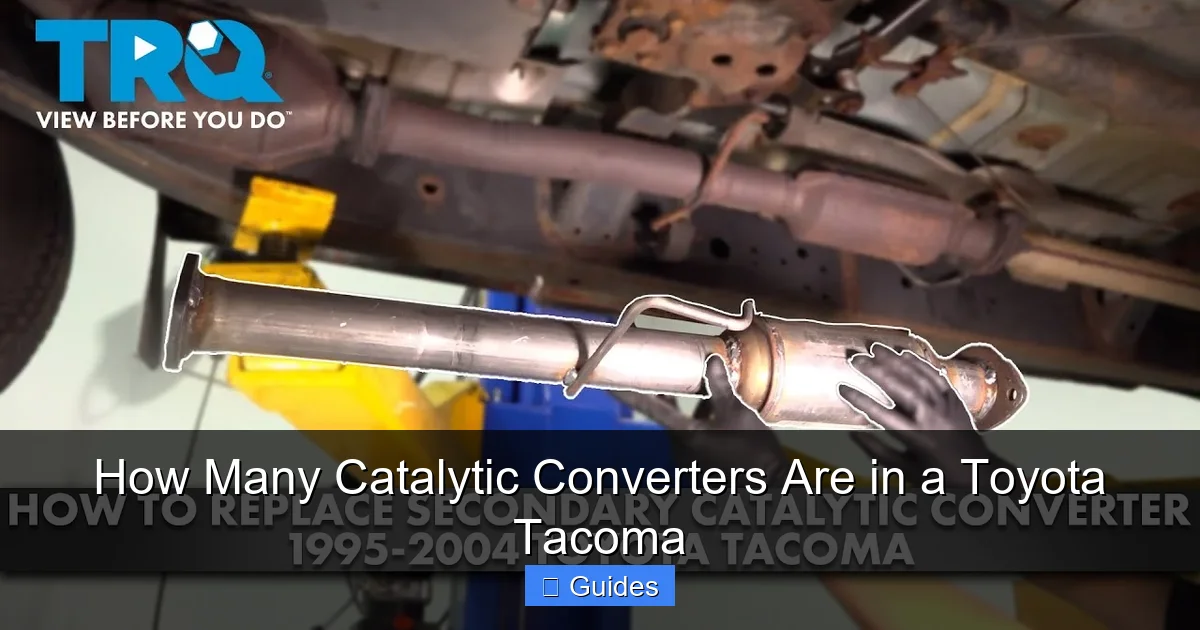
Visual guide about How Many Catalytic Converters Are in a Toyota Tacoma
Image source: i.ytimg.com
Now that you know how many catalytic converters your Tacoma likely has, let’s talk about how to find them—and how to protect them.
Locating the Catalytic Converters
Catalytic converters are usually located under the vehicle, along the exhaust pipe. Here’s how to find them:
– Look for shiny, bullet-shaped or oval canisters welded to the exhaust system.
– They’re often near the engine (pre-cats) or further back near the muffler (post-cats).
– On V6 models, you’ll typically see one on each side of the engine bay, near the exhaust manifolds.
– On 4WD models with dual exhaust, check both sides of the truck.
If you’re unsure, consult your owner’s manual or look up a parts diagram for your specific model year and engine.
Signs of a Failing Catalytic Converter
Watch for these warning signs:
– Check engine light (especially P0420 or P0430 codes)
– Reduced engine power or hesitation
– Poor fuel economy
– Rattling noise from under the truck
– Strong sulfur smell from the exhaust
If you notice any of these, have your truck inspected by a trusted mechanic. Early diagnosis can prevent further damage and save you money.
How to Prevent Catalytic Converter Theft
Here are practical tips to protect your Tacoma:
– **Park in well-lit, secure areas:** Avoid dark alleys or isolated parking lots.
– **Install a catalytic converter shield:** These metal plates bolt over the converter, making it harder to cut out. Brands like Cat Shield and One-Trip offer Tacoma-specific models.
– **Engrave your VIN on the converter:** This makes it harder to sell and easier to identify if stolen.
– **Use a security system:** Some alarms can detect vibrations or lifting of the vehicle.
– **Consider etching or painting:** High-temperature paint or etching your license plate number on the converter can deter thieves.
Many insurance companies also offer coverage for catalytic converter theft under comprehensive auto insurance. Check your policy to see if you’re protected.
Common Misconceptions About Catalytic Converters in the Tacoma
There’s a lot of misinformation out there about catalytic converters. Let’s clear up some common myths.
Myth 1: “All Tacomas Have the Same Number of Converters”
False. As we’ve seen, the number varies widely based on engine, year, and drivetrain. Assuming your Tacoma has only one converter could lead to missed diagnoses or incomplete repairs.
Myth 2: “Aftermarket Converters Are Just as Good as OEM”
Not always. While some high-quality aftermarket converters (like those from MagnaFlow or Walker) meet or exceed OEM standards, cheaper units may fail prematurely or not pass emissions tests. Always choose a converter that’s EPA-compliant and CARB-certified (if you’re in California).
Myth 3: “You Can Just Remove the Catalytic Converter”
Illegal and harmful. Removing a catalytic converter violates federal law and can result in fines up to $25,000. It also increases pollution and can damage your engine over time due to altered backpressure.
Myth 4: “Catalytic Converters Last Forever”
No. While they’re designed to last 100,000+ miles, they can fail early due to engine problems (like misfires or oil burning), physical damage, or contamination. Regular maintenance is key.
Final Thoughts: Know Your Tacoma’s Emissions System
The number of catalytic converters in your Toyota Tacoma isn’t just a trivia fact—it’s a key part of understanding your vehicle’s emissions, performance, and security.
Whether you drive a 2005 2.7L with one converter or a 2023 3.5L V6 with four, knowing your setup helps you:
– Diagnose problems faster
– Avoid costly repairs
– Pass emissions tests
– Protect against theft
Take a few minutes to inspect your exhaust system. Look under your truck, identify the converters, and consider installing a shield if you’re in a high-theft area. And if you ever see that check engine light, don’t ignore it—early action can save you thousands.
The Toyota Tacoma is built to last, and with proper care, your catalytic converters can too. Stay informed, stay protected, and keep your Tacoma running clean and strong for years to come.
Frequently Asked Questions
How many catalytic converters does a 2020 Toyota Tacoma have?
A 2020 Toyota Tacoma typically has two to four catalytic converters, depending on the engine and drivetrain. The 2.7L four-cylinder usually has two, while the 3.5L V6 often has three or four—especially in 4WD models with dual exhaust systems.
Can I drive my Tacoma with a bad catalytic converter?
You can drive short distances, but it’s not recommended. A failing converter can reduce performance, increase emissions, and eventually cause engine damage. It may also trigger a check engine light and cause your truck to fail emissions tests.
Why are catalytic converters stolen from Tacomas?
Toyota Tacomas are prime targets because they have high ground clearance, making it easy to access the converters, and often have multiple units containing valuable precious metals like platinum, palladium, and rhodium.
How much does it cost to replace a catalytic converter on a Tacoma?
Replacing one catalytic converter on a Toyota Tacoma typically costs between $1,500 and $3,000 for OEM parts and labor. Aftermarket options may be cheaper but vary in quality and compliance.
Can I install a catalytic converter shield on my Tacoma?
Yes, catalytic converter shields are available for most Tacoma models and can be installed by a mechanic or DIY enthusiast. They provide a physical barrier that makes theft more difficult and time-consuming.
Will a missing catalytic converter cause my check engine light to come on?
Yes, a missing or malfunctioning catalytic converter will almost always trigger a check engine light, usually with codes like P0420 or P0430. These indicate low catalytic efficiency and require diagnosis and repair.

At CarLegit, we believe information should be clear, factual, and genuinely helpful. That’s why every guide, review, and update on our website is created with care, research, and a strong focus on user experience.