
The number of catalytic converters in a Toyota Tundra varies by engine size, model year, and exhaust configuration—typically ranging from two to four units. Understanding their placement and function helps with maintenance, emissions compliance, and troubleshooting performance issues.
If you’re a Toyota Tundra owner—or thinking about becoming one—you’ve probably heard the term “catalytic converter” thrown around, especially when talking about emissions, performance, or that dreaded check engine light. But how many catalytic converters are actually in a Toyota Tundra? The answer isn’t as straightforward as you might think. It depends on several factors, including the engine size, model year, and whether your truck has a single or dual exhaust system.
The catalytic converter is a critical component of your vehicle’s exhaust system. Its job is to reduce harmful emissions by converting toxic gases like carbon monoxide, nitrogen oxides, and unburned hydrocarbons into less harmful substances such as carbon dioxide, nitrogen, and water vapor. Because of strict environmental regulations—especially in the U.S.—modern vehicles like the Toyota Tundra are equipped with multiple catalytic converters to meet emissions standards.
In this guide, we’ll break down exactly how many catalytic converters you can expect in your Toyota Tundra, where they’re located, how they function, and what to do if one fails. Whether you drive a 2000 model with a V6 or a 2023 Tundra TRD Pro with a twin-turbo V6, this article will give you the full picture. We’ll also cover maintenance tips, common symptoms of failure, and what to expect if you need a replacement. So grab a coffee, get comfortable, and let’s dive into the world of catalytic converters in one of America’s favorite full-size trucks.
In This Article
- 1 Key Takeaways
- 2 📑 Table of Contents
- 3 Understanding Catalytic Converters: What They Are and Why They Matter
- 4 How Many Catalytic Converters Are in a Toyota Tundra? A Model-by-Model Breakdown
- 5 Where Are the Catalytic Converters Located on a Toyota Tundra?
- 6 Common Symptoms of a Failing Catalytic Converter
- 7 Maintenance and Replacement: What You Need to Know
- 8 Catalytic Converter Security: Protecting Your Tundra from Theft
- 9 Conclusion
- 10 Frequently Asked Questions
- 10.1 How many catalytic converters does a 2023 Toyota Tundra have?
- 10.2 Can I drive my Tundra with a bad catalytic converter?
- 10.3 How much does it cost to replace a catalytic converter on a Toyota Tundra?
- 10.4 Are Toyota Tundra catalytic converters prone to theft?
- 10.5 What causes catalytic converters to fail in a Tundra?
- 10.6 Can I replace just one catalytic converter if only one is bad?
Key Takeaways
- Most Toyota Tundras have two to four catalytic converters depending on the engine and model year, with V8 models often using more than V6 versions.
- Dual exhaust systems usually mean dual catalytic converters, especially in performance-oriented or higher-trim models.
- Pre-2005 models may have fewer converters due to less strict emissions standards, while post-2005 trucks often include additional units for compliance.
- Catalytic converters are located along the exhaust system, typically near the engine (pre-cats) and under the vehicle (main cats).
- Replacing a catalytic converter can be expensive, ranging from $1,000 to $3,000 per unit, making maintenance and early detection crucial.
- Check engine lights or reduced fuel economy may signal a failing catalytic converter—diagnose early to avoid further damage.
- Regular maintenance and using quality fuel can extend the life of your Tundra’s catalytic converters and improve overall performance.
📑 Table of Contents
- Understanding Catalytic Converters: What They Are and Why They Matter
- How Many Catalytic Converters Are in a Toyota Tundra? A Model-by-Model Breakdown
- Where Are the Catalytic Converters Located on a Toyota Tundra?
- Common Symptoms of a Failing Catalytic Converter
- Maintenance and Replacement: What You Need to Know
- Catalytic Converter Security: Protecting Your Tundra from Theft
- Conclusion
Understanding Catalytic Converters: What They Are and Why They Matter
Before we get into the specifics of the Toyota Tundra, it’s important to understand what a catalytic converter actually does—and why it’s such a big deal. Think of it as your truck’s environmental guardian. Every time your engine burns fuel, it produces exhaust gases. Some of these gases are harmless, but others are pollutants that contribute to smog, acid rain, and respiratory issues.
That’s where the catalytic converter steps in. Inside this metal canister—usually made of stainless steel—are small honeycomb structures coated with precious metals like platinum, palladium, and rhodium. These metals act as catalysts, triggering chemical reactions that transform harmful emissions into safer ones. For example, carbon monoxide (CO) is converted into carbon dioxide (CO₂), and nitrogen oxides (NOx) are broken down into nitrogen and oxygen.
Modern vehicles, including the Toyota Tundra, often use multiple catalytic converters to maximize efficiency. This is especially true for trucks with larger engines or higher performance outputs. The U.S. Environmental Protection Agency (EPA) and California Air Resources Board (CARB) have strict emissions standards, and automakers must design exhaust systems that meet or exceed these requirements.
Types of Catalytic Converters
There are two main types of catalytic converters used in vehicles: two-way and three-way.
Two-way converters, common in older vehicles, primarily handle carbon monoxide and hydrocarbons. They were standard in cars made before the 1980s.
Three-way converters, used in most modern vehicles including the Tundra, handle three pollutants: carbon monoxide, hydrocarbons, and nitrogen oxides. They’re more efficient and required for compliance with current emissions laws.
Additionally, some vehicles use “pre-catalytic converters” (or pre-cats) mounted close to the engine, and “main catalytic converters” located further down the exhaust system. Pre-cats heat up faster, helping reduce emissions during cold starts, while main cats handle the bulk of the conversion once the system is warm.
Why the Number Varies by Vehicle
The number of catalytic converters in a vehicle depends on several factors:
– Engine size and configuration (V6 vs. V8)
– Model year and emissions standards at the time
– Single vs. dual exhaust systems
– Drivetrain (RWD, 4WD, AWD)
– Trim level and performance packages
For example, a V8 engine produces more exhaust gases than a V6, so it often requires more catalytic converters to clean the emissions effectively. Similarly, dual exhaust systems—common in performance trims—typically have two separate catalytic converters, one for each exhaust pipe.
Now that we’ve covered the basics, let’s look specifically at the Toyota Tundra and how many catalytic converters you can expect based on your truck’s specs.
How Many Catalytic Converters Are in a Toyota Tundra? A Model-by-Model Breakdown
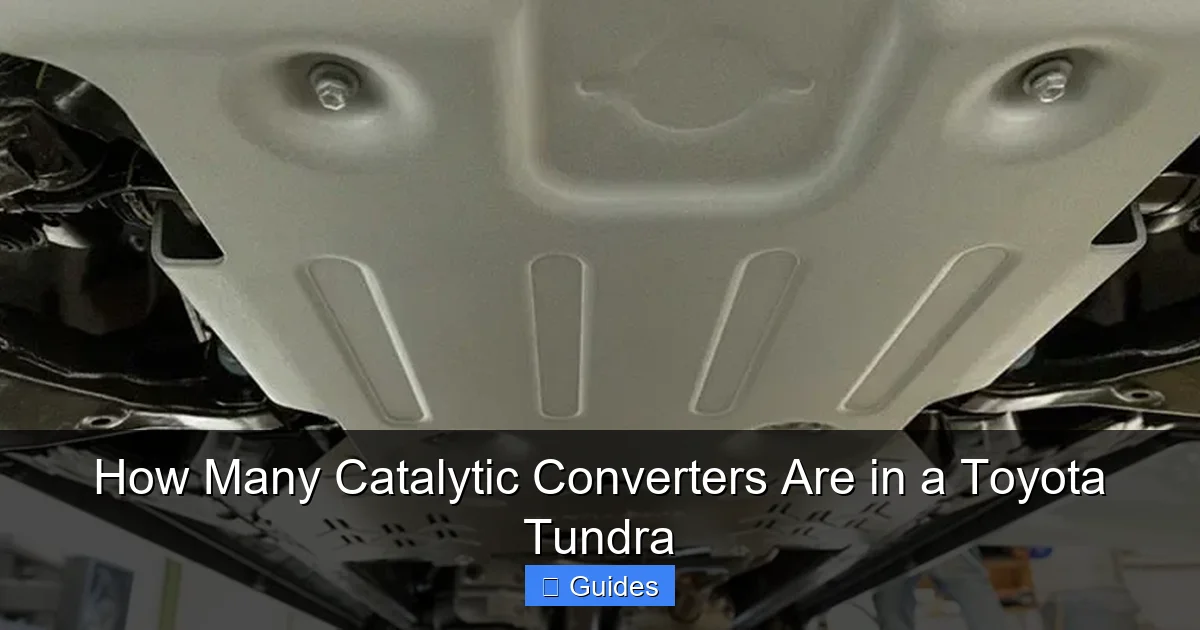
Visual guide about How Many Catalytic Converters Are in a Toyota Tundra
Image source: moparmax.com
The Toyota Tundra has evolved significantly since its debut in 1999. Over the years, engine options, emissions standards, and exhaust designs have changed—meaning the number of catalytic converters has too. Let’s break it down by generation and engine type.
First Generation (2000–2006)
The first-generation Tundra came with two engine options: a 3.4L V6 and a 4.7L V8. Emissions standards were less strict than today, but still required catalytic converters.
– **3.4L V6 Models**: These typically had **two catalytic converters**—one for each bank of the V6 engine. Since it’s a V6 with a single exhaust system, the converters are usually located under the vehicle, near the transmission.
– **4.7L V8 Models**: The V8 version often had **three or four catalytic converters**. This is because the V8 has two exhaust manifolds (one per cylinder bank), and many models used a dual exhaust setup. Each bank could have a pre-cat near the engine and a main cat further back, totaling four. Some models, especially those with a single exhaust, may have only two or three.
For example, a 2005 Tundra SR5 with the 4.7L V8 and dual exhaust likely has four catalytic converters: two pre-cats and two main cats. But a base model with a single exhaust might only have two.
Second Generation (2007–2021)
The second-generation Tundra introduced a new 5.7L V8 engine and updated emissions systems to meet stricter standards. This generation saw a significant increase in catalytic converter usage.
– **4.6L and 5.7L V8 Models**: These engines almost always have **four catalytic converters**. Each cylinder bank has a pre-catalytic converter mounted directly to the exhaust manifold (close to the engine), and a main catalytic converter further down the exhaust pipe. This setup ensures maximum emissions reduction, especially during cold starts.
– **4.0L V6 Models**: The V6 version typically has **two catalytic converters**—one per bank. These are usually located under the vehicle, integrated into the exhaust system.
For instance, a 2015 Tundra Limited with the 5.7L V8 will have four catalytic converters: two pre-cats and two main cats. This is standard across most trims and drivetrains for this engine.
Third Generation (2022–Present)
The current-generation Tundra, introduced in 2022, features a complete redesign—including a new twin-turbo 3.4L V6 engine (i-FORCE) and an optional hybrid version (i-FORCE MAX). Despite the smaller engine size, emissions standards are now stricter than ever, and the exhaust system is more complex.
– **3.4L V6 (i-FORCE)**: This engine uses **four catalytic converters**—two pre-cats and two main cats—similar to the older V8 models. The twin-turbo design increases exhaust flow, requiring efficient emissions control.
– **3.4L V6 Hybrid (i-FORCE MAX)**: The hybrid version also uses **four catalytic converters**, with additional sensors and monitoring systems to ensure optimal performance and emissions compliance.
Even though the engine is smaller, the number of catalytic converters hasn’t decreased. In fact, Toyota has added more advanced monitoring and control systems to meet CARB and EPA standards.
Single vs. Dual Exhaust Systems
One of the biggest factors affecting the number of catalytic converters is whether your Tundra has a single or dual exhaust system.
– **Single Exhaust**: Common on base models and V6 engines. Typically uses two catalytic converters—one per cylinder bank—located under the vehicle.
– **Dual Exhaust**: Found on higher trims (like TRD Pro, Limited, and 1794 Edition) and V8 models. Each exhaust pipe has its own catalytic converter, often resulting in four total units (two pre-cats and two main cats).
For example, a 2020 Tundra SR with a single exhaust and 5.7L V8 might have two main catalytic converters. But a 2020 Tundra TRD Pro with dual exhaust will have four—two near the engine and two under the truck.
Where Are the Catalytic Converters Located on a Toyota Tundra?
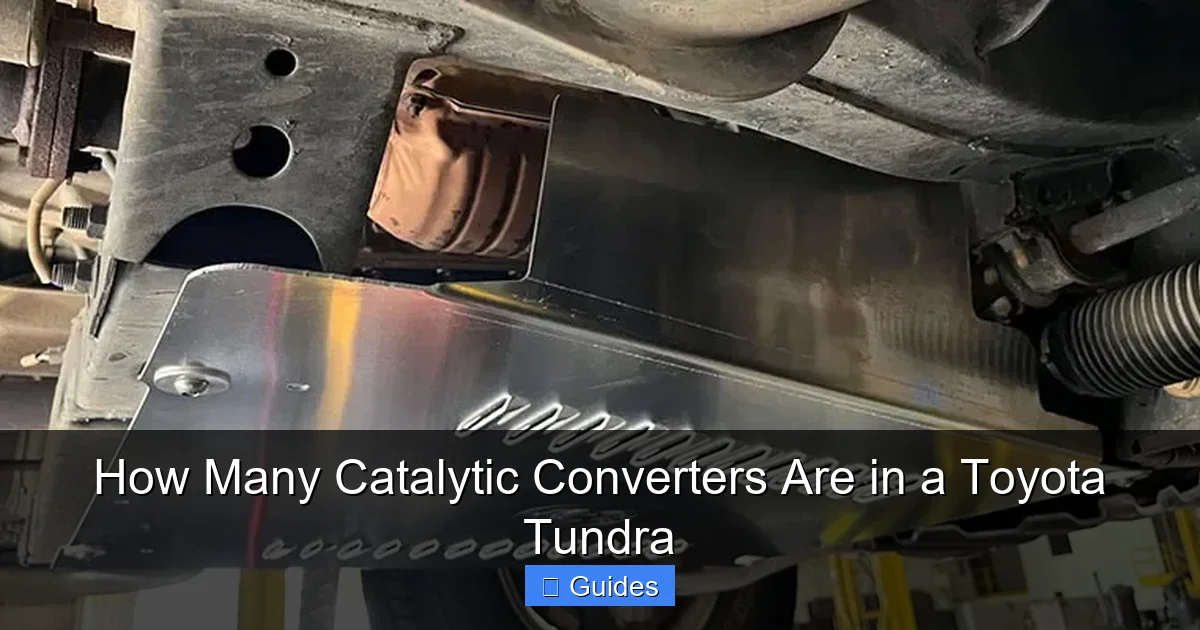
Visual guide about How Many Catalytic Converters Are in a Toyota Tundra
Image source: moparmax.com
Knowing where your catalytic converters are located can help with maintenance, diagnosis, and even theft prevention (yes, catalytic converter theft is a real issue!).
Pre-Catalytic Converters (Pre-Cats)
Pre-cats are mounted directly to the exhaust manifolds, close to the engine. They’re designed to heat up quickly and start reducing emissions as soon as the engine starts. On a V8 Tundra, you’ll typically find one pre-cat on each side of the engine bay, bolted to the exhaust manifolds.
These units are often referred to as “manifold converters” or “close-coupled catalysts.” They’re more expensive to replace because they’re integrated into the exhaust manifold and require more labor to access.
Main Catalytic Converters
Main catalytic converters are located further down the exhaust system, usually under the vehicle near the transmission or rear axle. They’re larger and handle the majority of emissions conversion once the exhaust gases have cooled slightly.
On a dual-exhaust Tundra, you’ll find one main cat per exhaust pipe. On a single-exhaust model, there’s usually one main cat that serves both cylinder banks.
Visual Identification Tips
If you’re under your Tundra with a flashlight, here’s how to spot them:
– Look for **bulky metal canisters** with **oxygen sensor ports** (usually two per converter).
– Pre-cats are **close to the engine**, often near the firewall.
– Main cats are **farther back**, usually near the center or rear of the vehicle.
– They’re typically **covered in heat shields** and may have a honeycomb-like interior if you can see inside.
Pro tip: If you’re unsure, consult your owner’s manual or a repair guide specific to your Tundra’s year and engine. Many online forums and YouTube videos also show detailed undercarriage shots.
Common Symptoms of a Failing Catalytic Converter

Visual guide about How Many Catalytic Converters Are in a Toyota Tundra
Image source: garagevehicle.com
Catalytic converters don’t last forever. Over time, they can become clogged, damaged, or contaminated—leading to performance issues and emissions problems. Here are the most common signs that one (or more) of your Tundra’s catalytic converters may be failing.
Check Engine Light
The most obvious sign is the check engine light. Modern Tundras have oxygen sensors before and after each catalytic converter. If the downstream sensor detects that the converter isn’t reducing emissions effectively, the engine control unit (ECU) will trigger a diagnostic trouble code (DTC), such as P0420 or P0430.
– **P0420**: Catalyst system efficiency below threshold (Bank 1)
– **P0430**: Catalyst system efficiency below threshold (Bank 2)
These codes indicate that one of the catalytic converters isn’t working properly. Don’t ignore them—driving with a failing converter can damage other components.
Reduced Engine Performance
A clogged catalytic converter restricts exhaust flow, which can cause:
– Loss of power, especially during acceleration
– Poor fuel economy
– Rough idling or stalling
– Difficulty starting the engine
If your Tundra feels sluggish or struggles to reach highway speeds, a blocked converter could be the culprit.
Rattling Noise
Over time, the honeycomb structure inside the converter can break apart. This creates a rattling sound, especially when you start the engine or accelerate. If you hear a metallic rattle from under the truck, it’s a strong sign the converter is damaged.
Excessive Heat Under the Vehicle
A failing catalytic converter may overheat due to unburned fuel entering the exhaust system. If you notice a strong smell of sulfur (like rotten eggs) or see smoke from under the truck, it could indicate a clogged or overheating converter.
Failed Emissions Test
If your Tundra fails a state emissions test, a faulty catalytic converter is often the reason. High levels of hydrocarbons or carbon monoxide in the exhaust suggest the converter isn’t doing its job.
Maintenance and Replacement: What You Need to Know
Catalytic converters are durable, but they’re not maintenance-free. With proper care, they can last 100,000 to 150,000 miles—or even longer. But neglect, poor fuel quality, or engine problems can shorten their lifespan.
How to Extend the Life of Your Catalytic Converters
– **Use high-quality fuel**: Low-quality or contaminated fuel can leave deposits that clog the converter.
– **Fix engine problems promptly**: Misfires, rich fuel mixtures, or oil leaks can dump unburned fuel into the exhaust, damaging the converter.
– **Avoid short trips**: Frequent cold starts prevent the converter from reaching optimal operating temperature, leading to buildup.
– **Keep up with regular maintenance**: Change spark plugs, oxygen sensors, and air filters as recommended.
Replacement Costs and Options
Replacing a catalytic converter is expensive. Here’s what to expect:
– **OEM (Toyota) converter**: $1,500–$3,000 per unit (including labor)
– **Aftermarket converter**: $800–$2,000 per unit (may not be CARB-compliant)
– **Universal or direct-fit converters**: $500–$1,500 (quality varies)
Labor costs depend on accessibility. Pre-cats are harder to replace than main cats, so expect higher labor fees.
Should You Replace All Converters at Once?
Not necessarily. If only one converter is failing, you can replace just that one. However, if your Tundra has high mileage or multiple converters are old, it may be wise to replace them all at the same time to avoid future repairs.
Always consult a trusted mechanic or Toyota dealership for diagnosis and replacement. And remember: in many states, only CARB-compliant converters can be legally installed.
Catalytic Converter Security: Protecting Your Tundra from Theft
Unfortunately, catalytic converters are a prime target for thieves. They contain precious metals like platinum, palladium, and rhodium, which can be sold for hundreds of dollars per unit. The Tundra’s high ground clearance and valuable converters make it a popular target.
How to Protect Your Tundra
– **Park in well-lit, secure areas**: Garages or monitored lots reduce risk.
– **Install a catalytic converter shield**: These metal plates make it harder to access the converter.
– **Etch your VIN on the converter**: Makes it harder to sell and easier to identify if stolen.
– **Use a security system**: Some alarms detect vibrations or lifting.
Many insurance policies cover catalytic converter theft, so check your coverage.
Conclusion
So, how many catalytic converters are in a Toyota Tundra? The answer depends on your truck’s engine, model year, and exhaust setup—but most Tundras have between two and four units. V6 models typically use two, while V8 and newer twin-turbo V6 models often use four. Dual exhaust systems usually mean more converters, and newer models include advanced monitoring for emissions compliance.
Understanding the number, location, and function of your catalytic converters helps you maintain your Tundra, diagnose problems early, and avoid costly repairs. Whether you’re troubleshooting a check engine light or planning a long road trip, knowing your exhaust system is key to keeping your truck running smoothly and cleanly.
With proper care, your Tundra’s catalytic converters can last for years—keeping your truck efficient, legal, and environmentally friendly. And if you ever need a replacement, now you know what to expect in terms of cost, location, and options.
So the next time someone asks, “How many catalytic converters are in a Toyota Tundra?” you’ll have the full answer—and maybe even a few tips to share.
Frequently Asked Questions
How many catalytic converters does a 2023 Toyota Tundra have?
The 2023 Toyota Tundra, equipped with the 3.4L twin-turbo V6 engine (i-FORCE or i-FORCE MAX), has four catalytic converters—two pre-cats near the engine and two main cats under the vehicle. This setup ensures compliance with strict emissions standards.
Can I drive my Tundra with a bad catalytic converter?
You can drive short distances, but it’s not recommended. A failing converter can reduce performance, decrease fuel economy, and damage other engine components. It may also cause your truck to fail emissions tests.
How much does it cost to replace a catalytic converter on a Toyota Tundra?
Replacement costs range from $800 to $3,000 per converter, depending on whether you use OEM or aftermarket parts and whether it’s a pre-cat or main cat. Labor costs vary based on accessibility.
Are Toyota Tundra catalytic converters prone to theft?
Yes, due to their high ground clearance and valuable precious metals, Tundras are common targets for catalytic converter theft. Use security measures like shields, VIN etching, and secure parking to reduce risk.
What causes catalytic converters to fail in a Tundra?
Common causes include engine misfires, oil or coolant leaks, poor fuel quality, and physical damage. Regular maintenance and prompt repairs can help prevent premature failure.
Can I replace just one catalytic converter if only one is bad?
Yes, if only one converter is faulty, you can replace just that unit. However, if your Tundra has high mileage, consider replacing all converters at once to avoid future issues.

At CarLegit, we believe information should be clear, factual, and genuinely helpful. That’s why every guide, review, and update on our website is created with care, research, and a strong focus on user experience.