
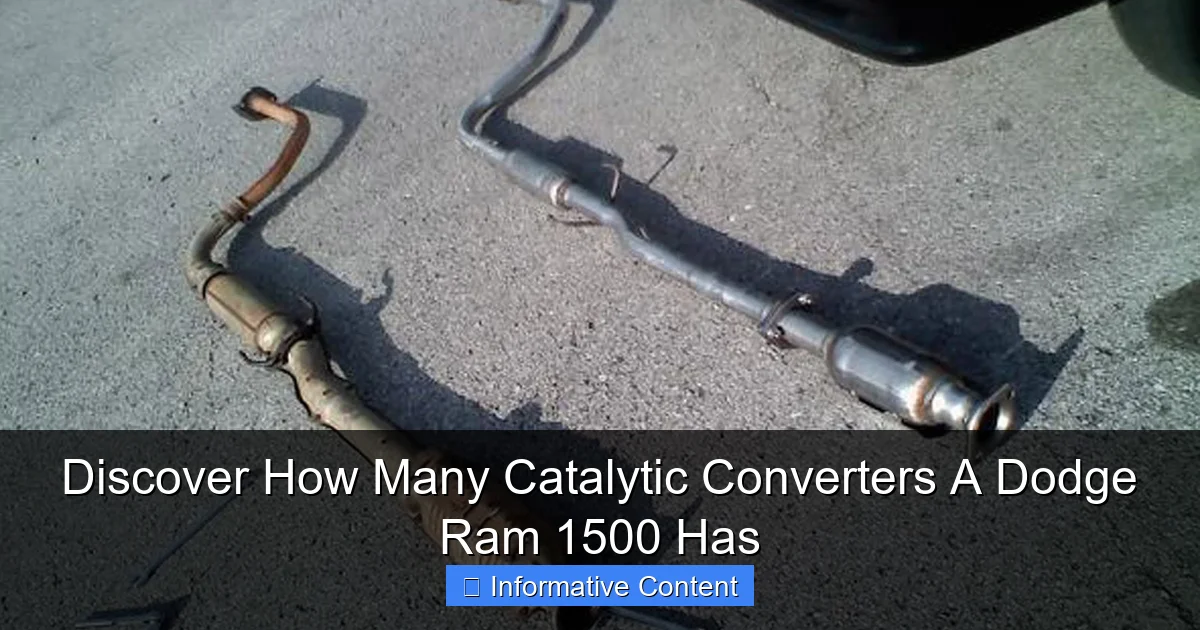
Featured image for how-many-catalytic-converters-does-a-dodge-ram-1500-have
Image source: i2.wp.com
A Dodge Ram 1500 most commonly has two catalytic converters, one for each exhaust bank in its standard V8 configuration. The exact number can vary by model year and engine, with some versions containing up to four to meet stringent emissions standards.
In This Article
- 1 Key Takeaways
- 2 📑 Table of Contents
- 3 Discover How Many Catalytic Converters A Dodge Ram 1500 Has
- 4 The Straight Answer: How Many Catalytic Converters Are We Talking?
- 5 Why Your Truck Needs Catalytic Converters (It’s Not Just About Smog)
- 6 Finding Them: A Visual Guide to Their Location
- 7 Model Year and Engine Breakdown: A Closer Look
- 8 Signs of a Failing Catalytic Converter in Your Ram 1500
- 9 Replacement Considerations: What You Need to Know
- 10 Keeping Your Catalytic Converters Healthy for the Long Haul
- 11 Wrapping Up: Knowledge is Power (and Savings)
- 12 Frequently Asked Questions
- 12.1 How many catalytic converters does a Dodge Ram 1500 have?
- 12.2 Why does the Dodge Ram 1500 have multiple catalytic converters?
- 12.3 What are the signs of a bad catalytic converter in a Dodge Ram 1500?
- 12.4 How can I tell if my Dodge Ram 1500 catalytic converter is failing?
- 12.5 Does the number of catalytic converters vary by model year?
- 12.6 What is the purpose of catalytic converters in a Dodge Ram 1500?
Key Takeaways
- Count varies by model year: Newer models often have more for stricter emissions.
- Engine type determines quantity: V8 engines typically feature two or three converters.
- Check under the vehicle: Visually inspect the exhaust system to locate them.
- Consult your owner’s manual: It provides specific details for your configuration.
- Replacement costs add up: More converters mean higher potential repair expenses.
- Emissions compliance is key: Proper functioning is essential for legal operation.
- Professional inspection recommended: Seek a mechanic for accurate count and condition.
📑 Table of Contents
- Discover How Many Catalytic Converters A Dodge Ram 1500 Has
- The Straight Answer: How Many Catalytic Converters Are We Talking?
- Why Your Truck Needs Catalytic Converters (It’s Not Just About Smog)
- Finding Them: A Visual Guide to Their Location
- Model Year and Engine Breakdown: A Closer Look
- Signs of a Failing Catalytic Converter in Your Ram 1500
- Replacement Considerations: What You Need to Know
- Keeping Your Catalytic Converters Healthy for the Long Haul
- Wrapping Up: Knowledge is Power (and Savings)
Discover How Many Catalytic Converters A Dodge Ram 1500 Has
Picture this. You’re cruising down the highway in your trusty Dodge Ram 1500. The engine hums, the ride is smooth, and life is good. Then, out of nowhere, a new light pops up on your dash. It’s the dreaded “check engine” light, glowing a menacing orange. A quick trip to the auto parts store for a code read reveals a catalytic converter efficiency code. Your first thought? “How many catalytic converters does this truck even have, and which one is the culprit?”
If that scenario sounds familiar, you’re not alone. For Ram 1500 owners, understanding the exhaust system is key to maintenance and avoiding costly surprises. It’s not just a metal box; it’s a crucial, and often targeted, part of your truck. Today, we’re going to get our hands dirty (figuratively) and answer that question in detail. We’ll look under the hood—and under the truck—to give you the complete picture of your Ram’s catalytic converter setup.
The Straight Answer: How Many Catalytic Converters Are We Talking?
Let’s cut to the chase. Most Dodge Ram 1500 trucks, across many model years, have two catalytic converters. This is the standard configuration for the vast majority of V8 and V6 models. However, as with anything in the automotive world, the devil is in the details. The exact number can depend on your engine, model year, and whether your truck is designed for specific emissions standards.
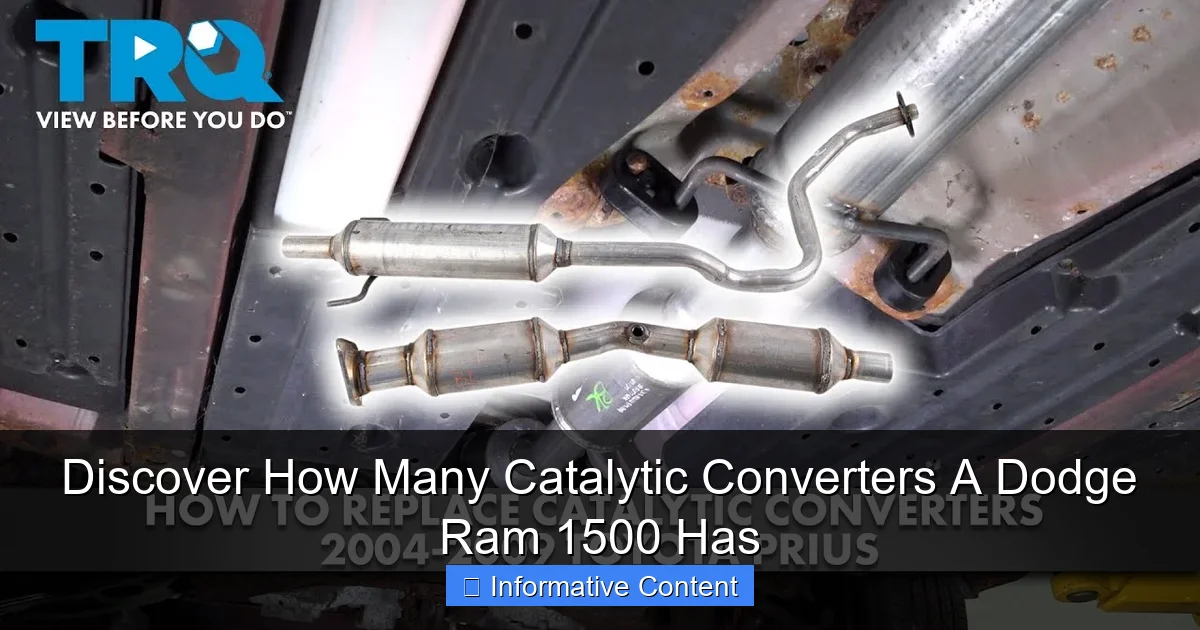
Visual guide about how-many-catalytic-converters-does-a-dodge-ram-1500-have
Image source: i.ytimg.com
Why two? Modern trucks are designed with precision emissions control. Typically, each bank of the engine (the group of cylinders on one side) gets its own catalytic converter to handle the exhaust gases immediately and efficiently. This setup is often referred to as a “dual” or “two-cat” system. It’s a common design that helps the truck meet strict environmental regulations while maintaining performance.
A Quick Note on Model Year Variations
While two is the magic number for most, there are exceptions. Some older models or specific engine configurations might have a slightly different setup. The key is knowing your specific truck. For instance, some heavy-duty or high-performance variants might have additional pre-cats or more complex systems. But for your average Ram 1500 owner, planning for two is a safe bet.
Why Your Truck Needs Catalytic Converters (It’s Not Just About Smog)
Think of your catalytic converters as the environmental conscience of your Ram 1500. They’re not there just to make life complicated or expensive. They perform a critical chemical reaction right inside your exhaust system.
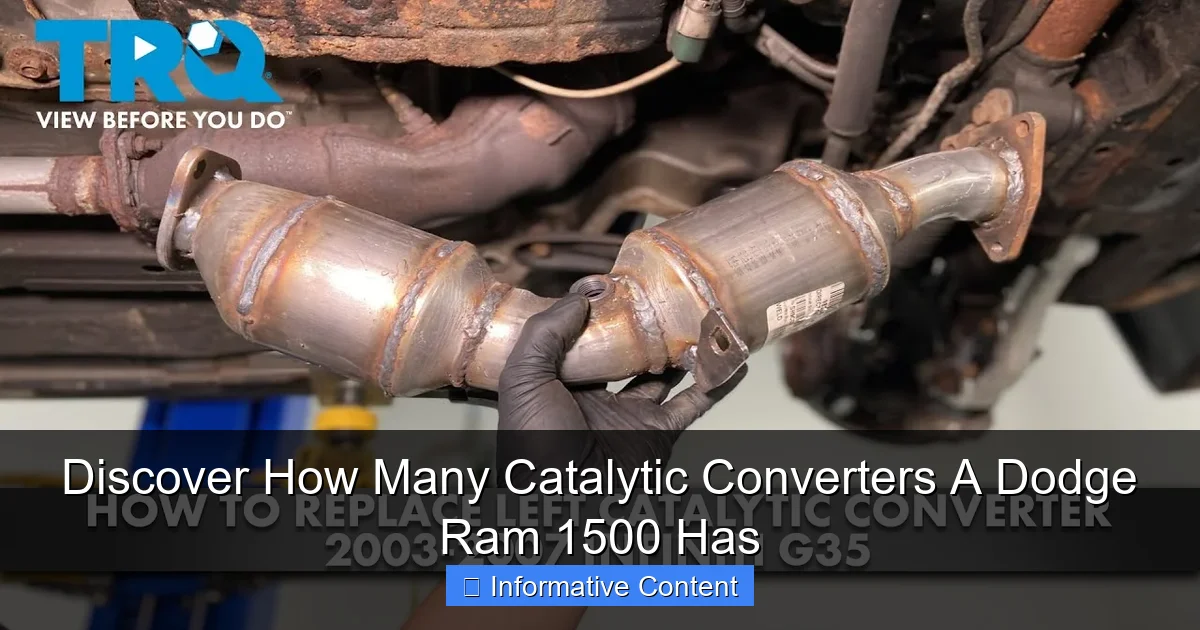
Visual guide about how-many-catalytic-converters-does-a-dodge-ram-1500-have
Image source: i.ytimg.com
Their main job is to transform harmful pollutants in the exhaust gas into less harmful substances before they exit the tailpipe. They use precious metals like platinum, palladium, and rhodium as catalysts to make this happen. Here’s what they’re targeting:
- Carbon Monoxide (CO): A poisonous gas gets converted to carbon dioxide (CO2).
- Hydrocarbons (HC): Unburned fuel gets turned into water and CO2.
- Nitrogen Oxides (NOx): These smog-forming gases get broken down into nitrogen and oxygen.
Without them, your truck would be a rolling pollution machine, and it would fail emissions tests instantly. They’re a key part of why modern vehicles are so much cleaner than those from decades past.
The Unfortunate Side Effect: They’re a Target for Thieves
Here’s the relatable, gritty part. Those precious metals inside the cat we just mentioned? They’re worth a lot of money on the scrap market. This has made catalytic converters, especially on high-clearance vehicles like trucks and SUVs, a prime target for thieves. A Dodge Ram 1500 is often parked high enough off the ground for someone to slide under quickly with a saw. Knowing you have two of these valuable components is the first step in protecting your investment. Simple tips like parking in well-lit areas, etching your VIN on the converters, or even installing a protective shield can be worthwhile.
Finding Them: A Visual Guide to Their Location
Okay, so you have two. But where are they hiding? Let’s take a virtual walk under your Ram 1500.
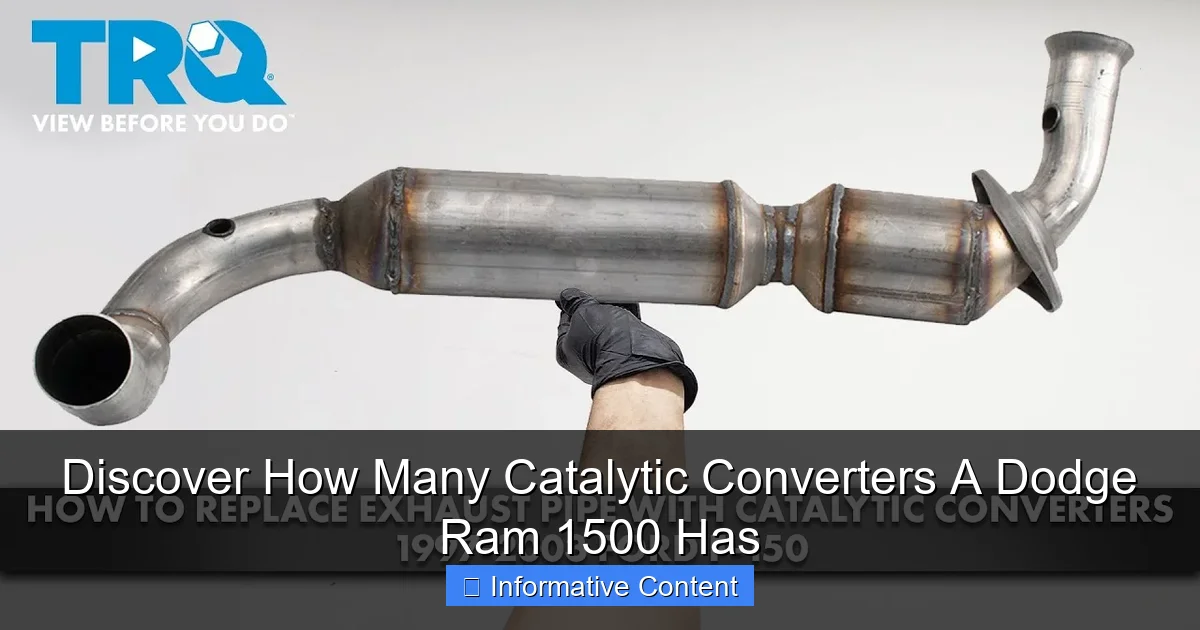
Visual guide about how-many-catalytic-converters-does-a-dodge-ram-1500-have
Image source: i.ytimg.com
The catalytic converters are part of the exhaust system, which runs along the underside of your truck from the engine to the rear bumper. They are not near the engine block itself, nor are they at the very back by the tailpipe. They are typically located in the front section of the exhaust system, closer to the engine.
Follow the Exhaust Manifolds
Start at the engine. Exhaust gases leave each cylinder bank through the exhaust manifold. Connected to these manifolds are pipes called the “downpipes” or “exhaust front pipes.” It’s on these front pipes, usually a foot or two away from the engine, where you will find your two catalytic converters. They look like bulging, oblong metal boxes welded into the pipe. From there, the cleaned gases travel through the rest of the exhaust system, through the muffler, and out the tailpipe.
If you’re ever unsure, a mechanic can point them out in seconds. Their location makes them susceptible to road debris and corrosion, which is why inspections during oil changes are a good habit.
Model Year and Engine Breakdown: A Closer Look
While the “two converter” rule is generally solid, your specific Ram 1500’s details matter. The design has evolved over the years to meet changing EPA regulations.
The V8 Engines (Hemi and Beyond)
For the popular 5.7L Hemi V8 and other V8 configurations, the two-cat system is almost universal. Each bank of the V8 (4 cylinders each) feeds into its own catalytic converter. This is efficient and effective. Some model years, particularly in the 2000s, might have additional, smaller “pre-catalytic converters” right at the exhaust manifolds, but the main underbody cats are still present.
The V6 Engine Consideration
The same principle applies to V6 engines in the Ram 1500. With two banks of three cylinders, the standard setup includes two catalytic converters. The size and specific design might differ from the V8 models, but the quantity remains consistent for proper emissions management.
Data at a Glance: Ram 1500 Catalytic Converter Overview
Here’s a simplified table to summarize the typical setup across common configurations:
| Engine Type | Typical Number of Main Catalytic Converters | Common Location | Notes |
|---|---|---|---|
| 5.7L Hemi V8 | 2 | On front exhaust pipes, under front cabin area | The most common configuration. High target for theft. |
| 3.6L Pentastar V6 | 2 | On front exhaust pipes, under front cabin area | Similar layout to V8, parts may be specific to engine. |
| EcoDiesel V6 | 2+ (Complex System) | Various points in exhaust | Includes Diesel Oxidation Catalyst (DOC) and Diesel Particulate Filter (DPF) in addition to SCR system. |
Note: Diesel models, like the EcoDiesel, use a fundamentally different and more complex emissions system that includes a Diesel Particulate Filter (DPF) and Selective Catalytic Reduction (SCR), which uses DEF fluid. It’s accurate to say they have multiple catalytic components, but the system is different from gasoline engines.
Signs of a Failing Catalytic Converter in Your Ram 1500
Knowing how many catalytic converters your Dodge Ram 1500 has is helpful, but knowing when one is failing is crucial. They don’t last forever. Here are the telltale signs, explained plainly:
- The Check Engine Light: This is the big one. The truck’s computer monitors the cat’s efficiency. If it’s not cleaning properly, it will trigger a code (like P0420 or P0430) and light up your dash.
- Rotten Egg Smell: A failing cat can’t process sulfur compounds correctly, leading to that distinctive sulfuric odor from the exhaust.
- Poor Performance: A clogged converter acts like a restrictive plug in your exhaust. You might notice a significant loss of power, especially when trying to accelerate, as if the truck is struggling to breathe.
- Loud Rattle: The internal honeycomb structure can break apart. If you hear a disturbing rattle from underneath when you start the truck or go over bumps, the insides might be loose.
- Failed Emissions Test: This is the official confirmation. If you take your Ram in for a test and it fails on emissions, a faulty catalytic converter is a prime suspect.
If you notice any of these, don’t ignore them. A bad converter can lead to worse fuel economy and even damage other engine components over time.
Replacement Considerations: What You Need to Know
Let’s say the worst happens, and you need to replace one—or both—of the catalytic converters on your Dodge Ram 1500. This is a major repair, so let’s break down what to expect.
First, diagnosis is key. A P0420 code (Bank 1) or P0430 code (Bank 2) will tell you which side is likely failing. A good mechanic will confirm this isn’t caused by a simpler issue like a bad oxygen sensor or an exhaust leak before recommending replacement.
The Cost Factor
Replacing a catalytic converter is expensive. The parts alone, due to those precious metals, can cost anywhere from $800 to $2,500 or more for OEM (Original Equipment Manufacturer) parts for a Ram 1500. Aftermarket options are less expensive but may not last as long or meet the exact emissions standards for your state. Labor adds several hundred more. This is why protecting them from theft and maintaining your engine (to prevent unburned fuel from clogging them) is so important.
OEM vs. Aftermarket and State Laws
This is critical. Some states, like California and those that follow California Air Resources Board (CARB) standards, require CARB-compliant catalytic converters. An aftermarket “universal” cat might not be legal for your truck if you live in such a state. Always check your local regulations. Using an incorrect converter will cause your truck to fail its next emissions inspection.
Keeping Your Catalytic Converters Healthy for the Long Haul
The best repair is the one you never have to make. You can extend the life of your Ram’s catalytic converters with some simple habits.
- Fix Engine Problems Promptly: A misfiring spark plug or a leaky fuel injector can send raw fuel into the exhaust, overheating and melting the ceramic inside the cat. That check engine light for a cylinder misfire? Get it fixed now to save a fortune later.
- Use the Right Fuel: Stick with the octane rating recommended in your owner’s manual. There’s no need for premium in a truck designed for regular, and using a lower grade than required can cause problems.
- Avoid Short Trips: The catalytic converter needs to get hot to work properly. Frequent very short trips where it never reaches optimal temperature can lead to premature clogging. When you can, take the truck for a good 20-30 minute highway drive to let everything heat up and burn off contaminants.
- Regular Maintenance is Key: This is the golden rule. Regular oil changes, timely spark plug replacements, and using quality air filters all contribute to a clean-burning engine, which is the best thing you can do for your exhaust system.
Wrapping Up: Knowledge is Power (and Savings)
So, there you have it. Your Dodge Ram 1500 most likely has two catalytic converters, working tirelessly under your truck to clean its exhaust. Understanding this simple fact empowers you as an owner. You know what to listen for, what warning signs to watch, and why protecting them from theft and damage is a smart move.
Remember, your truck is a system. Taking good care of the engine up front saves the expensive exhaust components in the back. Whether you’re troubleshooting a check engine light, preparing for an emissions test, or just want to be a more informed owner, knowing the ins and outs of your catalytic converter setup is a vital piece of the puzzle. Now you can hit the road with a little more confidence and a lot more knowledge about what’s happening beneath your feet.
Frequently Asked Questions
How many catalytic converters does a Dodge Ram 1500 have?
Typically, a Dodge Ram 1500 has two catalytic converters, one for each bank of the V6 or V8 engine. However, depending on the model year and emissions requirements, some configurations may include up to four catalytic converters.
Why does the Dodge Ram 1500 have multiple catalytic converters?
Multiple catalytic converters are used to efficiently process exhaust gases from each cylinder bank, ensuring optimal emission reduction. This design helps meet strict environmental standards by converting harmful pollutants into less toxic substances before they exit the exhaust system.
What are the signs of a bad catalytic converter in a Dodge Ram 1500?
Common signs include reduced engine power, poor fuel economy, and a sulfur-like odor from the exhaust. You may also notice the check engine light activating, often with diagnostic trouble codes pointing to catalytic converter inefficiency.
How can I tell if my Dodge Ram 1500 catalytic converter is failing?
Listen for rattling sounds underneath the vehicle, which may indicate a broken internal substrate. Additionally, watch for sluggish acceleration and failed emissions tests, as these are key indicators of a failing catalytic converter in your Ram 1500.
Does the number of catalytic converters vary by model year?
Yes, the number can differ based on the model year and engine specifications. For instance, newer Dodge Ram 1500 models with advanced emissions systems often have more catalytic converters compared to older versions, aligning with updated regulatory requirements.
What is the purpose of catalytic converters in a Dodge Ram 1500?
Catalytic converters reduce harmful exhaust emissions by transforming pollutants like carbon monoxide and nitrogen oxides into safer compounds such as carbon dioxide and water vapor. This crucial component helps your Ram 1500 comply with air quality laws and minimizes environmental impact.

At CarLegit, we believe information should be clear, factual, and genuinely helpful. That’s why every guide, review, and update on our website is created with care, research, and a strong focus on user experience.