
The Kia Soul typically has one catalytic converter, but certain models—especially those with turbocharged engines or AWD—may feature two. Understanding your Soul’s setup helps with maintenance, repairs, and staying compliant with emissions laws.
In This Article
- 1 Key Takeaways
- 2 📑 Table of Contents
- 3 How Many Catalytic Converters Does a Kia Soul Have?
- 4 Understanding the Catalytic Converter: Why It Matters
- 5 Kia Soul Model Variations and Catalytic Converter Count
- 6 How to Determine How Many Catalytic Converters Your Kia Soul Has
- 7 Why Some Kia Souls Have Two Catalytic Converters
- 8 Common Issues and Maintenance Tips
- 9 Replacement Costs and Options
- 10 Conclusion
- 11 Frequently Asked Questions
- 11.1 How many catalytic converters does a 2020 Kia Soul have?
- 11.2 Can I drive my Kia Soul with a bad catalytic converter?
- 11.3 How much does it cost to replace a catalytic converter on a Kia Soul?
- 11.4 Why do some Kia Souls have two catalytic converters?
- 11.5 How can I tell if my Kia Soul has one or two catalytic converters?
- 11.6 Is catalytic converter theft common on Kia Souls?
Key Takeaways
- Most Kia Souls have one catalytic converter: The standard naturally aspirated 2.0L engine models usually come with a single catalytic converter located in the exhaust system.
- Turbocharged and AWD models may have two: Kia Soul Turbo and all-wheel-drive (AWD) variants often include a second catalytic converter, either upstream or downstream, to meet stricter emissions standards.
- Location matters for diagnostics and repairs: The primary converter is typically near the engine (pre-cat), while a secondary may be further down the exhaust line (post-cat), affecting how mechanics diagnose issues.
- Catalytic converter theft is a real concern: Due to precious metals like platinum and palladium, converters are targeted by thieves—especially on higher-clearance vehicles like the Soul.
- Replacement can be costly: OEM catalytic converters for the Kia Soul can range from $1,200 to $2,500+ installed, making aftermarket or used options tempting but risky.
- Regular maintenance helps longevity: Keeping the engine tuned, using quality fuel, and addressing check engine lights promptly can prevent premature converter failure.
- Emissions testing compliance depends on converter function: A failing or missing catalytic converter will cause your Kia Soul to fail state emissions inspections in most regions.
📑 Table of Contents
- How Many Catalytic Converters Does a Kia Soul Have?
- Understanding the Catalytic Converter: Why It Matters
- Kia Soul Model Variations and Catalytic Converter Count
- How to Determine How Many Catalytic Converters Your Kia Soul Has
- Why Some Kia Souls Have Two Catalytic Converters
- Common Issues and Maintenance Tips
- Replacement Costs and Options
- Conclusion
How Many Catalytic Converters Does a Kia Soul Have?
If you’re a Kia Soul owner—or thinking about becoming one—you’ve probably wondered about the inner workings of your quirky, boxy ride. One question that pops up often, especially when dealing with emissions, check engine lights, or repair bills, is: *How many catalytic converters does a Kia Soul have?* It’s not just a technical curiosity. Knowing the answer can save you money, help you pass inspections, and even protect your car from theft.
The short answer? Most Kia Souls have one catalytic converter. But it’s not that simple. Depending on the model year, engine type, and drivetrain, some Souls are equipped with two. This guide will walk you through everything you need to know—from how to identify your Soul’s setup to why it matters for maintenance, performance, and legality.
Whether you’re driving a 2010 base model or a 2023 Soul Turbo, understanding your vehicle’s emissions system is key. Let’s dive in.
Understanding the Catalytic Converter: Why It Matters

Visual guide about How Many Catalytic Converters Does a Kia Soul Have
Image source: 2carpros.com
Before we get into the specifics of the Kia Soul, let’s take a moment to understand what a catalytic converter actually does. Think of it as your car’s environmental guardian. It’s a critical part of the exhaust system that converts harmful gases—like carbon monoxide, nitrogen oxides, and unburned hydrocarbons—into less harmful substances such as carbon dioxide, nitrogen, and water vapor.
Without a functioning catalytic converter, your car would spew toxic fumes into the atmosphere, fail emissions tests, and likely trigger a check engine light. In many states, driving without one—or with a malfunctioning unit—is illegal.
Modern vehicles, including the Kia Soul, are designed with increasingly strict emissions standards in mind. That’s why automakers have evolved their exhaust systems over the years, sometimes adding multiple converters to improve efficiency and reduce pollution.
How Catalytic Converters Work
Inside the catalytic converter are ceramic honeycomb structures coated with precious metals—platinum, palladium, and rhodium. As exhaust gases pass through, these metals act as catalysts (hence the name), triggering chemical reactions that break down pollutants.
There are two main types of catalytic converters in modern vehicles:
– Two-way converters: Found in older vehicles, they primarily handle carbon monoxide and hydrocarbons.
– Three-way converters: Standard in cars made after 1981, they reduce nitrogen oxides in addition to the other two pollutants.
Most Kia Souls use three-way catalytic converters, which are far more effective and required by law in the U.S. and many other countries.
Why Location and Number Matter
The number and placement of catalytic converters affect how your car performs, how it’s diagnosed during repairs, and even how vulnerable it is to theft. For example:
– A converter close to the engine (called a “pre-cat” or “manifold converter”) heats up faster, improving efficiency.
– A second converter further down the exhaust (a “post-cat”) helps clean up any remaining pollutants after the first stage.
Knowing whether your Soul has one or two converters helps mechanics pinpoint issues faster and ensures you’re not overpaying for unnecessary repairs.
Kia Soul Model Variations and Catalytic Converter Count
Visual guide about How Many Catalytic Converters Does a Kia Soul Have
Image source: res.cloudinary.com
Now, let’s get specific. The number of catalytic converters in your Kia Soul depends largely on the model year, engine, and drivetrain. Here’s a breakdown by generation and configuration.
First Generation (2010–2013)
The original Kia Soul came with a 1.6L or 2.0L naturally aspirated four-cylinder engine. Most of these models—especially the base 1.6L—were equipped with a single catalytic converter located in the exhaust manifold or just downstream of it.
The 2.0L engine, which produced more power and emissions, sometimes featured a slightly larger or more robust converter, but still typically just one. These early Souls were front-wheel drive only, and emissions standards were less strict than today, so a single converter was sufficient.
Second Generation (2014–2019)
With the second generation, Kia introduced the Soul + (Plus) and the high-performance Soul Turbo (available in select markets like the U.S. and Canada). This is where things get interesting.
– Standard 2.0L engine (non-turbo): Still usually one catalytic converter.
– Soul Turbo (1.6L turbocharged): This model often has two catalytic converters. The turbocharged engine produces higher exhaust temperatures and emissions, so Kia added a second converter—usually a smaller “pre-cat” near the turbo and a larger “main cat” further down the line.
Additionally, some 2014–2019 models with updated emissions systems (especially those sold in California or other strict-emissions states) may have dual converters even without the turbo, due to enhanced regulatory requirements.
Third Generation (2020–Present)
The current-generation Kia Soul continues the trend of cleaner, more efficient engines. The standard 2.0L MPI (multi-point injection) engine still typically uses one catalytic converter.
However, the Kia Soul Turbo (2020–2023)—powered by a 1.6L turbocharged engine—almost always has two catalytic converters. This is due to the increased exhaust flow and the need to meet Tier 3 Bin 30 emissions standards in the U.S.
Also, while the Soul has never officially offered all-wheel drive (AWD) in the U.S., some international markets (like Europe) have seen AWD prototypes or special editions. If such a model were produced, it would likely require additional emissions control, potentially including a second converter.
Hybrid and Electric Variants
As of 2024, Kia has not released a hybrid or fully electric version of the Soul in the U.S. (though the Niro EV fills that role). However, in some global markets, a mild-hybrid version of the Soul has been rumored. If such a model launches, it may use a smaller or differently configured catalytic converter system, possibly with one high-efficiency unit rather than two.
For now, all U.S.-market Souls are gasoline-powered, so the one-or-two converter rule applies.
How to Determine How Many Catalytic Converters Your Kia Soul Has

Visual guide about How Many Catalytic Converters Does a Kia Soul Have
Image source: jeepexplorer.com
So, how can you tell how many catalytic converters are on your specific Kia Soul? You don’t need to be a mechanic—just follow these steps.
Check Your Owner’s Manual
The owner’s manual often includes a section on emissions systems. Look for diagrams of the exhaust system or mentions of “catalytic converter(s).” Some manuals will explicitly state the number and location.
For example, the 2021 Kia Soul Turbo owner’s manual includes a detailed exhaust layout showing both the pre-cat (near the turbo) and the main catalytic converter.
Use an OBD2 Scanner
Modern Kia Souls come with advanced onboard diagnostics (OBD2). Plug in an OBD2 scanner (available for under $20) and check for trouble codes related to the catalytic converter.
Common codes include:
– P0420: Catalyst System Efficiency Below Threshold (Bank 1)
– P0430: Catalyst System Efficiency Below Threshold (Bank 2)
If you see a P0430 code, it often indicates a problem with a second catalytic converter—meaning your car likely has two.
Note: “Bank 1” refers to the side of the engine with cylinder 1. Most four-cylinder engines (like the Soul’s) have only one bank, so P0420 and P0430 usually refer to the first and second converters, respectively.
Visual Inspection (With Caution)
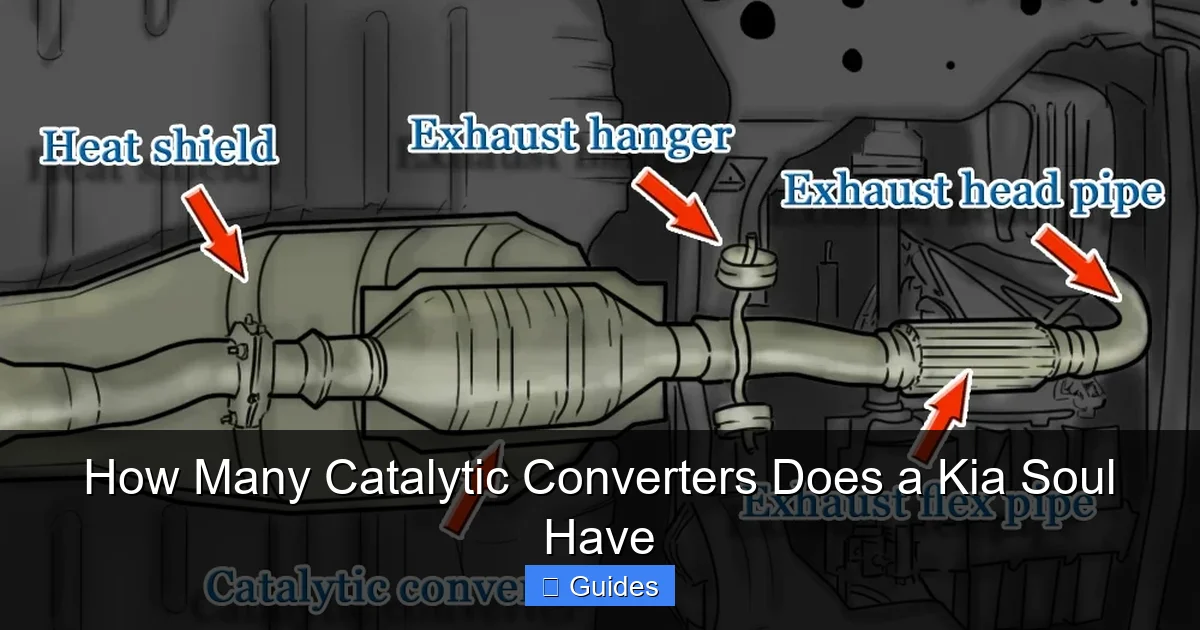
If you’re comfortable getting under your car (use jack stands—never rely on a jack alone!), you can look for the catalytic converters. They’re typically cylindrical or oval metal boxes with heat shields, located along the exhaust pipe.
– The first converter is usually close to the engine, often integrated into the exhaust manifold.
– A second converter will be further down, closer to the muffler.
On a Soul Turbo, you’ll often see a small converter right after the turbocharger outlet—this is the pre-cat. Then, about 18–24 inches downstream, you’ll find the larger main converter.
Consult a Mechanic or Dealership
If you’re unsure, take your Soul to a trusted mechanic or Kia dealership. They can run a diagnostic and confirm the number of converters. Many shops offer free inspections, especially if you’re already in for service.
You can also call a Kia service center with your VIN (Vehicle Identification Number). They can look up your exact configuration in their system.
Why Some Kia Souls Have Two Catalytic Converters
Now that we know some Souls have two converters, let’s explore why. It’s not just about being “fancier” or “more powerful.” There are real engineering and regulatory reasons.
Stricter Emissions Standards
Over the past decade, emissions regulations have tightened significantly. The U.S. Environmental Protection Agency (EPA) and California Air Resources Board (CARB) require vehicles to produce fewer pollutants over their lifetime.
Turbocharged engines, while efficient, can produce higher concentrations of nitrogen oxides (NOx) under load. Adding a second catalytic converter helps capture these extra emissions before they exit the tailpipe.
Improved Efficiency and Performance
A second converter allows for better exhaust flow management. The first converter (pre-cat) handles the initial burst of hot, high-pressure exhaust from the turbo. The second (main cat) polishes the remaining gases, ensuring maximum cleanup.
This staged approach reduces backpressure, which can improve engine performance and fuel economy—especially important in a small car like the Soul.
Onboard Diagnostics and Monitoring
Modern vehicles use oxygen sensors before and after each catalytic converter to monitor efficiency. With two converters, the car’s computer can compare readings from multiple sensors to detect failures more accurately.
For example:
– Sensor 1 (pre-cat) measures raw exhaust.
– Sensor 2 (between converters) checks the first converter’s output.
– Sensor 3 (post-cat) verifies the final emissions level.
This triple-sensor setup is common on dual-converter systems and helps ensure compliance with OBD2 monitoring requirements.
Future-Proofing and Global Markets
Kia designs its vehicles to meet the strictest global standards, even if sold in more lenient regions. A dual-converter setup allows the same engine to be used across multiple markets without major redesigns.
For instance, the 1.6L turbo engine in the Soul Turbo is also used in the Hyundai Kona and Kia Sportage. These platforms often share emissions hardware, including dual catalytic converters.
Common Issues and Maintenance Tips
Catalytic converters are durable, but they’re not indestructible. Here’s what Kia Soul owners should know about maintaining and troubleshooting their converters.
Signs of a Failing Catalytic Converter
Watch for these symptoms:
– Check Engine Light: Often triggered by P0420 or P0430 codes.
– Reduced Fuel Economy: A clogged converter restricts exhaust flow, making the engine work harder.
– Loss of Power: Especially noticeable when accelerating or going uphill.
– Rattling Noise: A broken internal honeycomb structure can rattle when you tap the converter.
– Excessive Heat Under the Car: A failing converter may overheat, sometimes glowing red.
If you notice any of these, get your car checked immediately. Driving with a failed converter can damage the engine and lead to costly repairs.
Preventing Catalytic Converter Problems
You can extend the life of your converter with these tips:
– Use Quality Fuel: Cheap or contaminated gas can leave deposits that clog the converter.
– Fix Engine Problems Promptly: Misfires, rich fuel mixtures, or oil burning can dump unburned fuel into the exhaust, overheating the converter.
– Avoid Short Trips: Catalytic converters need to reach high temperatures (around 800°F) to work efficiently. Frequent cold starts without warming up can lead to buildup.
– Don’t Ignore the Check Engine Light: Even if the car seems to run fine, a pending code could indicate an early issue.
Catalytic Converter Theft: A Growing Threat
Unfortunately, catalytic converters are prime targets for thieves. They contain precious metals worth hundreds of dollars on the black market. The Kia Soul, with its relatively high ground clearance, is easier to slide under than lower cars—making it a target.
To protect your Soul:
– Park in well-lit, secure areas.
– Install a catalytic converter shield or anti-theft device.
– Engrave your VIN on the converter (many shops offer this service).
– Consider comprehensive insurance that covers theft.
Replacement Costs and Options
If your catalytic converter fails, replacement is not cheap—but it’s necessary.
OEM vs. Aftermarket vs. Used
– OEM (Original Equipment Manufacturer): The most reliable option, but also the most expensive. A new OEM converter for a Kia Soul can cost $1,200–$2,500+ installed. However, it comes with a warranty and ensures compliance with emissions laws.
– Aftermarket: Brands like MagnaFlow, Walker, and Bosal offer direct-fit converters at lower prices ($600–$1,200). Make sure they’re EPA-compliant and CARB-certified if you live in California or other strict states.
– Used or Reconditioned: Can cost $300–$800, but come with no warranty and may fail sooner. Only consider if you’re on a tight budget and plan to sell the car soon.
Labor Costs
Replacing a catalytic converter isn’t just about the part. Labor can add $200–$500, depending on accessibility. On some Souls, the converter is welded in, requiring cutting and welding—increasing time and cost.
Is It Worth Repairing?
In most cases, yes. A new converter can last 100,000+ miles if the underlying engine issues are fixed. However, if your Soul is old or has other major problems, it might be time to consider a replacement vehicle.
Conclusion
So, how many catalytic converters does a Kia Soul have? The answer depends on your model, but here’s the bottom line:
Most Kia Souls—especially non-turbo, front-wheel-drive models—have one catalytic converter. However, the Kia Soul Turbo and certain high-emissions variants feature two converters to meet stricter environmental standards and improve performance.
Knowing your Soul’s setup helps you maintain it properly, avoid costly repairs, and stay legal on the road. Whether you’re diagnosing a check engine light, shopping for parts, or just curious about your car’s design, understanding the catalytic converter is a smart move.
Take care of your converter, and it will take care of you—and the planet—for many miles to come.
Frequently Asked Questions
How many catalytic converters does a 2020 Kia Soul have?
The 2020 Kia Soul with the standard 2.0L engine typically has one catalytic converter. However, the 2020 Kia Soul Turbo (1.6L turbocharged) usually has two—one near the turbo and one further down the exhaust.
Can I drive my Kia Soul with a bad catalytic converter?
You can drive short distances, but it’s not recommended. A failing converter can reduce performance, damage the engine, and cause your car to fail emissions tests. Get it checked as soon as possible.
How much does it cost to replace a catalytic converter on a Kia Soul?
Replacement costs vary: OEM units range from $1,200 to $2,500+ installed, while aftermarket options can be $600–$1,200. Labor adds $200–$500 depending on the job’s complexity.
Why do some Kia Souls have two catalytic converters?
Turbocharged engines and stricter emissions standards require more efficient pollution control. A second converter helps clean exhaust gases more thoroughly, especially under high load.
How can I tell if my Kia Soul has one or two catalytic converters?
Check your owner’s manual, use an OBD2 scanner for trouble codes (like P0430), or inspect the exhaust system visually. A mechanic can also confirm based on your VIN.
Is catalytic converter theft common on Kia Souls?
Yes, the Kia Soul is a target due to its ground clearance and valuable converter materials. Protect your car with anti-theft devices, secure parking, and insurance coverage.

At CarLegit, we believe information should be clear, factual, and genuinely helpful. That’s why every guide, review, and update on our website is created with care, research, and a strong focus on user experience.