
The number of catalytic converters in a Toyota Tundra depends on the model year, engine size, and drivetrain configuration. Most modern Tundras come equipped with two or four catalytic converters, designed to meet strict emissions standards and protect the environment.
If you’re a Toyota Tundra owner—or thinking about becoming one—you’ve probably heard the term “catalytic converter” thrown around, especially when it comes to emissions, maintenance, or that dreaded check engine light. But how many catalytic converters does a Toyota Tundra actually have? The answer isn’t as straightforward as you might think. It depends on several factors, including the year your truck was made, the engine under the hood, and even whether you’re driving a two-wheel or four-wheel-drive model.
Catalytic converters are essential components of your vehicle’s exhaust system. They work behind the scenes to reduce harmful emissions like carbon monoxide, nitrogen oxides, and unburned hydrocarbons before they exit the tailpipe. In short, they help your Tundra run cleaner and comply with environmental regulations. But because modern trucks like the Tundra are built with powerful engines and complex exhaust setups, they often require more than one converter to get the job done effectively.
So, let’s dive into the details. Whether you’re troubleshooting an emissions issue, planning a repair, or just curious about your truck’s inner workings, this guide will break down everything you need to know about how many catalytic converters your Toyota Tundra has—and why that number matters.
In This Article
- 1 Key Takeaways
- 2 📑 Table of Contents
- 3 Understanding Catalytic Converters: What They Do and Why They Matter
- 4 How Many Catalytic Converters Does a Toyota Tundra Have? A Model-by-Model Breakdown
- 5 Why Does the Toyota Tundra Have Multiple Catalytic Converters?
- 6 Signs of a Failing Catalytic Converter in Your Toyota Tundra
- 7 Maintaining and Replacing Catalytic Converters in Your Tundra
- 8 Environmental and Legal Considerations
- 9 Conclusion
- 10 Frequently Asked Questions
- 10.1 How many catalytic converters does a 2020 Toyota Tundra have?
- 10.2 Can I drive my Tundra with a bad catalytic converter?
- 10.3 How long do Toyota Tundra catalytic converters last?
- 10.4 Are aftermarket catalytic converters legal for my Tundra?
- 10.5 Why are catalytic converters stolen from trucks like the Tundra?
- 10.6 Can I clean a clogged catalytic converter?
Key Takeaways
- Most Toyota Tundras have two to four catalytic converters: The exact number varies by engine type, model year, and whether the truck is equipped with a V6 or V8 engine.
- V8 engines typically use four catalytic converters: These include two pre-cats (close to the engine) and two main catalytic converters in the exhaust system.
- V6 models usually have two catalytic converters: Found in the exhaust manifold and mid-pipe, they help reduce harmful emissions efficiently.
- Four-wheel-drive models may have additional components: The added complexity of the drivetrain can influence exhaust routing and converter placement.
- Regular maintenance extends converter life: Avoiding oil leaks, using quality fuel, and fixing engine misfires early can prevent premature failure.
- Replacing a catalytic converter is expensive: Costs can range from $1,000 to $3,000+ per unit, making prevention and early detection crucial.
- Emissions laws affect replacement options: Always use EPA-compliant or CARB-certified converters, especially in states like California.
📑 Table of Contents
- Understanding Catalytic Converters: What They Do and Why They Matter
- How Many Catalytic Converters Does a Toyota Tundra Have? A Model-by-Model Breakdown
- Why Does the Toyota Tundra Have Multiple Catalytic Converters?
- Signs of a Failing Catalytic Converter in Your Toyota Tundra
- Maintaining and Replacing Catalytic Converters in Your Tundra
- Environmental and Legal Considerations
- Conclusion
Understanding Catalytic Converters: What They Do and Why They Matter
Before we get into the specifics of the Toyota Tundra, it’s important to understand what a catalytic converter actually does. Think of it as your truck’s environmental filter. Inside the converter, precious metals like platinum, palladium, and rhodium act as catalysts—hence the name—to trigger chemical reactions that transform toxic gases into less harmful substances like carbon dioxide, nitrogen, and water vapor.
For example, carbon monoxide (a deadly gas) is converted into carbon dioxide, while unburned fuel is oxidized into water and CO₂. Nitrogen oxides, which contribute to smog, are broken down into nitrogen and oxygen. Without catalytic converters, vehicles would release far more pollution into the atmosphere, contributing to air quality issues and health problems.
In the U.S., catalytic converters became mandatory on all new vehicles starting in 1975, thanks to the Clean Air Act. Since then, emissions standards have only gotten stricter. Modern trucks like the Toyota Tundra are engineered to meet or exceed these standards, which is why they often use multiple converters in their exhaust systems.
The number of converters isn’t just about meeting regulations—it’s also about efficiency. Larger engines, like the 5.7L V8 found in many Tundras, produce more exhaust gases. To handle that volume effectively, automakers often install additional converters closer to the engine (called “pre-cats”) and further down the exhaust line (“main cats”). This staged approach ensures that emissions are reduced as much as possible before they leave the vehicle.
How Many Catalytic Converters Does a Toyota Tundra Have? A Model-by-Model Breakdown
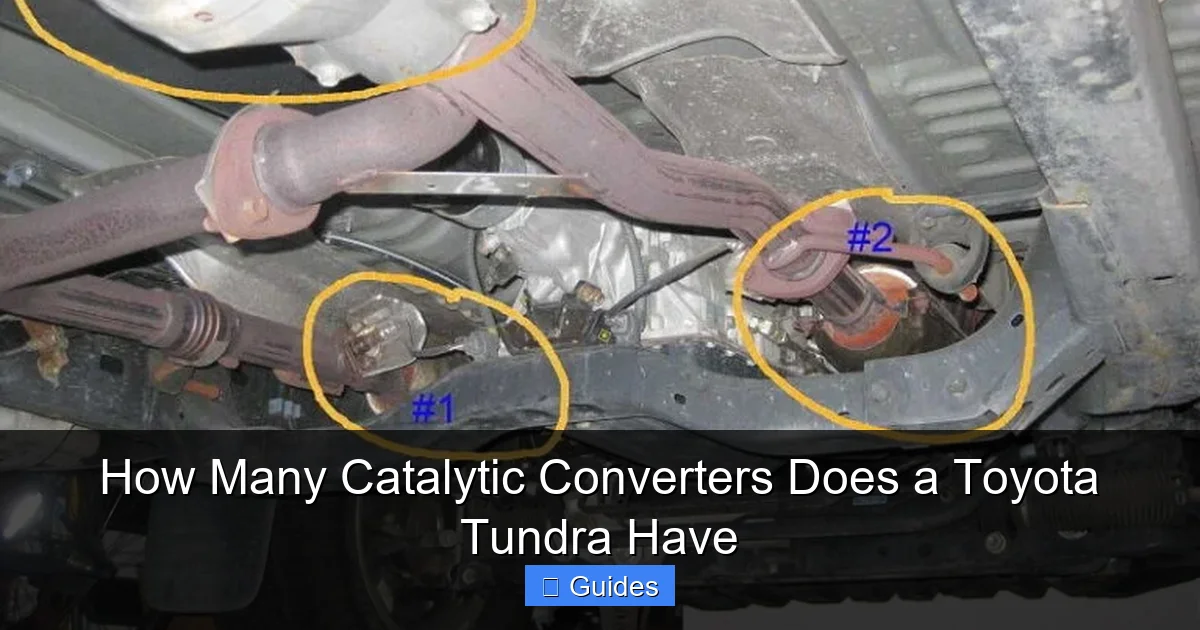
Visual guide about How Many Catalytic Converters Does a Toyota Tundra Have
Image source: guidemechanic.com
Now, let’s get to the heart of the question: how many catalytic converters does a Toyota Tundra have? The answer varies depending on the specific model and configuration. Here’s a detailed breakdown by engine and model year.
V6 Engine Models (Typically 4.0L)
Toyota Tundras equipped with the 4.0L V6 engine—common in models from 2000 to 2021—usually have two catalytic converters. One is located in the exhaust manifold (often called a “manifold converter” or “pre-cat”), and the second is positioned further down the exhaust pipe, typically near the transmission tunnel. This dual setup allows the V6 to meet emissions standards without overcomplicating the exhaust system.
For example, a 2015 Toyota Tundra SR5 with the 4.0L V6 will have two catalytic converters: one bolted directly to the exhaust manifold on each bank of the engine (since it’s a V6, there are two manifolds), and a second converter in the mid-pipe. However, in many cases, the manifold-mounted converters are integrated into the manifold itself, making them harder to replace separately.
V8 Engine Models (5.7L and 3.5L Twin-Turbo)
The story changes significantly with V8 engines. Most Toyota Tundras with the 5.7L V8—used from 2007 to 2021—come equipped with four catalytic converters. That’s right: four. Here’s how it breaks down:
– Two “pre-catalytic converters” mounted directly to the exhaust manifolds (one per cylinder bank).
– Two “main” or “underbody” catalytic converters located further down the exhaust system, usually before the muffler.
This four-converter setup is designed to handle the higher exhaust volume and temperature produced by the V8 engine. The pre-cats work quickly to reduce emissions right after combustion, while the main cats provide additional cleaning before the gases exit the tailpipe.
Even the newer 2022 and later Tundras, which switched to a 3.5L twin-turbo V6 engine, often retain a similar four-converter layout. Toyota engineered this engine for high performance and efficiency, but it still produces significant emissions that require robust after-treatment. As a result, many 2022+ Tundras also feature four catalytic converters, though their placement and design may differ slightly from older V8 models.
Four-Wheel-Drive vs. Two-Wheel-Drive Models
You might be wondering: does drivetrain affect the number of catalytic converters? In most cases, the answer is no. Whether your Tundra is 2WD or 4WD, the number of converters is primarily determined by the engine, not the drivetrain. However, 4WD models may have slightly different exhaust routing due to the transfer case and driveshaft, which can affect where the converters are mounted—but not how many there are.
That said, some 4WD models with extended wheelbases or different exhaust configurations might have longer exhaust systems, potentially requiring additional sensors or heat shielding. But the core number of converters remains tied to the engine type.
Model Year Variations
Emissions standards have evolved over the years, and so has Toyota’s approach to catalytic converter design. Early Tundras (2000–2006) with the 4.7L V8 typically had two catalytic converters—one per exhaust bank. But as regulations tightened, especially with the introduction of Tier 2 and later Tier 3 emissions standards, Toyota upgraded to four converters on V8 models starting around 2007.
From 2007 onward, most V8 Tundras consistently featured four catalytic converters. The shift to the 3.5L twin-turbo V6 in 2022 didn’t reduce this number; if anything, it reinforced the need for multiple converters due to the engine’s high output and turbocharged design.
Why Does the Toyota Tundra Have Multiple Catalytic Converters?

Visual guide about How Many Catalytic Converters Does a Toyota Tundra Have
Image source: guidemechanic.com
At this point, you might be wondering: why so many? Couldn’t one or two do the job? The answer lies in engineering, emissions compliance, and performance.
Meeting Strict Emissions Standards
The U.S. Environmental Protection Agency (EPA) and California Air Resources Board (CARB) set stringent limits on vehicle emissions. Trucks, especially full-size pickups like the Tundra, are subject to these rules just like cars. To meet these standards, automakers must ensure that exhaust gases are treated as thoroughly as possible.
Multiple catalytic converters allow for a “staged” approach to emissions control. The pre-cats, located close to the engine, start working almost immediately after the engine fires up. This is crucial because the first few minutes of engine operation—when the converter is still cold—are when the most emissions are released. By placing converters near the exhaust ports, Toyota ensures that harmful gases are treated quickly, even before the main converter reaches optimal operating temperature.
Handling High Exhaust Volumes
The Toyota Tundra’s V8 engine is a powerhouse. The 5.7L V8, for instance, produces over 380 horsepower and 400 lb-ft of torque. That kind of output generates a lot of exhaust gas. A single catalytic converter might not be able to process all of it efficiently, especially under heavy load or high RPMs.
By using four converters, Toyota spreads the workload. The pre-cats handle the initial surge of hot exhaust, while the main cats provide secondary treatment. This redundancy ensures that emissions stay within legal limits, even when the truck is towing a trailer or climbing a steep hill.
Improving Fuel Efficiency and Performance
You might think that more converters would restrict exhaust flow and hurt performance, but modern designs actually help optimize engine efficiency. By reducing backpressure and allowing exhaust gases to exit more smoothly, multiple converters can improve scavenging—the process of pulling spent gases out of the cylinders. This, in turn, can enhance horsepower and fuel economy.
Additionally, the use of close-coupled pre-cats helps the engine reach optimal operating temperature faster, which improves combustion efficiency and reduces cold-start emissions.
Compliance with State-Specific Regulations
Some states, like California, have even stricter emissions rules than the federal government. Vehicles sold in these states must meet CARB standards, which often require more advanced emissions systems. The four-converter setup in many Tundras ensures that the truck can be sold nationwide, including in CARB-compliant states.
Signs of a Failing Catalytic Converter in Your Toyota Tundra
Even with multiple converters, they don’t last forever. Over time, catalytic converters can become clogged, damaged, or contaminated, leading to performance issues and emissions problems. Here are some common signs that one or more of your Tundra’s catalytic converters may be failing:
Check Engine Light Is On
The most obvious sign is the check engine light. Modern Tundras are equipped with oxygen (O2) sensors before and after each catalytic converter. If the system detects that the converter isn’t reducing emissions effectively, it will trigger a diagnostic trouble code (DTC), such as P0420 or P0430. These codes indicate low catalytic converter efficiency.
Reduced Engine Performance
A clogged converter can restrict exhaust flow, causing the engine to lose power. You might notice sluggish acceleration, especially when merging onto highways or climbing hills. In severe cases, the engine may even stall or struggle to idle.
Increased Fuel Consumption
When the engine has to work harder to push exhaust gases through a blocked converter, it burns more fuel. If you notice your Tundra’s gas mileage dropping suddenly, a failing catalytic converter could be the culprit.
Rattling Noise from Under the Truck
Inside the catalytic converter, there’s a honeycomb-like substrate made of ceramic or metal. Over time, this material can break apart due to heat or physical damage. If you hear a rattling sound when you start the engine or drive over bumps, it could mean the substrate has shattered and is loose inside the converter.
Excessive Heat Under the Vehicle
A failing converter may overheat due to unburned fuel entering the exhaust system. If you notice unusually high temperatures under the truck—especially near the converter—it could indicate a problem. In extreme cases, the converter can glow red-hot, which is a serious fire hazard.
Failed Emissions Test
If your Tundra fails a state emissions test, a faulty catalytic converter is one of the most common reasons. High levels of hydrocarbons (HC) or carbon monoxide (CO) in the exhaust often point to converter inefficiency.
Maintaining and Replacing Catalytic Converters in Your Tundra
Catalytic converters are durable components, but they require proper care to last. Here’s how to maintain them and what to do if replacement becomes necessary.
Preventative Maintenance Tips
– Use high-quality fuel: Low-quality or contaminated fuel can leave deposits that clog the converter.
– Fix engine problems promptly: Misfires, rich fuel mixtures, or oil leaks can dump unburned fuel into the exhaust, overheating and damaging the converter.
– Avoid short trips: Frequent cold starts prevent the converter from reaching operating temperature, leading to buildup.
– Inspect exhaust system regularly: Look for rust, leaks, or physical damage that could affect converter performance.
Replacement Costs and Options
Replacing a catalytic converter is not cheap. OEM (original equipment manufacturer) converters can cost $1,500 to $3,000 or more per unit, especially for V8 models with four converters. Aftermarket options are cheaper—often $500 to $1,200—but may not last as long or meet emissions standards in all states.
In California and other CARB states, you must use a CARB-compliant converter, which limits your options and can increase costs. Always check local regulations before purchasing.
DIY vs. Professional Installation
While some mechanically inclined owners may attempt to replace a converter themselves, it’s a complex job. Converters are often welded in place, requiring cutting and welding equipment. Additionally, improper installation can trigger new error codes or cause exhaust leaks.
For most people, it’s best to have a trusted mechanic or exhaust shop handle the replacement. They’ll also be able to diagnose whether the converter failure was caused by another issue—like a misfiring spark plug—that needs to be fixed first.
Environmental and Legal Considerations
Catalytic converters play a vital role in reducing vehicle emissions, but they also come with legal and environmental responsibilities.
Emissions Compliance
Driving a Tundra with a missing or tampered catalytic converter is illegal in most states. Federal law prohibits removing or disabling emissions equipment, and penalties can include fines, registration denial, or even vehicle impoundment.
Theft Prevention
Unfortunately, catalytic converters are prime targets for thieves due to the valuable metals inside. Tundras, especially older models, are often targeted. To protect your truck, consider installing a catalytic converter shield, parking in well-lit areas, or engraving your VIN on the converter to deter theft.
Recycling and Disposal
When a converter is replaced, the old unit should be recycled. Many scrap yards and automotive shops accept used converters and extract the precious metals for reuse. This not only reduces waste but also recovers valuable resources.
Conclusion
So, how many catalytic converters does a Toyota Tundra have? The answer depends on your truck’s engine and model year, but most modern Tundras—especially those with V8 or twin-turbo V6 engines—are equipped with four catalytic converters. V6 models typically have two. This multi-converter setup ensures that your Tundra meets strict emissions standards, performs efficiently, and protects the environment.
Understanding your truck’s emissions system helps you maintain it properly, avoid costly repairs, and stay compliant with the law. Whether you’re diagnosing a check engine light or planning a long-term maintenance schedule, knowing how many catalytic converters your Tundra has is a key piece of the puzzle.
By taking care of your converters—and addressing issues early—you’ll keep your Tundra running strong for years to come.
Frequently Asked Questions
How many catalytic converters does a 2020 Toyota Tundra have?
A 2020 Toyota Tundra with the 5.7L V8 engine has four catalytic converters: two pre-cats mounted to the exhaust manifolds and two main converters in the underbody exhaust system. V6 models from the same year typically have two.
Can I drive my Tundra with a bad catalytic converter?
You can drive short distances, but it’s not recommended. A failing converter can reduce performance, increase emissions, and eventually cause the engine to stall. It may also trigger a check engine light and cause your truck to fail emissions tests.
How long do Toyota Tundra catalytic converters last?
Most catalytic converters last 100,000 to 150,000 miles. However, factors like engine misfires, oil leaks, or poor fuel quality can shorten their lifespan. Regular maintenance helps extend their life.
Are aftermarket catalytic converters legal for my Tundra?
In most states, yes—as long as they meet EPA standards. However, in California and other CARB states, you must use a CARB-certified converter. Always check local regulations before purchasing.
Why are catalytic converters stolen from trucks like the Tundra?
Catalytic converters contain precious metals like platinum, palladium, and rhodium, which can be sold for scrap. Trucks like the Tundra sit higher off the ground, making it easier for thieves to slide underneath and cut them out.
Can I clean a clogged catalytic converter?
There are fuel additives and cleaning solutions that claim to clean converters, but they’re often ineffective for severe clogs. In most cases, a clogged converter must be replaced. Prevention—like fixing engine problems early—is the best approach.

At CarLegit, we believe information should be clear, factual, and genuinely helpful. That’s why every guide, review, and update on our website is created with care, research, and a strong focus on user experience.