
The Toyota Highlander typically holds between 17.1 and 17.9 gallons of fuel, depending on the model year and drivetrain. This capacity allows for an estimated driving range of 400–500 miles on a full tank, making it ideal for long trips and daily commutes alike.
In This Article
- 1 Key Takeaways
- 2 📑 Table of Contents
- 3 How Many Gallons Does a Toyota Highlander Hold? A Complete Guide
- 4 Understanding Fuel Tank Capacity: Why It Matters
- 5 Toyota Highlander Fuel Tank Capacity by Model Year
- 6 Gas vs. Hybrid: How Fuel Tank Size Affects Range
- 7 Factors That Influence Fuel Efficiency and Range
- 8 Tips to Maximize Your Highlander’s Fuel Range
- 9 Planning Long Trips: How Far Can You Go?
- 10 Conclusion: Making the Most of Your Highlander’s Fuel Capacity
- 11 Frequently Asked Questions
- 11.1 How many gallons does a 2023 Toyota Highlander hold?
- 11.2 Does the Highlander Hybrid have a smaller fuel tank?
- 11.3 Can I increase my Highlander’s fuel tank capacity?
- 11.4 How far can a Toyota Highlander go on a full tank?
- 11.5 Does AWD affect fuel tank size in the Highlander?
- 11.6 What fuel should I use in my Toyota Highlander?
Key Takeaways
- Fuel Tank Capacity: Most Toyota Highlander models from 2001 to 2024 hold between 17.1 and 17.9 gallons of gasoline.
- Hybrid vs. Gas Models: Hybrid versions have slightly smaller tanks (around 17.1 gallons) but achieve better fuel economy, extending overall range.
- Driving Range: With a full tank, the Highlander can travel approximately 400–500 miles, depending on driving conditions and fuel efficiency.
- Trim and Drivetrain Impact: All-wheel drive (AWD) models may have a marginally larger tank than front-wheel drive (FWD) versions in certain years.
- Fuel Type Matters: Always use the recommended fuel (typically regular unleaded) to maintain performance and fuel economy.
- Maintenance Tips: Regular maintenance like air filter changes and tire inflation can help you get the most miles per gallon.
- Planning Long Trips: Knowing your tank size helps plan refueling stops—especially useful for road trips or rural driving.
📑 Table of Contents
- How Many Gallons Does a Toyota Highlander Hold? A Complete Guide
- Understanding Fuel Tank Capacity: Why It Matters
- Toyota Highlander Fuel Tank Capacity by Model Year
- Gas vs. Hybrid: How Fuel Tank Size Affects Range
- Factors That Influence Fuel Efficiency and Range
- Tips to Maximize Your Highlander’s Fuel Range
- Planning Long Trips: How Far Can You Go?
- Conclusion: Making the Most of Your Highlander’s Fuel Capacity
How Many Gallons Does a Toyota Highlander Hold? A Complete Guide
If you’re driving a Toyota Highlander—or thinking about buying one—you’ve probably asked yourself: “How many gallons does a Toyota Highlander hold?” It’s a smart question. Knowing your SUV’s fuel tank capacity helps you plan road trips, budget for gas, and understand how far you can go between fill-ups. Whether you’re commuting to work, shuttling kids to soccer practice, or heading out on a cross-country adventure, fuel capacity plays a big role in your driving experience.
The Toyota Highlander has been a favorite among families and adventure-seekers since its debut in 2001. Over the years, it’s evolved from a modest mid-size SUV into a spacious, tech-savvy, and fuel-efficient vehicle. But one thing has remained fairly consistent: its fuel tank size. Most Highlander models, whether gas or hybrid, hold between 17.1 and 17.9 gallons of fuel. That might not sound like a huge range, but even a small difference can affect your driving range—especially if you’re trying to stretch every mile on a long drive.
In this guide, we’ll break down everything you need to know about the Toyota Highlander’s fuel tank capacity. We’ll look at how it varies by model year, trim level, and drivetrain. We’ll also explore how fuel efficiency, driving habits, and maintenance impact your real-world range. By the end, you’ll have a clear picture of how far your Highlander can take you—and how to get the most out of every gallon.
Understanding Fuel Tank Capacity: Why It Matters
Visual guide about How Many Gallons Does a Toyota Highlander Hold
Image source: motortrend.com
Fuel tank capacity is more than just a number on a spec sheet. It’s a key factor in how convenient and practical your vehicle is for everyday use and long-distance travel. A larger tank means fewer stops at the pump, which can save time and reduce stress—especially on road trips or in areas with sparse gas stations.
For the Toyota Highlander, the fuel tank size is designed to balance interior space, weight, and driving range. Toyota engineers aim to give drivers enough fuel to go 400–500 miles on a single tank, which is competitive for the mid-size SUV segment. This range makes the Highlander a great choice for families who want both comfort and practicality.
But capacity isn’t the only thing that matters. Fuel efficiency—measured in miles per gallon (MPG)—plays an equally important role. A smaller tank with high MPG can outperform a larger tank with poor efficiency. That’s why hybrid Highlanders, despite having slightly smaller tanks, often achieve better overall range than their gas-only counterparts.
Knowing your tank size also helps with budgeting. If you drive 15,000 miles a year and your Highlander gets 25 MPG, you’ll need about 600 gallons of gas annually. At $3.50 per gallon, that’s over $2,100 a year. Understanding your fuel needs can help you plan for costs and even consider more efficient alternatives like the Highlander Hybrid.
Toyota Highlander Fuel Tank Capacity by Model Year
Visual guide about How Many Gallons Does a Toyota Highlander Hold
Image source: appgecet.co.in
One of the most common questions drivers ask is: “How many gallons does a Toyota Highlander hold?” The answer depends on the model year, trim, and whether it’s a gas or hybrid version. Let’s break it down by generation.
First Generation (2001–2007)
The original Toyota Highlander debuted in 2001 as a 2001 model. It was built on the same platform as the Lexus RX and offered a V6 engine with front-wheel or all-wheel drive. During this period, the fuel tank capacity was consistently **19.8 gallons**—larger than later models. This gave the early Highlander a strong driving range, even with lower fuel efficiency (around 18–20 MPG combined).
Second Generation (2008–2013)
With the second generation, Toyota redesigned the Highlander to be more refined and fuel-efficient. The fuel tank size was reduced to **17.2 gallons** for most models. This change reflected a shift toward better aerodynamics and lighter materials. Despite the smaller tank, improvements in engine technology helped maintain a solid range. The 2008–2013 Highlander typically achieved 18–21 MPG combined, depending on the engine and drivetrain.
Third Generation (2014–2019)
The third-generation Highlander brought a more modern design, increased interior space, and the introduction of the Highlander Hybrid. For gas models, the fuel tank capacity remained at **17.2 gallons**. The hybrid version, however, had a slightly smaller tank—around **17.1 gallons**—due to the placement of the hybrid battery pack under the rear seats.
Even with a smaller tank, the hybrid model offered impressive efficiency, achieving up to 28 MPG combined. This meant that despite holding less fuel, the hybrid could often match or exceed the range of the gas model.
Fourth Generation (2020–Present)
The current generation Highlander, introduced in 2020, continues the trend of balancing capacity and efficiency. Gas models (including the LE, XLE, Limited, and Platinum trims) have a fuel tank capacity of **17.9 gallons**. This is the largest tank size in recent years, giving drivers more range between fill-ups.
The Highlander Hybrid, available in LE Hybrid, XLE Hybrid, and Limited Hybrid trims, retains a **17.1-gallon** tank. However, thanks to its hybrid powertrain, it achieves up to 36 MPG in the city and 35 MPG on the highway—making it one of the most fuel-efficient three-row SUVs on the market.
Special Editions and Trim Differences
While most trims have the same fuel tank size, there are minor variations. For example, some AWD models may have a slightly different fuel tank configuration due to underbody packaging. However, these differences are usually negligible—less than 0.2 gallons—and don’t significantly impact range.
It’s also worth noting that Toyota doesn’t always publish exact tank sizes for every trim. But based on owner reports, service manuals, and EPA data, the numbers above are accurate for the vast majority of Highlander models.
Gas vs. Hybrid: How Fuel Tank Size Affects Range
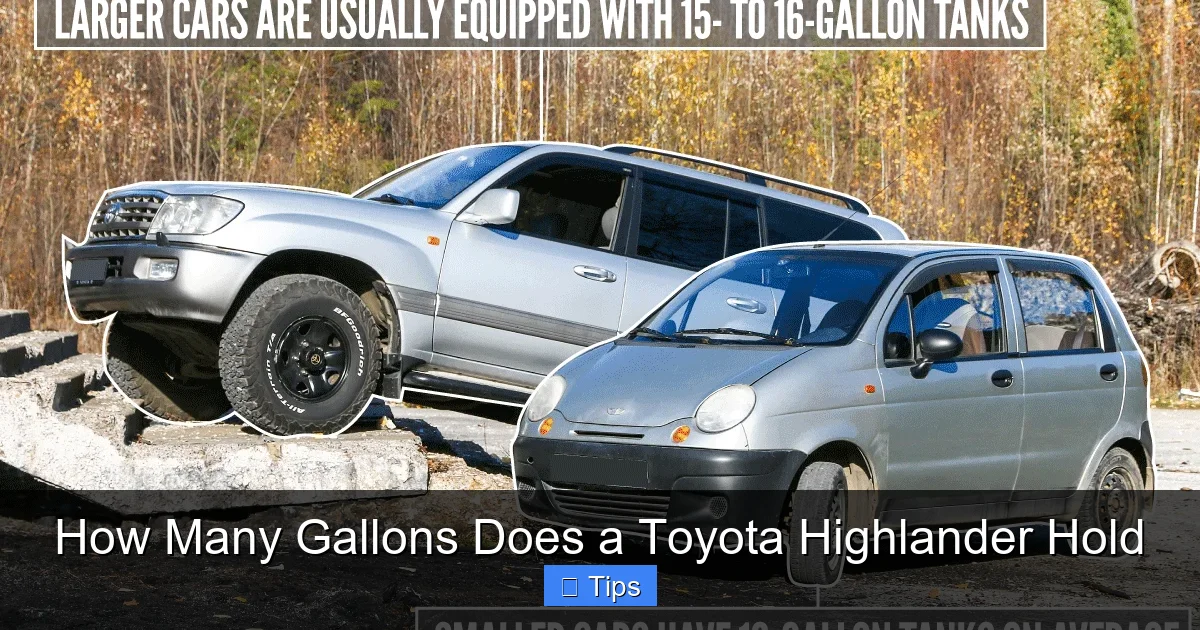
Visual guide about How Many Gallons Does a Toyota Highlander Hold
Image source: vehq.com
When comparing gas and hybrid Highlanders, the fuel tank size tells only part of the story. The real difference lies in how efficiently each model uses that fuel.
Gas Highlander: Power and Practicality
The standard Toyota Highlander comes with a 3.5-liter V6 engine that produces 295 horsepower. It’s paired with an 8-speed automatic transmission and available in FWD or AWD. With a 17.9-gallon tank and an EPA-estimated 21 MPG city / 29 MPG highway (FWD), the gas Highlander can travel approximately **376 miles in the city** and **520 miles on the highway** on a full tank.
That’s a solid range for a three-row SUV. For example, if you’re driving from Los Angeles to San Francisco (about 380 miles), you could make the trip on a single tank—especially if you’re doing mostly highway driving.
Highlander Hybrid: Efficiency Without Sacrifice
The Highlander Hybrid uses a 2.5-liter four-cylinder engine combined with electric motors, delivering a total of 243 horsepower. While it has less power than the gas V6, it makes up for it with superior fuel economy.
With a 17.1-gallon tank and an EPA rating of 36 MPG city / 35 MPG highway, the hybrid can travel about **616 miles in the city** and **599 miles on the highway**. That’s significantly more range than the gas model, despite having a smaller tank.
Let’s put that into perspective. If you drive 50 miles a day, the hybrid could go over 12 days without needing a refill. The gas model would need a fill-up after about 7–8 days.
Real-World Driving: What to Expect
Of course, real-world mileage can vary. Factors like traffic, weather, terrain, and driving style all affect fuel economy. For instance, frequent stop-and-go driving in the city will lower your MPG, while steady highway cruising will maximize it.
Many Highlander Hybrid owners report achieving 34–38 MPG in mixed driving, which is close to EPA estimates. Gas model owners typically see 20–24 MPG, depending on conditions.
One tip: Use the Highlander’s Eco driving mode to improve efficiency. It adjusts throttle response and climate control to reduce fuel consumption. Also, keeping your tires properly inflated can improve MPG by up to 3%.
Factors That Influence Fuel Efficiency and Range
Knowing how many gallons a Toyota Highlander holds is just the beginning. To get the most out of your fuel, you need to understand what affects your mileage.
Driving Habits
How you drive has a huge impact on fuel economy. Aggressive acceleration, hard braking, and speeding can reduce MPG by 15–30%. Smooth, steady driving helps your Highlander use fuel more efficiently.
For example, accelerating gently from a stop and maintaining a consistent speed on the highway can add several miles to your range. Using cruise control on long trips also helps.
Vehicle Load and Cargo
The more weight your Highlander carries, the more fuel it burns. An extra 100 pounds can reduce MPG by about 1%. If you’re packing for a family vacation, try to pack light and avoid roof racks when not in use—they create drag and lower efficiency.
Tire Pressure and Maintenance
Underinflated tires increase rolling resistance, which hurts fuel economy. Check your tire pressure monthly and keep it at the recommended level (usually 33–35 PSI for the Highlander).
Regular maintenance is also key. A dirty air filter, old spark plugs, or a clogged fuel injector can reduce engine efficiency. Follow Toyota’s recommended service schedule to keep your Highlander running smoothly.
Climate and Weather
Cold weather can reduce fuel economy by 10–20%, especially for short trips. That’s because the engine takes longer to warm up and the heater uses extra energy. In summer, using the air conditioner also increases fuel consumption.
If you live in a cold climate, consider using a block heater or parking in a garage to reduce warm-up time.
Fuel Quality and Type
Always use the fuel recommended in your owner’s manual. For most Highlanders, that’s regular unleaded gasoline (87 octane). Using premium fuel won’t improve performance or efficiency unless your specific model requires it.
Avoid gas stations with questionable fuel quality. Contaminated or low-quality gas can harm your engine and reduce MPG.
Tips to Maximize Your Highlander’s Fuel Range
Now that you know how many gallons a Toyota Highlander holds and what affects its efficiency, here are some practical tips to get the most miles out of every tank.
Plan Your Routes
Use GPS apps like Google Maps or Waze to find the most efficient route. Avoid heavy traffic, construction zones, and hilly terrain when possible. Even small detours can save fuel if they mean smoother driving.
Combine Trips
Cold engines use more fuel. If you need to run several errands, do them in one trip instead of multiple short drives. This reduces warm-up time and improves overall efficiency.
Use Eco Mode
The Highlander’s Eco mode adjusts engine performance and climate control to save fuel. It’s great for city driving and long commutes. Just remember it may feel less responsive—so switch back to Normal mode when you need more power.
Keep Up with Maintenance
Regular oil changes, air filter replacements, and tire rotations keep your Highlander running efficiently. A well-maintained vehicle can improve MPG by up to 4%.
Monitor Your Fuel Economy
Use the Highlander’s trip computer to track your MPG. Many models display instant and average fuel economy. This helps you adjust your driving habits in real time.
Consider the Hybrid
If fuel efficiency is a top priority, the Highlander Hybrid is a smart choice. It offers excellent range, lower emissions, and significant savings at the pump—especially if you drive a lot in the city.
Planning Long Trips: How Far Can You Go?
One of the biggest advantages of knowing your Highlander’s fuel tank capacity is trip planning. Whether you’re driving across the country or just heading to the mountains for the weekend, understanding your range helps you avoid running out of gas.
Let’s say you’re taking a road trip from Denver, Colorado, to Moab, Utah—about 350 miles. With a full tank, your gas Highlander (29 MPG highway) could make the trip with room to spare. The hybrid could go even farther, potentially reaching Salt Lake City (about 500 miles away) without refueling.
But always plan for safety. Don’t wait until your tank is near empty. Aim to refuel when you’re down to a quarter tank—especially in remote areas. Use apps like GasBuddy to find the cheapest and closest stations along your route.
Also, consider your driving conditions. Mountain driving, high altitudes, and strong winds can reduce fuel economy. Give yourself a buffer and plan extra stops if needed.
Conclusion: Making the Most of Your Highlander’s Fuel Capacity
So, how many gallons does a Toyota Highlander hold? The answer is typically between 17.1 and 17.9 gallons, depending on the model year and type. While that might not seem like a lot compared to full-size trucks or SUVs, it’s more than enough for most drivers—especially when paired with the Highlander’s solid fuel efficiency.
Whether you drive a gas or hybrid model, understanding your fuel tank capacity helps you plan better, save money, and enjoy longer drives with fewer stops. And with a few smart habits—like maintaining your vehicle, driving smoothly, and using Eco mode—you can stretch every gallon even further.
The Toyota Highlander isn’t just a reliable family SUV. It’s a practical, efficient, and versatile vehicle designed for real-life adventures. Knowing how far it can take you is the first step to making the most of every mile.
Frequently Asked Questions
How many gallons does a 2023 Toyota Highlander hold?
The 2023 Toyota Highlander gas models hold 17.9 gallons, while the hybrid version holds 17.1 gallons. This capacity supports a driving range of over 500 miles for the gas model and nearly 600 miles for the hybrid.
Does the Highlander Hybrid have a smaller fuel tank?
Yes, the Highlander Hybrid has a slightly smaller fuel tank (17.1 gallons) compared to the gas model (17.9 gallons). However, its superior fuel economy allows it to achieve a longer overall range.
Can I increase my Highlander’s fuel tank capacity?
No, the fuel tank size is fixed by the manufacturer. Aftermarket larger tanks are not recommended or widely available for the Highlander and could void your warranty or affect safety.
How far can a Toyota Highlander go on a full tank?
Depending on the model and driving conditions, a Highlander can travel between 400 and 600 miles on a full tank. The hybrid typically achieves the longest range due to higher MPG.
Does AWD affect fuel tank size in the Highlander?
AWD models may have minor packaging differences, but the fuel tank size remains nearly identical to FWD versions—usually within 0.1–0.2 gallons. The impact on range is negligible.
What fuel should I use in my Toyota Highlander?
Most Highlander models are designed to run on regular unleaded gasoline (87 octane). Using higher-octane fuel is not necessary unless specified in your owner’s manual.

At CarLegit, we believe information should be clear, factual, and genuinely helpful. That’s why every guide, review, and update on our website is created with care, research, and a strong focus on user experience.