
The Toyota Tacoma’s fuel tank capacity varies by model year and configuration, typically ranging from 20 to 21 gallons. Understanding your Tacoma’s specific tank size helps with trip planning, fuel budgeting, and maximizing driving range.
If you’re a proud owner of a Toyota Tacoma—or thinking about becoming one—you’ve probably asked yourself: “How many gallons does a Toyota Tacoma hold?” It’s a simple question, but the answer isn’t always straightforward. The fuel tank capacity of a Toyota Tacoma depends on several factors, including the model year, cab configuration, and even the drivetrain. Whether you’re planning a cross-country road trip, hauling gear for a weekend adventure, or just trying to budget your weekly gas expenses, knowing your truck’s fuel capacity is essential.
The Toyota Tacoma has been a favorite among midsize truck enthusiasts for decades, thanks to its rugged reliability, off-road capability, and strong resale value. But beyond its tough exterior and impressive towing capacity, one of the most practical aspects of owning a Tacoma is understanding its fuel system. From city driving to backcountry trails, your truck’s fuel tank plays a crucial role in how far you can go between fill-ups. And while most drivers don’t think about their gas tank until the fuel light comes on, knowing the exact capacity can help you plan better, drive smarter, and get the most out of every gallon.
In this guide, we’ll break down everything you need to know about the Toyota Tacoma’s fuel tank capacity. We’ll explore how many gallons different models hold, why the numbers vary, and how you can use this information to improve your driving experience. Whether you drive a 2005 Tacoma or a brand-new 2024 model, this article will give you the clarity and confidence to hit the road with peace of mind.
In This Article
- 1 Key Takeaways
- 2 📑 Table of Contents
- 3 Understanding the Toyota Tacoma’s Fuel Tank Capacity
- 4 Fuel Tank Sizes by Model Year and Generation
- 5 How Cab and Bed Configuration Affects Fuel Capacity
- 6 Calculating Your Tacoma’s Driving Range
- 7 Tips to Maximize Fuel Efficiency and Range
- 8 Aftermarket and Auxiliary Fuel Options
- 9 Conclusion
- 10 Frequently Asked Questions
- 10.1 How many gallons does a 2023 Toyota Tacoma hold?
- 10.2 Did older Tacomas have bigger gas tanks?
- 10.3 Does the Double Cab Tacoma have a smaller fuel tank?
- 10.4 Can I increase my Tacoma’s fuel capacity?
- 10.5 What fuel should I use in my Toyota Tacoma?
- 10.6 How far can a Toyota Tacoma go on a full tank?
Key Takeaways
- Standard Tank Size: Most Toyota Tacomas have a fuel tank capacity of 20 to 21 gallons, depending on the model year and drivetrain.
- Model Year Variations: Older models (pre-2016) often have 21-gallon tanks, while newer models (2016 and later) typically hold 20 gallons.
- Cab and Bed Configuration Impact: Extended cab and crew cab models may have slightly different tank sizes due to underbody space constraints.
- Driving Range Estimates: With a 20–21 gallon tank and average fuel economy of 18–22 MPG, Tacomas can travel 360–460 miles on a full tank.
- Fuel Type Matters: Tacomas are designed for regular unleaded gasoline; using premium fuel offers no significant benefit unless specified.
- Fuel Efficiency Tips: Proper tire inflation, regular maintenance, and smooth driving can improve MPG and extend range.
- Aftermarket Upgrades: Larger auxiliary fuel tanks are available for overlanding and long-distance travel enthusiasts.
📑 Table of Contents
Understanding the Toyota Tacoma’s Fuel Tank Capacity
When it comes to fuel tank size, the Toyota Tacoma is designed with practicality in mind. Most models are equipped with a fuel tank that holds between 20 and 21 gallons of gasoline. This range is consistent across many years and trims, but there are some important nuances to consider. For example, older Tacomas—particularly those from the second generation (2005–2015)—often feature a 21-gallon fuel tank. These models were built with slightly larger underbody space, allowing for a bigger tank that supports longer driving ranges.
Starting with the third-generation Tacoma (introduced in 2016), Toyota made some design changes that affected the fuel system. The newer models typically come with a 20-gallon fuel tank. While this is a slight reduction from the previous generation, it’s important to note that Toyota also improved the engine efficiency in these newer trucks. The 2016 and later Tacomas feature updated V6 and four-cylinder engines that deliver better fuel economy, which helps offset the smaller tank size. So even though you’re carrying one gallon less fuel, you’re likely getting more miles per gallon (MPG), which can balance out the difference.
Another factor that influences fuel tank capacity is the cab configuration. Toyota offers the Tacoma in several layouts: Regular Cab, Access Cab (extended cab), and Double Cab (crew cab). The Regular Cab, which is less common today, often has a slightly larger fuel tank due to more available space under the chassis. In contrast, the Double Cab, with its longer cabin and rear seats, may have a marginally smaller tank because of space constraints. However, the difference is usually minimal—often just a fraction of a gallon—and rarely impacts real-world driving range.
It’s also worth noting that the drivetrain (2WD vs. 4WD) doesn’t significantly affect fuel tank size. Both two-wheel-drive and four-wheel-drive Tacomas typically come with the same tank capacity. The main difference lies in fuel efficiency: 4WD models tend to be slightly heavier and may have a small impact on MPG, but the tank size remains consistent.
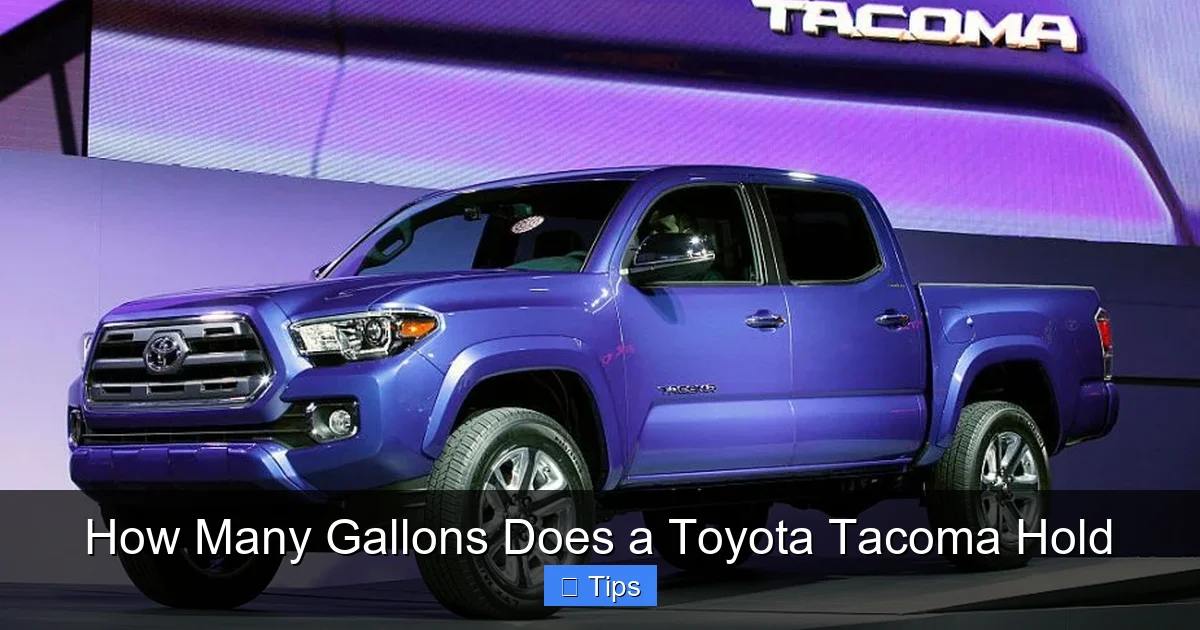
Fuel Tank Sizes by Model Year and Generation
Visual guide about How Many Gallons Does a Toyota Tacoma Hold
Image source: gearopen.com
To get a clearer picture of how many gallons a Toyota Tacoma holds, it helps to look at the data by generation and model year. Let’s break it down:
First Generation (1995–2004)
The first-generation Tacoma, introduced in 1995, was a compact truck that laid the foundation for the model’s success. These early models typically came with a 15.9-gallon fuel tank. While this is smaller than later versions, it was sufficient for the time, especially considering the smaller engine sizes and lower overall vehicle weight. Most first-gen Tacomas were equipped with a 2.4L four-cylinder or a 3.4L V6 engine, both of which were relatively fuel-efficient for their era.
Second Generation (2005–2015)
The second-generation Tacoma marked a significant upgrade in size, power, and capability. This generation introduced a larger chassis, more powerful engines, and improved towing capacity. One of the most notable changes was the increase in fuel tank size. Most 2005–2015 Tacomas came with a 21-gallon fuel tank, giving drivers a substantial driving range. This was especially beneficial for off-road enthusiasts and those who frequently traveled long distances without access to gas stations.
For example, a 2010 Toyota Tacoma TRD Off-Road with a 4.0L V6 engine and 4WD could achieve around 17–19 MPG combined. With a 21-gallon tank, that translates to a driving range of approximately 357–399 miles on a full tank. That’s more than enough for a weekend camping trip or a long commute without needing to stop for fuel.
Third Generation (2016–Present)
The current generation of the Toyota Tacoma, which began in 2016, features a redesigned body, updated interiors, and more advanced technology. However, the fuel tank size was slightly reduced to 20 gallons. This change was partly due to packaging constraints and the need to accommodate newer safety and emissions systems. Despite the smaller tank, Toyota improved the engine efficiency, particularly with the introduction of the 3.5L V6 engine and the optional 2.7L four-cylinder.
For instance, a 2023 Toyota Tacoma SR5 with a 2.7L four-cylinder engine and 2WD can achieve up to 20 MPG in the city and 23 MPG on the highway. With a 20-gallon tank, that gives you a potential range of 400–460 miles. Even the more powerful V6 models, which average around 18–20 MPG combined, can still travel 360–400 miles on a full tank. So while the tank is smaller, the improved efficiency helps maintain a strong overall range.
How Cab and Bed Configuration Affects Fuel Capacity
Visual guide about How Many Gallons Does a Toyota Tacoma Hold
Image source: i.ytimg.com
When shopping for a Toyota Tacoma, you’ll notice that it comes in different cab and bed combinations. These configurations not only affect passenger and cargo space but can also influence the fuel tank size. Let’s take a closer look at how each setup impacts fuel capacity.
Regular Cab (Short Bed)
The Regular Cab is the most basic configuration, featuring a single row of seats and a longer bed. Because it has fewer interior components and more underbody space, Regular Cab models often have the largest fuel tanks. In the second generation, for example, Regular Cab Tacomas typically came with the full 21-gallon tank. This setup is ideal for work trucks and drivers who prioritize cargo space over passenger comfort.
Access Cab (Extended Cab)
The Access Cab, also known as the extended cab, adds small rear-hinged doors and a small rear seat or storage area. This configuration strikes a balance between passenger space and bed length. Most Access Cab models come with a 20- or 21-gallon fuel tank, depending on the model year. The slight reduction in tank size (compared to the Regular Cab) is due to the added structural components needed for the rear doors and seating.
Double Cab (Crew Cab)
The Double Cab, or crew cab, offers four full doors and a spacious rear seat, making it the most family-friendly option. However, the increased cabin size means less room under the chassis for a large fuel tank. As a result, most Double Cab Tacomas—especially in the third generation—come with a 20-gallon tank. While this is slightly smaller than the Access Cab or Regular Cab versions, the difference in real-world range is minimal, especially with the improved fuel economy of newer engines.
It’s also worth noting that bed length (short bed vs. long bed) doesn’t significantly impact fuel tank size. Both short and long bed Tacomas typically use the same fuel tank, as the tank is usually mounted ahead of the rear axle and doesn’t interfere with bed length.
Calculating Your Tacoma’s Driving Range
Visual guide about How Many Gallons Does a Toyota Tacoma Hold
Image source: i.pinimg.com
Knowing how many gallons your Toyota Tacoma holds is only half the story. The other half is understanding how far you can actually drive on a full tank. This is where fuel economy comes into play. The driving range of your Tacoma depends on several factors, including engine type, drivetrain, driving conditions, and your personal driving habits.
Let’s break it down with some real-world examples:
Example 1: 2018 Toyota Tacoma SR5 (V6, 4WD)
– Fuel tank capacity: 20 gallons
– EPA-estimated fuel economy: 18 MPG city / 22 MPG highway / 19 MPG combined
– Estimated driving range:
– City: 20 gallons × 18 MPG = 360 miles
– Highway: 20 gallons × 22 MPG = 440 miles
– Combined: 20 gallons × 19 MPG = 380 miles
This means you could drive from Los Angeles to San Francisco (about 380 miles) on a single tank—assuming you’re mostly on the highway and driving efficiently.
Example 2: 2021 Toyota Tacoma TRD Pro (V6, 4WD)
– Fuel tank capacity: 20 gallons
– EPA-estimated fuel economy: 17 MPG city / 20 MPG highway / 18 MPG combined
– Estimated driving range:
– City: 340 miles
– Highway: 400 miles
– Combined: 360 miles
Even with slightly lower fuel economy due to the off-road suspension and larger tires, the TRD Pro can still cover significant distances.
Example 3: 2023 Toyota Tacoma SR (Four-Cylinder, 2WD)
– Fuel tank capacity: 20 gallons
– EPA-estimated fuel economy: 20 MPG city / 23 MPG highway / 21 MPG combined
– Estimated driving range:
– City: 400 miles
– Highway: 460 miles
– Combined: 420 miles
This model offers the best range thanks to its efficient four-cylinder engine and lighter weight.
Keep in mind that these are estimates. Real-world driving conditions—such as traffic, weather, terrain, and load—can affect your actual MPG. For example, driving uphill, towing a trailer, or carrying heavy cargo will reduce fuel efficiency and shorten your range.
Tips to Maximize Fuel Efficiency and Range
Now that you know how many gallons your Toyota Tacoma holds and how far it can go, let’s talk about how to get the most out of every drop of fuel. Improving your fuel efficiency not only saves money but also extends your driving range, which is especially useful for long trips or remote adventures.
1. Maintain Proper Tire Pressure
Underinflated tires create more rolling resistance, which forces your engine to work harder and burn more fuel. Check your tire pressure at least once a month and before long trips. The recommended pressure for your Tacoma is usually listed on a sticker inside the driver’s door jamb. Keeping your tires properly inflated can improve fuel economy by up to 3%.
2. Follow the Recommended Maintenance Schedule
Regular maintenance is key to keeping your engine running efficiently. This includes oil changes, air filter replacements, spark plug checks, and fuel system cleanings. A well-maintained engine burns fuel more cleanly and efficiently. For example, a clogged air filter can reduce MPG by as much as 10%.
3. Drive Smoothly
Aggressive driving—such as rapid acceleration, hard braking, and high-speed cruising—can significantly reduce fuel economy. Try to accelerate gradually, maintain a steady speed, and anticipate traffic patterns to avoid unnecessary braking. Using cruise control on the highway can also help maintain a consistent speed and improve efficiency.
4. Reduce Excess Weight
The more weight your truck carries, the more fuel it burns. Remove unnecessary items from your cab and bed, especially heavy tools or gear you don’t need. For every 100 pounds of extra weight, your fuel economy can drop by 1–2%.
5. Use the Right Fuel
Toyota recommends using regular unleaded gasoline (87 octane) for all Tacoma models. Using premium fuel (91 octane or higher) won’t improve performance or efficiency unless your specific model requires it (which most don’t). Stick to the manufacturer’s recommendation to avoid wasting money.
6. Consider Aerodynamic Upgrades
If you frequently drive at highway speeds, consider adding aerodynamic accessories like a tonneau cover. These covers reduce drag by smoothing airflow over the bed, which can improve fuel economy by 5–10%. Similarly, removing roof racks or bike carriers when not in use can also help.
7. Plan Your Routes
Use GPS or mapping apps to find the most efficient routes. Avoid heavy traffic, construction zones, and hilly terrain when possible. Even small detours can add up in fuel costs over time.
Aftermarket and Auxiliary Fuel Options
For Tacoma owners who frequently travel long distances or venture into remote areas, the standard 20–21 gallon fuel tank might not be enough. Fortunately, there are aftermarket solutions that can increase your truck’s fuel capacity and extend your range.
Auxiliary Fuel Tanks
Auxiliary fuel tanks are additional fuel containers that can be installed in the bed or under the chassis of your Tacoma. These tanks typically hold between 10 and 30 gallons of fuel and are connected to the main fuel system via a transfer pump. When the main tank runs low, the auxiliary tank automatically feeds fuel into the system, effectively doubling your range.
Popular brands like Transfer Flow and RDS Manufacturing offer high-quality auxiliary tanks designed specifically for the Toyota Tacoma. These systems are DOT-approved and include safety features like rollover valves and fuel level sensors. Installation usually requires professional help, but the investment can be worth it for overlanders, hunters, and long-haul drivers.
Fuel Cans and Portable Tanks
Another option is to carry portable fuel cans in the bed of your truck. While not as convenient as an auxiliary tank, fuel cans are affordable and easy to use. Just be sure to store them securely and follow safety guidelines. Never store fuel in the cab, and always use approved containers.
Hybrid and Future Electric Options
While the current Tacoma is not available as a hybrid or electric vehicle, Toyota has hinted at future electrified versions. The 2024 Tacoma is expected to offer a hybrid powertrain option, which could significantly improve fuel efficiency and reduce emissions. Keep an eye on Toyota’s announcements for updates on electrified Tacoma models.
Conclusion
So, how many gallons does a Toyota Tacoma hold? The answer is typically 20 to 21 gallons, depending on the model year, cab configuration, and generation. Older models (2005–2015) often have 21-gallon tanks, while newer models (2016 and later) usually come with 20-gallon tanks. Despite the slight reduction in capacity, improvements in engine efficiency help maintain a strong driving range—often between 360 and 460 miles on a full tank.
Understanding your Tacoma’s fuel system is more than just a numbers game. It’s about planning smarter, driving more efficiently, and getting the most out of your truck. Whether you’re commuting to work, towing a trailer, or exploring the backcountry, knowing your fuel capacity and range can make all the difference.
By following maintenance tips, driving smoothly, and considering aftermarket upgrades, you can maximize your Tacoma’s fuel efficiency and extend your adventures. And with the possibility of hybrid and electric models on the horizon, the future of the Toyota Tacoma looks even more efficient and capable.
So the next time you fill up at the pump, you’ll know exactly how far your Tacoma can take you—and how to make every gallon count.
Frequently Asked Questions
How many gallons does a 2023 Toyota Tacoma hold?
The 2023 Toyota Tacoma has a fuel tank capacity of 20 gallons, regardless of cab configuration or drivetrain. This is standard across all trims and models for this year.
Did older Tacomas have bigger gas tanks?
Yes, most second-generation Tacomas (2005–2015) came with a 21-gallon fuel tank, which was larger than the 20-gallon tanks found in newer models.
Does the Double Cab Tacoma have a smaller fuel tank?
The Double Cab may have a slightly smaller tank due to space constraints, but the difference is minimal—usually less than a gallon—and most models still hold 20 gallons.
Can I increase my Tacoma’s fuel capacity?
Yes, you can install an auxiliary fuel tank or carry portable fuel cans to extend your range, especially for long trips or off-road adventures.
What fuel should I use in my Toyota Tacoma?
Toyota recommends using regular unleaded gasoline (87 octane) for all Tacoma models. Premium fuel is not required and offers no significant benefit.
How far can a Toyota Tacoma go on a full tank?
Depending on the model and driving conditions, a Tacoma can travel between 360 and 460 miles on a full tank, thanks to its 20–21 gallon capacity and average fuel economy of 18–22 MPG.

At CarLegit, we believe information should be clear, factual, and genuinely helpful. That’s why every guide, review, and update on our website is created with care, research, and a strong focus on user experience.