
Subaru catalytic converters can fetch anywhere from $50 to over $500 when sold for scrap, depending on the model, year, and precious metal content. Prices fluctuate based on market demand for platinum, palladium, and rhodium, so timing and location matter when selling.
If you’ve ever wondered, “How much are Subaru catalytic converters worth for scrap?” you’re not alone. Whether you’re scrapping an old Legacy, replacing a damaged converter on your Forester, or just curious about the value of auto parts, understanding the scrap value of a catalytic converter can save you money—or even earn you some extra cash.
Catalytic converters are essential components in your Subaru’s exhaust system. They reduce harmful emissions by converting toxic gases like carbon monoxide and nitrogen oxides into less harmful substances like carbon dioxide and nitrogen. But beyond their environmental role, these devices contain precious metals that make them surprisingly valuable when recycled. That’s why they’ve become a target for theft—and why knowing their worth is important if you’re planning to sell or recycle one.
In this guide, we’ll break down everything you need to know about the scrap value of Subaru catalytic converters. From what affects pricing to where to sell and how to protect yourself, we’ve got you covered. Whether you’re a DIY mechanic, a car enthusiast, or just dealing with an end-of-life vehicle, this information will help you make smart, informed decisions.
In This Article
- 1 Key Takeaways
- 2 📑 Table of Contents
- 3 What Determines the Scrap Value of a Subaru Catalytic Converter?
- 4 Current Market Prices for Subaru Catalytic Converters
- 5 How to Identify a Valuable Subaru Catalytic Converter
- 6 Where to Sell Your Subaru Catalytic Converter for Scrap
- 7 Legal and Ethical Considerations
- 8 Tips to Maximize Your Scrap Value
- 9 Conclusion
- 10 Frequently Asked Questions
- 10.1 How much is a Subaru catalytic converter worth in 2024?
- 10.2 Which Subaru models have the most valuable catalytic converters?
- 10.3 Can I sell a catalytic converter I removed from my running Subaru?
- 10.4 Do I need proof of ownership to sell a catalytic converter?
- 10.5 How do I find the best price for my Subaru catalytic converter?
- 10.6 Is it worth cleaning a catalytic converter before selling?
Key Takeaways
- Subaru catalytic converters vary widely in scrap value: Older models may be worth $50–$150, while newer or high-performance versions can exceed $400.
- Precious metal content drives pricing: Platinum, palladium, and rhodium—used in the catalyst—are the main factors determining how much your converter is worth.
- Year and engine size matter: Vehicles with larger engines (like the Subaru WRX STI or Outback 3.6L) typically have more valuable catalytic converters.
- Market prices fluctuate daily: Scrap metal markets change based on global supply and demand, so check current rates before selling.
- Only sell to licensed recyclers: Unauthorized buyers may offer lowball prices or engage in illegal activity—always verify credentials.
- Remove and sell responsibly: Tampering with emissions systems is illegal in most states; only remove converters from vehicles being scrapped or repaired legally.
- Documentation helps: Having the vehicle’s VIN and model details can help recyclers assess value accurately and avoid suspicion of theft.
📑 Table of Contents
- What Determines the Scrap Value of a Subaru Catalytic Converter?
- Current Market Prices for Subaru Catalytic Converters
- How to Identify a Valuable Subaru Catalytic Converter
- Where to Sell Your Subaru Catalytic Converter for Scrap
- Legal and Ethical Considerations
- Tips to Maximize Your Scrap Value
- Conclusion
What Determines the Scrap Value of a Subaru Catalytic Converter?
The value of a Subaru catalytic converter on the scrap market isn’t random. It’s based on a combination of factors, with the most important being the type and amount of precious metals inside. Let’s look at what really drives the price.
Precious Metal Content: The Real Money Makers
At the heart of every catalytic converter are three precious metals: platinum, palladium, and rhodium. These metals act as catalysts—hence the name—to speed up the chemical reactions that clean your exhaust gases. Because they’re rare and expensive, they’re the primary reason converters have any scrap value at all.
– Platinum is used in diesel engines and some gasoline models. It’s valuable but less so than the others.
– Palladium is commonly used in gasoline engines and has seen huge price spikes in recent years due to high demand.
– Rhodium is the most valuable of the three—often worth more than gold—and is used in small amounts but has a big impact on value.
The exact mix depends on the year, make, and model of your Subaru. For example, a 2020 Subaru WRX with a turbocharged engine likely has a higher concentration of palladium and rhodium than a 2005 Impreza with a smaller engine. That’s why two converters from different Subarus can have very different scrap values—even if they look similar.
Converter Type and Design
Not all catalytic converters are created equal. Subaru uses different types depending on the vehicle:
– OEM (Original Equipment Manufacturer) converters are installed by Subaru and typically contain higher amounts of precious metals. These are the most valuable.
– Aftermarket converters are cheaper replacements and often use less or lower-grade metals. They’re worth significantly less at scrap yards.
– High-flow or performance converters, like those found in the WRX STI or modified vehicles, may have more catalyst material and thus higher value.
Additionally, some Subarus have multiple catalytic converters—especially models with dual exhaust systems or all-wheel drive setups. For instance, a Subaru Outback with a 3.6L H6 engine might have two or even three converters. Each one can be sold separately, increasing your total scrap return.
Year, Model, and Engine Size
The age and specs of your Subaru play a big role in converter value. Generally:
– Newer models (2015–2024) tend to have higher-value converters because emissions standards are stricter, requiring more catalyst material.
– Older models (pre-2000) often have lower metal content and may be worth less, though some rare or high-demand units can still fetch a good price.
– Turbocharged engines (like the 2.0L or 2.5L in the WRX) usually have more valuable converters than naturally aspirated ones due to higher exhaust temperatures and flow rates.
For example, a catalytic converter from a 2022 Subaru WRX STI could be worth $400–$500 in scrap, while one from a 2003 Subaru Forester might only bring in $60–$90. It’s not just about the brand—it’s about the engineering behind the emissions system.
Current Market Prices for Subaru Catalytic Converters

Visual guide about How Much Are Subaru Catalytic Converters Worth for Scrap
Image source: mcsm.ca
So, how much are Subaru catalytic converters actually worth right now? Prices change daily based on global metal markets, but here’s a realistic breakdown based on recent data (as of 2024).
Average Scrap Prices by Model
While exact values depend on the recycler and location, here are approximate ranges for common Subaru models:
– Subaru Impreza (2000–2010): $50–$120
These older models typically have lower metal content. The 2.5L engine version is slightly more valuable than the 2.2L.
– Subaru Legacy (2005–2015): $80–$180
The 2.5L and 3.0R models have more catalyst material, especially in AWD versions.
– Subaru Outback (2010–2020): $100–$250
The 3.6L H6 engine models often have two converters, doubling potential earnings.
– Subaru Forester (2014–2022): $90–$200
The turbocharged XT models are worth more than the standard versions.
– Subaru WRX / WRX STI (2015–2024): $300–$550+
These performance models have high-flow converters with significant palladium and rhodium content. The STI, in particular, is a top-tier scrap item.
– Subaru Ascent (2019–2024): $200–$400
As a newer, larger SUV with a 2.4L turbo engine, it uses modern, high-value converters.
Keep in mind that these are estimates. A recycler might offer more or less based on condition, location, and current metal prices.
How Metal Prices Affect Scrap Value
The scrap value of your converter is directly tied to the spot price of platinum, palladium, and rhodium. These metals are traded globally, and their prices can swing dramatically.
For example:
– In 2021, palladium prices soared above $2,800 per ounce due to supply shortages and high demand from automakers.
– Rhodium peaked near $30,000 per ounce in 2021, though it has since stabilized around $4,000–$6,000.
– Platinum has been more stable, trading between $900 and $1,100 per ounce.
When these prices rise, so does the value of your catalytic converter. Conversely, if metal prices drop, recyclers will pay less. That’s why it’s smart to check current rates before selling. Websites like Kitco.com or Metalary.com offer free spot price updates.
Regional Differences in Pricing
Where you live also affects how much you’ll get. Scrap yards in urban areas with high demand (like Los Angeles, Chicago, or Atlanta) may pay more due to competition. Rural areas might have fewer buyers and lower offers.
Additionally, some states have stricter emissions laws, which can influence converter design and value. California, for example, requires vehicles to meet CARB (California Air Resources Board) standards, often resulting in more complex and valuable converters.
Always get quotes from multiple recyclers in your area. A little research can mean the difference between $100 and $200 for the same part.
How to Identify a Valuable Subaru Catalytic Converter

Visual guide about How Much Are Subaru Catalytic Converters Worth for Scrap
Image source: carscrapsurrey.co.uk
Not sure if your Subaru’s converter is worth much? Here’s how to tell if you’ve got a high-value unit.
Check the Sticker or Stamp
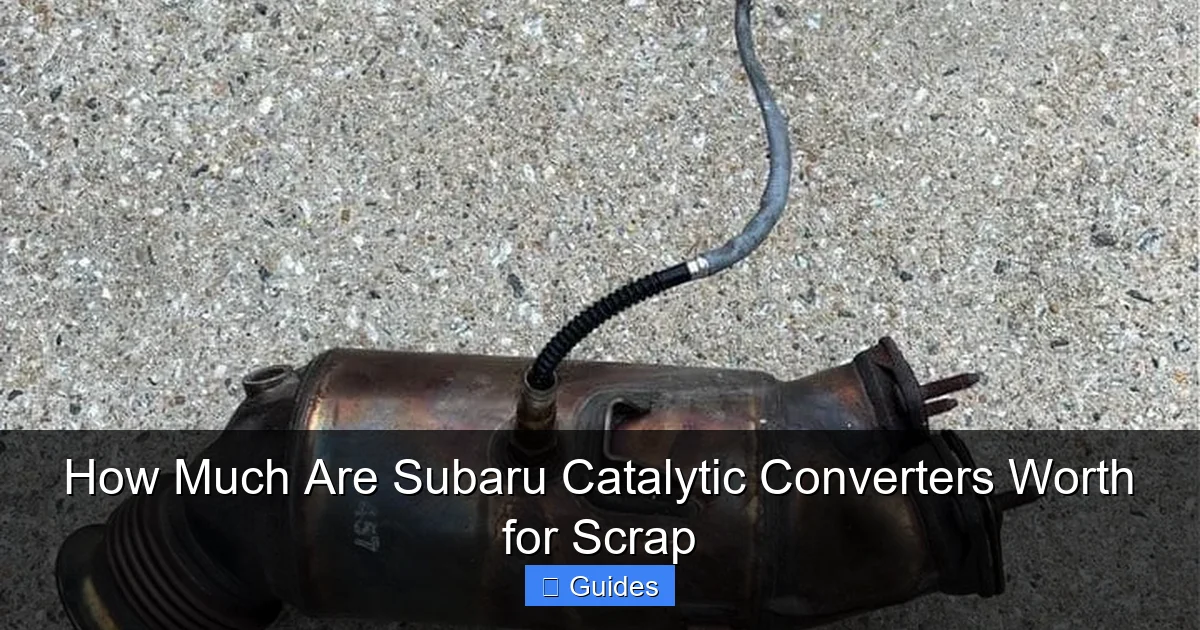
Most OEM catalytic converters have a stamped code or sticker with information like:
– Manufacturer (e.g., “Denso,” “Bosal,” “MagnaFlow”)
– Part number
– Vehicle application (e.g., “Subaru WRX 2018”)
This info helps recyclers identify the model and estimate metal content. Some high-value converters also have a “CARB EO” number, indicating they meet strict emissions standards—another sign of higher quality and value.
Look at the Size and Weight
Larger, heavier converters usually contain more catalyst material. A small, thin unit from a compact car is likely low-value. A bulky, dense converter from a turbocharged or V6 engine is probably worth more.
You can also compare it to known models. For example, the converter from a 2020 WRX STI is noticeably larger and heavier than one from a 2008 Impreza.
Use Online Lookup Tools
Several websites and apps allow you to enter your converter’s details and get an estimated scrap value. Some popular options include:
– Converter King
– CatScrapValue.com
– iScrap App
These tools use databases of known converter values and current metal prices to give you a ballpark figure. While not 100% accurate, they’re a great starting point.
Ask a Professional
If you’re unsure, take the converter to a licensed scrap yard or auto recycler. Many will inspect it for free and give you a quote. Just make sure they’re reputable—more on that below.
Where to Sell Your Subaru Catalytic Converter for Scrap
Visual guide about How Much Are Subaru Catalytic Converters Worth for Scrap
Image source: passionplans.com
Once you know your converter’s value, the next step is finding the right buyer. Not all scrap yards are created equal, and some may try to lowball you or even engage in illegal activity.
Licensed Auto Recyclers and Scrap Yards
Your best bet is to sell to a licensed auto recycler or scrap metal dealer. These businesses are regulated and required to follow environmental and legal guidelines. They’re more likely to offer fair prices and proper documentation.
Look for yards that:
– Are registered with your state’s environmental agency
– Have positive online reviews
– Offer transparent pricing
– Provide receipts or proof of sale
Avoid “cash for converters” ads on Craigslist or social media unless you can verify the buyer’s legitimacy.
Metal Recycling Centers
Some large metal recycling centers specialize in processing catalytic converters. They have the equipment to safely extract and refine the precious metals, so they can often pay more than smaller yards.
Examples include:
– Sims Metal Management
– SA Recycling
– OmniSource
These companies may require you to drop off the converter or schedule a pickup, but they typically offer competitive rates.
Online Buyers (Use Caution)
A few online companies buy catalytic converters by mail. You ship the unit, and they send payment after inspection. While convenient, this method has risks:
– You might not get paid if they claim the converter is “low value”
– Shipping damaged or stolen parts can lead to legal trouble
– Scams are common
If you go this route, only use well-reviewed, established companies and always get a written agreement.
Selling to a Mechanic or Junkyard
Some mechanics and junkyards buy converters directly from customers. This can be convenient, especially if you’re already having work done. However, they may offer less than a dedicated recycler since they’re not specialized in metal recovery.
Still, it’s worth asking—especially if you’re scrapping the whole car. Some junkyards will give you a better deal if you sell the entire vehicle.
Legal and Ethical Considerations
Selling a catalytic converter isn’t as simple as handing over a part. There are legal and environmental rules you need to follow.
Is It Legal to Sell a Catalytic Converter?
In most cases, yes—but only under certain conditions:
– The converter must come from a vehicle you legally own
– The vehicle should be scrapped, recycled, or undergoing legitimate repair
– You must not remove a functioning converter from a running car just to sell it
Tampering with emissions systems is illegal under the Clean Air Act. Removing a converter from a vehicle that’s still in use can result in fines, registration issues, or even criminal charges in some states.
Proof of Ownership
Many recyclers require proof that you legally obtained the converter. This might include:
– Vehicle registration
– Title or bill of sale
– VIN number
– Repair invoice (if removed during service)
This helps prevent the sale of stolen converters, which is a growing problem. In fact, catalytic converter theft has increased by over 300% in the past five years, with Subarus being common targets due to their popularity and converter value.
Environmental Responsibility
Catalytic converters contain hazardous materials, including ceramics and metals that can be harmful if mishandled. Never break one open or burn it. Always take it to a licensed recycler who can process it safely.
Recycling also helps reduce the need for mining new precious metals, which is better for the environment. So by selling your converter responsibly, you’re doing your part.
Tips to Maximize Your Scrap Value
Want to get the most money for your Subaru catalytic converter? Follow these practical tips.
Time Your Sale Right
Since metal prices fluctuate, try to sell when palladium and rhodium are high. Check market trends monthly and consider holding onto the converter if prices are low.
Clean the Converter
Remove dirt, oil, and rust before selling. A clean converter is easier to inspect and may get a better price. Use a wire brush and degreaser—just don’t damage the internal honeycomb structure.
Keep It Intact
Don’t cut or crush the converter. Recyclers pay more for whole units because they’re easier to process. Damaged or shredded converters may be rejected or paid at a lower rate.
Bundle with Other Scrap
If you’re scrapping a whole Subaru, sell the converter along with the rest of the vehicle. Some recyclers offer bonuses for complete cars, and you’ll save on multiple trips.
Negotiate
Don’t accept the first offer. Get quotes from 2–3 recyclers and use them to negotiate. If one offers $200 and another $250, ask the first if they’ll match it.
Document Everything
Keep records of the sale, including the buyer’s info, price, and date. This protects you in case of disputes and helps with taxes if you’re selling multiple units.
Conclusion
So, how much are Subaru catalytic converters worth for scrap? The answer depends on several factors—but the good news is that many Subaru models, especially newer or performance-oriented ones, can fetch a solid return when recycled properly.
From the WRX STI to the Outback 3.6R, the value comes down to precious metal content, converter design, and market conditions. While older models may only bring in $50–$100, high-performance or late-model Subarus can easily exceed $400. And with metal prices still relatively strong, now can be a great time to cash in.
But remember: always sell legally and ethically. Only remove converters from vehicles you own and are scrapping or repairing. Work with licensed recyclers, keep documentation, and avoid scams. By doing so, you’ll not only get fair value for your part—you’ll also help protect the environment and reduce theft.
Whether you’re cleaning out the garage or saying goodbye to an old Subaru, that catalytic converter might be worth more than you think. A little research and the right approach can turn a piece of scrap into real cash.
Frequently Asked Questions
How much is a Subaru catalytic converter worth in 2024?
The scrap value of a Subaru catalytic converter in 2024 ranges from $50 to over $500, depending on the model, year, and precious metal content. High-performance models like the WRX STI typically fetch the highest prices.
Which Subaru models have the most valuable catalytic converters?
Subaru WRX, WRX STI, Outback 3.6L, and Ascent models tend to have the most valuable converters due to their larger engines, turbocharging, and higher precious metal content.
Can I sell a catalytic converter I removed from my running Subaru?
No, removing a functioning catalytic converter from a vehicle still in use is illegal in most states and violates the Clean Air Act. Only sell converters from vehicles being scrapped or legally repaired.
Do I need proof of ownership to sell a catalytic converter?
Yes, most licensed recyclers require proof of ownership, such as a vehicle title, registration, or repair invoice, to prevent the sale of stolen parts.
How do I find the best price for my Subaru catalytic converter?
Get quotes from multiple licensed scrap yards or auto recyclers in your area. Use online lookup tools to estimate value and check current metal prices before selling.
Is it worth cleaning a catalytic converter before selling?
Yes, cleaning off dirt, oil, and rust can help recyclers assess the unit more easily and may result in a higher offer. Just avoid damaging the internal structure.

At CarLegit, we believe information should be clear, factual, and genuinely helpful. That’s why every guide, review, and update on our website is created with care, research, and a strong focus on user experience.