
Wondering how much you can sell your car for? You’re not alone. The value of your vehicle depends on factors like age, mileage, condition, and market demand. With the right tools and strategy, you can price it right and sell it quickly.
[FEATURED_IMAGE_PLACEOLDER]
In This Article
- 1 Key Takeaways
- 2 📑 Table of Contents
- 3 How Much Can I Sell My Car For? A Complete Guide to Getting Top Dollar
- 4 Step 1: Use Online Valuation Tools to Get a Ballpark Estimate
- 5 Step 2: Understand the Factors That Affect Your Car’s Value
- 6 Step 3: Choose the Right Selling Method
- 7 Step 4: Prepare Your Car to Maximize Value
- 8 Step 5: Price It Right and Negotiate Smart
- 9 Step 6: Close the Sale Safely and Legally
- 10 Final Thoughts: Get What Your Car Is Worth
- 11 Frequently Asked Questions
- 11.1 How accurate are online car valuation tools?
- 11.2 Should I sell my car privately or trade it in?
- 11.3 Can I sell my car if it has mechanical problems?
- 11.4 How much does it cost to sell a car privately?
- 11.5 What paperwork do I need to sell my car?
- 11.6 How long does it take to sell a car privately?
Key Takeaways
- Use trusted valuation tools: Websites like Kelley Blue Book (KBB), Edmunds, and NADA Guides give accurate estimates based on your car’s details.
- Know your car’s condition: A clean, well-maintained vehicle with service records can fetch 10–15% more than one in average shape.
- Check local market trends: Prices vary by region—urban areas often pay more for fuel-efficient or compact cars.
- Private sale vs. trade-in: Selling privately typically earns 20–30% more than trading in at a dealership.
- Timing matters: Convertibles sell better in spring, while SUVs and trucks peak in fall and winter.
- Be honest in listings: Transparency builds trust and reduces negotiation time, helping you sell faster.
- Prepare your car for sale: A $100 detail job can increase perceived value and justify a higher asking price.
📑 Table of Contents
- How Much Can I Sell My Car For? A Complete Guide to Getting Top Dollar
- Step 1: Use Online Valuation Tools to Get a Ballpark Estimate
- Step 2: Understand the Factors That Affect Your Car’s Value
- Step 3: Choose the Right Selling Method
- Step 4: Prepare Your Car to Maximize Value
- Step 5: Price It Right and Negotiate Smart
- Step 6: Close the Sale Safely and Legally
- Final Thoughts: Get What Your Car Is Worth
How Much Can I Sell My Car For? A Complete Guide to Getting Top Dollar
So, you’ve decided it’s time to part ways with your car. Maybe you’re upgrading to something newer, downsizing, or just ready for a change. Whatever the reason, one question is likely top of mind: How much can I sell my car for?
It’s a fair question—and one that millions of car owners ask every year. The truth is, your car’s value isn’t just a random number. It’s based on real data, market trends, and the specific condition of your vehicle. And while no two cars are exactly alike, there are proven ways to estimate your car’s worth and maximize your return.
In this guide, we’ll walk you through everything you need to know to answer that all-important question: How much can I sell my car for? From using online valuation tools to understanding market demand, preparing your vehicle, and choosing the right selling method, we’ve got you covered. Whether you’re selling a 5-year-old sedan or a 10-year-old SUV, these tips will help you get the best possible price.
Step 1: Use Online Valuation Tools to Get a Ballpark Estimate
Visual guide about How Much Can I Sell My Car For
Image source: image.isu.pub
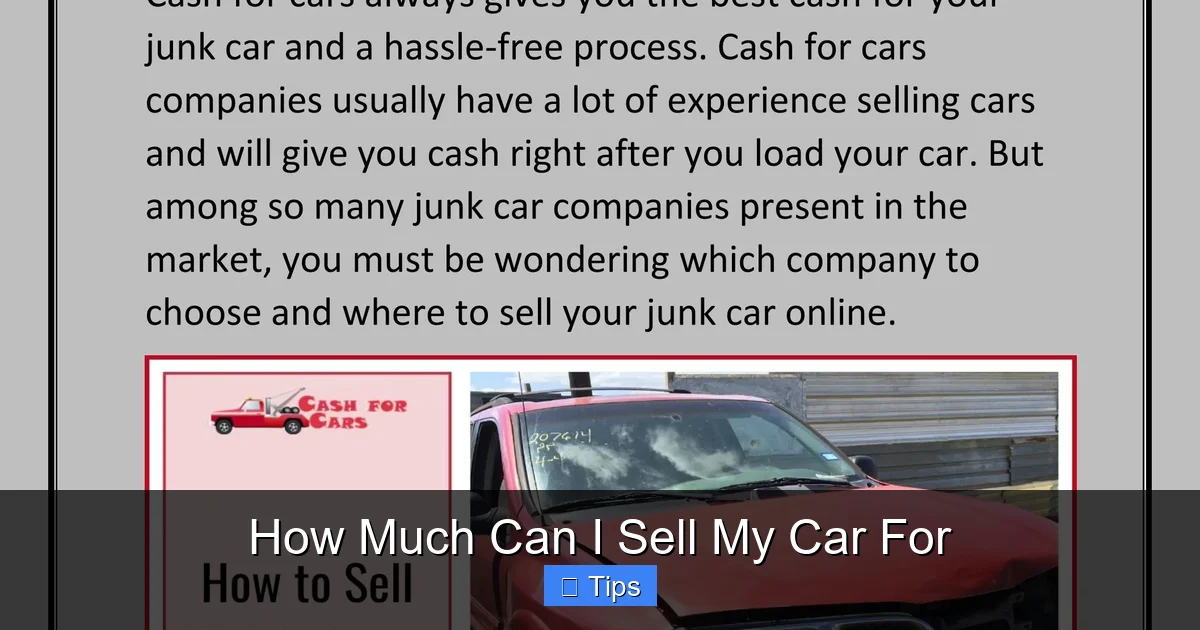
The first step in determining how much you can sell your car for is getting an accurate estimate. And the best way to do that is by using trusted online valuation tools. These platforms analyze millions of data points—including recent sales, regional trends, and vehicle specs—to give you a realistic price range.
Top Car Valuation Websites
Three of the most reliable tools are Kelley Blue Book (KBB), Edmunds, and the National Automobile Dealers Association (NADA) Guides. Each offers a slightly different perspective, so it’s smart to check all three.
– Kelley Blue Book (KBB): KBB is one of the most widely used resources. It provides three key values: trade-in value, private party value, and suggested retail price. For most sellers, the private party value is the most relevant—it reflects what you can expect to get from an individual buyer.
– Edmunds: Known for its detailed reviews, Edmunds also offers a “True Market Value” (TMV) tool. It considers local listings and recent sales to give a hyper-local estimate. This is especially helpful if you live in a competitive market.
– NADA Guides: Often used by dealerships, NADA tends to be slightly more generous in its valuations. It’s a good benchmark if you’re aiming for a higher price, especially for older or luxury vehicles.
To use any of these tools, you’ll need your car’s make, model, year, mileage, trim level, and condition. Be honest about the condition—selecting “excellent” when your car is only “good” will give you an inflated estimate.
Example: Valuing a 2018 Honda Civic
Let’s say you have a 2018 Honda Civic LX with 60,000 miles, in good condition, with no major accidents. According to KBB, the private party value might be around $15,500. Edmunds might show $15,200, and NADA could list it at $15,800. That gives you a solid range of $15,200–$15,800.
But remember—these are just starting points. The final price you get will depend on how you present your car and where you sell it.
Step 2: Understand the Factors That Affect Your Car’s Value
Visual guide about How Much Can I Sell My Car For
Image source: atlas-content-cdn.pixelsquid.com
Now that you have a baseline estimate, it’s time to dig deeper. Several key factors influence how much you can sell your car for. Understanding these will help you adjust your expectations and make smart decisions.
1. Age and Mileage
These are the two biggest depreciation drivers. Generally, a car loses about 15–20% of its value the moment you drive it off the lot, and another 15–20% each year after that. High mileage accelerates this process.
For example, a 2020 Toyota Camry with 30,000 miles will be worth significantly more than the same model with 90,000 miles—even if both are in excellent condition.
2. Vehicle Condition
This includes both mechanical and cosmetic condition. A car with a clean interior, no dents or scratches, and a well-maintained engine will always command a higher price.
Keep in mind:
– Minor cosmetic flaws (like small scratches or worn upholstery) can reduce value by 5–10%.
– Mechanical issues (such as a check engine light or transmission problems) can cut value in half or more.
– Accident history matters—even if repaired, a car with a salvage title or major accident history will sell for less.
3. Trim Level and Options
Higher trim levels (like EX, Touring, or Limited) and added features (sunroof, leather seats, advanced safety tech) increase value. A base model Civic will sell for less than a fully loaded one, even if they have the same mileage.
4. Market Demand
Some cars are simply more desirable. Fuel-efficient hybrids, reliable SUVs, and popular brands (like Toyota, Honda, and Subaru) tend to hold their value better. Conversely, luxury brands with high maintenance costs (like BMW or Mercedes) may depreciate faster.
Also, seasonal trends play a role. Convertibles sell better in spring and summer, while trucks and SUVs are in higher demand during fall and winter.
5. Location
Where you live affects pricing. In urban areas, compact cars and hybrids are often more valuable due to traffic and parking constraints. In rural or suburban areas, trucks and SUVs may fetch a premium.
For example, a Ford F-150 might sell for $2,000 more in Texas than in New York City, where parking is tight and gas prices are high.
Step 3: Choose the Right Selling Method

Visual guide about How Much Can I Sell My Car For
Image source: groupnews24.com
Once you know your car’s value, the next step is deciding how to sell it. Your choice will directly impact how much you can sell your car for and how quickly it sells.
Private Sale: Highest Profit, More Work
Selling your car privately—through platforms like Craigslist, Facebook Marketplace, or OfferUp—typically yields the highest return. You avoid dealer markups and can negotiate directly with buyers.
On average, private sellers earn 20–30% more than those who trade in their cars. For a $15,000 car, that’s an extra $3,000–$4,500 in your pocket.
But it comes with responsibilities:
– You’ll need to create a compelling listing with photos and details.
– You’ll handle test drives, negotiations, and paperwork.
– You may need to meet strangers, so safety is important.
Trade-In: Convenient, but Lower Return
Trading in your car at a dealership is the easiest option. You drive in, get an offer, and apply it toward your new purchase—all in one trip.
However, dealerships need to make a profit, so they’ll offer less than market value. On average, trade-in values are 10–15% below private sale prices.
That said, trade-ins can save you money on sales tax. In most states, you only pay tax on the difference between your new car’s price and your trade-in value. So if you’re buying a $25,000 car and trading in a $15,000 vehicle, you’ll only pay tax on $10,000.
Sell to a Car Buying Service: Fast and Fair
Companies like CarMax, Carvana, and Vroom offer instant online quotes and quick payouts. They’re a middle ground between private sales and trade-ins.
These services inspect your car and make a no-obligation offer. If you accept, they’ll pick it up or have you drop it off. The price is usually lower than a private sale but higher than a trade-in.
Pros:
– Fast and hassle-free.
– No need to meet buyers or handle paperwork.
– Competitive offers based on real market data.
Cons:
– You’ll still get less than a private sale.
– Some services charge fees or deduct for minor issues.
Example: Comparing Selling Methods
Let’s go back to our 2018 Honda Civic worth $15,500 privately.
– Private sale: You sell it for $15,500 after a few days of marketing.
– Trade-in: Dealer offers $13,200, citing reconditioning costs.
– CarMax offer: $14,300 after inspection.
In this case, the private sale nets you $2,300 more than the trade-in and $1,200 more than CarMax. But it also takes more time and effort.
Step 4: Prepare Your Car to Maximize Value
You’ve done your research, chosen your selling method, and now it’s time to get your car ready. A little prep work can go a long way in boosting how much you can sell your car for.
Clean It Inside and Out
First impressions matter. A dirty car suggests neglect, even if it’s mechanically sound.
– Exterior: Wash, wax, and touch up minor scratches. A $50 detail job can make your car look years younger.
– Interior: Vacuum, wipe down surfaces, clean windows, and remove personal items. Consider an odor eliminator if there’s any lingering smell.
Fix Minor Issues
You don’t need to rebuild the engine, but small fixes can increase value:
– Replace burnt-out bulbs.
– Fix cracked windshield wipers.
– Repair small dents or paint chips.
– Replace worn floor mats.
These cost $100–$300 but can justify a $500–$1,000 higher asking price.
Gather Documentation
Buyers want proof that your car has been well cared for. Have these ready:
– Service records: Show regular oil changes, tire rotations, and major repairs.
– Vehicle history report: Use Carfax or AutoCheck to show no accidents or title issues.
– Owner’s manual and spare keys: These small touches add perceived value.
Take High-Quality Photos
If you’re selling privately, photos are your first impression. Use natural light, shoot from multiple angles, and include close-ups of the interior, engine, and wheels.
Avoid cluttered backgrounds and shadows. A clean, well-lit photo can make your car look more attractive and trustworthy.
Be Honest in Your Listing
Transparency builds trust. Clearly state the car’s condition, mileage, and any known issues. Buyers appreciate honesty and are more likely to make a serious offer.
For example:
“2018 Honda Civic LX, 60,000 miles, excellent condition. Recent oil change, new tires, no accidents. Small scratch on rear bumper (see photo). Clean title, one owner.”
This kind of detail shows you’re a responsible seller—and that your car is worth the price.
Step 5: Price It Right and Negotiate Smart
Pricing your car correctly is crucial. Overprice it, and it sits on the market. Underprice it, and you leave money on the table.
Set a Competitive Asking Price
Start with your valuation tool estimate, then adjust based on:
– Local listings (check similar cars on Craigslist or Autotrader).
– Your car’s condition (add $500–$1,000 if it’s exceptionally clean).
– Market demand (increase price slightly if it’s a hot model).
A good rule of thumb: List your car for 5–10% above your target sale price to leave room for negotiation.
Be Ready to Negotiate
Most buyers will try to negotiate. Be prepared with your bottom line—the lowest you’re willing to go.
If a buyer offers $14,000 on your $15,500 Civic, don’t panic. Ask why. Maybe they’re concerned about mileage or condition. Address their concerns, and counter with $15,000.
Stay calm and confident. Remember, you’re not desperate—you’ve done your homework.
Know When to Walk Away
Not every offer is worth accepting. If a buyer lowballs you or seems unreliable, it’s okay to say no. There are plenty of other buyers who will appreciate your car’s value.
Step 6: Close the Sale Safely and Legally
Once you’ve agreed on a price, it’s time to finalize the sale. Do it right to avoid scams, legal issues, or payment problems.
Accept Secure Payment
Never accept cash for large amounts—it’s risky. Use a cashier’s check or bank transfer. Verify the check before handing over the keys.
For private sales, meet at a bank so the buyer can get a cashier’s check on the spot.
Complete the Paperwork
You’ll need to:
– Sign over the title (check your state’s requirements—some need notarization).
– Provide a bill of sale (available online or from your DMV).
– Notify your DMV of the sale (to avoid liability).
– Cancel your insurance once the sale is complete.
Protect Yourself
– Meet in a public place during daylight hours.
– Bring a friend if possible.
– Avoid sharing personal information like your home address.
Selling your car doesn’t have to be stressful. With the right preparation, you can answer the question “How much can I sell my car for?” with confidence—and walk away with a fair price.
Final Thoughts: Get What Your Car Is Worth
So, how much can you sell your car for? The answer isn’t just a number—it’s the result of smart research, honest assessment, and strategic selling.
Start with trusted valuation tools to get a baseline. Factor in your car’s age, mileage, condition, and market demand. Choose the selling method that best fits your goals—whether that’s maximum profit, convenience, or speed. Prepare your car to look its best, price it competitively, and negotiate with confidence.
Remember, every car has value. Even older models can sell for thousands if they’re well-maintained and marketed effectively. By following the steps in this guide, you’ll not only get a fair price—you’ll also sell your car faster and with less hassle.
Whether you’re upgrading, downsizing, or just ready for a change, knowing how much you can sell your car for puts you in control. So take a deep breath, do your homework, and get ready to drive away with cash in hand.
Frequently Asked Questions
How accurate are online car valuation tools?
Online tools like KBB and Edmunds are generally accurate, but they provide estimates based on averages. Your car’s actual value may vary depending on condition, location, and market demand. Always use them as a starting point, not a final price.
Should I sell my car privately or trade it in?
Selling privately typically earns 20–30% more than trading in, but it requires more time and effort. Trade-ins are convenient and can reduce sales tax on your next purchase. Choose based on your priorities: profit or convenience.
Can I sell my car if it has mechanical problems?
Yes, but you’ll need to disclose the issues and price it accordingly. Some buyers look for project cars, but expect to sell for significantly less—often 30–50% below market value.
How much does it cost to sell a car privately?
Most listing platforms are free or low-cost (under $30). Budget $100–$200 for cleaning, minor repairs, and photography to maximize your car’s appeal and value.
What paperwork do I need to sell my car?
You’ll need the title, bill of sale, vehicle history report, and possibly a release of liability form. Check your state’s DMV website for specific requirements.
How long does it take to sell a car privately?
On average, it takes 2–4 weeks to sell a car privately, depending on price, condition, and market demand. Well-priced, clean cars often sell within a week.

At CarLegit, we believe information should be clear, factual, and genuinely helpful. That’s why every guide, review, and update on our website is created with care, research, and a strong focus on user experience.