
Idling your car burns fuel unnecessarily and adds up over time. Most vehicles use between 0.25 and 0.5 gallons of gas per hour while idling, costing you money and increasing emissions. Learn how to reduce idle time and improve fuel efficiency today.
In This Article
- 1 Key Takeaways
- 2 📑 Table of Contents
- 3 How Much Gas Does a Car Use When Idling?
- 4 Understanding Idling: What It Is and Why It Matters
- 5 How Much Fuel Does Idling Actually Use?
- 6 Factors That Affect Idle Fuel Consumption
- 7 The Real Cost of Idling: Money, Environment, and Engine Health
- 8 When Is Idling Necessary? Smart Exceptions
- 9 How to Reduce Idling and Save Fuel
- 10 Conclusion: Small Changes, Big Impact
- 11 Frequently Asked Questions
Key Takeaways
- Typical idle fuel consumption: Most cars use 0.25 to 0.5 gallons of gasoline per hour when idling, depending on engine size and vehicle type.
- Engine size matters: Larger engines (V6, V8) consume more fuel at idle than smaller four-cylinder engines.
- Idling costs money: Leaving your car running for just 10 minutes a day can waste over 100 gallons of gas per year.
- Environmental impact: Idling increases CO₂ emissions and contributes to air pollution, even when the car isn’t moving.
- Modern cars idle less: Many newer vehicles come with automatic start-stop systems that shut off the engine when stopped to save fuel.
- Turn it off when possible: Experts recommend turning off your engine if you’re stopped for more than 10 seconds (except in traffic).
- Exceptions apply: Idling may be necessary in extreme cold or for certain vehicle functions, but it should be minimized.
📑 Table of Contents
- How Much Gas Does a Car Use When Idling?
- Understanding Idling: What It Is and Why It Matters
- How Much Fuel Does Idling Actually Use?
- Factors That Affect Idle Fuel Consumption
- The Real Cost of Idling: Money, Environment, and Engine Health
- When Is Idling Necessary? Smart Exceptions
- How to Reduce Idling and Save Fuel
- Conclusion: Small Changes, Big Impact
How Much Gas Does a Car Use When Idling?
Have you ever sat in your car with the engine running, waiting for someone or just taking a break, and wondered how much fuel you’re actually burning? It’s a common scenario—maybe you’re parked outside a school, warming up the car on a cold morning, or stuck in a drive-thru line. But here’s the truth: every second your engine idles, it’s using gasoline—even though you’re not going anywhere.
Understanding how much gas a car uses when idling isn’t just about curiosity. It’s about saving money, reducing wear on your engine, and helping the environment. Idling might seem harmless, but over time, it adds up. Whether you’re a daily commuter, a parent doing school pickups, or someone who likes to warm up the car in winter, knowing the real cost of idling can change your habits for the better.
In this guide, we’ll break down exactly how much fuel your car burns while idling, what factors influence that number, and—most importantly—what you can do to cut down on unnecessary fuel use. We’ll also explore the environmental and financial impacts, and share practical tips to help you make smarter decisions behind the wheel.
Understanding Idling: What It Is and Why It Matters
Visual guide about How Much Gas Does a Car Use When Idling
Image source: rerev.com
So, what exactly is idling? Simply put, idling is when your car’s engine is running but the vehicle isn’t moving. You’re in park (or neutral), your foot’s off the gas, and the engine is just… humming. It might feel like nothing’s happening, but under the hood, fuel is being burned to keep the engine, alternator, and other systems operating.
Now, why does this matter? Because idling uses fuel without moving you forward. Unlike driving, where fuel is converted into motion, idling is pure consumption with zero progress. Think of it like leaving your kitchen faucet running while you’re not using it—wasteful and unnecessary.
But idling isn’t always avoidable. Sometimes it’s practical—like when you’re waiting in a long line at a drive-thru or letting your car warm up in freezing temperatures. However, many people idle out of habit, not necessity. They leave the car running while running into a store, talking on the phone, or just “taking a moment.” These small moments add up.
The Environmental Protection Agency (EPA) and other automotive experts agree: unnecessary idling wastes fuel, increases emissions, and shortens the life of your engine components. Even modern cars, which are more fuel-efficient than ever, still burn gas when idling. And while the amount might seem small per minute, it accumulates quickly over days, weeks, and months.
Common Reasons People Idle Their Cars
Let’s look at some everyday situations where people tend to idle:
– **Warming up the car in winter:** Many believe the engine needs to run for several minutes before driving. While some warm-up is helpful, excessive idling isn’t necessary.
– **Waiting for passengers:** Parents waiting outside schools, friends picking up friends, or drivers waiting for rideshare passengers.
– **Drive-thrus and fast food lines:** It’s common to leave the engine running while waiting in line.
– **Traffic stops or accidents:** Sometimes you’re stuck and can’t turn off the engine.
– **Using accessories:** Running the AC, heater, or stereo while parked.
While some of these are unavoidable, others can be managed. The key is knowing when idling is truly needed—and when it’s just a habit you can break.
The Myth of Engine Warm-Up
One of the biggest reasons people idle is to “warm up” their car, especially in cold weather. But here’s a fact: modern engines don’t need long idle times to warm up. In fact, the best way to warm up your engine is to drive gently after a short start-up period—usually 30 seconds to a minute.
Idling for 5 or 10 minutes in the driveway doesn’t warm up the engine faster. It just wastes fuel and increases emissions. The engine warms up more efficiently when it’s under light load, like driving at low speeds. Plus, idling doesn’t warm up the transmission, wheels, or cabin air as effectively as driving does.
So, unless it’s extremely cold (below 0°F or -18°C), you don’t need to idle for more than a minute before driving. And even then, modern cars are designed to handle cold starts safely.
How Much Fuel Does Idling Actually Use?
Visual guide about How Much Gas Does a Car Use When Idling
Image source: i.ytimg.com
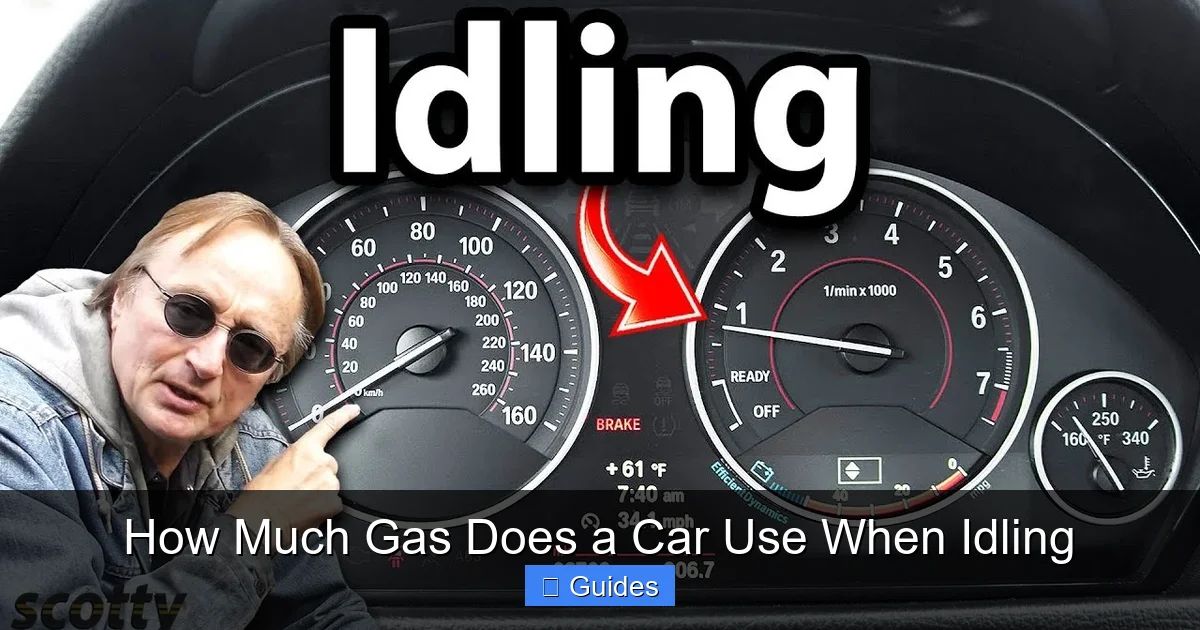
Now for the big question: how much gas does a car use when idling? The answer depends on several factors, but we can give you a solid range based on real-world data.
On average, a typical passenger car with a 2.0 to 3.5-liter engine uses between **0.25 and 0.5 gallons of gasoline per hour** while idling. That might not sound like much, but let’s put it into perspective.
Imagine you idle your car for 10 minutes every day—say, while waiting to pick up your kids or during a coffee break. That’s 1/6 of an hour per day. At 0.375 gallons per hour (the midpoint of our range), you’d burn about **0.0625 gallons per day**. Over a year, that adds up to **22.8 gallons of wasted fuel**.
At $3.50 per gallon, that’s **$80 per year**—just for 10 minutes of daily idling. And that’s on the low end. If you idle longer or drive a larger vehicle, the cost climbs quickly.
Fuel Consumption by Engine Size
Not all engines are created equal when it comes to idling. Larger engines burn more fuel, even when not moving. Here’s a general breakdown:
– **Small 4-cylinder engines (1.5L–2.0L):** ~0.25 gallons per hour
– **Mid-size 4-cylinder or V6 engines (2.5L–3.5L):** ~0.35–0.45 gallons per hour
– **Large V6 or V8 engines (4.0L and up):** ~0.5–0.75 gallons per hour
– **Diesel engines (common in trucks and SUVs):** ~0.5–1.0 gallon per hour
For example, a Toyota Corolla with a 2.0L engine might use about 0.25 gallons per hour, while a Ford F-150 with a 5.0L V8 could use up to 0.75 gallons per hour. That’s three times more fuel for the same idle time.
Real-World Examples
Let’s look at a few scenarios to make this more tangible:
**Scenario 1: Daily School Pickup**
You wait 15 minutes every weekday (250 school days per year) with the engine running.
– Idle time: 15 min × 250 = 3,750 minutes = 62.5 hours
– Fuel used (mid-size car): 62.5 hrs × 0.4 gal/hr = **25 gallons**
– Cost at $3.50/gal: **$87.50 per year**
**Scenario 2: Winter Warm-Up**
You idle your car for 10 minutes every morning during a 90-day cold season.
– Idle time: 10 min × 90 = 900 minutes = 15 hours
– Fuel used (V6 SUV): 15 hrs × 0.6 gal/hr = **9 gallons**
– Cost: **$31.50**
**Scenario 3: Drive-Thru Habit**
You hit the drive-thru 3 times a week, idling for 5 minutes each time.
– Weekly idle time: 15 minutes
– Annual idle time: 15 min × 52 = 780 minutes = 13 hours
– Fuel used: 13 hrs × 0.35 gal/hr = **4.55 gallons**
– Cost: **$15.93**
These examples show how small habits lead to real costs. And that’s just fuel—there’s also wear and tear on your engine and increased emissions to consider.
How to Measure Your Car’s Idle Fuel Use
Curious about your own vehicle? You can estimate your car’s idle fuel consumption using the following method:
1. Fill up your gas tank completely.
2. Drive normally for a week, but note any extended idling (e.g., 10+ minutes at a time).
3. At the end of the week, fill up again and record how many gallons you used.
4. Subtract the fuel used while driving (based on odometer and average MPG) from the total.
5. The remainder is roughly the fuel used during idling.
Alternatively, some newer cars have built-in fuel economy displays that show instant and average fuel use—even at idle. If your car has this feature, you can watch the numbers drop while parked.
You can also consult your owner’s manual. Some manufacturers list idle fuel consumption rates, especially for commercial or fleet vehicles.
Factors That Affect Idle Fuel Consumption
Visual guide about How Much Gas Does a Car Use When Idling
Image source: images.theconversation.com
While we’ve given average numbers, several factors can increase or decrease how much gas your car uses when idling. Understanding these can help you make smarter decisions.
1. Engine Size and Type
As mentioned, larger engines burn more fuel. A V8 truck will use significantly more gas at idle than a compact sedan. This is because larger engines have bigger cylinders and require more fuel to keep running.
Diesel engines, common in trucks and some SUVs, also tend to use more fuel at idle than gasoline engines. They’re designed for torque and efficiency under load, not for low-speed operation.
2. Vehicle Age and Condition
Older cars, especially those with carbureted engines (pre-1990s), tend to idle less efficiently. Modern fuel-injected engines are more precise, but only if they’re well-maintained.
A poorly tuned engine—dirty air filters, old spark plugs, or faulty oxygen sensors—can increase idle fuel consumption. Regular maintenance helps keep idle efficiency high.
3. Climate and Weather
Cold weather increases idle fuel use. In winter, engines take longer to reach optimal operating temperature, and the engine control unit (ECU) may enrich the fuel mixture to keep it running smoothly. This means more fuel is burned per minute.
In extreme cold, some cars even have “winter idle” modes that increase RPMs to generate heat faster. This can double or triple fuel use during the first few minutes.
Hot weather also plays a role. If you’re idling with the AC on, the compressor puts extra load on the engine, increasing fuel consumption. Running the AC at idle can add 10–20% more fuel use.
4. Accessories in Use
Every electrical accessory you use while idling draws power from the engine, which means more fuel is burned to keep up.
– **Air conditioning:** High load, increases fuel use
– **Heater:** Moderate load (uses engine heat, but fan uses electricity)
– **Lights, radio, phone chargers:** Low load, but still adds up over time
– **Defrosters:** High load, especially in winter
If you’re idling for a long time, turning off unnecessary accessories can save fuel.
5. Altitude and Air Density
At higher altitudes, the air is thinner, which affects engine performance. Engines may run richer (more fuel) to compensate, increasing idle fuel consumption. This is more noticeable in naturally aspirated engines than in turbocharged ones.
6. Transmission Type
Automatic transmissions typically use slightly more fuel at idle than manuals because of the torque converter. However, the difference is small—usually less than 5%.
The Real Cost of Idling: Money, Environment, and Engine Health
Now that we know how much fuel idling uses, let’s talk about the real-world impact.
Financial Cost
We’ve already seen how idling adds up. But let’s go bigger. Suppose you idle for 30 minutes a day—maybe while waiting, warming up, or running errands.
– Daily idle time: 0.5 hours
– Annual idle time: 0.5 × 365 = 182.5 hours
– Fuel used (mid-size car): 182.5 × 0.4 = **73 gallons**
– Cost at $3.50/gal: **$255.50 per year**
That’s over $250 wasted—money that could go toward gas for actual driving, car maintenance, or even a weekend trip.
For families with multiple drivers or fleet vehicles (like delivery vans or taxis), the cost multiplies quickly. A delivery driver idling 2 hours a day could waste over 150 gallons per year—costing $500+ in fuel.
Environmental Impact
Idling doesn’t just waste money—it harms the environment. Burning gasoline releases carbon dioxide (CO₂), a major greenhouse gas. The average gallon of gasoline produces about 19.6 pounds of CO₂ when burned.
Using our 73-gallon example:
– 73 gallons × 19.6 lbs CO₂ = **1,431 pounds of CO₂ per year**
That’s like driving an extra 1,700 miles in a typical car. And that’s just from one person idling 30 minutes a day.
Idling also emits other pollutants:
– **Nitrogen oxides (NOx):** Contribute to smog and respiratory issues
– **Particulate matter (PM):** Tiny particles that can penetrate lungs
– **Volatile organic compounds (VOCs):** React with sunlight to form ground-level ozone
Even though modern cars have cleaner emissions systems, idling still releases more pollutants per mile than driving. That’s because the catalytic converter works best when the engine is warm and under load—conditions not met during idle.
Engine Wear and Maintenance
Contrary to popular belief, excessive idling can actually harm your engine. Here’s why:
– **Incomplete combustion:** At idle, engines run cooler and may not burn fuel completely, leading to carbon buildup in the combustion chamber and exhaust system.
– **Oil contamination:** Fuel can seep past piston rings and dilute engine oil, reducing its lubricating properties.
– **Catalytic converter damage:** Unburned fuel can overheat and damage the catalytic converter, a costly repair ($1,000+).
– **Battery drain:** While the alternator charges the battery at idle, prolonged idling with accessories on can strain the system.
Modern engines are designed to handle short idle periods, but long-term idling—especially in older cars—can shorten engine life.
When Is Idling Necessary? Smart Exceptions
We’re not saying you should never idle. There are legitimate times when it’s the best or only option. The key is knowing when it’s truly needed.
Extreme Cold Weather
In very cold climates (below 0°F or -18°C), a short idle (1–2 minutes) can help the engine reach a stable temperature. However, even in cold weather, driving gently is the fastest way to warm up the entire vehicle—including the transmission and cabin.
Avoid idling for more than 5 minutes in extreme cold. Use a block heater if possible—it pre-warms the engine and reduces startup strain.
Emergency Situations
If you’re stranded, injured, or in a dangerous situation, idling may be necessary to keep the heater, lights, or communication devices running. Safety comes first.
Vehicle Systems That Require Idling
Some vehicles—like ambulances, police cars, or utility trucks—need to idle to power equipment (lights, radios, computers). In these cases, auxiliary power units (APUs) or battery systems can reduce fuel use.
Traffic and Safety
In heavy traffic or at long stops (like railroad crossings), it’s safer to keep the engine running. Turning it off and on repeatedly in stop-and-go traffic can be more stressful than helpful.
But for short stops—like at a red light or in a parking lot—turning off the engine is usually better.
How to Reduce Idling and Save Fuel
The good news? You can cut down on idling with a few simple habits. Here’s how:
1. Turn Off the Engine When Stopped
The rule of thumb from the EPA and automotive experts: **If you’re going to be stopped for more than 10 seconds (and not in traffic), turn off the engine.**
This includes:
– Waiting at a drive-thru
– Parked and talking on the phone
– Waiting for someone outside a store
– Warming up the car (after 30–60 seconds)
Yes, even 10 seconds matters. It takes less fuel to restart a modern engine than to idle for that long.
2. Use Start-Stop Technology
Many new cars come with automatic start-stop systems. These shut off the engine when you stop (like at a red light) and restart it when you press the gas.
Studies show these systems can improve fuel economy by 3–10%, especially in city driving. If you’re buying a new car, look for this feature.
3. Plan Ahead
Avoid situations where you’ll need to idle. For example:
– Order food online for pickup instead of using the drive-thru
– Park and walk into stores instead of idling in the lot
– Use a timer to leave the house so you don’t need to warm up the car
4. Use Remote Start Wisely
Remote starters are convenient, but they encourage unnecessary idling. If you use one, set it to run for just 1–2 minutes—enough to start defrosting, but not long enough to waste fuel.
Better yet, use a remote start with a timer or smartphone app that lets you control duration.
5. Maintain Your Vehicle
A well-maintained car idles more efficiently. Regular oil changes, clean air filters, and proper tire pressure all help reduce fuel use—both while driving and idling.
6. Educate Others
Share this information with family, friends, and coworkers. Fleet managers can train drivers to reduce idling. Schools can promote “no-idling zones” during pickup and drop-off.
Conclusion: Small Changes, Big Impact
So, how much gas does a car use when idling? The answer is: more than you think. While it might seem like a small amount per minute, idle fuel consumption adds up fast—costing you money, harming the environment, and putting extra strain on your engine.
The average car uses between 0.25 and 0.5 gallons per hour at idle, with larger engines using even more. Over time, just 10–30 minutes of daily idling can waste dozens of gallons of fuel and hundreds of dollars per year.
But the solution is simple: turn off the engine when you’re stopped for more than 10 seconds (unless in traffic). Use start-stop technology, plan ahead, and maintain your vehicle. These small changes make a big difference.
By reducing unnecessary idling, you’re not just saving fuel—you’re driving smarter, cleaner, and more efficiently. And that’s good for your wallet, your car, and the planet.
So next time you’re tempted to leave the engine running, ask yourself: is it really necessary? Chances are, the answer is no.
Frequently Asked Questions
How much gas does a car use per minute when idling?
Most cars use about 0.004 to 0.008 gallons of gas per minute while idling. That’s roughly 1/4 to 1/2 gallon per hour, depending on engine size and vehicle type.
Is it bad to idle your car every day?
Occasional short idling is fine, but daily long idling can waste fuel, increase emissions, and contribute to engine wear. It’s best to minimize idle time whenever possible.
Does idling use more gas than restarting the engine?
No. Modern engines use less fuel to restart than they do to idle for more than 10 seconds. Turning off the engine during short stops saves fuel.
Should I idle my car to warm it up in winter?
No, not for long. A 30–60 second idle is enough. The best way to warm up your engine is to drive gently after starting.
Do hybrid cars use gas when idling?
Hybrid cars can idle using battery power, but if the gas engine kicks in (e.g., for heat or battery charging), they will use fuel. Some hybrids have electric-only idle modes.
Can idling damage my car’s engine?
Prolonged idling can lead to carbon buildup, oil dilution, and catalytic converter damage. It’s not recommended for extended periods, especially in older vehicles.

At CarLegit, we believe information should be clear, factual, and genuinely helpful. That’s why every guide, review, and update on our website is created with care, research, and a strong focus on user experience.