
The Nissan Altima typically holds between 16 and 18 gallons of gasoline, depending on the model year and trim. Knowing your Altima’s fuel tank capacity helps you plan long trips, monitor fuel efficiency, and avoid unexpected stops at the pump.
[FEATURED_IMAGE_PLACEOLDER]
In This Article
- 1 Key Takeaways
- 2 📑 Table of Contents
- 3 How Much Gas Does a Nissan Altima Hold? A Complete Guide
- 4 Understanding Fuel Tank Capacity in the Nissan Altima
- 5 Fuel Tank Capacity by Model Year and Trim
- 6 How Fuel Tank Capacity Affects Driving Range
- 7 Fueling Tips and Best Practices for Your Nissan Altima
- 8 Common Myths About Fuel Tank Capacity
- 9 Conclusion: Get the Most Out of Your Altima’s Fuel Capacity
- 10 Frequently Asked Questions
- 10.1 What is the fuel tank capacity of a 2023 Nissan Altima?
- 10.2 Can I use premium gas in my Nissan Altima?
- 10.3 How far can a Nissan Altima go on a full tank?
- 10.4 Does the Nissan Altima have a hybrid version?
- 10.5 Why does my Altima’s fuel range seem lower than advertised?
- 10.6 How often should I refuel my Nissan Altima?
Key Takeaways
- Standard Fuel Tank Capacity: Most Nissan Altima models from 2013 to 2024 have a fuel tank capacity of 16 to 18 gallons.
- Model Year Variations: Older models (pre-2013) may have slightly smaller tanks, while newer trims like the SR and Platinum often feature the full 18-gallon capacity.
- Fuel Efficiency Impact: With a full tank, the Altima can travel up to 500+ miles on the highway, thanks to its efficient 4-cylinder and turbocharged engine options.
- Gas Type Matters: Always use the recommended fuel type (usually regular unleaded) to maintain engine performance and fuel economy.
- Monitor Fuel Levels: Use the dashboard fuel gauge and low-fuel warning light to avoid running out of gas unexpectedly.
- Fuel-Saving Tips: Smooth driving, proper tire inflation, and regular maintenance can help you get the most out of every gallon.
- EV and Hybrid Options: While the standard Altima uses gasoline, Nissan offers hybrid variants in some markets—check your local availability.
📑 Table of Contents
- How Much Gas Does a Nissan Altima Hold? A Complete Guide
- Understanding Fuel Tank Capacity in the Nissan Altima
- Fuel Tank Capacity by Model Year and Trim
- How Fuel Tank Capacity Affects Driving Range
- Fueling Tips and Best Practices for Your Nissan Altima
- Common Myths About Fuel Tank Capacity
- Conclusion: Get the Most Out of Your Altima’s Fuel Capacity
How Much Gas Does a Nissan Altima Hold? A Complete Guide
If you’re driving a Nissan Altima—or thinking about buying one—you’ve probably wondered: How much gas does a Nissan Altima hold? It’s a practical question that affects everything from road trip planning to monthly fuel budgets. Whether you’re commuting daily or gearing up for a cross-country adventure, knowing your car’s fuel tank capacity helps you stay prepared and in control.
The good news? The Nissan Altima is designed with efficiency and practicality in mind. Most models come equipped with a fuel tank that holds between 16 and 18 gallons of gasoline. That’s a solid range that balances trunk space, weight distribution, and driving range. But the exact number depends on the year, trim level, and engine configuration. For example, a 2023 Altima SV with the standard 2.5L engine has an 18-gallon tank, while some earlier models from the 2000s might only hold around 16 gallons.
In this guide, we’ll break down everything you need to know about the Nissan Altima’s fuel capacity. We’ll explore how it varies across model years, how it impacts your driving range, and how to get the most out of every tank. Plus, we’ll share tips to improve fuel efficiency and answer common questions drivers have about fueling up their Altima.
Understanding Fuel Tank Capacity in the Nissan Altima
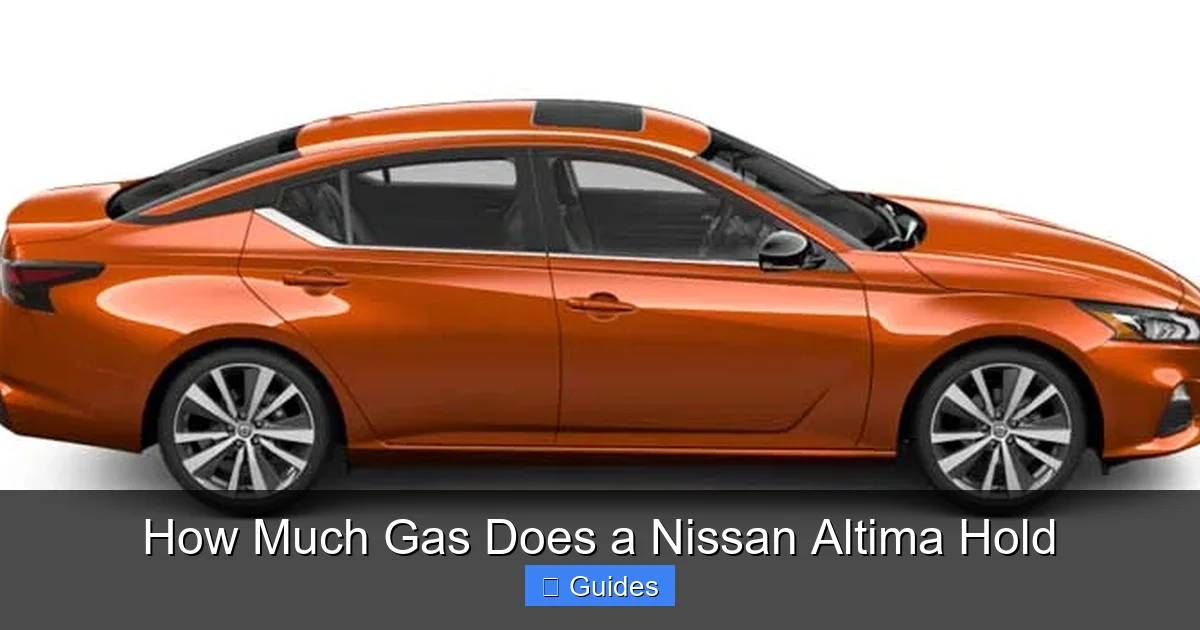
Visual guide about How Much Gas Does a Nissan Altima Hold
Image source: mpgof.com
When we talk about “how much gas a Nissan Altima holds,” we’re referring to the total volume of gasoline the fuel tank can store when full. This is known as the fuel tank capacity and is measured in gallons (in the U.S.) or liters (in other countries). For the Altima, this number typically falls between 16 and 18 gallons, but it’s not the same across every model.
Why does this matter? Because your fuel tank capacity directly affects how far you can drive before needing to refuel. A larger tank means fewer stops on long drives, while a smaller one might require more frequent fill-ups—especially if you’re driving in stop-and-go traffic or hauling heavy loads.
Let’s look at some real-world examples. A 2020 Nissan Altima SR with the 2.0L turbocharged engine has an 18-gallon tank. With an EPA-estimated 28 mpg in the city and 39 mpg on the highway, that gives you a potential range of over 500 miles on a single tank. That’s enough to drive from Los Angeles to San Francisco and back—without stopping for gas.
On the other hand, a 2008 Altima 2.5 S with a 16-gallon tank and lower fuel efficiency (around 23 mpg city / 31 mpg highway) would give you a range of roughly 400 miles. Still impressive, but noticeably less than newer models.
Why Fuel Tank Size Varies by Model Year
You might be wondering why the fuel tank size isn’t the same across all Altima models. The answer lies in design changes, engineering updates, and evolving consumer needs. Over the years, Nissan has tweaked the Altima’s chassis, engine layout, and interior space to improve performance, safety, and comfort. These changes sometimes require adjustments to the fuel tank size.
For instance, when Nissan redesigned the Altima in 2013, they increased the wheelbase and overall length, allowing for a slightly larger fuel tank. This was part of a broader effort to enhance ride quality and interior space. Similarly, the introduction of turbocharged engines in later models (like the 2.0L VC-Turbo) required more precise fuel delivery systems, which influenced tank placement and capacity.
Trim levels also play a role. Higher trims like the Platinum and SR often come with larger tanks or optimized fuel systems to support performance driving. Base models, like the S or base SV, might have slightly smaller tanks to reduce weight and cost.
How to Check Your Altima’s Exact Fuel Tank Capacity
If you’re not sure how much gas your specific Altima holds, there are a few easy ways to find out:
1. **Check the Owner’s Manual:** This is the most reliable source. Look for the “Fuel Information” or “Specifications” section. It will list the exact fuel tank capacity in gallons or liters.
2. **Look at the Fuel Door or Gas Cap:** Some Nissan models have the fuel tank size printed near the fuel filler neck or on the inside of the gas cap.
3. **Use Nissan’s Official Website:** Visit Nissan’s vehicle configurator or model year archive. Enter your VIN or select your year, trim, and engine to see detailed specs.
4. **Ask a Nissan Dealer:** If you’re still unsure, a quick call or visit to a local dealership can confirm your car’s fuel capacity.
For most drivers, knowing the general range (16–18 gallons) is sufficient. But if you’re planning a long trip or comparing fuel costs, getting the exact number can help you budget more accurately.
Fuel Tank Capacity by Model Year and Trim
Visual guide about How Much Gas Does a Nissan Altima Hold
Image source: appgecet.co.in
To give you a clearer picture, let’s break down the fuel tank capacity for the Nissan Altima across different model years and trims. This will help you understand how much gas your specific Altima holds—and how it compares to other models.
2013–2018 Nissan Altima
The 2013 redesign marked a major shift for the Altima. These models typically feature a 18-gallon fuel tank across most trims, including the S, SV, SL, and SR. The 2.5L 4-cylinder engine was standard, with an optional 3.5L V6 on higher trims (though the V6 was discontinued after 2017).
– **2.5L Engine Models:** 18-gallon tank
– **3.5L V6 Models (2013–2017):** Also 18 gallons
These models are known for their smooth ride and good fuel economy, with the 2.5L engine achieving up to 38 mpg on the highway. With a full tank, you could easily drive 600+ miles on the highway—perfect for road trips.
2019–2024 Nissan Altima
The current generation of the Altima, introduced in 2019, continues the trend of an 18-gallon fuel tank. However, there are some nuances:
– **Base 2.5L Engine (S, SV, SL trims):** 18-gallon tank
– **2.0L VC-Turbo Engine (SR, Platinum trims):** Also 18 gallons
The 2.0L turbocharged engine is more powerful and efficient, offering up to 250 horsepower while still delivering strong fuel economy (up to 34 mpg combined). Despite the increased performance, the fuel tank size remains consistent, ensuring long-range capability.
One thing to note: Some hybrid or plug-in variants may have slightly different fuel systems, but as of 2024, the standard Altima remains gasoline-only in most markets.
2007–2012 Nissan Altima
Earlier models from this era typically have a 16-gallon fuel tank. These include the sedan and coupe versions, with engine options ranging from the 2.5L 4-cylinder to the 3.5L V6.
– **2.5L Models:** 16-gallon tank
– **3.5L V6 Models:** 16 gallons
While the tank is smaller, these models are still efficient for their time. The 2.5L engine delivers around 27 mpg city / 38 mpg highway, giving a range of about 450–500 miles per tank.
2002–2006 Nissan Altima
Older Altimas from the early 2000s also feature a 16-gallon fuel tank. These models were known for their reliability and affordability, though fuel efficiency was lower than today’s standards (around 23 mpg city / 30 mpg highway).
Despite the smaller tank and lower mpg, these cars were popular for their durability. Many are still on the road today, proving that a well-maintained Altima can go the distance.
Hybrid and Alternative Fuel Options
While the standard Nissan Altima runs on gasoline, it’s worth mentioning that Nissan has offered hybrid versions in the past. The Altima Hybrid was available from 2007 to 2011 and used a combination of a 2.5L gasoline engine and an electric motor.
– **Altima Hybrid (2007–2011):** 16-gallon fuel tank
The hybrid system improved fuel economy significantly—up to 35 mpg combined—but the fuel tank size remained the same as the gasoline-only models. Unfortunately, the hybrid version was discontinued due to low demand and the rise of more advanced hybrids from competitors.
As of 2024, Nissan does not offer a hybrid or electric Altima in the U.S., though the brand is expanding its EV lineup with models like the Ariya. For now, if you want a fuel-efficient Altima, the 2.0L turbo or 2.5L engine with proper maintenance is your best bet.
How Fuel Tank Capacity Affects Driving Range

Visual guide about How Much Gas Does a Nissan Altima Hold
Image source: appgecet.co.in
Now that you know how much gas a Nissan Altima holds, let’s talk about what that means for your actual driving range. The total distance you can travel on a full tank depends on two main factors: fuel tank capacity and fuel efficiency (measured in miles per gallon, or mpg).
Let’s do the math. If your Altima has an 18-gallon tank and gets 30 mpg combined, your estimated range is:
18 gallons × 30 mpg = 540 miles
That’s a lot of ground to cover! But remember, real-world conditions can affect this number. Here’s how:
City vs. Highway Driving
Fuel efficiency varies significantly between city and highway driving. In the city, stop-and-go traffic, idling, and frequent acceleration reduce your mpg. On the highway, consistent speeds and less braking help you achieve better fuel economy.
For example:
– A 2023 Altima SV gets 28 mpg in the city and 39 mpg on the highway.
– With an 18-gallon tank, that’s:
– City range: 18 × 28 = 504 miles
– Highway range: 18 × 39 = 702 miles
That’s a huge difference! If you’re planning a long highway trip, you could go over 700 miles without stopping. But in heavy city traffic, you might need to refuel after 400–500 miles.
Factors That Reduce Fuel Efficiency
Even with a full tank, your actual range can be lower due to several factors:
– **Aggressive Driving:** Rapid acceleration and hard braking can reduce fuel economy by up to 30%.
– **Excess Weight:** Carrying heavy luggage, roof racks, or towing a trailer increases fuel consumption.
– **Poor Tire Pressure:** Underinflated tires create more rolling resistance, lowering mpg.
– **Air Conditioning Use:** Running the A/C in hot weather can reduce fuel efficiency, especially in city driving.
– **Engine Maintenance:** Dirty air filters, old spark plugs, or low oil levels can hurt performance and fuel economy.
Tips to Maximize Your Altima’s Range
Want to get the most out of every gallon? Here are some practical tips:
1. **Drive Smoothly:** Accelerate gradually and anticipate stops to avoid unnecessary braking.
2. **Maintain Proper Tire Pressure:** Check your tires monthly. The recommended PSI is usually listed on the driver’s door jamb.
3. **Use Cruise Control on Highways:** This helps maintain a steady speed and improves fuel economy.
4. **Remove Excess Weight:** Take out unnecessary items from your trunk or back seat.
5. **Service Your Engine Regularly:** Follow the maintenance schedule in your owner’s manual.
6. **Use the Eco Mode (if equipped):** Many newer Altimas have an Eco driving mode that adjusts throttle response and climate control to save fuel.
By following these tips, you can stretch your fuel range and reduce the number of trips to the gas station.
Fueling Tips and Best Practices for Your Nissan Altima
Knowing how much gas your Altima holds is just the first step. To keep your car running smoothly and efficiently, it’s important to follow good fueling habits.
Use the Right Type of Gas
Nissan recommends using **regular unleaded gasoline** with an octane rating of 87 or higher for most Altima models. Higher trims with turbocharged engines (like the 2.0L VC-Turbo) may benefit from mid-grade or premium fuel, but it’s not required unless specified in your owner’s manual.
Using premium gas in a car designed for regular fuel won’t improve performance or efficiency—it just costs more. Save your money and stick to the recommended fuel type.
Don’t Let the Tank Run Too Low
While modern fuel pumps are designed to work even when the tank is nearly empty, running on fumes can cause problems over time. Sediment and debris at the bottom of the tank can get sucked into the fuel system, potentially clogging filters or damaging the fuel pump.
Most Altimas have a low-fuel warning light that comes on when you have about 2–3 gallons left. Try to refuel before this light comes on, or at least within 50–100 miles of it appearing.
Fill Up When Prices Are Low
Gas prices fluctuate, so it pays to fill up when costs are lower. Use apps like GasBuddy or Waze to find the cheapest stations near you. Some credit cards also offer cash back or rewards for fuel purchases.
Avoid Overfilling the Tank
When pumping gas, stop when the nozzle clicks off. Overfilling can cause fuel to spill into the vapor recovery system, leading to damage or emissions issues. It’s also a fire hazard.
Consider Fuel Additives (Occasionally)
While not necessary, using a fuel system cleaner once or twice a year can help remove carbon deposits and keep your engine running smoothly. Look for products that are compatible with your Altima’s engine type.
Common Myths About Fuel Tank Capacity
There are a lot of misconceptions about fuel tanks and fueling habits. Let’s clear up a few common myths:
Myth: You Should Always Fill the Tank Completely
While it’s good to keep your tank at least half full (especially in winter), you don’t need to top it off every time. Filling to the top doesn’t improve performance, and it can lead to spills or vapor lock in hot weather.
Myth: Bigger Tanks Are Always Better
A larger tank means fewer stops, but it also adds weight and takes up space. Nissan balances tank size with overall vehicle design to optimize efficiency, safety, and comfort.
Myth: Premium Gas Makes Any Car Run Better
Unless your Altima specifically recommends premium fuel, using it won’t improve performance or fuel economy. Stick to regular unleaded unless your owner’s manual says otherwise.
Conclusion: Get the Most Out of Your Altima’s Fuel Capacity
So, how much gas does a Nissan Altima hold? For most models from 2013 to 2024, the answer is **18 gallons**. Older models typically hold 16 gallons. This capacity, combined with the Altima’s efficient engines, gives you a driving range of 500 to 700 miles on a full tank—depending on driving conditions and habits.
Understanding your fuel tank capacity helps you plan trips, budget for gas, and maintain your vehicle properly. Whether you’re commuting to work or exploring the open road, your Altima is built to go the distance.
To maximize efficiency, drive smoothly, maintain your car, and use the right fuel. And remember: a little knowledge goes a long way. Now that you know how much gas your Altima holds, you’re ready to hit the road with confidence.
Frequently Asked Questions
What is the fuel tank capacity of a 2023 Nissan Altima?
The 2023 Nissan Altima has an 18-gallon fuel tank across all trims, including the S, SV, SL, SR, and Platinum. This capacity allows for a driving range of up to 700 miles on the highway.
Most Nissan Altimas are designed to run on regular unleaded gasoline (87 octane). While premium gas won’t harm the engine, it’s not necessary unless your specific model recommends it.
How far can a Nissan Altima go on a full tank?
With an 18-gallon tank and highway fuel economy of up to 39 mpg, a Nissan Altima can travel over 700 miles on a single tank under ideal conditions.
Does the Nissan Altima have a hybrid version?
The Altima Hybrid was available from 2007 to 2011 but has been discontinued. As of 2024, there is no hybrid or electric version of the Altima in the U.S. market.
Why does my Altima’s fuel range seem lower than advertised?
Real-world fuel economy can be affected by driving habits, traffic, weather, and vehicle maintenance. Aggressive driving or carrying heavy loads can reduce your actual range.
How often should I refuel my Nissan Altima?
It’s best to refuel when the low-fuel warning light comes on, which typically happens when you have 2–3 gallons left. This helps prevent fuel system issues and ensures you don’t run out of gas.

At CarLegit, we believe information should be clear, factual, and genuinely helpful. That’s why every guide, review, and update on our website is created with care, research, and a strong focus on user experience.