
The value of a 2000 Toyota 4Runner varies widely, typically ranging from $3,000 to $8,500 depending on condition, mileage, and trim level. Well-maintained models with low mileage and 4WD can command higher prices, while high-mileage or damaged units fall on the lower end.
If you’re wondering, “How much is a 2000 Toyota 4Runner worth?” you’re not alone. This rugged, reliable SUV has earned a loyal following over the years, and its value today reflects both its legendary durability and its growing status as a classic off-road vehicle. Whether you’re looking to buy, sell, or simply assess your current 4Runner’s worth, understanding the factors that influence its price is essential.
The 2000 Toyota 4Runner was part of the third generation (1996–2002), a era known for building tough, body-on-frame SUVs that could handle everything from daily commutes to weekend trail adventures. Unlike modern crossovers, the 4Runner of this era was built like a truck—solid, simple, and incredibly dependable. That reputation has helped it retain value better than many of its contemporaries. But just because it’s reliable doesn’t mean all 2000 4Runners are worth the same. In fact, the difference between a low-mileage, well-cared-for example and a high-mileage, neglected one can be thousands of dollars.
So, what determines the value? It’s not just about the year or the model. Mileage, condition, trim level, drivetrain, maintenance history, and even your geographic location all play a role. In this guide, we’ll break down everything you need to know to accurately assess how much a 2000 Toyota 4Runner is worth—whether you’re buying, selling, or just curious.
In This Article
- 1 Key Takeaways
- 2 📑 Table of Contents
- 3 Understanding the 2000 Toyota 4Runner’s Market Value
- 4 The Role of Mileage in Valuation
- 5 Drivetrain: 2WD vs. 4WD Impact on Price
- 6 Condition, Maintenance, and History
- 7 Regional and Market Influences
- 8 How to Determine the Exact Value of Your 2000 4Runner
- 9 Tips for Sellers: Maximizing Your 4Runner’s Value
- 10 Tips for Buyers: Getting the Best Deal
- 11 Conclusion
- 12 Frequently Asked Questions
Key Takeaways
- Price Range: Most 2000 Toyota 4Runners sell between $3,000 and $8,500, with exceptional examples reaching up to $10,000.
- Mileage Matters: Vehicles under 150,000 miles hold significantly more value than those over 200,000 miles.
- 4WD Adds Value: Four-wheel-drive models are more desirable and typically sell for $1,000–$2,000 more than 2WD versions.
- Trim Level Impact: The SR5 and Limited trims offer more features and command higher resale prices than base models.
- Maintenance History: A documented service record can increase value by 10–15% and boost buyer confidence.
- Regional Differences: Prices vary by location—rust-free models in dry climates sell for more than those in snowy, salt-heavy areas.
- Market Trends: Classic SUV demand is rising, making well-kept 4Runners a smart buy for enthusiasts and collectors.
📑 Table of Contents
- Understanding the 2000 Toyota 4Runner’s Market Value
- The Role of Mileage in Valuation
- Drivetrain: 2WD vs. 4WD Impact on Price
- Condition, Maintenance, and History
- Regional and Market Influences
- How to Determine the Exact Value of Your 2000 4Runner
- Tips for Sellers: Maximizing Your 4Runner’s Value
- Tips for Buyers: Getting the Best Deal
- Conclusion
Understanding the 2000 Toyota 4Runner’s Market Value
When evaluating how much a 2000 Toyota 4Runner is worth, it’s important to start with a realistic price range. Based on current market data from sources like Kelley Blue Book (KBB), Edmunds, and actual sales on platforms like eBay Motors, Craigslist, and Facebook Marketplace, the typical value falls between $3,000 and $8,500.
That’s a wide range—and for good reason. A 2000 4Runner with 250,000 miles, body rust, and a check engine light might barely crack $3,000. On the other hand, a low-mileage (under 120,000), rust-free, fully maintained 4WD Limited model could easily fetch $8,000 or more. In rare cases, especially for pristine examples with original paperwork and low ownership, prices can reach $9,000–$10,000.
Several factors influence where a specific 4Runner lands on this spectrum. Let’s explore them in detail.
Average Pricing by Condition
Condition is the single biggest factor in determining value. Most pricing guides break vehicles into three main categories: excellent, good, and fair/poor.
– Excellent Condition: These are the cream of the crop. Think garage-kept, low-mileage (under 130,000), no accidents, full service records, and minimal wear inside and out. These 4Runners often sell for $7,000–$8,500, especially if they’re 4WD and a higher trim.
– Good Condition: This is the most common category. The vehicle runs well, has some cosmetic wear (minor scratches, faded paint, worn seats), and may have 150,000–180,000 miles. Expect to see these selling for $4,500–$6,500.
– Fair or Poor Condition: These vehicles need work. They might have high mileage (200,000+), mechanical issues, rust, or missing maintenance records. Prices here typically range from $2,500 to $4,000, and often require negotiation.
For example, a 2000 4Runner SR5 4WD with 110,000 miles, new tires, and a recent timing belt replacement might list for $7,200. Meanwhile, a similar model with 220,000 miles, a slipping transmission, and surface rust on the rocker panels might only get $3,800.
How Trim Levels Affect Value
The 2000 Toyota 4Runner came in three main trims: base (often called “Standard”), SR5, and Limited. Each offers different features, and that impacts resale value.
– Base Model: These are the most basic, usually 2WD, with manual windows, cloth seats, and minimal options. They’re the least desirable and typically sell for $3,000–$5,000 unless in exceptional condition.
– SR5: The SR5 is the most popular trim. It often includes 4WD, power windows and locks, upgraded audio, and better suspension. It strikes a great balance between affordability and features. Expect to pay $5,000–$7,500 for a well-maintained SR5.
– Limited: The top-tier Limited trim adds luxury touches like leather seats, a sunroof, premium sound, and chrome accents. These are rarer and more desirable, especially in 4WD. A clean Limited can easily command $7,000–$8,500, and sometimes more.
For instance, a 2000 4Runner Limited 4WD with 125,000 miles and a clean title recently sold for $8,200 on a private sale. In contrast, a base model 2WD with 190,000 miles and no service history went for $3,600.
The Role of Mileage in Valuation
Visual guide about How Much Is a 2000 Toyota 4runner Worth
Image source: cdn.dealeraccelerate.com
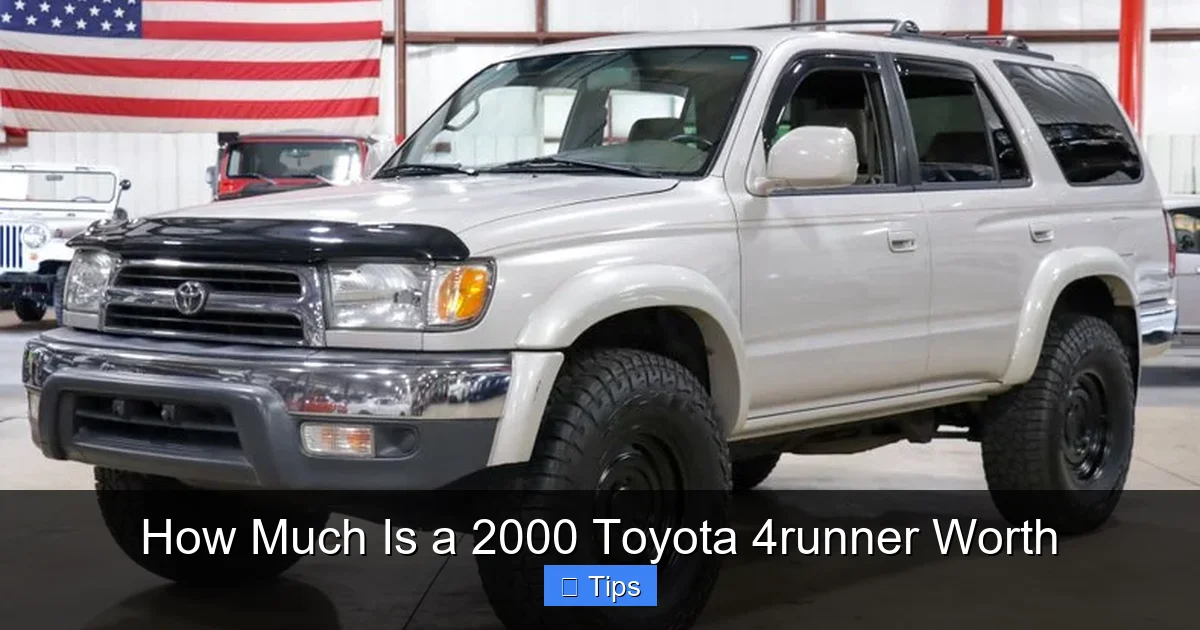
Mileage is one of the most straightforward indicators of a vehicle’s wear and tear—and it directly affects how much a 2000 Toyota 4Runner is worth.
The average driver puts about 12,000 to 15,000 miles per year on a vehicle. So, a 2000 model with 24 years on the road might reasonably have 288,000 to 360,000 miles. But many 4Runners haven’t reached that level, thanks to their durability.
Low Mileage = Higher Value
A 2000 4Runner with under 120,000 miles is considered low mileage for its age. These vehicles are rare and highly sought after. Why? Because they’ve likely been driven gently, stored properly, and maintained well.
For example, a 4Runner with 95,000 miles might sell for $7,500, while one with 160,000 miles—even in similar condition—might only get $5,500. That’s a $2,000 difference just for mileage.
Buyers are willing to pay a premium for low-mileage examples because they expect longer life and fewer repairs. A well-documented low-mileage 4Runner can feel almost like a new car in terms of reliability.
High Mileage Doesn’t Always Mean Low Value
Now, here’s the twist: high mileage doesn’t automatically mean low value—especially with Toyotas. The 3.4L V6 engine in the 2000 4Runner is known for lasting 300,000+ miles with proper care.
If a 4Runner has 220,000 miles but has had regular oil changes, a recent timing belt and water pump replacement, and no major mechanical issues, it can still be a great buy. In fact, some buyers prefer high-mileage, well-maintained Toyotas because they know the engine is “broken in” and proven.
However, high-mileage vehicles without service records or with known issues (like transmission problems or oil leaks) will see a steep drop in value. A 2000 4Runner with 230,000 miles and a slipping transmission might only be worth $3,000–$3,500, even if the exterior looks decent.
Drivetrain: 2WD vs. 4WD Impact on Price
Visual guide about How Much Is a 2000 Toyota 4runner Worth
Image source: motorbiscuit.com
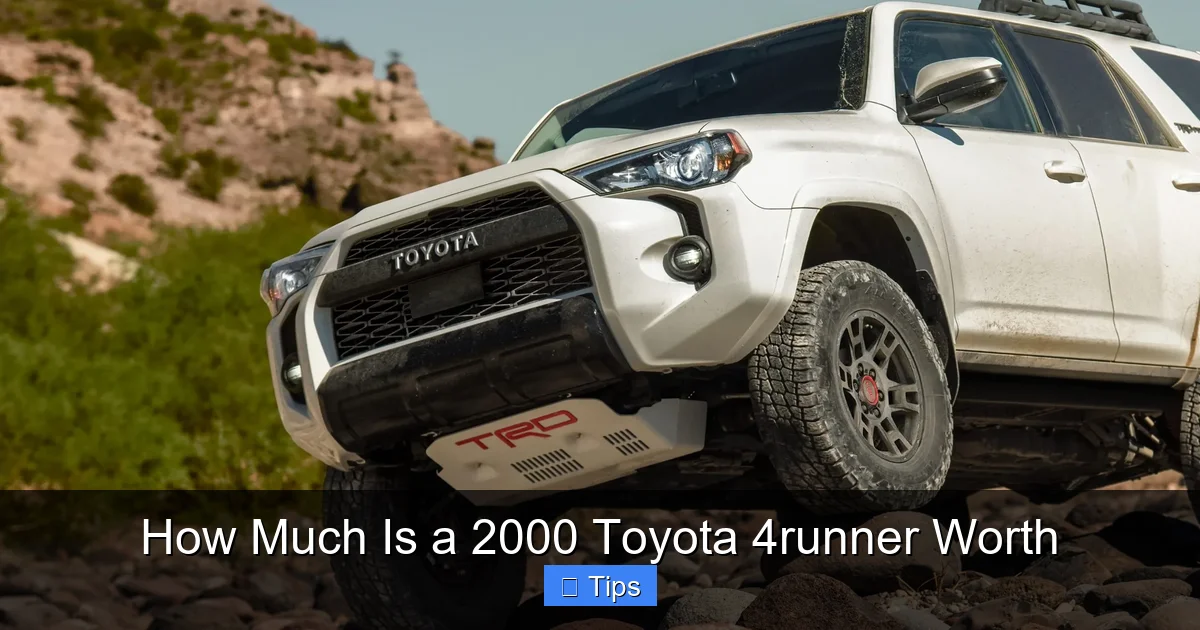
One of the biggest value differentiators for the 2000 Toyota 4Runner is whether it’s two-wheel drive (2WD) or four-wheel drive (4WD).
Why 4WD Commands a Premium
4WD models are more desirable for several reasons:
– Off-Road Capability: The 4Runner was built for adventure. 4WD allows it to tackle dirt roads, snow, mud, and light trails—something 2WD models can’t do safely.
– Resale Demand: Enthusiasts, overlanders, and rural buyers specifically seek 4WD models. This higher demand drives up prices.
– Durability Perception: Many believe 4WD models are built tougher, with heavier-duty suspension and drivetrain components.
As a result, 4WD 4Runners typically sell for $1,000 to $2,000 more than comparable 2WD models.
For example:
– A 2000 4Runner SR5 2WD with 140,000 miles might sell for $5,200.
– The same model in 4WD with similar mileage could fetch $6,500–$7,000.
That’s a significant difference—and one that makes 4WD a smart choice if you’re buying or selling.
When 2WD Might Be Better
That said, 2WD isn’t worthless. In urban areas with mild weather, 2WD can be more fuel-efficient and cheaper to maintain. It also appeals to buyers who don’t need off-road capability and want to save money.
But even then, the price gap remains. Unless you’re in a region where 4WD is rarely used (like Southern California or Arizona), 4WD will almost always be more valuable.
Condition, Maintenance, and History

Visual guide about How Much Is a 2000 Toyota 4runner Worth
Image source: motorbiscuit.com
Beyond mileage and drivetrain, the overall condition and maintenance history of a 2000 Toyota 4Runner heavily influence its worth.
The Power of a Clean Title and No Accidents
A clean title (not salvage or rebuilt) and no accident history can add thousands to a vehicle’s value. Buyers want peace of mind, and a clean Carfax or AutoCheck report provides that.
For instance, two identical 2000 4Runners—same mileage, same trim—can differ by $1,500 or more if one has a minor accident reported and the other doesn’t.
Service Records Are Gold
A vehicle with a full maintenance history is worth more. Why? Because it proves the owner cared for it. Key services to look for (or provide) include:
– Timing belt and water pump replacement (recommended every 90,000–100,000 miles)
– Oil changes every 3,000–5,000 miles
– Transmission fluid changes
– Brake and suspension inspections
A 4Runner with documented timing belt replacement at 95,000 miles is far more valuable than one with unknown maintenance—even if both have similar mileage.
Rust: The Silent Value Killer
Rust is the enemy of older SUVs, especially in northern states where road salt is used in winter. Surface rust on the body might be cosmetic, but rust on frame rails, rocker panels, or suspension mounts can be structural and dangerous.
A 4Runner with minor surface rust might lose $500–$1,000 in value. One with severe frame rust could be nearly unsellable—or worth only scrap value.
If you’re selling, addressing rust (even just sanding and sealing) can boost your sale price. If you’re buying, always inspect underneath.
Regional and Market Influences
Where you live—or where the vehicle is located—can significantly affect how much a 2000 Toyota 4Runner is worth.
Climate and Rust
In dry, warm climates like Arizona, Nevada, or Southern California, vehicles tend to be rust-free and well-preserved. These “desert cars” often sell for top dollar.
In contrast, 4Runners from snowy, salty regions like the Midwest, Northeast, or Canada may have rust issues, even if they’ve been garage-kept. Buyers know this, so prices are lower.
For example, a rust-free 2000 4Runner from Phoenix might sell for $7,800, while a similar model from Michigan with surface rust on the undercarriage might only get $5,500.
Local Demand
In rural areas or places with rough terrain, 4Runners are more popular. That increases demand and prices. In urban areas with good public transit, demand may be lower.
Also, the rise of the “classic SUV” trend has boosted interest in older 4Runners. Enthusiasts are restoring them, lifting them, and using them for overlanding. This niche market is willing to pay a premium for clean, original examples.
How to Determine the Exact Value of Your 2000 4Runner
Now that you know the factors, how do you figure out exactly how much your 2000 Toyota 4Runner is worth?
Use Online Valuation Tools
Start with trusted sources:
– Kelley Blue Book (KBB): Enter your VIN, mileage, condition, and options. KBB gives a private party and trade-in value.
– Edmunds: Similar to KBB, but often more accurate for older vehicles.
– NADA Guides: Popular with dealers; tends to be slightly higher than KBB.
These tools give you a baseline, but remember—they’re estimates. Real-world prices depend on local market conditions.
Check Recent Sales
Look at actual sold listings on:
– eBay Motors (filter by “sold” listings)
– Facebook Marketplace
– Craigslist (check completed sales)
– Bring a Trailer (for enthusiast-grade models)
This shows what people are actually paying—not just what sellers are asking.
Get a Pre-Purchase Inspection (If Buying)
If you’re buying, spend $100–$150 on a pre-purchase inspection (PPI) by a trusted mechanic. They’ll check for hidden issues like frame rust, engine wear, or transmission problems. This can save you thousands—and give you leverage in negotiations.
Negotiate Based on Condition
Use any flaws—high mileage, missing records, cosmetic damage—as negotiation tools. For example:
– “The tires are worn; I’d like $500 off.”
– “No service records; I’m offering $6,000 instead of $7,000.”
Be respectful but firm. Most private sellers expect some haggling.
Tips for Sellers: Maximizing Your 4Runner’s Value
If you’re selling your 2000 Toyota 4Runner, here’s how to get the best price:
Clean It Thoroughly
A clean car looks more valuable. Wash the exterior, vacuum the interior, clean the engine bay, and remove personal items. A $50 detail can add $500 to your sale price.
Fix Minor Issues
Replace burnt-out bulbs, fix cracked windshields, and address small mechanical issues. These are cheap fixes that show you care.
Gather Documentation
Collect all service records, owner’s manuals, and repair receipts. Present them in a folder. This builds trust and justifies a higher price.
Take Great Photos
Use good lighting, shoot from multiple angles, and include close-ups of the interior, engine, and undercarriage. Avoid shadows and clutter.
Price It Right
Don’t overprice. Check similar listings and price competitively. If you’re asking $8,000, make sure your 4Runner is truly worth it.
Advertise Smartly
Use platforms like Facebook Marketplace, Craigslist, and Toyota forums. Write a clear, honest description highlighting low mileage, 4WD, maintenance, and condition.
Tips for Buyers: Getting the Best Deal
If you’re in the market for a 2000 Toyota 4Runner, here’s how to avoid overpaying:
Set a Budget
Decide your max price—including taxes, registration, and potential repairs—and stick to it.
Prioritize 4WD and Low Mileage
Focus on 4WD models under 150,000 miles. They’ll last longer and hold value better.
Inspect for Rust
Check the frame, rocker panels, wheel wells, and under the doors. Use a flashlight and look for bubbling paint or flaking metal.
Test Drive Thoroughly
Listen for unusual noises, test the 4WD system, and check for transmission slippage or rough shifting.
Walk Away If Needed
Don’t feel pressured. There are plenty of 4Runners out there. If something feels off, walk away.
Conclusion
So, how much is a 2000 Toyota 4Runner worth? The answer isn’t one-size-fits-all. But with the right information, you can make a smart decision—whether you’re buying, selling, or just curious.
Most 2000 4Runners sell between $3,000 and $8,500, with the best examples reaching $9,000 or more. Key factors like mileage, condition, 4WD, trim level, and maintenance history all play a role. And don’t forget regional differences—rust-free models in dry climates command premiums.
This SUV isn’t just a vehicle; it’s a piece of automotive history. Built to last, loved by enthusiasts, and increasingly seen as a classic, the 2000 Toyota 4Runner continues to prove its worth—on and off the road.
Whether you’re restoring one, daily-driving one, or passing it on to the next owner, knowing its true value ensures you get—or give—a fair deal.
Frequently Asked Questions
What is the average price of a 2000 Toyota 4Runner?
The average price ranges from $3,000 to $8,500, depending on condition, mileage, and trim. Well-maintained 4WD models with low mileage often sell for $7,000 or more.
Is a 2000 Toyota 4Runner reliable?
Yes, the 2000 4Runner is known for its reliability, especially the 3.4L V6 engine. With proper maintenance, these vehicles often exceed 300,000 miles.
Does 4WD increase the value of a 2000 4Runner?
Absolutely. 4WD models typically sell for $1,000–$2,000 more than 2WD versions due to higher demand and off-road capability.
How much does mileage affect the value?
Mileage significantly impacts value. A 4Runner under 120,000 miles can be worth $2,000+ more than one with 200,000+ miles, all else being equal.
Can a 2000 4Runner be worth $10,000?
Yes, but only in exceptional cases—low mileage, pristine condition, full service history, and 4WD. These are rare and usually sold to collectors or enthusiasts.
Should I buy a high-mileage 2000 4Runner?
It depends. If it has a solid maintenance record and no major issues, a high-mileage 4Runner can still be a great buy. Just budget for potential repairs.

At CarLegit, we believe information should be clear, factual, and genuinely helpful. That’s why every guide, review, and update on our website is created with care, research, and a strong focus on user experience.