
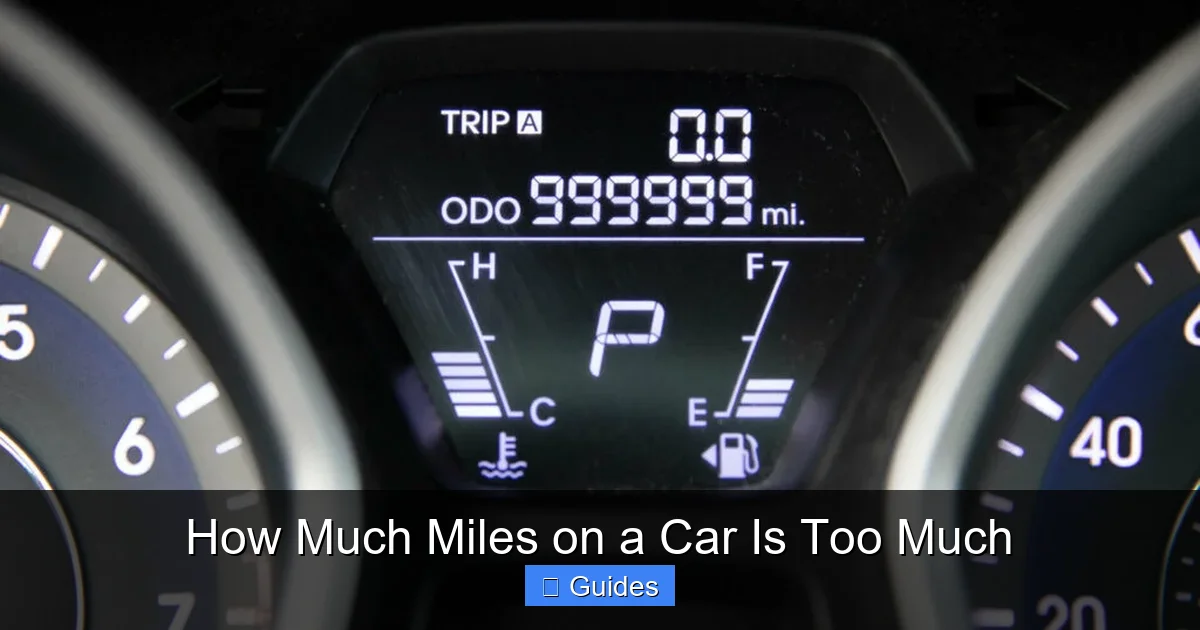
There’s no single “magic number” for when a car has too many miles—it depends on the vehicle’s make, model, maintenance history, and driving conditions. While 100,000 miles used to be a red flag, modern cars can easily surpass 200,000 miles with proper care. This guide breaks down how to assess high-mileage cars and make smart decisions.
In This Article
- 1 Key Takeaways
- 2 📑 Table of Contents
- 3 How Much Miles on a Car Is Too Much?
- 4 Understanding What High Mileage Really Means
- 5 Factors That Matter More Than Mileage
- 6 When Is High Mileage a Dealbreaker?
- 7 How to Evaluate a High-Mileage Car
- 8 Real-World Examples of High-Mileage Cars
- 9 Tips for Extending Your Car’s Life
- 10 Conclusion
- 11 Frequently Asked Questions
Key Takeaways
- Mileage isn’t everything: A well-maintained 150,000-mile car can be more reliable than a neglected 80,000-mile one.
- Modern engines last longer: Thanks to better engineering and materials, many cars now exceed 200,000 miles without major issues.
- Maintenance history matters most: Regular oil changes, timely repairs, and proper care significantly extend a car’s lifespan.
- Driving habits impact longevity: Highway miles are gentler on engines than stop-and-go city driving.
- Brand and model reliability vary: Some brands, like Toyota and Honda, are known for high-mileage durability.
- Watch for warning signs: Unusual noises, leaks, or frequent breakdowns may indicate it’s time to walk away.
- Get a pre-purchase inspection: Always have a trusted mechanic check a high-mileage car before buying.
📑 Table of Contents
How Much Miles on a Car Is Too Much?
Buying a car—whether new or used—is a big decision. One of the first things people look at is the odometer. But here’s the truth: **how much miles on a car is too much** isn’t as simple as hitting a specific number. A 120,000-mile Honda Civic might still have plenty of life left, while a 90,000-mile luxury sedan could be on its last legs.
In the past, hitting 100,000 miles was often seen as the end of the road. Mechanics would say, “Time to trade it in.” But today’s vehicles are built differently. Advances in engineering, materials, and manufacturing have made cars more durable than ever. Many now last well beyond 200,000 miles with the right care.
So instead of focusing only on the number on the odometer, smart buyers look at the bigger picture. That includes the car’s maintenance history, how it was driven, and what kind of vehicle it is. A high-mileage car isn’t automatically a bad buy—it just needs a closer look.
Understanding What High Mileage Really Means

Visual guide about How Much Miles on a Car Is Too Much
Image source: media.wheelscene.com
When people ask, “How much miles on a car is too much?” they’re usually trying to figure out if a vehicle is near the end of its life. But mileage alone doesn’t tell the whole story. Think of it like this: two people might both be 70 years old, but one runs marathons and the other hasn’t left the couch in a decade. Age isn’t the only factor—lifestyle matters.
The same goes for cars. A 150,000-mile Toyota Camry that’s had regular oil changes, timely brake service, and gentle highway driving could be in better shape than a 100,000-mile sports car that’s been driven hard and rarely serviced.
What Counts as High Mileage?
There’s no universal rule, but here’s a general guideline:
– **Under 75,000 miles:** Low mileage. Often found in newer used cars or vehicles driven infrequently.
– **75,000–125,000 miles:** Moderate mileage. Common for 5–8-year-old cars.
– **125,000–200,000 miles:** High mileage. Many cars in this range are still reliable if well cared for.
– **Over 200,000 miles:** Very high mileage. These vehicles are outliers but not unheard of—especially with brands known for longevity.
Keep in mind that the average American drives about 13,500 miles per year. So a 10-year-old car with 135,000 miles is right on track. But a 10-year-old car with only 60,000 miles might have sat unused for long periods—which can cause its own problems, like dry rot in tires or stale fuel.
The Myth of the “Magic Number”
You’ve probably heard people say, “Anything over 100,000 miles is too much.” That advice made sense 30 years ago, when engines weren’t built to last. But today, that number is outdated.
Modern engines are designed with tighter tolerances, better cooling systems, and more durable components. Many automakers now offer 100,000-mile powertrain warranties, which shows they expect their vehicles to last that long—and beyond.
For example, the 2020 Toyota Corolla is rated to last over 300,000 miles with proper maintenance. That’s not a typo. Real-world examples of high-mileage Corollas, Civics, and Accords are common, with owners reporting smooth performance even past 250,000 miles.
So instead of focusing on a single number, ask: How has this car been treated?
Factors That Matter More Than Mileage

Visual guide about How Much Miles on a Car Is Too Much
Image source: art.ngfiles.com
If mileage isn’t the only factor, what should you look at instead? Here are the key elements that determine whether a high-mileage car is still a good buy.
Maintenance History
This is the #1 predictor of a car’s longevity. A car with a complete service record—oil changes every 5,000–7,500 miles, timing belt replaced on schedule, transmission fluid flushed—is far more likely to last than one with no records.
Look for:
– Regular oil changes (synthetic oil is better for high-mileage engines)
– Brake and tire replacements
– Coolant and transmission fluid changes
– Timing belt or chain replacements (critical on many engines)
If the seller can’t provide records, that’s a red flag. Even if the car looks clean, poor maintenance can lead to hidden problems.
Driving Conditions and Habits
Not all miles are created equal. A car driven mostly on highways accumulates what’s called “gentle miles.” The engine runs at a steady RPM, the transmission shifts smoothly, and there’s less wear on brakes and suspension.
In contrast, city driving—with constant stopping, starting, and idling—puts more stress on the engine, transmission, and brakes. A 100,000-mile car used for daily city commutes may have more wear than a 120,000-mile highway cruiser.
Also consider:
– Was the car used for towing? That adds strain to the engine and transmission.
– Was it driven in extreme climates? Hot deserts or freezing winters can accelerate wear.
– Was it driven aggressively? Hard acceleration and braking reduce component life.
Vehicle Make and Model
Some cars are just built to last longer. Brands like Toyota, Honda, Subaru, and Lexus consistently rank high in reliability studies. Their engines and transmissions are known for durability.
For example:
– The Toyota Tacoma and 4Runner are legendary for hitting 300,000+ miles.
– Honda Accords and CR-Vs often reach 250,000 miles with routine care.
– Ford F-150s and Chevrolet Silverados can also last a long time, especially the V8 models.
On the other hand, some luxury brands or performance cars may have more complex systems that are expensive to repair at high mileage. A 150,000-mile BMW might need a new transmission or suspension components, which can cost thousands.
Signs of Wear and Tear
Even with good maintenance, high-mileage cars show signs of aging. Look for:
– **Oil leaks:** Small drips under the engine or transmission.
– **Rough idling:** The engine shakes or stalls at stoplights.
– **Transmission slipping:** Delayed or jerky shifting.
– **Suspension noise:** Clunks or squeaks over bumps.
– **Electrical issues:** Flickering lights, faulty sensors, or warning lights.
These don’t necessarily mean the car is doomed—but they do mean repairs may be needed soon.
When Is High Mileage a Dealbreaker?

Visual guide about How Much Miles on a Car Is Too Much
Image source: thevehiclelab.com
So, how much miles on a car is too much? It depends on your budget, needs, and risk tolerance. But here are some situations where high mileage should make you think twice.
You’re on a Tight Budget
High-mileage cars often need more repairs. If you can’t afford unexpected expenses—like a $2,000 transmission rebuild—you might want to avoid cars over 150,000 miles unless you’re confident in their condition.
That doesn’t mean you can’t buy one. But set aside a repair fund. Experts recommend budgeting $1,000–$2,000 per year for maintenance on a high-mileage vehicle.
The Car Has Major Known Issues
Some models have common problems that worsen with mileage. For example:
– The 2001–2006 Honda Civic has a known issue with the automatic transmission failing around 120,000–150,000 miles.
– The 2004–2008 Ford Freestyle has a faulty CVT transmission that often fails before 100,000 miles.
– The 2011–2014 Hyundai Sonata has engine problems that can lead to catastrophic failure.
Research the specific make, model, and year before buying. Websites like Consumer Reports, Edmunds, and NHTSA.gov offer reliability ratings and recall information.
No Maintenance Records
If the seller can’t prove the car was well cared for, walk away. A missing timing belt replacement or skipped oil changes can lead to engine damage that’s not obvious during a test drive.
You Need Long-Term Reliability
If you plan to keep the car for 10+ years or drive it 20,000+ miles per year, a high-mileage car might not be the best choice. Even reliable models have limits. At some point, components wear out.
But if you only need a car for a few years or short commutes, a 150,000-mile vehicle could be perfect.
How to Evaluate a High-Mileage Car
Thinking about buying a car with high mileage? Here’s how to make sure it’s worth it.
Get a Pre-Purchase Inspection (PPI)
This is non-negotiable. A PPI by a trusted mechanic can uncover hidden problems—like worn suspension, engine wear, or transmission issues—that aren’t obvious during a test drive.
The mechanic will check:
– Engine compression and leaks
– Transmission fluid condition
– Brake and suspension wear
– Frame and undercarriage for rust or damage
– Electrical systems and sensors
A good PPI costs $100–$200 but can save you thousands in repairs.
Check the Vehicle History Report
Use services like Carfax or AutoCheck to see:
– Accident history
– Number of previous owners
– Title status (clean, salvage, rebuilt)
– Odometer readings over time (to check for rollback)
A car with one careful owner and no accidents is better than one with five owners and a salvage title.
Test Drive It Thoroughly
Don’t just drive around the block. Take the car on highways, hills, and stop-and-go traffic. Listen for:
– Knocking or ticking from the engine
– Grinding or slipping in the transmission
– Squealing or grinding brakes
– Vibrations at high speeds
Also check:
– Does the AC blow cold?
– Do all windows and locks work?
– Are there warning lights on the dashboard?
Negotiate the Price
High-mileage cars should cost less. Use the mileage, age, and condition to negotiate. For example, a 2015 Honda Accord with 140,000 miles might be priced at $12,000, but you could offer $10,000 based on market data and needed repairs.
Real-World Examples of High-Mileage Cars
Still skeptical? Here are real examples of cars that have lasted far beyond average expectations.
Toyota Camry with 300,000 Miles
A 2002 Toyota Camry owned by a taxi driver in New York hit 300,000 miles with only routine maintenance. The owner changed the oil every 5,000 miles, replaced the timing belt at 90,000 and 180,000 miles, and never missed a service. The car still ran smoothly when it was retired.
Honda Civic with 280,000 Miles
A 1998 Honda Civic owned by a college professor in Oregon reached 280,000 miles. The owner followed the maintenance schedule religiously and only replaced the clutch and brakes. The engine never needed a rebuild.
Ford F-150 with 250,000 Miles
A 2004 Ford F-150 used for light towing and highway driving made it to 250,000 miles. The owner changed the oil every 3,000 miles (older recommendation), replaced the water pump at 150,000 miles, and upgraded to synthetic oil at 200,000 miles. The truck still had strong compression and no major leaks.
These examples show that with care, cars can last a very long time.
Tips for Extending Your Car’s Life
If you already own a high-mileage car—or plan to buy one—here’s how to keep it running longer.
Follow the Maintenance Schedule
Your owner’s manual has a maintenance schedule for a reason. Stick to it. Key items include:
– Oil and filter changes
– Air filter replacement
– Spark plug replacement
– Transmission fluid flush
– Coolant replacement
– Brake fluid change
Use High-Quality Fluids and Parts
Don’t skimp on oil. Use synthetic oil if recommended. Replace filters with OEM or high-quality aftermarket parts. Cheap parts can fail faster and damage other components.
Drive Gently
Avoid rapid acceleration and hard braking. Let the engine warm up in cold weather. Don’t overload the vehicle.
Address Problems Early
A small oil leak can become a major engine repair if ignored. A squeaky brake pad can damage the rotor. Fix issues as soon as you notice them.
Store the Car Properly
If you don’t drive often, start the car weekly and take it for a short drive. This keeps fluids circulating and prevents seals from drying out.
Conclusion
So, how much miles on a car is too much? The answer isn’t a number—it’s a combination of factors. A well-maintained 150,000-mile car can be a better buy than a neglected 80,000-mile one. Modern vehicles are built to last, and many can exceed 200,000 miles with proper care.
Instead of fearing high mileage, learn to evaluate it wisely. Look at the maintenance history, driving conditions, make and model, and overall condition. Get a pre-purchase inspection, check the vehicle history, and test drive thoroughly.
High-mileage cars aren’t for everyone—but for the right buyer, they can offer great value and reliable transportation for years to come. With the right approach, you can drive confidently, even with six figures on the odometer.
Frequently Asked Questions
Is 150,000 miles too much for a car?
Not necessarily. Many cars can run well beyond 150,000 miles if they’ve been properly maintained. It depends on the vehicle’s history, make, and how it was driven.
Can a car last 300,000 miles?
Yes, especially models from reliable brands like Toyota, Honda, and Subaru. With regular maintenance, some cars have been known to reach 300,000 miles or more.
Should I avoid cars with over 100,000 miles?
Not always. A well-cared-for 120,000-mile car can be a smart buy. Focus on maintenance records and condition rather than mileage alone.
What’s the average lifespan of a modern car?
Most modern cars last between 150,000 and 200,000 miles. Some exceed 250,000 miles with proper care and timely repairs.
How can I tell if a high-mileage car is reliable?
Check the maintenance history, get a pre-purchase inspection, review the vehicle history report, and test drive it thoroughly. Look for signs of wear or neglect.
Are high-mileage cars more expensive to maintain?
They can be, as older components wear out. Budget for potential repairs and stick to a regular maintenance schedule to avoid costly breakdowns.

At CarLegit, we believe information should be clear, factual, and genuinely helpful. That’s why every guide, review, and update on our website is created with care, research, and a strong focus on user experience.