
The Toyota Tacoma is a rugged, reliable midsize pickup known for its off-road prowess and everyday versatility. But how much weight can it actually carry? Understanding payload capacity, towing limits, and real-world usage is key to getting the most out of your Tacoma without risking damage or safety issues.
If you’re the proud owner of a Toyota Tacoma—or thinking about becoming one—you probably already know it’s one of the most dependable trucks on the road. Whether you’re hauling camping gear to the mountains, towing a small trailer for a weekend project, or just loading up the bed with mulch for your garden, the Tacoma is built to handle real work. But here’s the thing: even the toughest trucks have limits. And knowing exactly how much weight your Tacoma can carry isn’t just about bragging rights—it’s about safety, performance, and longevity.
So, how much weight can a Toyota Tacoma carry? The short answer is: it depends. Payload capacity varies significantly based on the model year, engine, cab configuration, bed length, and whether you’re driving a 4×4 or 4×2. But don’t worry—we’re going to break it all down in simple terms so you can make smart decisions every time you load up your truck. Whether you’re a weekend warrior, a DIY enthusiast, or a full-time contractor, understanding your Tacoma’s weight limits will help you get the job done right.
In this guide, we’ll walk you through everything you need to know about payload, towing, and safe cargo management. We’ll explain the difference between payload and towing capacity, show you how to calculate your truck’s limits, and give you practical tips for maximizing your Tacoma’s utility. By the end, you’ll know exactly how much your truck can handle—and how to do it safely.
In This Article
- 1 Key Takeaways
- 2 📑 Table of Contents
- 3 Understanding Payload vs. Towing Capacity
- 4 How to Calculate Your Tacoma’s Payload Capacity
- 5 Toyota Tacoma Payload Capacity by Model and Trim
- 6 Towing Capacity: How Much Can a Tacoma Pull?
- 7 Tips for Safely Carrying Weight in Your Tacoma
- 8 Common Mistakes to Avoid
- 9 Conclusion
- 10 Frequently Asked Questions
- 10.1 What is the average payload capacity of a Toyota Tacoma?
- 10.2 Can a Toyota Tacoma tow a travel trailer?
- 10.3 How do I find my Tacoma’s GVWR?
- 10.4 Does adding accessories reduce payload capacity?
- 10.5 Can I increase my Tacoma’s payload capacity?
- 10.6 What happens if I exceed my Tacoma’s payload limit?
Key Takeaways
- Payload capacity varies by model and configuration: Most Tacomas can carry between 1,100 and 1,600 pounds, depending on trim, cab style, and drivetrain.
- Towing capacity ranges from 3,500 to 6,800 pounds: Higher trims with the V6 engine and towing package offer the best towing performance.
- GVWR and curb weight matter: Payload is calculated by subtracting curb weight from Gross Vehicle Weight Rating (GVWR).
- Proper weight distribution is crucial: Uneven loading can affect handling, braking, and tire wear.
- Use the right equipment: Hitches, bed racks, and tonneau covers can help manage cargo safely.
- Check your owner’s manual: Always refer to your specific model year and trim for accurate numbers.
- Don’t exceed limits: Overloading can void warranties, increase wear, and create dangerous driving conditions.
📑 Table of Contents
Understanding Payload vs. Towing Capacity
Before we dive into numbers, let’s clear up a common confusion: payload and towing capacity are not the same thing. They’re both important, but they measure different things.
Payload refers to the total weight your Tacoma can carry inside the vehicle and in the bed. This includes passengers, gear, tools, luggage, and anything else you’re hauling. It’s the weight that’s added to the truck itself. Towing capacity, on the other hand, is how much weight your truck can pull behind it—like a trailer, camper, or boat.
Think of it this way: payload is what’s *in* your truck, and towing is what’s *behind* it. Both affect your truck’s performance, but they’re calculated differently and have separate limits.
For example, a Tacoma might have a payload capacity of 1,400 pounds and a towing capacity of 6,500 pounds. That means you can carry up to 1,400 pounds of people and cargo in the cab and bed, and still pull a 6,500-pound trailer—as long as the combined weight doesn’t exceed the Gross Combined Weight Rating (GCWR). But if you load 1,500 pounds into the bed, you’ve already exceeded your payload limit, even if the trailer is light.
Understanding this difference is crucial. Many people assume that a high towing capacity means they can also carry a lot in the bed. But in reality, payload is often the limiting factor—especially if you’re carrying heavy tools, equipment, or multiple passengers.
Why Payload Matters More Than You Think
Payload might not get as much attention as towing, but it’s just as important—if not more so—for everyday use. Most of your hauling will involve payload: moving furniture, transporting firewood, carrying construction materials, or loading up for a camping trip. And if you exceed your payload limit, you’re putting your truck—and yourself—at risk.
Overloading the bed can cause suspension damage, brake failure, tire blowouts, and poor handling. It can also make your truck more difficult to control, especially in emergency situations. Plus, it can void your warranty and lead to costly repairs down the road.
So, while it’s tempting to pile everything in and hit the road, it’s always better to know your limits. And the good news? Most Tacomas are built to handle a respectable amount of weight—just not unlimited amounts.
How to Calculate Your Tacoma’s Payload Capacity
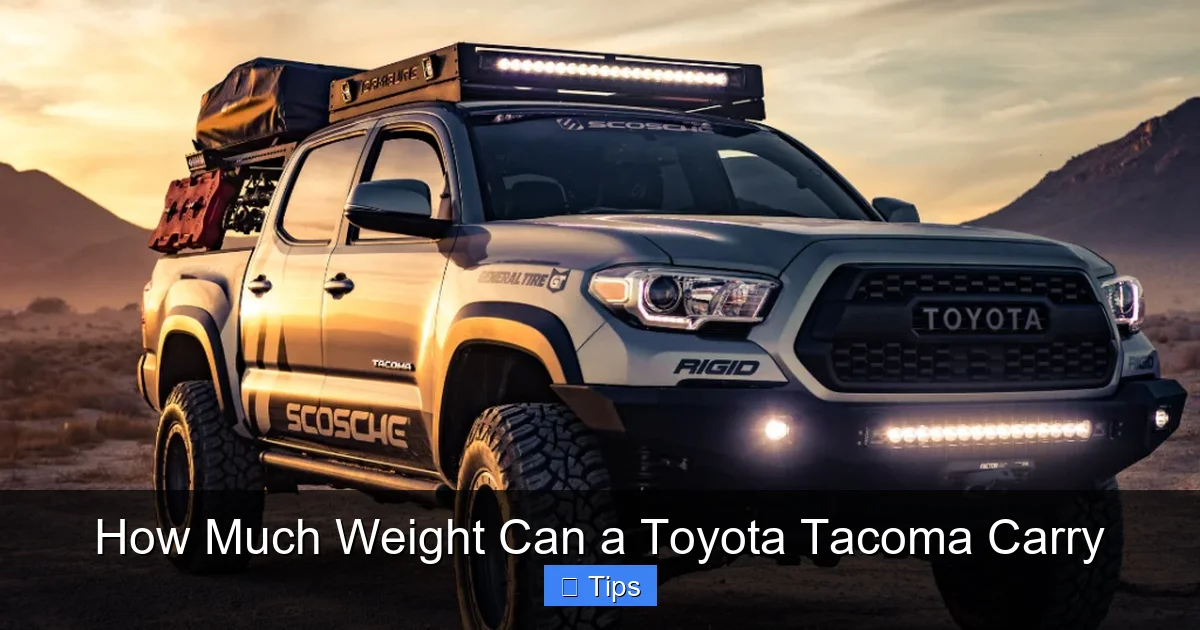
Visual guide about How Much Weight Can a Toyota Tacoma Carry
Image source: durangovalueautos.com
Now that you know what payload is, let’s talk about how to find out exactly how much your Tacoma can carry. The best way is to check your truck’s specific payload capacity, which is determined by a simple formula:
Payload Capacity = Gross Vehicle Weight Rating (GVWR) – Curb Weight
Let’s break that down.
GVWR is the maximum total weight your truck is designed to handle, including the vehicle itself, passengers, cargo, fuel, and accessories. You can find this number on the driver’s side door jamb sticker—it’s usually labeled “Tire and Loading Information.”
Curb weight is how much your truck weighs when it’s empty, with a full tank of gas and all standard equipment, but no passengers or cargo. This number is typically listed in your owner’s manual or on Toyota’s official website.
Once you have both numbers, subtract the curb weight from the GVWR, and you’ll get your payload capacity.
For example, let’s say your Tacoma has a GVWR of 5,600 pounds and a curb weight of 4,200 pounds. That gives you a payload capacity of 1,400 pounds. That means you can safely carry up to 1,400 pounds of people, gear, and cargo combined.
Where to Find Your GVWR and Curb Weight
If you’re not sure where to look, here’s a quick guide:
– **GVWR**: Check the sticker on the driver’s side door jamb. It’s usually near the latch or hinge. Look for a label that says “Tire and Loading Information” or “Vehicle Certification Label.” The GVWR will be clearly listed.
– **Curb Weight**: This is often found in your owner’s manual under “Specifications” or “Vehicle Dimensions.” You can also find it on Toyota’s official website by searching your model year and trim.
If you can’t find the curb weight, you can weigh your truck at a public scale (like a truck stop or recycling center) when it’s empty and fueled up. That will give you an accurate curb weight.
Real-World Example: Calculating Payload
Let’s say you have a 2023 Toyota Tacoma TRD Off-Road with a Double Cab and 4×4 drivetrain. According to Toyota’s specs, this model has a GVWR of 5,600 pounds and a curb weight of 4,250 pounds.
Using the formula:
5,600 (GVWR) – 4,250 (curb weight) = 1,350 pounds of payload capacity.
Now, let’s say you’re planning a weekend trip. You’ve got two passengers (150 lbs each), a full tank of gas (about 40 lbs), and you’re bringing camping gear, coolers, and a portable grill. That’s roughly 600 pounds of cargo.
Total payload: 150 + 150 + 40 + 600 = 940 pounds.
That’s well under your 1,350-pound limit, so you’re good to go. But if you add a 500-pound ATV to the bed, you’d be at 1,440 pounds—over your limit. That’s when you need to rethink your load.
Toyota Tacoma Payload Capacity by Model and Trim

Visual guide about How Much Weight Can a Toyota Tacoma Carry
Image source: durangovalueautos.com
Payload capacity isn’t the same across all Tacoma models. It varies depending on the engine, cab style, bed length, and drivetrain. Let’s look at some typical ranges for recent model years (2020–2024).
Access Cab vs. Double Cab
The cab style makes a big difference. Access Cab models (with smaller rear doors) tend to have higher payload capacities because they’re lighter. Double Cab models (with full rear doors and seating) are heavier, so they usually have slightly lower payload.
For example:
– A 2023 Tacoma Access Cab 4×2 with the 2.7L 4-cylinder engine might have a payload of around 1,600 pounds.
– A 2023 Tacoma Double Cab 4×4 with the 3.5L V6 engine might have a payload of around 1,200 pounds.
That’s a 400-pound difference—just from the cab style and drivetrain.
Engine and Drivetrain Impact
The engine and drivetrain also affect payload. The 2.7L 4-cylinder engine is lighter than the 3.5L V6, so trucks with the smaller engine often have higher payload capacities. Similarly, 4×2 models are lighter than 4x4s, so they can carry more.
For instance:
– A 2022 Tacoma SR Access Cab 4×2 with the 2.7L engine: ~1,550 lbs payload
– A 2022 Tacoma TRD Pro Double Cab 4×4 with the 3.5L V6: ~1,100 lbs payload
The TRD Pro is packed with off-road features like upgraded suspension and skid plates, which add weight and reduce payload.
Bed Length and Options
Short beds (5-foot) are lighter than long beds (6-foot), so they can sometimes carry a bit more. But the difference is usually small—around 50 to 100 pounds.
Accessories like bed liners, tonneau covers, and roof racks also add weight. While they’re useful, they reduce your available payload. So if you’ve loaded up your Tacoma with aftermarket gear, remember to subtract that weight from your total capacity.
Model Year Variations
Payload capacities can change slightly from year to year due to updates in design, materials, or safety features. For example, the 2024 Tacoma has a new platform and is slightly heavier than the 2023 model, which may reduce payload in some trims.
Always check the specs for your exact model year and trim. Toyota’s website or your owner’s manual is the best source.
Towing Capacity: How Much Can a Tacoma Pull?
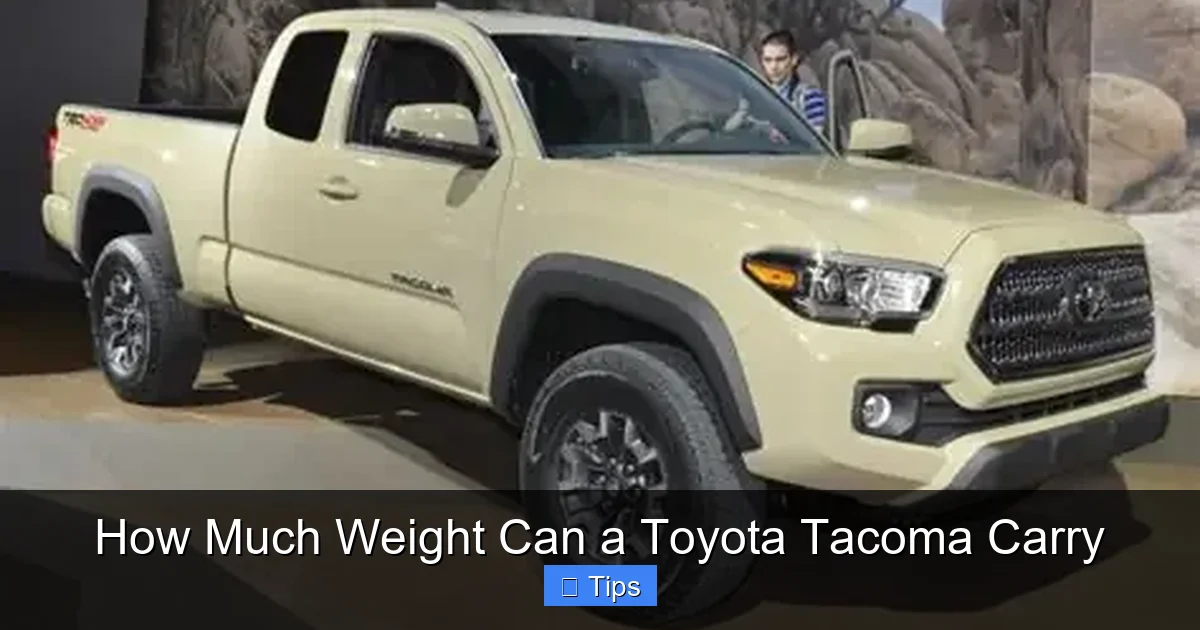
Visual guide about How Much Weight Can a Toyota Tacoma Carry
Image source: autozonic.com
While payload is about what’s inside your truck, towing capacity is about what you can pull behind it. And the Tacoma is no slouch when it comes to towing.
Most Tacomas can tow between 3,500 and 6,800 pounds, depending on the configuration. The key factors are engine, drivetrain, and whether you have the towing package.
V6 Engine and Towing Package
The 3.5L V6 engine is the towing champion of the Tacoma lineup. When paired with the 4×4 drivetrain and the optional towing package, it can tow up to 6,800 pounds—the highest in the midsize truck segment.
The towing package includes:
– Class IV hitch receiver
– 7-pin wiring harness
– Transmission cooler
– Heavy-duty battery and alternator
– Upgraded cooling system
Without the towing package, even a V6 Tacoma may be limited to around 3,500 pounds.
4-Cylinder Engine Limitations
The 2.7L 4-cylinder engine is fuel-efficient and reliable, but it’s not built for heavy towing. Most 4-cylinder Tacomas have a towing capacity of 3,500 pounds—enough for a small trailer, pop-up camper, or jet ski, but not a large boat or travel trailer.
If you plan to tow regularly, the V6 is the better choice.
Real-World Towing Examples
Let’s say you want to tow a 5,000-pound travel trailer. You’ll need a Tacoma with the V6 engine, 4×4 drivetrain, and towing package. A Double Cab 4×4 with those specs can handle it easily.
But if you try to tow that same trailer with a 4-cylinder Access Cab, you’re over your limit—and risking serious damage.
Always check the trailer’s gross weight (including cargo, water, and propane) and make sure it’s within your Tacoma’s towing capacity.
Tips for Safely Carrying Weight in Your Tacoma
Knowing your limits is one thing—using your truck safely is another. Here are some practical tips to help you carry weight without compromising safety or performance.
Distribute Weight Evenly
Never pile all your cargo in one corner of the bed. Uneven weight can cause sway, reduce traction, and make your truck harder to control. Aim to keep heavy items centered and low in the bed, close to the cab.
Use tie-downs, ratchet straps, or cargo nets to secure everything. Loose items can shift during driving, creating hazards.
Don’t Overload the Bed
Even if your payload limit is 1,400 pounds, don’t assume you can fill the bed to the brim. The shape of the bed and the weight of the cargo matter. For example, 1,400 pounds of feathers will take up a lot more space than 1,400 pounds of steel.
Also, avoid stacking cargo too high. Tall loads can raise your center of gravity and increase the risk of rollover, especially on curves or during sudden maneuvers.
Use the Right Equipment
Invest in quality gear to make hauling easier and safer:
– **Tonneau covers**: Protect cargo from weather and theft.
– **Bed extenders**: Help secure long items like ladders or kayaks.
– **Roof racks**: Useful for lightweight items like bikes or cargo boxes, but remember they add weight and wind resistance.
– **Hitches and trailer brakes**: Essential for safe towing, especially with heavier loads.
Check Tire Pressure and Suspension
Heavier loads require proper tire pressure. Underinflated tires can overheat and fail. Check your owner’s manual for recommended pressure when carrying a full payload.
If you frequently carry heavy loads, consider upgrading to heavy-duty shocks or air suspension helpers. These can improve ride quality and prevent sagging.
Mind the Passengers
Don’t forget that passengers count toward your payload. A full cab with four adults can easily add 600–800 pounds. If you’re already carrying gear, that can push you close to or over your limit.
Plan ahead: if you’re going on a trip with friends and lots of luggage, consider what you really need to bring.
Common Mistakes to Avoid
Even experienced truck owners make mistakes when it comes to weight. Here are some common pitfalls to watch out for.
Assuming All Tacomas Are the Same
Just because your friend’s Tacoma can carry 1,500 pounds doesn’t mean yours can. Always check your specific model’s specs.
Ignoring the Door Jamb Sticker
That little label on the door jamb has vital information. Don’t ignore it. It tells you the GVWR, tire size, and recommended tire pressure—all essential for safe loading.
Overestimating Towing Capacity
Towing capacity isn’t just about the truck—it’s about the setup. Without the right hitch, wiring, and cooling, you can’t safely tow the maximum weight.
Forgetting About Fuel and Fluids
A full tank of gas weighs about 40 pounds. Add in oil, coolant, and windshield washer fluid, and you’re looking at another 20–30 pounds. It adds up.
Driving Aggressively with a Load
Heavy loads change how your truck handles. Braking distances increase, and acceleration slows. Drive smoothly, leave extra space, and avoid sudden maneuvers.
Conclusion
The Toyota Tacoma is a capable, versatile truck that can handle a surprising amount of weight—whether you’re hauling gear in the bed or towing a trailer down the highway. But like any vehicle, it has limits. Knowing how much weight your Tacoma can carry isn’t just about numbers—it’s about safety, performance, and getting the most out of your investment.
Most Tacomas can carry between 1,100 and 1,600 pounds of payload, depending on the model. Towing capacity ranges from 3,500 to 6,800 pounds, with the V6 engine and towing package offering the best performance. Always calculate your payload using the GVWR and curb weight, and never exceed your truck’s limits.
Use the right equipment, distribute weight evenly, and drive responsibly. And when in doubt, check your owner’s manual or consult a Toyota dealer.
With the right knowledge and preparation, your Tacoma can be the reliable workhorse you need—whether you’re tackling a home project, heading out on an adventure, or just getting through the daily grind. So load up wisely, drive safely, and enjoy the ride.
Frequently Asked Questions
What is the average payload capacity of a Toyota Tacoma?
The average payload capacity of a Toyota Tacoma ranges from 1,100 to 1,600 pounds, depending on the model year, engine, cab style, and drivetrain. Access Cab 4×2 models typically carry more than Double Cab 4×4 versions.
Can a Toyota Tacoma tow a travel trailer?
Yes, a Toyota Tacoma can tow a travel trailer, but only if it’s equipped with the 3.5L V6 engine, 4×4 drivetrain, and towing package. In this configuration, it can tow up to 6,800 pounds—enough for many mid-sized travel trailers.
How do I find my Tacoma’s GVWR?
You can find your Tacoma’s GVWR on the driver’s side door jamb sticker, usually labeled “Tire and Loading Information” or “Vehicle Certification Label.” It lists the maximum total weight your truck is designed to handle.
Does adding accessories reduce payload capacity?
Yes, adding accessories like roof racks, bed liners, or tonneau covers increases the truck’s curb weight, which reduces available payload. Always account for the weight of aftermarket parts when calculating how much you can carry.
Can I increase my Tacoma’s payload capacity?
No, you cannot legally or safely increase your Tacoma’s payload capacity. It’s determined by the manufacturer based on structural and mechanical limits. Overloading can cause damage, void your warranty, and create dangerous driving conditions.
What happens if I exceed my Tacoma’s payload limit?
Exceeding your payload limit can lead to suspension damage, brake failure, tire blowouts, and poor handling. It also increases wear on components and can make your truck unsafe to drive. Always stay within the recommended limits.

At CarLegit, we believe information should be clear, factual, and genuinely helpful. That’s why every guide, review, and update on our website is created with care, research, and a strong focus on user experience.