

Wondering how much weight you can legally pull without a Commercial Driver’s License (CDL)? In most states, you can tow up to 10,000 pounds gross vehicle weight (GVWR) with a standard driver’s license. Understanding these limits helps you avoid fines, stay safe, and tow confidently—whether you’re hauling a trailer, boat, or equipment.
In This Article
- 1 Key Takeaways
- 2 📑 Table of Contents
- 3 How Much Weight Can You Pull Without a CDL?
- 4 Understanding the 10,000-Pound Rule
- 5 Vehicle Towing Capacity vs. Legal Limits
- 6 Types of Trailers and Their Weight Limits
- 7 Safety and Equipment Requirements
- 8 Insurance, Registration, and Legal Considerations
- 9 Real-World Examples and Scenarios
- 10 Conclusion
- 11 Frequently Asked Questions
- 11.1 Can I tow a 12,000-pound trailer without a CDL?
- 11.2 Do I need a CDL to tow a fifth-wheel camper?
- 11.3 What happens if I exceed the 10,000-pound limit without a CDL?
- 11.4 Can I tow a trailer over 10,000 pounds with a regular license?
- 11.5 Do I need special insurance for towing heavy trailers?
- 11.6 How do I know my trailer’s GVWR?
Key Takeaways
- 10,000 lbs is the general CDL threshold: In most U.S. states, you can tow up to 10,000 pounds GVWR without needing a CDL.
- Your vehicle matters: The towing capacity of your truck or SUV must exceed the trailer’s weight—check your owner’s manual.
- State laws vary: Some states have different rules for recreational vs. commercial towing—always verify local regulations.
- Trailer type affects legality: Fifth-wheel, gooseneck, and bumper-pull trailers all have different weight distributions and requirements.
- Safety equipment is essential: Even under the CDL limit, use proper hitches, brakes, and safety chains to prevent accidents.
- Insurance and registration matter: Heavier trailers may require special registration or insurance coverage, even without a CDL.
- Know the difference between GVWR and actual weight: GVWR includes cargo, fuel, and passengers—don’t exceed it, even if your vehicle can handle more.
📑 Table of Contents
How Much Weight Can You Pull Without a CDL?
So, you’ve got a big project coming up—maybe you’re moving a shed, hauling a camper across the country, or towing a boat to the lake. You’ve got the vehicle, the trailer, and the motivation. But there’s one big question hanging over everything: How much weight can I actually pull without needing a Commercial Driver’s License (CDL)?
It’s a common question, and for good reason. The rules around towing can feel confusing, especially when you’re trying to figure out what’s legal, what’s safe, and what might get you a hefty fine. The good news? In most cases, you don’t need a CDL to tow heavy loads—as long as you stay within certain limits. The magic number in most states is 10,000 pounds. That’s the general threshold where a CDL becomes required for commercial drivers.
But it’s not just about the number on the scale. Your vehicle’s capabilities, the type of trailer, state-specific laws, and even how you load your cargo all play a role. This guide will walk you through everything you need to know about towing without a CDL—so you can hit the road with confidence, stay legal, and keep everyone safe.
Understanding the 10,000-Pound Rule

Visual guide about How Much Weight Can You Pull Without a Cdl
Image source: thetruckhow.com
The 10,000-pound rule is the cornerstone of non-CDL towing in the United States. It’s based on the Federal Motor Carrier Safety Administration (FMCSA) guidelines, which state that a CDL is required for any commercial vehicle with a gross vehicle weight rating (GVWR) of 26,001 pounds or more. But for non-commercial drivers, the line is drawn at 10,000 pounds.
Here’s how it breaks down:
– If your vehicle’s GVWR is under 10,000 pounds, and the trailer’s GVWR is also under 10,000 pounds, you can typically tow it with a standard driver’s license.
– If the combined GVWR of your vehicle and trailer exceeds 10,000 pounds, you may need a CDL—especially if you’re using the vehicle for commercial purposes.
But wait—there’s a catch. The 10,000-pound rule applies primarily to the trailer’s GVWR, not the actual weight. GVWR is the maximum weight the trailer is designed to carry, including its own weight plus cargo, fuel, water, and passengers. So even if your trailer only weighs 8,000 pounds when empty, if its GVWR is 10,500 pounds, you’re over the limit and may need a CDL in some states.
Why 10,000 Pounds?
The 10,000-pound threshold isn’t arbitrary. It’s designed to distinguish between personal/recreational towing and commercial operations. Vehicles under this limit are generally considered manageable for everyday drivers with proper training and equipment. Once you cross that line, the risk increases—larger trailers require better braking systems, more advanced handling skills, and often specialized training.
For example, a Ford F-150 with a GVWR of 7,000 pounds can safely tow a 9,000-pound travel trailer with the right setup. But if that trailer’s GVWR is 11,000 pounds, you’re in CDL territory in many states—even if you’re just using it for weekend camping trips.
State-by-State Variations
While the 10,000-pound rule is widely adopted, it’s not universal. Some states have slightly different thresholds or additional requirements. For instance:
– California: You can tow up to 10,000 pounds GVWR without a CDL, but if the trailer exceeds 10,000 pounds, you may need a non-commercial Class B license.
– Texas: The limit is also 10,000 pounds, but trailers over 4,500 pounds require brake controllers and safety chains.
– New York: Trailers over 10,000 pounds GVWR require a CDL if used commercially, but recreational users may be exempt under certain conditions.
Always check your state’s Department of Motor Vehicles (DMV) or transportation website for the most accurate and up-to-date information.
Vehicle Towing Capacity vs. Legal Limits
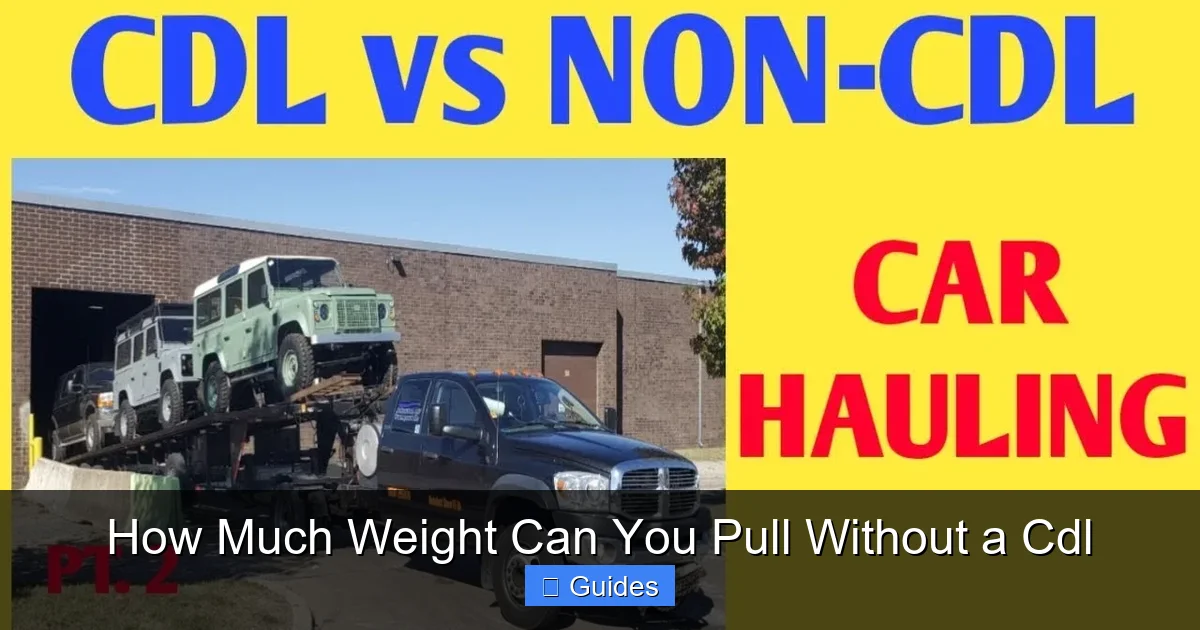
Visual guide about How Much Weight Can You Pull Without a Cdl
Image source: thetruckhow.com
Here’s where things get tricky: Your vehicle’s towing capacity is not the same as the legal weight limit. Just because your truck can pull 12,000 pounds doesn’t mean you can legally do it without a CDL.
Let’s break it down with an example.
Say you drive a Ram 2500 with a towing capacity of 19,000 pounds. That’s impressive—but if you hook up a trailer with a GVWR of 11,000 pounds, you’re over the 10,000-pound threshold. In most states, that means you need a CDL if you’re using the setup for commercial purposes.
But if you’re towing that same trailer for personal use—like hauling a camper for a family vacation—you might be exempt. Many states allow non-commercial drivers to tow over 10,000 pounds without a CDL, as long as the vehicle and trailer are not used for business.
How to Find Your Vehicle’s Towing Capacity
Your vehicle’s towing capacity is listed in the owner’s manual or on the manufacturer’s website. It’s usually based on:
– Engine size and type
– Transmission (manual vs. automatic)
– Axle ratio
– Suspension setup
– Whether you have a towing package
For example, a Toyota Tacoma might have a towing capacity of 3,500 to 6,800 pounds, depending on the model and configuration. A Chevrolet Silverado 1500 can tow between 7,000 and 11,500 pounds.
But remember: towing capacity is the maximum your vehicle can safely pull—not the legal limit. You must stay under both the vehicle’s capacity and the legal GVWR threshold to avoid trouble.
The Role of GVWR and GCWR
Two key terms you’ll hear often are:
– GVWR (Gross Vehicle Weight Rating): The maximum weight your vehicle or trailer can safely carry, including its own weight plus cargo, passengers, and fuel.
– GCWR (Gross Combination Weight Rating): The maximum allowable weight of your fully loaded vehicle plus the fully loaded trailer.
For example, if your truck has a GVWR of 8,000 pounds and your trailer has a GVWR of 9,000 pounds, the combined GCWR might be 17,000 pounds. But if your truck’s towing capacity is only 10,000 pounds, you can’t legally or safely tow a 9,000-pound trailer if it pushes the total over that limit.
Always ensure your loaded vehicle and trailer stay under both the GVWR and GCWR limits.
Types of Trailers and Their Weight Limits
Visual guide about How Much Weight Can You Pull Without a Cdl
Image source: thetruckhow.com
Not all trailers are created equal—and the type of trailer you’re pulling affects how much weight you can legally tow without a CDL.
Bumper-Pull Trailers
These are the most common type of trailer, connected to your vehicle via a hitch mounted on the bumper or frame. They’re used for everything from small utility trailers to large travel trailers.
– Typical GVWR: 3,000 to 10,000 pounds
– CDL required? Usually no, if under 10,000 pounds GVWR
– Best for: Boats, small campers, landscaping equipment
Example: A 7,000-pound GVWR travel trailer can be towed by a mid-size SUV like a Ford Explorer or Toyota Highlander, as long as the vehicle’s towing capacity supports it.
Fifth-Wheel Trailers
These large trailers connect to a special hitch in the bed of a pickup truck. They’re popular for RVs and horse trailers.
– Typical GVWR: 10,000 to 20,000 pounds
– CDL required? Often yes, if GVWR exceeds 10,000 pounds and used commercially
– Best for: Full-time RVers, livestock transport
Even if you’re using a fifth-wheel for personal travel, some states require a special endorsement or license if the trailer exceeds 10,000 pounds GVWR.
Gooseneck Trailers
Similar to fifth-wheel trailers, gooseneck trailers also attach to the truck bed but use a different hitch system. They’re common for heavy-duty hauling.
– Typical GVWR: 10,000 to 30,000 pounds
– CDL required? Usually yes for commercial use over 10,000 pounds
– Best for: Construction equipment, large livestock trailers
If you’re using a gooseneck trailer for personal use (like hauling a horse trailer on weekends), you may not need a CDL—but check your state’s rules.
Utility and Cargo Trailers
These are smaller, open-bed trailers used for hauling tools, furniture, or debris.
– Typical GVWR: 1,000 to 10,000 pounds
– CDL required? No, if under 10,000 pounds
– Best for: DIY projects, moving, landscaping
A 5,000-pound GVWR utility trailer can be towed by most pickup trucks without any special licensing.
Safety and Equipment Requirements
Just because you can tow a certain weight doesn’t mean you should—without the right equipment and preparation. Safety should always come first.
Hitch and Towing Setup
Using the correct hitch is critical. A mismatched or improperly installed hitch can lead to trailer sway, loss of control, or even detachment.
– Weight-carrying hitches: For trailers under 10,000 pounds with no weight distribution.
– Weight-distributing hitches: For heavier loads, they help balance the weight between the vehicle and trailer.
– Fifth-wheel and gooseneck hitches: Required for those specific trailer types.
Always ensure your hitch is rated for the trailer’s GVWR.
Brake Controllers
Trailers over 3,000 pounds GVWR typically require electric brakes. A brake controller in your vehicle allows you to activate the trailer’s brakes independently or in sync with your truck’s brakes.
– Proportional controllers: Adjust brake force based on how hard you press the pedal.
– Time-delayed controllers: Apply a set amount of brake force after a delay.
Without a brake controller, stopping a heavy trailer can be dangerous—especially on hills or in emergencies.
Safety Chains and Breakaway Systems
Safety chains are a must. They should be crossed under the trailer tongue to create a cradle that catches the trailer if it detaches.
Breakaway systems are required for trailers with brakes. They activate the trailer’s brakes if it becomes disconnected from the tow vehicle.
Lighting and Signals
Your trailer must have working brake lights, turn signals, and taillights. Use a wiring harness that matches your vehicle’s electrical system.
Tire Pressure and Load Distribution
Underinflated tires can overheat and fail. Always check tire pressure before towing.
Load your trailer properly: 60% of the weight should be in front of the axle, 40% behind. This prevents sway and improves handling.
Insurance, Registration, and Legal Considerations
Even if you don’t need a CDL, towing heavy loads comes with other responsibilities.
Trailer Registration
Most states require trailers over a certain weight (often 3,000 or 4,500 pounds) to be registered. Fees vary by state and trailer type.
Insurance Coverage
Your auto insurance may not cover damage to the trailer or cargo. Consider adding:
– Trailer coverage: Protects the trailer itself.
– Cargo coverage: Covers items inside the trailer.
– Liability coverage: Protects you if the trailer causes damage to others.
Check with your insurer to ensure you’re fully covered.
Commercial vs. Recreational Use
This is a big one. If you’re towing for business—like delivering goods, hauling equipment for a construction company, or renting out your trailer—you’re likely considered a commercial operator. That means CDL rules apply, even if the weight is under 10,000 pounds in some cases.
But if you’re using the trailer for personal use—camping, boating, moving furniture—you’re usually exempt from CDL requirements, even if the trailer is heavy.
Real-World Examples and Scenarios
Let’s look at a few common situations to see how the rules apply.
Example 1: Weekend Camper
You drive a Ford F-150 with a towing capacity of 11,000 pounds. You’re towing a 9,500-pound GVWR travel trailer for a family vacation.
– CDL required? No—under 10,000 pounds GVWR, personal use.
– Requirements: Brake controller, safety chains, proper hitch, trailer registration.
Example 2: Small Business Owner
You run a landscaping business and use a Ram 2500 to tow a 12,000-pound GVWR equipment trailer.
– CDL required? Yes—over 10,000 pounds and used commercially.
– Requirements: CDL, commercial insurance, proper braking system.
Example 3: Horse Trailer Hauling
You tow a 9,000-pound GVWR gooseneck horse trailer on weekends for personal use.
– CDL required? No—under 10,000 pounds, non-commercial.
– Requirements: Gooseneck hitch, brake controller, safety chains.
Conclusion
So, how much weight can you pull without a CDL? In most cases, the answer is up to 10,000 pounds GVWR—as long as you’re not using the vehicle for commercial purposes. But it’s not just about the number. Your vehicle’s towing capacity, the type of trailer, state laws, and safety equipment all play a role.
The key is to do your homework. Check your vehicle’s specs, know your trailer’s GVWR, and verify your state’s regulations. And never forget safety—proper hitches, brakes, and load distribution can mean the difference between a smooth trip and a dangerous situation.
Whether you’re hauling a camper, a boat, or a load of firewood, staying under the CDL threshold doesn’t mean cutting corners. It means being smart, prepared, and responsible. With the right knowledge and equipment, you can tow confidently—without needing a commercial license.
Frequently Asked Questions
Can I tow a 12,000-pound trailer without a CDL?
It depends on how you’re using it. If it’s for personal, non-commercial use, some states allow it without a CDL. But if it’s for business, you likely need a CDL due to the weight exceeding 10,000 pounds GVWR.
Do I need a CDL to tow a fifth-wheel camper?
Not necessarily. If the fifth-wheel’s GVWR is under 10,000 pounds and you’re using it for personal travel, you usually don’t need a CDL. But check your state’s rules for recreational exemptions.
What happens if I exceed the 10,000-pound limit without a CDL?
You could face fines, penalties, or even have your vehicle impounded. In some cases, your insurance may not cover accidents if you were operating outside legal limits.
Can I tow a trailer over 10,000 pounds with a regular license?
Yes, in many states—if it’s for personal use. Commercial operations typically require a CDL regardless of weight, but recreational towing often has exemptions.
Do I need special insurance for towing heavy trailers?
Your standard auto insurance may not cover the trailer or its contents. Consider adding trailer and cargo coverage to protect your investment.
How do I know my trailer’s GVWR?
Check the trailer’s VIN plate or certification label, usually located on the front left side. It will list the GVWR, tire size, and other important specs.

At CarLegit, we believe information should be clear, factual, and genuinely helpful. That’s why every guide, review, and update on our website is created with care, research, and a strong focus on user experience.