
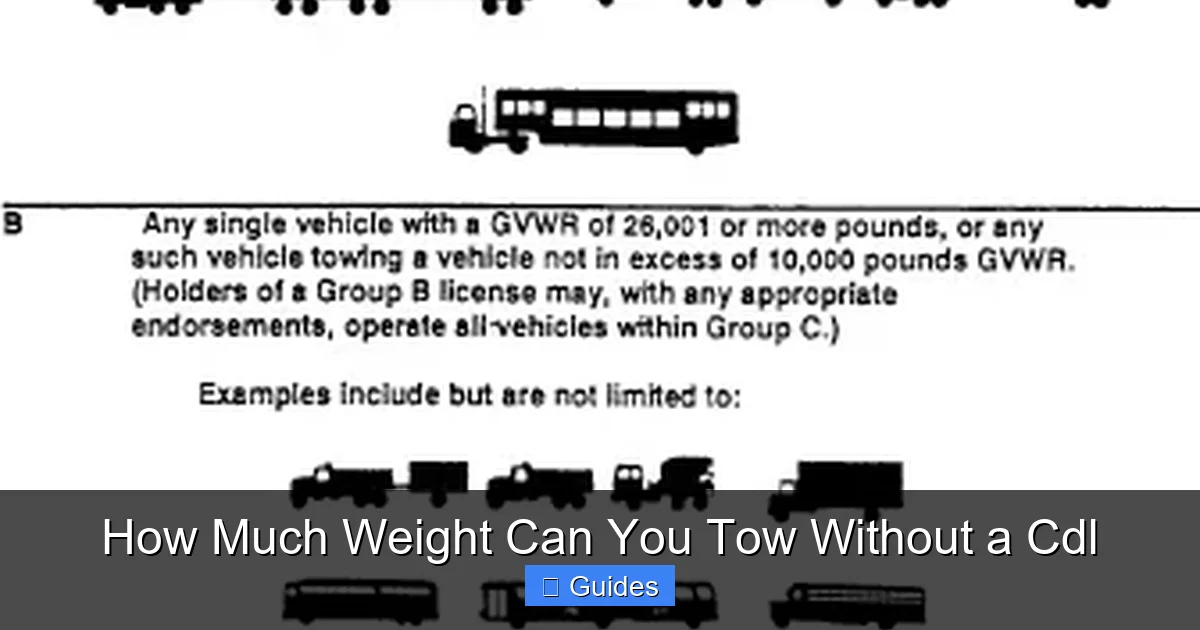
You can typically tow up to 10,000 pounds without a Commercial Driver’s License (CDL), but the exact limit depends on your vehicle’s Gross Vehicle Weight Rating (GVWR), trailer type, and state regulations. Understanding these rules helps you stay legal, safe, and avoid costly fines—whether you’re hauling a camper, boat, or equipment trailer.
In This Article
- 1 Key Takeaways
- 2 📑 Table of Contents
- 3 Understanding CDL Requirements and Towing Basics
- 4 Weight Limits for Towing Without a CDL
- 5 Vehicle Types and Their Towing Capabilities
- 6 State-Specific Rules and Regulations
- 7 Equipment and Safety Tips for Safe Towing
- 8 When You Might Need a CDL (Even Under 26,001 lbs)
- 9 Conclusion
- 10 Frequently Asked Questions
- 10.1 Do I need a CDL to tow a 9,000-pound trailer?
- 10.2 Can I tow a 12,000-pound trailer without a CDL?
- 10.3 What happens if I tow over the weight limit without a CDL?
- 10.4 Do I need special insurance for towing a heavy trailer?
- 10.5 Are there training courses for towing without a CDL?
- 10.6 Can I tow commercially without a CDL?
Key Takeaways
- CDL is not required for most personal towing under 26,001 lbs GVWR: If your combined vehicle and trailer weight stays below this threshold, you usually don’t need a CDL.
- 10,000 lbs is a common practical limit for non-commercial towing: Most standard pickup trucks and SUVs can safely tow up to this weight without special licensing.
- State laws vary significantly: Some states have lower thresholds or additional requirements, so always check local regulations.
- Trailer type matters: Gooseneck and fifth-wheel trailers often allow higher towing capacity than bumper-pull trailers.
- Proper equipment and training are essential: Even without a CDL, safe towing requires the right hitch, brakes, and driving skills.
- Commercial use changes the rules: If you’re towing for business purposes, even under 10,000 lbs, you may need a CDL or other permits.
- Always check your vehicle’s towing capacity: Exceeding your truck or SUV’s rated limit can void insurance and cause mechanical failure.
📑 Table of Contents
Understanding CDL Requirements and Towing Basics
If you’ve ever wondered whether you need a Commercial Driver’s License (CDL) to tow a trailer, you’re not alone. Many people assume that hauling heavy loads automatically requires special licensing—but that’s not always true. In fact, most everyday towing activities—like pulling a camper, boat, or utility trailer—can be done legally without a CDL, as long as you stay within certain weight and usage guidelines.
The key to understanding when a CDL is necessary lies in two main factors: the total weight of your rig and whether you’re using it for personal or commercial purposes. The Federal Motor Carrier Safety Administration (FMCSA) sets the national standard: if your vehicle combination (truck plus trailer) has a Gross Vehicle Weight Rating (GVWR) of 26,001 pounds or more, you generally need a CDL. But if you’re under that threshold—and not operating commercially—you can usually tow without one.
That said, “usually” doesn’t mean “always.” State laws can differ, and some impose stricter rules. For example, California requires a non-commercial Class A license for certain heavy trailers, even if they’re under the federal CDL threshold. So while the 26,001-pound rule is a solid starting point, it’s just the beginning of the conversation.
What Is a CDL and When Is It Required?
A Commercial Driver’s License (CDL) is a special license required to operate large or heavy vehicles for commercial purposes. It’s not just about size—it’s about safety, training, and accountability. The FMCSA divides CDLs into three classes:
– Class A: For combination vehicles with a GVWR of 26,001 lbs or more, where the towed vehicle is over 10,000 lbs.
– Class B: For single vehicles with a GVWR of 26,001 lbs or more.
– Class C: For vehicles designed to transport 16 or more passengers or hazardous materials.
But here’s the good news: if you’re towing for personal use—like taking your family camping or moving your boat to the lake—you typically don’t need a CDL, even if your trailer is heavy. The critical factor is the total GVWR of your vehicle and trailer combined. As long as that number stays under 26,001 pounds, you’re in the clear.
Personal vs. Commercial Towing: Why It Matters
One of the most common misconceptions is that weight alone determines whether you need a CDL. But usage matters just as much. If you’re towing a trailer for personal recreation—say, a travel trailer for weekend trips—you’re not required to have a CDL, even if the trailer weighs 9,000 pounds. However, if you’re using that same trailer to transport goods for your business, the rules change.
For example, a contractor hauling tools and materials in a 8,000-pound trailer for a construction job may need a CDL or at least a commercial permit, depending on state law. The FMCSA defines “commercial use” broadly, so even part-time work can trigger licensing requirements.
This distinction is crucial. Many people unknowingly violate regulations by towing commercially without the proper license. The result? Fines, insurance issues, and even liability in the event of an accident. So always ask: Am I doing this for fun, or for business?
Weight Limits for Towing Without a CDL
Visual guide about How Much Weight Can You Tow Without a Cdl
Image source: gocarlife.com
Now let’s get to the heart of the matter: how much can you actually tow without needing a CDL? The short answer is up to 26,000 pounds combined GVWR—but in practice, most non-commercial drivers stay well below that.
The most common practical limit for everyday towing is around 10,000 pounds. This is the maximum weight that most full-size pickup trucks and heavy-duty SUVs are designed to handle safely. For example, a Ford F-250 or Chevrolet Silverado 2500 can typically tow between 9,000 and 13,000 pounds, depending on configuration. But even if your truck can handle more, you still need to consider the trailer’s weight and your state’s rules.
GVWR vs. Actual Weight: What’s the Difference?
It’s important to understand the difference between GVWR and actual weight. GVWR stands for Gross Vehicle Weight Rating—the maximum weight your vehicle or trailer is designed to carry, including fuel, passengers, cargo, and the vehicle itself. This number is set by the manufacturer and found on the door jamb or in the owner’s manual.
Actual weight, on the other hand, is what your rig weighs on a scale. You should never exceed the GVWR, even if your actual weight is lower. Why? Because GVWR accounts for structural limits, braking capacity, and tire ratings. Overloading—even slightly—can lead to tire blowouts, brake failure, or loss of control.
For towing, you need to calculate the combined GVWR of your tow vehicle and trailer. If that total is under 26,001 pounds, you’re generally exempt from CDL requirements. But again, check your state laws—some have lower thresholds.
Examples of Common Towing Scenarios
Let’s look at a few real-world examples to make this clearer:
– Travel Trailer: A 7,000-pound travel trailer pulled by a 6,000-pound GVWR truck. Combined GVWR: 13,000 lbs. No CDL needed.
– Boat Trailer: A 5,000-pound boat on a 2,000-pound trailer, towed by an 8,000-pound GVWR SUV. Combined: 15,000 lbs. Still under the limit.
– Utility Trailer: A 3,000-pound equipment trailer hauled by a 7,500-pound GVWR pickup. Combined: 10,500 lbs. No CDL required.
In all these cases, the driver can legally tow without a CDL, assuming personal use and proper equipment.
Vehicle Types and Their Towing Capabilities
Visual guide about How Much Weight Can You Tow Without a Cdl
Image source: cdn.prod.website-files.com
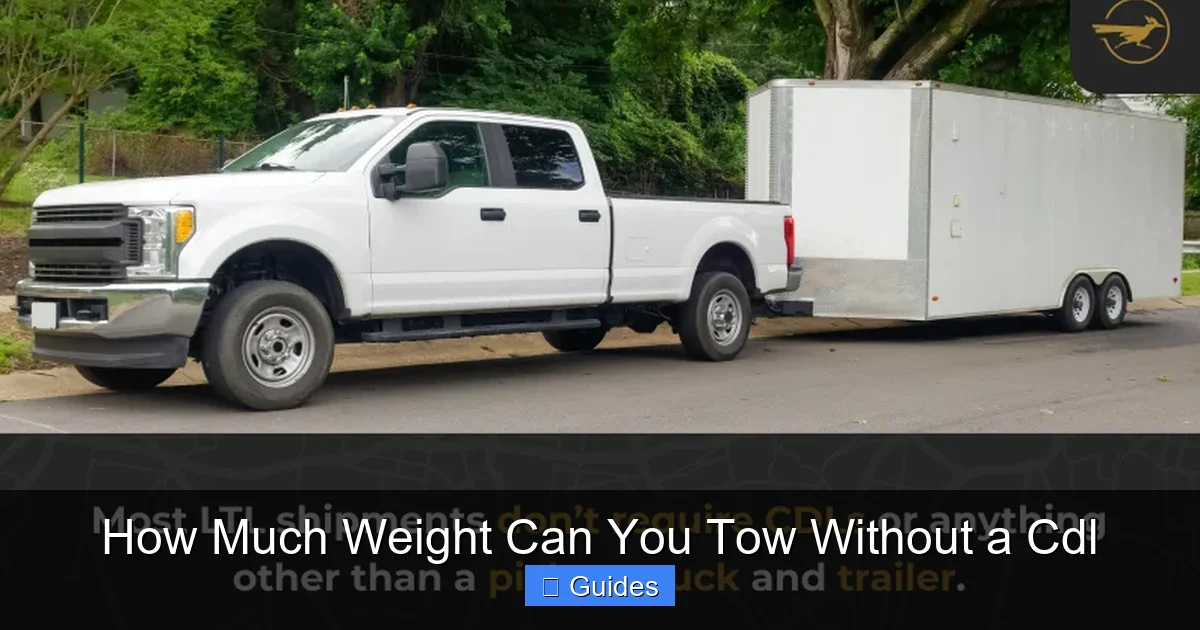
Not all vehicles are created equal when it comes to towing. Your truck or SUV’s towing capacity depends on its engine, transmission, suspension, and drivetrain. Here’s a breakdown of common vehicle types and what they can handle.
Half-Ton Pickups (e.g., Ford F-150, Ram 1500)
These are the most popular trucks for personal use. They typically have a GVWR between 6,000 and 7,500 pounds and can tow 5,000 to 12,000 pounds, depending on configuration. With a proper hitch and trailer brakes, a half-ton can safely handle a large travel trailer or a heavy boat.
However, towing near the upper limit requires careful planning. You’ll need a weight-distributing hitch, trailer brakes, and possibly a sway control system. Also, remember that towing reduces fuel economy and increases wear on your vehicle.
Three-Quarter and One-Ton Trucks (e.g., Ford F-250, Ram 3500)
These heavy-duty trucks are built for serious towing. With GVWRs ranging from 8,000 to 12,000 pounds, they can handle trailers up to 15,000 pounds or more. Many are equipped with gooseneck or fifth-wheel hitches, which allow for even greater capacity—up to 20,000 pounds in some cases.
Because of their size and power, these trucks are ideal for large RVs, horse trailers, or construction equipment. But they also require more skill to drive and park. If you’re new to towing, consider taking a towing safety course.
SUVs and Crossovers
Modern SUVs like the Toyota Sequoia, Chevrolet Tahoe, or Ford Expedition can tow between 5,000 and 9,000 pounds. While not as capable as trucks, they’re great for smaller trailers, boats, or pop-up campers.
Crossovers, such as the Honda Pilot or Hyundai Palisade, usually max out around 5,000 pounds. They’re perfect for light-duty towing but not suitable for heavy loads.
Always check your owner’s manual for the exact towing capacity. Don’t rely on marketing claims—real-world performance depends on gear ratios, cooling systems, and payload capacity.
State-Specific Rules and Regulations
Visual guide about How Much Weight Can You Tow Without a Cdl
Image source: i.ytimg.com
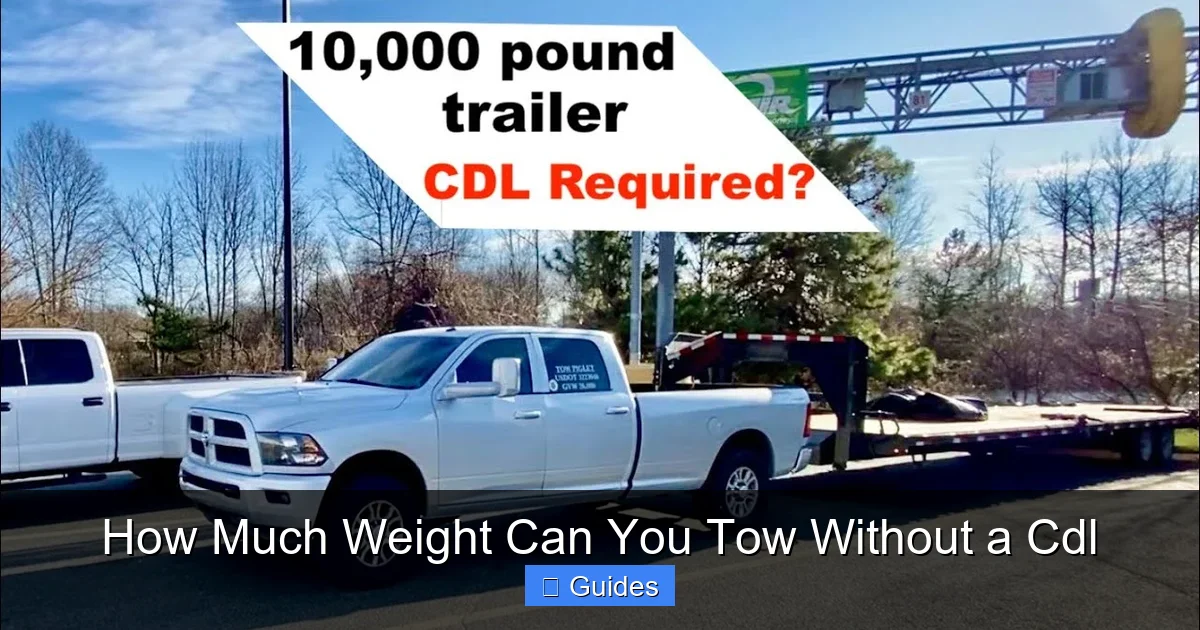
While federal law sets the 26,001-pound threshold for CDL requirements, individual states can impose additional rules. Some states have lower weight limits for non-commercial towing, while others require special licenses or permits.
States with Stricter Requirements
– California: Requires a non-commercial Class A license for trailers over 10,000 pounds GVWR, even if used personally.
– New York: Mandates a special permit for trailers over 10,000 pounds.
– Texas: No CDL needed under 26,001 lbs, but commercial use may require a CDL regardless of weight.
– Florida: Allows personal towing up to 26,000 lbs without a CDL, but requires trailer registration and brakes over certain weights.
Always check your state’s Department of Motor Vehicles (DMV) website before towing. Rules can change, and penalties for non-compliance can be steep—up to $1,000 in fines or even license suspension.
Registration and Insurance Considerations
Even if you don’t need a CDL, you may need to register your trailer and ensure it meets safety standards. Most states require:
– Trailer registration
– License plate and lights
– Brake requirements (usually for trailers over 3,000 lbs)
– Safety chains and breakaway systems
Insurance is another key factor. Your auto policy may not cover damage or liability if you’re towing beyond your vehicle’s capacity. Talk to your insurer about adding towing coverage or a separate trailer policy.
Equipment and Safety Tips for Safe Towing
Just because you can tow without a CDL doesn’t mean you should skip safety precautions. Proper equipment and driving techniques are essential for a safe trip.
Essential Towing Equipment
– Weight-Distributing Hitch: Helps balance the load and improves stability.
– Trailer Brakes: Required in most states for trailers over 3,000 lbs. Electric or surge brakes are common.
– Sway Control: Reduces trailer sway caused by wind or passing vehicles.
– Proper Tires: Ensure your tow vehicle and trailer have tires rated for the load.
– Mirrors: Extended towing mirrors improve visibility.
Driving Tips for New Towing
– Practice in an empty parking lot: Get used to turning, backing up, and braking.
– Allow extra stopping distance: Towing increases braking distance by 30–40%.
– Check your load: Distribute weight 60% in the front half of the trailer.
– Use lower gears on hills: Prevents overheating and loss of control.
– Inspect before every trip: Check lights, tires, hitch, and brakes.
Even experienced drivers should review towing safety annually. The FMCSA and organizations like the RV Safety & Education Foundation offer free resources and courses.
When You Might Need a CDL (Even Under 26,001 lbs)
While most personal towing under 26,001 lbs doesn’t require a CDL, there are exceptions. You may need one if:
– You’re transporting passengers for hire (e.g., a shuttle bus).
– You’re hauling hazardous materials (even in small quantities).
– Your state requires a commercial license for certain trailer types.
– You’re operating a vehicle with air brakes (some states require a CDL for this feature alone).
If you’re unsure, contact your state DMV or a CDL licensing expert. It’s better to be safe than sorry.
Conclusion
Towing without a CDL is not only possible—it’s common. Most people can legally and safely tow up to 10,000 pounds (and sometimes more) using a standard pickup truck or SUV, as long as they stay under the 26,001-pound combined GVWR threshold and avoid commercial use. But weight isn’t the only factor. State laws, vehicle capabilities, equipment, and safety practices all play a role.
The key is to do your homework. Check your vehicle’s towing capacity, know your state’s rules, and invest in the right gear. Whether you’re pulling a camper across the country or hauling a boat to the lake, staying informed helps you avoid fines, accidents, and stress.
Remember: just because you don’t need a CDL doesn’t mean you shouldn’t act like a professional. Safe towing starts with preparation, respect for limits, and a commitment to safety. With the right knowledge, you can tow confidently—and legally—without ever stepping into a CDL classroom.
Frequently Asked Questions
Do I need a CDL to tow a 9,000-pound trailer?
No, you typically don’t need a CDL to tow a 9,000-pound trailer if it’s for personal use and your combined vehicle and trailer GVWR is under 26,001 pounds. However, check your state’s rules, as some have lower thresholds.
Can I tow a 12,000-pound trailer without a CDL?
Yes, as long as your tow vehicle and trailer together have a GVWR under 26,001 pounds and you’re not using it commercially. Most one-ton trucks can handle this load safely with proper equipment.
What happens if I tow over the weight limit without a CDL?
You could face fines, insurance denial, or even legal liability in an accident. Overloading also risks mechanical failure, so always stay within your vehicle’s rated capacity.
Do I need special insurance for towing a heavy trailer?
Your standard auto policy may not cover heavy towing. Talk to your insurer about adding towing or trailer coverage, especially if you’re hauling expensive equipment.
Are there training courses for towing without a CDL?
Yes! Organizations like the RV Safety & Education Foundation and local driving schools offer towing safety courses. These are highly recommended for new or occasional towers.
Can I tow commercially without a CDL?
It depends on weight and state law. If your rig is under 26,001 lbs GVWR, you may not need a full CDL, but some states require commercial permits or endorsements for business use.

At CarLegit, we believe information should be clear, factual, and genuinely helpful. That’s why every guide, review, and update on our website is created with care, research, and a strong focus on user experience.