
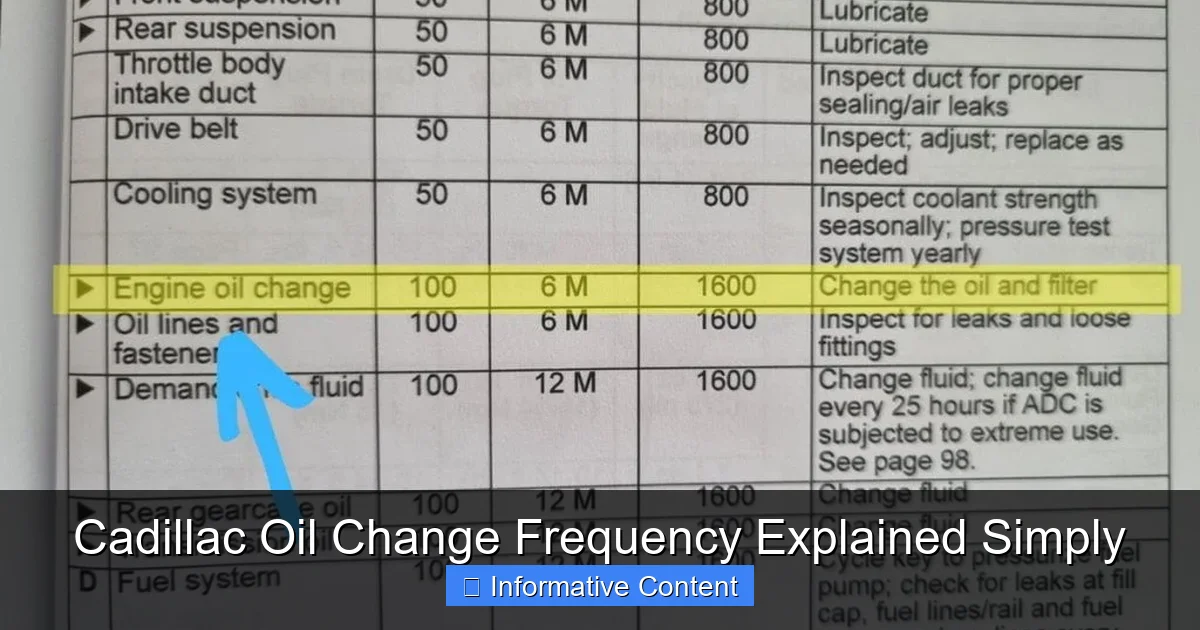
Modern Cadillac models typically require an oil change every 7,500 to 10,000 miles under normal driving conditions. However, this interval is not universal; severe service schedules for frequent short trips, towing, or extreme weather can necessitate changes as often as every 3,000 to 5,000 miles. Always consult your vehicle’s specific Owner’s Manual and the onboard Oil Life Monitoring System for the most accurate, personalized schedule.
In This Article
- 1 Key Takeaways
- 2 📑 Table of Contents
- 3 Cadillac Oil Change Frequency Explained Simply
- 4 The Old Rule is Dead: Understanding Modern Oil Change Intervals
- 5 Official Cadillac Recommendations: A Model-by-Model Guide
- 6 When to Ignore the Monitor: Severe Driving Conditions
- 7 The Right Stuff: Choosing Oil for Your Cadillac
- 8 Data at a Glance: Cadillac Oil Change Summary Table
- 9 Beyond the Oil Change: A Holistic Maintenance Mindset
- 10 Your Clear Path Forward
- 11 Frequently Asked Questions
- 11.1 How often should I change the oil in my Cadillac?
- 11.2 What is the recommended Cadillac oil change frequency for older models?
- 11.3 Does the type of oil affect how often I need a change?
- 11.4 Why does my Cadillac’s oil life monitor indicate a change sooner than expected?
- 11.5 Can I go longer than 10,000 miles between oil changes?
- 11.6 What happens if I delay a needed Cadillac oil change?
Key Takeaways
- Check your owner’s manual first: It provides the definitive schedule for your specific model.
- Modern Cadillacs often use synthetic oil: This typically allows for longer intervals between changes.
- Follow the Oil Life Monitoring System: This intelligent system calculates the optimal change time.
- Severe driving conditions require more frequent changes: This includes frequent short trips or towing.
- Never exceed 10,000 miles or one year: This is the maximum safe interval for most models.
- Use only the recommended oil grade: Using the wrong oil can damage your engine.
📑 Table of Contents
- Cadillac Oil Change Frequency Explained Simply
- The Old Rule is Dead: Understanding Modern Oil Change Intervals
- Official Cadillac Recommendations: A Model-by-Model Guide
- When to Ignore the Monitor: Severe Driving Conditions
- The Right Stuff: Choosing Oil for Your Cadillac
- Data at a Glance: Cadillac Oil Change Summary Table
- Beyond the Oil Change: A Holistic Maintenance Mindset
- Your Clear Path Forward
Cadillac Oil Change Frequency Explained Simply
Let’s be honest. For many of us, the “check engine” light or a little sticker in the corner of the windshield is our main reminder to think about an oil change. You see it, you groan, and you promise yourself you’ll deal with it… soon. If you drive a Cadillac, that approach might be costing you more than just a little worry.
I remember talking to a neighbor who had just bought a gorgeous, pre-owned Cadillac XT5. He was thrilled but confused. His old truck needed an oil change every 3,000 miles like clockwork. His new Cadillac’s dashboard message said he still had 40% oil life left at 5,000 miles. “Who’s right?” he asked. “The old rule or the car’s computer?” It’s a fantastic question that gets to the heart of modern car care.
The simple answer is that a modern Cadillac typically needs an oil change between 7,500 and 10,000 miles, but that’s just the start of the story. The real answer is smarter and more personalized than a one-size-fits-all number. It depends on your specific engine, how you drive, and the technology built into your Cadillac. Let’s clear up the confusion and explain exactly how to know when your Cadillac needs an oil change, in plain English.
The Old Rule is Dead: Understanding Modern Oil Change Intervals
For decades, the golden rule was “every 3,000 miles or 3 months.” It was easy to remember and served older cars well. But clinging to that rule for a modern Cadillac is like using a flip phone to manage your smart home—it works, but you’re missing out on a lot of advanced technology.

Visual guide about Cadillac oil change interval
Image source: d3s8goeblmpptu.cloudfront.net
Today’s Cadillacs, like most modern vehicles, use sophisticated synthetic oils and precision-engineered engines. Synthetic oil doesn’t break down and sludge up as quickly as the conventional oils of the past. It’s designed to last longer and protect better under extreme heat and cold.
More importantly, your Cadillac isn’t guessing. It’s calculating.
Your Car’s Brain: The Oil Life Monitoring System
Every modern Cadillac comes with a brilliant feature called the Oil Life Monitoring System (OLMS). This isn’t just a simple mileage counter. It’s a computer that actively analyzes your driving conditions in real-time.
Think of it as a fitness tracker for your engine. It doesn’t just count steps (miles); it looks at the intensity of the workout. The system tracks things like:
- Engine temperature and runtime
- Vehicle speed and load
- RPMs and driving patterns
- Cold starts and short trips
If you do a lot of gentle highway driving, the system will see that as “light exercise” and extend the oil life. If you’re constantly in stop-and-go traffic, towing a trailer, or only taking two-mile trips to the store, it sees that as a “hard workout” and will tell you to change the oil sooner. This personalized approach is far more accurate than any static mileage interval.
Official Cadillac Recommendations: A Model-by-Model Guide
While the Oil Life Monitor is your best guide, Cadillac provides general baseline recommendations. These are helpful for planning and understanding the range you can expect. Remember, these assume “normal” driving conditions and the use of the recommended synthetic oil.

Visual guide about Cadillac oil change interval
Image source: di-sitebuilder-assets.s3.amazonaws.com
Cadillac Sedans (CT4, CT5, CT6, XTS)
Most Cadillac sedans with standard turbocharged or V6 engines have an official recommended interval of every 7,500 miles or when the Oil Life Monitor indicates. For some high-performance variants, like the Blackwing models, following the monitor’s guidance is even more critical due to the intense stress on the engine.
Cadillac SUVs (XT4, XT5, XT6, Escalade)
The popular SUV lineup generally follows the same 7,500-mile baseline. The mighty Escalade and its high-output engines also use the 7,500-mile/OLMS guideline. For these larger vehicles that might be used for towing or carrying heavy loads, paying attention to the monitor’s messages is key.
The Electric Exception: Cadillac LYRIQ
Here’s a fun twist! The all-electric Cadillac LYRIQ doesn’t have a traditional engine oil change at all. Its electric motors require very different maintenance. However, it still has gearbox fluid and brake fluid that need periodic service according to the vehicle’s maintenance schedule. This highlights why knowing your specific model is so important.
When to Ignore the Monitor: Severe Driving Conditions
This is the most important section for many drivers. Cadillac defines “severe service” conditions that can cut your oil change frequency in half. If your driving life looks like this, you should consider changes at 3,000-5,000 miles, regardless of what the monitor says.
Visual guide about Cadillac oil change interval
Image source: mobility.lk
- Frequent Short Trips: Driving less than 5 miles regularly, especially in cold weather. The engine never fully warms up, allowing fuel and moisture to contaminate the oil.
- Heavy Traffic & Idling: Constant stop-and-go driving or long periods of idling (think ride-share or delivery drivers).
- Extreme Environments: Living in a very dusty, sandy, or heavily polluted area, or in a region with constant extreme hot or cold temperatures.
- Heavy Loads & Towing: Regularly towing a trailer, carrying max cargo, or using a roof-mounted cargo box.
- Performance Driving: Frequent track days, aggressive acceleration, and high-speed driving.
Personal tip: My friend who lives in the mountains and tows a small boat has a simple rule. He changes the oil in his XT6 every 5,000 miles, even if the monitor says 30% life is left. It’s cheap insurance for his expensive engine.
The Right Stuff: Choosing Oil for Your Cadillac
Putting the wrong oil in your Cadillac is like putting diesel fuel in a gasoline engine—a very bad idea. Always, always follow the recommendations in your owner’s manual. Here’s a simplified breakdown.
The Synthetic Oil Mandate
Virtually all newer Cadillacs require full synthetic oil. It flows better in the cold, resists breaking down in the heat, and keeps engine internals cleaner. Don’t try to save $20 by using a conventional blend; it’s not worth the risk to your engine’s longevity.
Understanding Viscosity: The “5W-30” Code
You’ll see a code like 0W-20, 5W-30, or 15W-40 on oil bottles. This is the viscosity, or thickness. The first number (with the “W” for Winter) shows how it flows when cold. The second number shows how it flows at engine operating temperature. Using the wrong viscosity can lead to poor lubrication, reduced fuel economy, or even engine damage. Your manual will state the exact grade required.
Genuine vs. Aftermarket Filters
The oil filter is just as important as the oil. A cheap filter might have less filtering material, a flimsy bypass valve, or a poor-quality seal. Cadillac Genuine or premium brand filters (like AC Delco, which is the OEM supplier) are designed for your engine’s specific flow requirements and filtration needs. Don’t let a $10 part compromise a $100 oil change.
Data at a Glance: Cadillac Oil Change Summary Table
This table gives you a quick-reference baseline. Your Oil Life Monitor and driving conditions are the final authority.
| Cadillac Model Type | Typical Baseline Interval | Key Consideration |
|---|---|---|
| Sedans (CT4, CT5, etc.) | 7,500 miles / OLMS | Performance models demand strict adherence. |
| SUVs (XT4, XT5, XT6, Escalade) | 7,500 miles / OLMS | Towing & heavy loads require more frequent changes. |
| High-Performance (V-Series, Blackwing) | Follow OLMS Strictly | Extreme engine stress; often requires specific premium oils. |
| Electric (LYRIQ) | No Engine Oil | Follow EV-specific schedule for gear reduction unit fluid. |
| All Models Under “Severe” Use | 3,000 – 5,000 miles | Consider this interval for short trips, towing, extreme climates. |
Beyond the Oil Change: A Holistic Maintenance Mindset
An oil change is the most vital routine service, but it’s not the only one. When you get your Cadillac’s oil changed, it’s the perfect time for a quick health check.
The Multi-Point Inspection
A good technician will (or should) check your tire pressure and tread, brake pad thickness, fluid levels (coolant, brake, windshield washer), lights, and look for any obvious leaks or wear. This 10-minute inspection can catch small problems before they become big, expensive repairs.
Resetting the Oil Life Monitor
After the oil change, the service technician must reset the Oil Life Monitor. This is a simple procedure done through the infotainment screen or steering wheel controls. If they forget, your car will give you an incorrect “change oil soon” warning. Don’t be shy about asking, “Did you reset the monitor?”
Keeping Records
Whether you use a dedicated app, a notes file on your phone, or the old-fashioned booklet in your glovebox, keep a log. Note the date, mileage, type of oil used, and who did the service. This is invaluable for warranty claims, increases your car’s resale value, and helps you track its history.
Your Clear Path Forward
So, how often does a Cadillac need an oil change? Forget the rigid 3,000-mile myth. Start with the smart system built into your dashboard—your Oil Life Monitor. For most driving, it will guide you to a sensible interval around 7,500 to 10,000 miles.
But be your own best advocate. Honestly assess your driving. Are you in the “severe service” club with short trips, towing, or extreme weather? If so, take control and change it more frequently, around every 5,000 miles. Always use the full synthetic oil and high-quality filter specified for your model.
Treating your Cadillac to timely oil changes with the right materials is the single best thing you can do for its health, performance, and longevity. It’s not just maintenance; it’s an investment in preserving the smooth, powerful, and luxurious drive you bought it for. Now, go enjoy that drive with confidence.
Frequently Asked Questions
How often should I change the oil in my Cadillac?
Modern Cadillacs with the Oil Life Monitoring System typically need an oil change every 7,500 to 10,000 miles under normal driving conditions. However, you should always follow the system’s alerts in your vehicle, as it calculates oil life based on your actual driving habits.
What is the recommended Cadillac oil change frequency for older models?
For older Cadillac models without a smart monitoring system, the traditional recommendation is an oil change every 3,000 to 5,000 miles. Always consult your specific model’s owner’s manual for the manufacturer’s official maintenance schedule.
Does the type of oil affect how often I need a change?
Yes, absolutely. Using the manufacturer-recommended synthetic oil, which is standard for most newer Cadillacs, allows for extended intervals between changes. Conventional oil generally requires more frequent changes to maintain engine protection.
Why does my Cadillac’s oil life monitor indicate a change sooner than expected?
The intelligent system tracks severe driving conditions like frequent short trips, extreme temperatures, or heavy towing. These factors degrade oil faster, so the monitor will alert you for a change sooner than the maximum mileage interval to ensure optimal engine health.
Can I go longer than 10,000 miles between oil changes?
While some synthetic oils are marketed for longer intervals, it is not recommended to exceed the guidance of your Cadillac’s Oil Life Monitoring System. Adhering to its alerts is the best way to protect your engine’s longevity and warranty coverage.
What happens if I delay a needed Cadillac oil change?
Delaying an oil change can lead to increased engine wear, sludge buildup, and reduced fuel efficiency. Over time, old, degraded oil fails to properly lubricate and protect engine components, which can result in costly repairs.

At CarLegit, we believe information should be clear, factual, and genuinely helpful. That’s why every guide, review, and update on our website is created with care, research, and a strong focus on user experience.