

Featured image for how to check miles to empty jeep grand cherokee 2023
Image source: thecarhow.com
Monitoring your 2023 Jeep Grand Cherokee’s remaining fuel range is straightforward, with the “miles to empty” (MTE) display prominently featured on the digital instrument cluster. Drivers can easily access this crucial information by navigating through the display options using the steering wheel controls. This vital feature empowers you to plan your trips confidently and avoid unexpected fuel concerns.
The open road beckons, the hum of the engine a symphony of adventure, and the iconic grille of your 2023 Jeep Grand Cherokee promises unmatched capability and style. Whether you’re navigating urban jungles, embarking on a cross-country expedition, or simply enjoying a weekend escape, one crucial piece of information often resides at the forefront of a driver’s mind: how much farther can I go before needing to refuel? For the modern Grand Cherokee owner, this isn’t just a matter of glancing at the fuel gauge; it’s about leveraging sophisticated onboard technology to precisely answer that question.
Understanding your vehicle’s fuel range is more than just convenience; it’s about peace of mind, efficient travel planning, and maximizing the legendary freedom your Jeep offers. The “Miles To Empty” (MTE) feature in the 2023 Jeep Grand Cherokee is a testament to automotive innovation, providing dynamic, real-time data that helps you make informed decisions on your journey. Gone are the days of educated guesses; in their place is a smart system designed to keep you aware and in control.
This comprehensive guide will delve into every aspect of checking and understanding the Miles To Empty feature in your 2023 Jeep Grand Cherokee. From the intuitive digital instrument cluster to the advanced Uconnect infotainment system, we’ll explore exactly how to access this vital information, interpret its readings, and even optimize your driving habits to extend your range. Get ready to master your fuel management and truly embrace every mile behind the wheel of your powerful Grand Cherokee.
In This Article
- 1 Key Takeaways
- 2 Understanding the “Miles To Empty” Feature in the Grand Cherokee 2023
- 3 Step-by-Step Guide: Accessing MTE on the Digital Instrument Cluster
- 4 Leveraging the Uconnect Infotainment System for Fuel Information
- 5 Factors Influencing MTE Accuracy and How to Interpret Readings
- 6 Advanced Tips for Fuel Management and Maximizing Range in Your Grand Cherokee
- 7 Troubleshooting Common MTE Discrepancies and System Quirks
- 8 Frequently Asked Questions
- 8.1 How do I check the ‘Miles To Empty’ in my 2023 Jeep Grand Cherokee?
- 8.2 Where is the ‘Miles To Empty’ displayed on the 2023 Jeep Grand Cherokee?
- 8.3 How accurate is the ‘Miles To Empty’ reading in a Jeep Grand Cherokee 2023?
- 8.4 What factors can influence the accuracy of the ‘Miles To Empty’ calculation in my 2023 Jeep Grand Cherokee?
- 8.5 Does the ‘Miles To Empty’ automatically update after I refuel my 2023 Jeep Grand Cherokee?
- 8.6 What should I do if my 2023 Jeep Grand Cherokee shows a very low ‘Miles To Empty’?
Key Takeaways
- Display MTE: Use steering wheel buttons to cycle the instrument cluster.
- Find “Range”: Look for “Range” or “Distance To Empty” in the display.
- MTE is an Estimate: Understand “Miles To Empty” constantly adjusts dynamically.
- Driving Affects MTE: Your driving style directly impacts the range calculation.
- Refuel Safely: Don’t push MTE to zero; refuel before it’s critical.
- Automatic Update: MTE automatically recalculates after adding fuel.
Understanding the “Miles To Empty” Feature in the Grand Cherokee 2023
Before diving into the “how-to,” it’s essential to grasp what the “Miles To Empty” (MTE) feature truly represents in your 2023 Jeep Grand Cherokee and why it’s such a pivotal tool for modern drivers. It’s more than just a simple calculation; it’s a sophisticated estimation driven by a complex interplay of sensors and algorithms.
What is Miles To Empty (MTE)?
Miles To Empty, often abbreviated as MTE, is an estimated distance your vehicle can travel before running out of fuel, based on the current fuel level and recent average fuel consumption. It’s a dynamic number, meaning it constantly updates in response to your driving style, road conditions, and the efficiency of your 2023 Jeep Grand Cherokee’s engine. Unlike a static fuel gauge that simply shows a proportion of fuel remaining, MTE attempts to provide a practical, actionable number in miles or kilometers, offering a tangible sense of your remaining range.
Why MTE is Crucial for Grand Cherokee Owners
For owners of a capable and versatile vehicle like the 2023 Jeep Grand Cherokee, the MTE feature offers several critical benefits:
- Strategic Trip Planning: Knowing your MTE allows you to plan fuel stops strategically, especially on long journeys or when venturing into areas with limited fuel stations. This is particularly valuable for Jeep owners who might take their Grand Cherokee off the beaten path.
- Reducing Range Anxiety: The fear of running out of fuel in an unfamiliar area can detract from the driving experience. MTE provides a clear, real-time figure, helping to alleviate “range anxiety” and fostering greater confidence in your travels.
- Optimizing Fuel Efficiency: By observing how your MTE changes based on your driving habits, you can become more aware of efficient driving techniques, subtly encouraging better fuel economy over time in your Jeep Grand Cherokee.
- Safety and Convenience: Avoiding situations where you’re desperately searching for a gas station, especially at night or in remote locations, is a significant safety and convenience benefit of accurately monitoring your Miles To Empty.
The Technology Behind MTE in Modern Jeeps
The accuracy and responsiveness of the Miles To Empty reading in your 2023 Jeep Grand Cherokee are powered by advanced automotive technology. It’s not a simple mathematical division of tank size by a fixed MPG; it’s a constantly evolving calculation:
- Fuel Level Sensor: At its core, a precise fuel level sensor in the tank reports the exact amount of fuel remaining to the vehicle’s Engine Control Unit (ECU).
- Engine Control Unit (ECU) and Powertrain Control Module (PCM): These onboard computers are the brains of the operation. They continuously monitor various parameters, including engine load, vehicle speed, gear selection, and throttle input, all of which influence fuel consumption.
- Average MPG Calculation: The system doesn’t rely on instantaneous MPG, which can fluctuate wildly. Instead, it typically uses a rolling average of your recent fuel economy (e.g., over the last 30-50 miles, or since the last reset) to predict future consumption. This average, combined with the remaining fuel, forms the basis of the MTE estimate for the 2023 Jeep Grand Cherokee.
- Dynamic Updates: Because it uses a rolling average and considers current driving conditions, the MTE value is dynamic. If you suddenly switch from highway cruising to stop-and-go city traffic, or begin towing a heavy trailer, you’ll observe the MTE number decrease more rapidly as the system recalibrates its predictions based on the increased fuel consumption.
Understanding this underlying technology helps Grand Cherokee owners appreciate why the MTE number can fluctuate and why it’s always an estimate, albeit a highly informed one.
Step-by-Step Guide: Accessing MTE on the Digital Instrument Cluster
The primary and most intuitive place to check your Miles To Empty in the 2023 Jeep Grand Cherokee is directly through the digital instrument cluster. Jeep has designed this interface to be user-friendly, allowing drivers to quickly access a wealth of vehicle information without distraction.
Visual guide about how to check miles to empty jeep grand cherokee 2023
Image source: jeepfixes.com
The 2023 Jeep Grand Cherokee features a fully digital instrument cluster, a vibrant and customizable screen positioned directly in front of the driver. This display is controlled via buttons conveniently located on the steering wheel. Here’s how to find your MTE:
- Start Your Jeep Grand Cherokee: Ensure your vehicle is running or at least in the “ACC” or “RUN” position to power up the instrument cluster.
- Locate Steering Wheel Controls: On the left side of your steering wheel, you’ll typically find a set of directional arrow buttons (up, down, left, right) and an “OK” or “Select” button in the center. These are your primary navigation tools for the digital cluster.
- Navigate to the Vehicle Information Screen: Use the left and right arrow buttons to cycle through the main menu categories displayed at the top or bottom of your instrument cluster. You’ll typically find categories like “Speedometer,” “Audio,” “Navigation,” “Vehicle Info,” and “Fuel Economy.” Your goal is to reach the “Vehicle Info” or “Fuel Economy” section.
- Select “Fuel Economy” or “Range”: Once you’ve highlighted “Vehicle Info” or a similar category, use the up and down arrows to scroll through the sub-menus or available widgets. Look for options labeled “Fuel Economy,” “Range,” or explicitly “Miles To Empty.”
- Confirm MTE Display: When “Miles To Empty” is highlighted, press the “OK” or “Select” button if required, or it may automatically display the value. The number shown will be your current estimated range in miles for your 2023 Jeep Grand Cherokee.
Practical Example: Imagine you’re driving your 2023 Jeep Grand Cherokee on a highway. You notice your fuel gauge is approaching half. To check your precise Miles To Empty, you’d simply tap the right arrow on your steering wheel until “Vehicle Info” appears on the screen, then use the down arrow to scroll through options like “Tire Pressure,” “Engine Temp,” until you see “Range” or “Miles To Empty.” The screen might then show “Range: 285 mi.”
Interpreting the Displayed MTE Value
When you see the Miles To Empty value, remember that it’s an estimate. Here’s what to keep in mind:
- Dynamic Nature: The number will change. If you were just driving economically on the highway and then enter heavy city traffic, the MTE will likely drop faster as the system recalibrates for the increased fuel consumption of stop-and-go driving. Conversely, if you transition to highway cruising after city driving, the MTE might appear to increase slightly as efficiency improves.
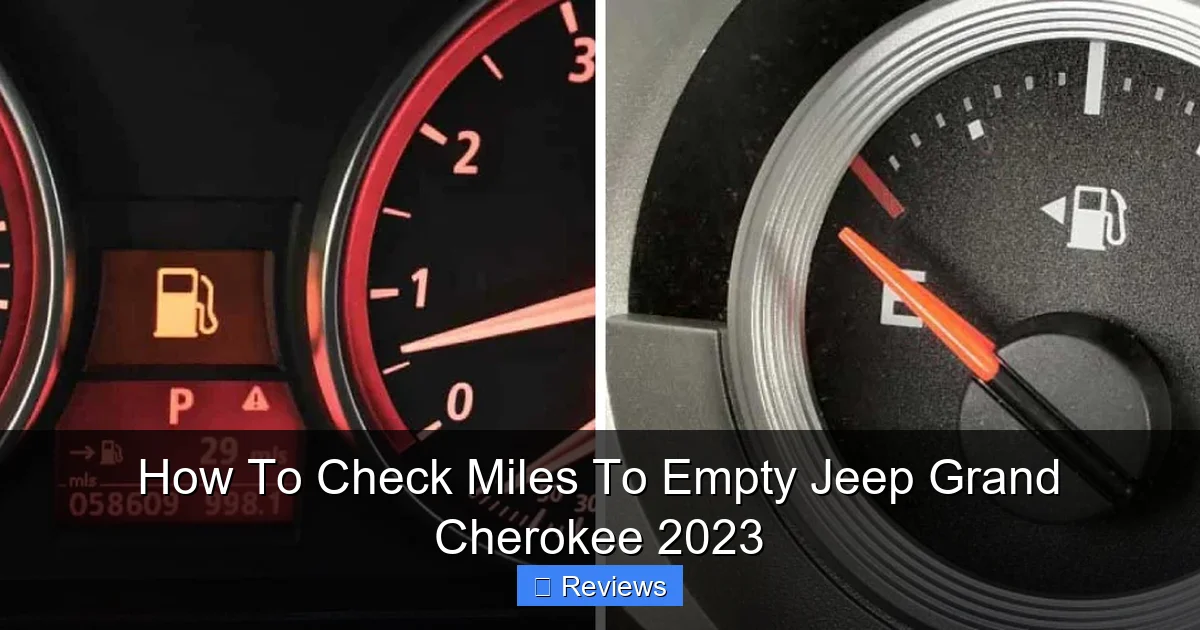
- “Low Fuel” Warnings: As your fuel level drops, the system will provide visual and often auditory warnings. Typically, around 50 miles to empty, a “Low Fuel” warning light will illuminate, and an alert message may appear on the screen. This is your cue to seriously consider refueling your Jeep Grand Cherokee.
- Reserve Fuel: Most vehicles, including the 2023 Jeep Grand Cherokee, have a small amount of “reserve” fuel that is not typically factored into the MTE calculation when it reaches zero. This is a safety buffer, but it’s strongly advised not to rely on it. Refuel well before the MTE hits zero to prevent potential damage to your fuel pump and to avoid being stranded.
Customizing Your Display for Quick MTE Access
The digital instrument cluster in the 2023 Jeep Grand Cherokee is highly customizable. You can often configure which information is displayed prominently or quickly accessible:
- Favorite Widgets: Some clusters allow you to set “favorite” displays or rearrange widgets. You might be able to set “Miles To Empty” as a primary display widget that you can toggle to with just one or two button presses, without having to navigate through deeper menus every time.
- Specific Layouts: Explore the settings within your instrument cluster menu (accessed via the steering wheel controls) to see if you can select a layout that always includes a fuel range or MTE indicator. This ensures that a glance at your dashboard is often enough to check your range.
Leveraging the Uconnect Infotainment System for Fuel Information
Beyond the digital instrument cluster, the Uconnect infotainment system in your 2023 Jeep Grand Cherokee provides another sophisticated avenue for monitoring fuel information, offering a more detailed overview and even historical data.
Visual guide about how to check miles to empty jeep grand cherokee 2023
Image source: jeepfixes.com
Uconnect 5 and Its Fuel Management Capabilities
The 2023 Jeep Grand Cherokee is equipped with the advanced Uconnect 5 system, featuring a large, responsive touchscreen that serves as the central hub for media, navigation, climate control, and various vehicle settings. This system also provides comprehensive fuel management tools:
- Accessing the Apps Menu: On the Uconnect touchscreen, locate and tap the “Apps” icon. This will open a grid of available applications and features.
- Finding the “Fuel Economy” or “Vehicle Info” App: Scroll through the apps until you find one labeled “Fuel Economy,” “Vehicle Info,” or similar. Tap on it.
- Viewing Detailed Fuel Data: Within the “Fuel Economy” app, you’ll typically find a dashboard displaying not only the current Miles To Empty but also other useful metrics such as:
- Average MPG: Your vehicle’s average miles per gallon over a given period (often resettable).
- Current MPG: Real-time fuel efficiency, which fluctuates with driving.
- Range History: Some Uconnect versions might offer graphical representations of your fuel economy history, showing trends over time.
- Eco Coaching: Hints and tips to improve your driving efficiency, directly tied to your fuel consumption.
The MTE displayed here should correspond with the reading on your digital instrument cluster, providing a consistent view of your 2023 Jeep Grand Cherokee’s remaining range.
The Uconnect system often presents this data with visually appealing graphics, making it easy to digest and understand. It’s a great tool for those who want a deeper dive into their fuel efficiency and range beyond just the single MTE number.
Voice Commands for MTE
For even greater convenience, the Uconnect 5 system in the 2023 Jeep Grand Cherokee supports robust voice commands. While specific commands can vary slightly, you can often inquire about your fuel status hands-free:
- Activating Voice Command: Press the voice command button on your steering wheel (usually a button with a speaking person icon or a microphone).
- Issuing Commands: Once prompted, speak clearly. Common commands might include:
- “How many miles to empty?”
- “What is my fuel range?”
- “Check fuel economy.”
The system will then verbally respond with the current Miles To Empty or display it on the Uconnect screen. This feature is particularly useful for maintaining focus on the road while still getting critical information about your 2023 Jeep Grand Cherokee.
A highly beneficial integration within the Uconnect 5 system, especially for long-distance travelers in their 2023 Jeep Grand Cherokee, is the ability to factor your Miles To Empty into navigation planning. While not always directly displaying “MTE to destination,” the system can often:
- Suggest Fuel Stations: As you approach low fuel levels, or if your MTE indicates you won’t reach your destination, the navigation system can proactively suggest nearby gas stations along your route or at your destination.
- Display POIs: You can actively search for “Gas Stations” as a Point of Interest (POI) through the navigation, viewing their distance and potentially pricing information, allowing you to compare your MTE with the distance to the next fuel stop for your 2023 Jeep Grand Cherokee.
This integration transforms MTE from a mere display of numbers into an active assistant for your journey, ensuring you can plan your stops efficiently and confidently.
Factors Influencing MTE Accuracy and How to Interpret Readings
While the “Miles To Empty” feature in the 2023 Jeep Grand Cherokee is remarkably intelligent, it’s crucial to understand that it provides an estimate. Several factors can significantly influence its accuracy, and knowing these will help you interpret the readings more effectively and avoid unexpected surprises.

Visual guide about how to check miles to empty jeep grand cherokee 2023
Image source: fourwheeltrends.com
Driving Habits and Their Impact
Your personal driving style is arguably the biggest determinant of your actual fuel consumption and, consequently, the accuracy of your MTE reading:
- Aggressive vs. Smooth Driving: Frequent hard accelerations, rapid braking, and high speeds drastically increase fuel consumption, causing your MTE to drop faster than anticipated. Smooth acceleration, gradual braking, and maintaining a consistent speed are far more fuel-efficient.
- Highway vs. City Driving: Highway cruising generally yields better MPG than stop-and-go city traffic. If your MTE is calculated based on recent highway driving, and you suddenly enter congested city streets, the MTE will likely decline at a quicker rate as the average consumption worsens for your 2023 Jeep Grand Cherokee.
- Engine Idling: While not moving, an idling engine still consumes fuel. Extended periods of idling, common in drive-thrus or waiting in traffic, will chip away at your MTE without adding miles to your odometer.
Environmental Conditions
External factors play a role in how efficiently your 2023 Jeep Grand Cherokee consumes fuel:
- Temperature: Extremely cold weather can reduce fuel efficiency. Engines take longer to warm up, lubricants are thicker, and winter-blend fuels may have slightly less energy content. Conversely, very hot weather might lead to increased use of air conditioning, which also draws power and fuel.
- Wind Resistance: Driving against a strong headwind forces your Jeep Grand Cherokee’s engine to work harder, consuming more fuel and reducing your MTE.
- Terrain: Uphill climbs require significantly more power and fuel than driving on flat terrain or downhill. If your MTE calculation is based on recent flat-road driving and you then enter mountainous regions, expect the MTE to decrease more rapidly.
Vehicle Load and Towing
The heavier your 2023 Jeep Grand Cherokee, the more fuel it will consume:
- Passenger and Cargo Weight: A fully loaded vehicle with passengers and luggage will have lower fuel efficiency than an empty one, directly impacting the MTE.
- Towing a Trailer: Towing is one of the most significant factors that can reduce your MTE. The added weight and aerodynamic drag of a trailer dramatically increase the engine’s workload and fuel consumption. Always factor this in when planning routes and fuel stops if you’re towing with your Jeep Grand Cherokee.
Fuel Quality and Type
While MTE calculations don’t directly factor in fuel quality, using the recommended octane level for your 2023 Jeep Grand Cherokee (typically regular unleaded for most Grand Cherokee models, though check your owner’s manual) is important for optimal engine performance and efficiency. Subpar fuel might lead to less efficient combustion over time, indirectly affecting your average MPG and thus your MTE.
Fuel Tank Reserve and MTE Calibration
It’s a common misconception that “0 Miles To Empty” means the fuel tank is absolutely dry. Most manufacturers, including Jeep, build in a small reserve capacity (typically 1-3 gallons) that is not fully accounted for in the MTE calculation when it reaches zero. This is a safety margin designed to give you a very short window to find a gas station. However, relying on this reserve is highly discouraged as it can lead to:
- Fuel Pump Damage: Running a fuel pump dry can cause it to overheat and fail, leading to costly repairs.
- Contaminants: Sediment often settles at the bottom of the fuel tank. Running on fumes can draw these contaminants into your fuel system, potentially clogging filters and injectors.
Therefore, consider “0 Miles To Empty” as truly empty and aim to refuel your 2023 Jeep Grand Cherokee well before you reach that point.
Data Table: Factors Affecting Miles To Empty Readings in the 2023 Jeep Grand Cherokee
To summarize, here’s a quick overview of how different factors can influence your MTE readings:
| Factor | Impact on MTE Reading | Explanation / Tip for Your 2023 Jeep Grand Cherokee |
|---|---|---|
| Driving Style (Aggressive) | Decreases more rapidly | Hard acceleration, fast braking, high speeds consume more fuel. Drive smoothly. |
| Driving Style (Smooth) | Decreases slower, more stable | Gentle acceleration, coasting, consistent speeds improve efficiency. |
| Terrain (Uphill) | Decreases more rapidly | Engine works harder to overcome gravity. Anticipate more fuel stops. |
| Terrain (Flat/Downhill) | Decreases slower/stable | Less engine strain. Utilize momentum on descents. |
| Heavy Vehicle Load | Decreases more rapidly | More weight requires more power to move. Pack lighter if possible. |
| Towing a Trailer | Significantly decreases rapidly | High drag and weight drastically cut range. Plan frequent fuel stops. |
| Extreme Cold Weather | Decreases slightly more rapidly | Engine takes longer to warm up; winter fuels can be less efficient. |
| Strong Headwind | Decreases more rapidly | Increased aerodynamic drag. Your Jeep Grand Cherokee has to push harder against the wind. |
| Extended Idling | Decreases steadily (miles not added) | Engine consumes fuel even when stationary. Turn off engine for long waits. |
| Recent Driving Avg. | Influences current prediction | MTE bases its estimate on your recent MPG. A change in driving conditions (e.g., highway to city) will cause it to adjust dynamically. |
Advanced Tips for Fuel Management and Maximizing Range in Your Grand Cherokee
Simply checking your Miles To Empty is a great start, but truly mastering fuel management in your 2023 Jeep Grand Cherokee involves proactive strategies to maximize your range and efficiency. These tips go beyond just monitoring a number; they focus on intelligent driving and maintenance practices.
The Art of Anticipatory Driving
One of the most effective ways to conserve fuel and extend your MTE is by adopting an anticipatory driving style:
- Look Ahead: Scan the road far in front of you. If you see a red light or slowing traffic, ease off the accelerator early and allow your Jeep Grand Cherokee to coast. This avoids unnecessary acceleration and hard braking.
- Maintain Space: Keeping a safe following distance gives you more time to react to traffic changes, reducing the need for sudden braking and re-acceleration.
- Smooth Inputs: Accelerate gently and brake smoothly. Aggressive driving forces the engine to work harder, consuming more fuel. Think of your gas and brake pedals as sensitive instruments, not on/off switches.
- Minimize Idling: If you anticipate being stopped for more than 30 seconds (e.g., waiting for a train or in a very long queue), it’s generally more fuel-efficient to turn off your engine.
These practices not only improve your fuel economy but also contribute to a safer, more relaxed driving experience in your 2023 Jeep Grand Cherokee.
Utilizing Eco Mode and Engine Stop/Start
Your 2023 Jeep Grand Cherokee is equipped with features specifically designed to enhance fuel efficiency:
- Eco Mode: Many Grand Cherokee models offer an “Eco Mode” that, when activated, adjusts engine and transmission parameters to prioritize fuel economy over performance. This might include less aggressive throttle response and earlier upshifts. While it might feel slightly less responsive, it can noticeably improve your Miles To Empty.
- Engine Stop/Start (ESS): This system automatically shuts off the engine when the vehicle comes to a complete stop (e.g., at a traffic light) and restarts it almost instantaneously when you release the brake pedal. ESS significantly reduces fuel consumption during idling, particularly in city driving conditions. Ensure this feature is enabled (unless you have a personal preference to disable it temporarily) to benefit from its fuel-saving capabilities in your 2023 Jeep Grand Cherokee.
Regular Vehicle Maintenance
A well-maintained 2023 Jeep Grand Cherokee is an efficient Jeep Grand Cherokee. Neglecting maintenance can directly impact your fuel economy and MTE:
- Tire Pressure: Underinflated tires increase rolling resistance, forcing your engine to work harder. Check your tire pressure regularly (at least once a month) and inflate them to the manufacturer’s recommended PSI, found on a sticker inside your driver’s side door jamb.
- Oil Changes: Using the correct type and viscosity of engine oil, and changing it according to the manufacturer’s schedule, ensures the engine operates with minimal friction, leading to better efficiency.
- Air Filter: A clogged engine air filter restricts airflow, making the engine work harder and potentially reducing fuel economy. Replace it as recommended in your owner’s manual.
- Spark Plugs: Worn spark plugs can lead to misfires and inefficient combustion. Replacing them at the recommended intervals ensures optimal engine performance and fuel burn for your Jeep Grand Cherokee.
Strategic Refueling Practices
How and when you refuel can also play a subtle role in your overall fuel management:
- Avoid Running on Empty: As discussed, routinely driving until your MTE is critically low or at zero can harm your fuel pump and draw in tank sediments. Refuel when your tank reaches about a quarter full.
- “Top Off” with Caution: While it’s good to have a full tank, avoid overfilling past the first click of the pump. Overfilling can sometimes lead to fuel system issues or simply waste fuel through evaporation.
- Consider Fuel Volume vs. Price: While not directly affecting MTE, being aware of fuel prices in your area and planning stops at more economical stations can save money over time, making your fuel budget go further in your 2023 Jeep Grand Cherokee.
Planning Longer Journeys with MTE in Mind
For extensive road trips in your 2023 Jeep Grand Cherokee, integrate MTE awareness into your pre-trip planning:
- Map Fuel Stops: Before heading out, use navigation apps or dedicated fuel planning tools to identify gas stations along your route, especially in remote areas. Note their locations and distances.
- Estimate Range Conservatively: When planning, assume your MTE might be slightly lower than average if you anticipate challenging terrain, heavy loads, or unfavorable weather. This provides a buffer and reduces stress.
- Monitor MTE Actively: On long drives, check your MTE more frequently than usual. This allows you to react to unexpected traffic or detours and adjust your refueling strategy for your Jeep Grand Cherokee.
Troubleshooting Common MTE Discrepancies and System Quirks
While the “Miles To Empty” system in your 2023 Jeep Grand Cherokee is advanced, it’s not infallible. Drivers occasionally notice what seem like discrepancies or odd behaviors. Understanding these common quirks can help you discern if there’s a real problem or just the system doing its job dynamically.
Why MTE Might Fluctuate Unexpectedly
One of the most frequently asked questions about MTE is why the number seems to jump around or drop disproportionately. This is usually due to its dynamic nature, as explained earlier:
- Sudden Change in Driving Conditions: If you’ve been cruising on a highway with excellent MPG and then exit into heavy city traffic, your average fuel consumption will immediately worsen. The MTE system for your 2023 Jeep Grand Cherokee will quickly recalibrate based on this new, less efficient average, causing the MTE number to drop faster than the actual miles driven. Conversely, switching from city to highway driving might cause the MTE to stabilize or even appear to increase slightly if your efficiency significantly improves.
- Refueling Partially: If you only add a few gallons of fuel, the system might take a moment to accurately update the MTE, or it might not “learn” the new average as quickly as it would with a full tank.
- Parking on an Incline: Parking your 2023 Jeep Grand Cherokee on a steep incline can cause the fuel level sensor to read inaccurately for a short period, potentially affecting the MTE reading until the vehicle is on level ground and driven for a few miles.
These fluctuations are usually normal and reflect the system’s attempt to provide the most current and relevant estimate based on immediate driving patterns.
Dealing with “Low Fuel” Warnings and MTE at Zero
As your fuel level dwindles, your 2023 Jeep Grand Cherokee will provide increasingly insistent warnings:
- Initial Low Fuel Warning: Typically, when your MTE reaches around 50 miles, a warning light (gas pump icon) will illuminate on your instrument cluster, often accompanied by an audible chime and a message like “Low Fuel” or “Range Low.” This is a clear indicator that you should plan to refuel soon.
- MTE Displays “LOW” or “—“: As the fuel level drops even further, your MTE display might change from a numerical value to “LOW” or even “—” (dashes). This indicates that the system can no longer confidently provide an accurate numerical estimate due to the critically low fuel level. At this point, you are running on the reserve fuel, and it is imperative to find the nearest gas station immediately for your 2023 Jeep Grand Cherokee.
- What to Do: If you encounter these warnings, prioritize finding a gas station. Reduce your speed, avoid aggressive acceleration and braking, and turn off non-essential accessories (like intense climate control) to conserve fuel.
Resetting the Fuel Economy Calculator
If you feel your MTE reading has become consistently inaccurate, or if you’ve recently changed your driving habits drastically and want the system to recalibrate quickly, you might consider resetting the fuel economy calculator. This typically clears the historical average MPG data that the MTE uses for its calculations:
- Resetting Trip Computer: Many 2023 Jeep Grand Cherokee models allow you to reset your Trip A or Trip B computer, which also resets the associated average MPG calculation. Navigate to the Trip Info screen on your digital instrument cluster using the steering wheel controls, highlight the average MPG, and then press and hold the “OK” or “Reset” button. This will force the system to start a fresh average, leading to a more immediate recalculation of your MTE based on your very recent driving.
- Battery Disconnection (Last Resort): In rare cases of persistent, inexplicable MTE errors, disconnecting the vehicle’s battery for a few minutes (ensure you know how to do this safely and understand any potential side effects like resetting infotainment settings) can sometimes clear the ECU’s memory. However, this is rarely necessary for MTE issues and should only be done if advised by a professional or as a last resort.
A simple reset of the trip computer is usually sufficient to address minor MTE discrepancies in your 2023 Jeep Grand Cherokee.
When to Consult a Dealership
While most MTE quirks are part of its dynamic operation, there are situations where you might need to consult a certified Jeep dealership:
- Consistent “0 Miles To Empty” with a Full Tank: If your MTE consistently reads “0” or “LOW” immediately after filling up your 2023 Jeep Grand Cherokee, or provides wildly inaccurate readings that don’t change, there could be a fault with the fuel level sending unit or a sensor.
- Check Engine Light: If an MTE issue is accompanied by a “Check Engine” light, it indicates a more serious underlying problem that requires professional diagnosis.
- Error Messages: Any specific error messages related to the fuel system or vehicle sensors should prompt a visit to the dealership.
- No MTE Display: If the MTE option is entirely missing from your digital cluster or Uconnect system despite navigating correctly, there might be a software glitch or a system malfunction.
For any persistent or concerning issues with the Miles To Empty feature in your 2023 Jeep Grand Cherokee, it’s always best to have it inspected by qualified technicians.
Mastering the Miles To Empty feature in your 2023 Jeep Grand Cherokee is about more than just knowing where to find the number; it’s about understanding its intelligent, dynamic nature and leveraging that knowledge for safer, more efficient, and stress-free travels. Your Grand Cherokee is built for adventure, and with a keen awareness of your fuel range, you’re perfectly equipped to explore every horizon without reservation.
The 2023 Jeep Grand Cherokee is a marvel of modern engineering, blending rugged capability with cutting-edge technology. The “Miles To Empty” feature is a prime example of this synergy, providing drivers with real-time, actionable intelligence to manage their journeys. By understanding how to access this information through both the digital instrument cluster and the intuitive Uconnect 5 system, you gain an invaluable tool for trip planning and peace of mind.
Remember that MTE is a dynamic estimate, constantly adjusting based on your driving habits, the terrain, and even the weather. Embracing smooth, anticipatory driving, utilizing your Jeep’s Eco Mode and Engine Stop/Start, and adhering to a strict maintenance schedule will not only maximize your fuel efficiency but also enhance the accuracy of your MTE readings. Being proactive about refueling and understanding the limitations of the “empty” warning will protect your vehicle and ensure you’re never caught off guard.
Ultimately, the Miles To Empty feature empowers you to take full control of your fuel consumption, transforming potential range anxiety into confident preparedness. So, whether you’re embarking on a daily commute or venturing into uncharted territories, your 2023 Jeep Grand Cherokee, with its smart fuel management system, is ready to deliver an unparalleled driving experience. Drive smart, drive far, and enjoy every mile.
Frequently Asked Questions
How do I check the ‘Miles To Empty’ in my 2023 Jeep Grand Cherokee?
You can typically check the “Miles To Empty” display within the instrument cluster directly behind the steering wheel. Use the controls on your steering wheel, usually on the left side, to cycle through the various vehicle information screens until you locate the fuel range or “Miles To Empty” readout.
Where is the ‘Miles To Empty’ displayed on the 2023 Jeep Grand Cherokee?
The “Miles To Empty” is primarily displayed on the Driver Information Display (DID) or digital gauge cluster in the center of your dashboard. You’ll need to use the left-hand steering wheel controls to navigate the menu and select the fuel information screen where this reading is shown.
How accurate is the ‘Miles To Empty’ reading in a Jeep Grand Cherokee 2023?
The “Miles To Empty” is an estimated value based on your recent driving conditions and average fuel economy. While it provides a good general guide, it can fluctuate based on changes in driving style, terrain, and accessories used. Always consider it an estimate rather than an exact measurement.
What factors can influence the accuracy of the ‘Miles To Empty’ calculation in my 2023 Jeep Grand Cherokee?
Several factors can affect its accuracy, including aggressive driving, stop-and-go city traffic, extended idling, using air conditioning or heating heavily, and towing. The system continuously recalculates based on your current and recent driving behavior, so it can change quickly.
Does the ‘Miles To Empty’ automatically update after I refuel my 2023 Jeep Grand Cherokee?
Yes, after you refuel your 2023 Jeep Grand Cherokee, the “Miles To Empty” display should automatically recalculate and update to reflect the new fuel level. It uses the amount of fuel added and your vehicle’s recent fuel economy data to provide a fresh estimated range.
What should I do if my 2023 Jeep Grand Cherokee shows a very low ‘Miles To Empty’?
If your “Miles To Empty” is critically low, it is strongly recommended to refuel your 2023 Jeep Grand Cherokee immediately to avoid running out of gas. While modern vehicles have a small reserve, consistently driving on very low fuel can potentially strain the fuel pump and system components.

At CarLegit, we believe information should be clear, factual, and genuinely helpful. That’s why every guide, review, and update on our website is created with care, research, and a strong focus on user experience.