
Checking tire pressure on your 2021 Honda Civic is simple, essential, and can save you money and improve safety. With built-in TPMS and manual tools, maintaining proper inflation ensures better fuel economy, longer tire life, and a smoother drive.
In This Article
- 1 Key Takeaways
- 2 📑 Table of Contents
- 3 Why Checking Tire Pressure Matters on Your 2021 Honda Civic
- 4 Understanding Tire Pressure Basics
- 5 Tools You’ll Need to Check Tire Pressure
- 6 Step-by-Step Guide: How to Check Tire Pressure on Honda Civic 2021
- 6.1 Step 1: Park on a Level Surface and Let Tires Cool
- 6.2 Step 2: Locate the Valve Stem and Remove the Cap
- 6.3 Step 3: Attach the Pressure Gauge and Read the PSI
- 6.4 Step 4: Compare Reading to Recommended PSI
- 6.5 Step 5: Add or Release Air as Needed
- 6.6 Step 6: Replace the Valve Cap and Repeat for All Tires
- 6.7 Step 7: Reset the TPMS (If Needed)
- 7 Using the Honda Civic’s Built-In TPMS
- 8 Common Mistakes to Avoid
- 9 When to Check Tire Pressure
- 10 Conclusion
- 11 Frequently Asked Questions
- 11.1 How often should I check tire pressure on my 2021 Honda Civic?
- 11.2 Can I rely only on the TPMS light to know if my tires are low?
- 11.3 What PSI should my 2021 Honda Civic tires be?
- 11.4 Is it okay to check tire pressure after driving?
- 11.5 Why does my TPMS light come on in cold weather?
- 11.6 Do I need to check the spare tire?
Key Takeaways
- Use the TPMS light to detect low pressure: The 2021 Honda Civic has a Tire Pressure Monitoring System that alerts you when pressure drops below safe levels.
- Check tires when cold: Always measure tire pressure before driving or after the car has sat for at least 3 hours for accurate readings.
- Recommended PSI is 32–35: Most 2021 Civics require 32–35 PSI, but check the driver’s door jamb sticker for the exact number.
- Manual gauges are reliable backups: Even with TPMS, a handheld tire pressure gauge ensures precision and confirms system accuracy.
- Inspect tires monthly: Regular checks prevent underinflation, which causes poor handling, reduced fuel efficiency, and blowouts.
- Adjust for temperature changes: Tire pressure drops about 1 PSI for every 10°F temperature decrease—check more often in winter.
- Don’t forget the spare: If your Civic comes with a spare tire, include it in your routine checks to stay prepared.
📑 Table of Contents
- Why Checking Tire Pressure Matters on Your 2021 Honda Civic
- Understanding Tire Pressure Basics
- Tools You’ll Need to Check Tire Pressure
- Step-by-Step Guide: How to Check Tire Pressure on Honda Civic 2021
- Using the Honda Civic’s Built-In TPMS
- Common Mistakes to Avoid
- When to Check Tire Pressure
- Conclusion
Why Checking Tire Pressure Matters on Your 2021 Honda Civic
Your 2021 Honda Civic is engineered for efficiency, comfort, and safety—but all of that depends on one often-overlooked detail: proper tire pressure. Whether you’re commuting to work, taking a weekend road trip, or just running errands, the air inside your tires plays a bigger role than you might think. Underinflated or overinflated tires can lead to poor fuel economy, uneven tread wear, reduced handling, and even dangerous blowouts.
Honda designed the 2021 Civic with advanced safety and convenience features, including a Tire Pressure Monitoring System (TPMS). But while this system alerts you when pressure is low, it doesn’t replace regular manual checks. In fact, TPMS can sometimes give false readings or fail to detect gradual pressure loss. That’s why knowing how to check tire pressure on your Honda Civic 2021 manually is a skill every owner should master. It’s quick, easy, and can save you hundreds in repairs and fuel costs over time.
Think of your tires as the only part of your car that touches the road. If they’re not properly inflated, your Civic’s performance suffers. You’ll notice a rougher ride, longer braking distances, and increased risk of hydroplaning in wet conditions. Plus, the Environmental Protection Agency (EPA) estimates that underinflated tires can reduce fuel efficiency by up to 0.2% for every 1 PSI drop in average pressure. Over a year, that could mean burning extra gallons of gas and spending more at the pump.
Understanding Tire Pressure Basics
What Is Tire Pressure and Why Does It Change?
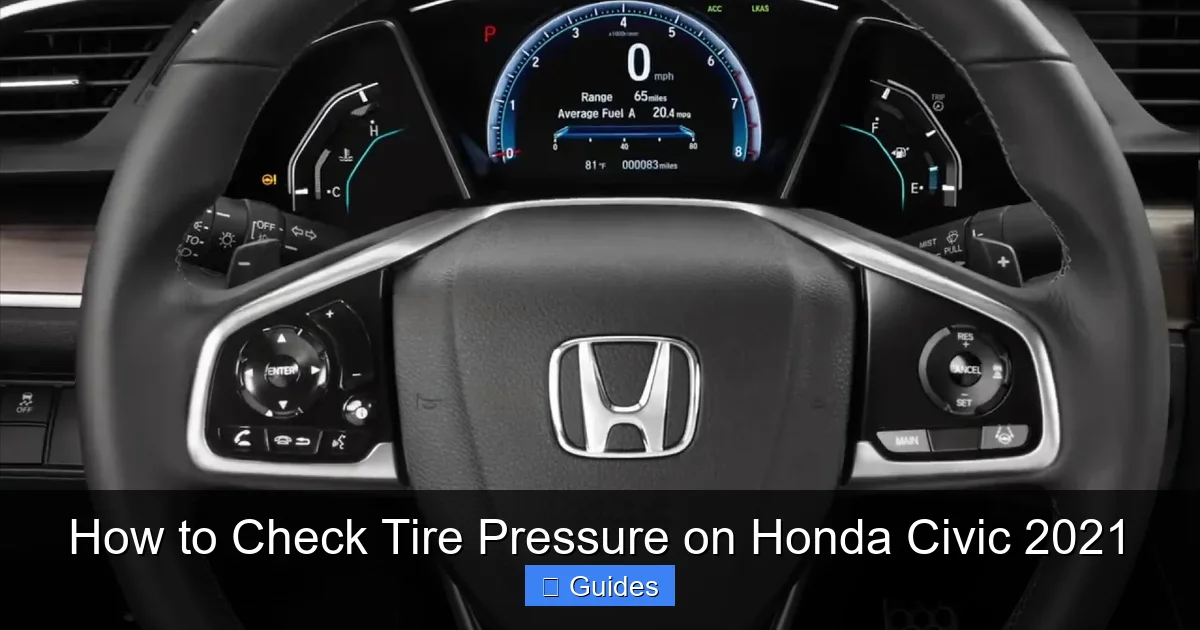
Tire pressure refers to the amount of air inside your tires, measured in pounds per square inch (PSI). This air supports the weight of your car, absorbs road shocks, and maintains tire shape. But pressure isn’t constant—it changes with temperature, driving conditions, and time. For example, when it’s cold outside, air molecules move slower and take up less space, causing pressure to drop. That’s why your TPMS light might come on during a chilly morning, even if your tires were fine the day before.
Visual guide about How to Check Tire Pressure on Honda Civic 2021
Image source: carglassadvisor.com
On the flip side, driving heats up your tires. The friction between the rubber and the road increases internal temperature, which expands the air and raises pressure. This is why experts recommend checking tire pressure when tires are “cold”—meaning the car hasn’t been driven for at least three hours or has been driven less than a mile at low speed. Checking hot tires can give you a misleadingly high reading, leading you to underinflate them when you top them off.
The Ideal PSI for Your 2021 Honda Civic
So, what’s the right number? For most 2021 Honda Civics, the recommended tire pressure is between 32 and 35 PSI. However, this can vary slightly depending on your trim level, tire size, and whether you’re carrying extra weight (like passengers or cargo). The most accurate source is the tire information label located on the driver’s side door jamb. Open the door and look for a sticker—it lists the correct front and rear PSI for your specific vehicle.
For example, a 2021 Civic LX with standard 16-inch wheels typically requires 32 PSI in all four tires. But if you have a Sport or Touring model with larger 18-inch wheels, the recommended pressure might be 35 PSI. Always follow the label, not the number printed on the tire sidewall. That sidewall PSI is the maximum the tire can handle, not the ideal for your car.
How Temperature Affects Tire Pressure
Temperature fluctuations are one of the biggest reasons tire pressure changes. As a general rule, tire pressure drops by about 1 PSI for every 10°F decrease in temperature. So if it’s 70°F today and drops to 40°F overnight, you could lose 3 PSI—enough to trigger your TPMS light. This is especially important in winter months or if you live in a region with dramatic seasonal shifts.
Conversely, summer heat can increase pressure. On a hot day, driving for an hour can raise tire temperature by 50°F or more, increasing pressure by 5–7 PSI. That’s why it’s crucial to check pressure when tires are cold. If you only check them after a long drive, you might think they’re overinflated and let air out—only to find them underinflated later when they cool down.
Tools You’ll Need to Check Tire Pressure
Digital Tire Pressure Gauge
A digital tire pressure gauge is the most accurate and user-friendly tool for checking PSI. These compact devices feature an LCD screen that displays the reading instantly. Simply press the gauge onto the tire’s valve stem, and it gives you a precise measurement. Many models also have a built-in flashlight, bleed valve, and auto-shutoff feature to save battery life.
Visual guide about How to Check Tire Pressure on Honda Civic 2021
Image source: i.ytimg.com
When shopping for a digital gauge, look for one with a range of at least 0–60 PSI and an accuracy of ±1 PSI. Brands like Accutire, AstroAI, and Michelin offer reliable options under $20. Some even connect to your smartphone via Bluetooth, allowing you to log readings and track trends over time. While not essential, these features can help you stay consistent with maintenance.
Analog (Dial) Tire Pressure Gauge
If you prefer a no-frills, battery-free option, an analog dial gauge is a solid choice. These mechanical gauges use a spring-loaded needle to display pressure on a circular dial. They’re durable, don’t require charging, and often come with a protective rubber casing. However, they can be slightly less accurate than digital models and may be harder to read in low light.
To use an analog gauge, press it firmly onto the valve stem and read the number where the needle points. Make sure the gauge is perpendicular to the stem to avoid air leaks. Some models include a pressure release button to let out excess air if you overinflate.
Pencil (Stick) Tire Pressure Gauge
Pencil gauges are the simplest and cheapest option—often found at gas stations for $1–$2. They consist of a hollow tube with a graduated scale and a spring-loaded plunger. When you press it on the valve stem, the plunger extends to show the pressure. While convenient, pencil gauges are the least accurate and can wear out over time, leading to incorrect readings.
These are best used as a quick check or backup, not for precise maintenance. If you rely on a pencil gauge, consider calibrating it against a digital one occasionally to ensure it’s still reliable.
TPMS Reset Tool (Optional)
Some Honda owners use a TPMS reset tool to recalibrate the system after rotating tires or replacing sensors. While the 2021 Civic can often reset the TPMS automatically after driving a short distance, a dedicated tool can speed up the process. These devices plug into the OBD-II port and communicate with the car’s computer to clear warnings and relearn sensor IDs.
However, most drivers won’t need this tool for routine pressure checks. It’s more useful for mechanics or enthusiasts who frequently service their vehicles. If your TPMS light stays on after inflating tires, consult your owner’s manual or a Honda dealer for guidance.
Step-by-Step Guide: How to Check Tire Pressure on Honda Civic 2021
Step 1: Park on a Level Surface and Let Tires Cool
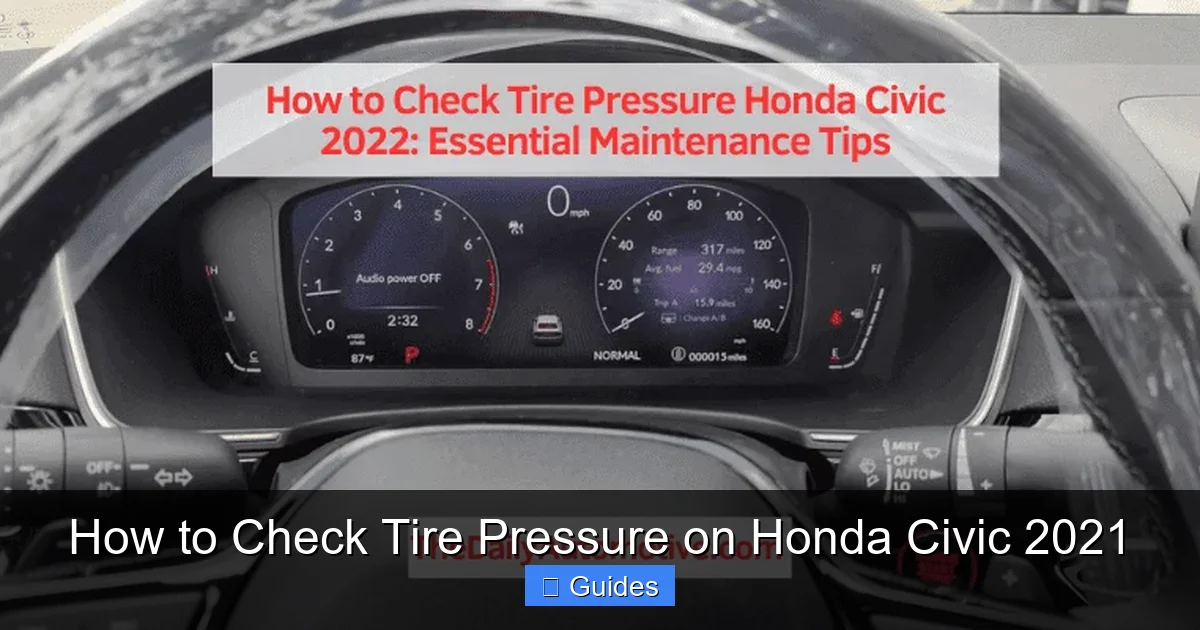
Start by parking your Civic on a flat, level surface—like a driveway or garage floor. Avoid checking pressure on gravel, grass, or uneven ground, as this can affect readings. Then, make sure the car hasn’t been driven for at least three hours. If you’ve just arrived home, wait before checking. Cold tires give the most accurate results.
Visual guide about How to Check Tire Pressure on Honda Civic 2021
Image source: thedailyautomotive.com
Pro tip: Check your tires first thing in the morning before heading out. This ensures they’re cold and gives you a chance to adjust pressure before your drive.
Step 2: Locate the Valve Stem and Remove the Cap
Each tire has a small rubber valve stem protruding from the rim. It looks like a tiny metal tube with a threaded cap. Twist the cap counterclockwise to remove it. Keep the cap in a safe place—like your pocket or center console—so you don’t lose it. If the cap is missing, dirt and moisture can enter the valve and cause leaks.
Some valve stems have a Schrader valve (similar to a bike tire), while others may have a TPMS sensor built in. Don’t worry—the process is the same for both. Just be gentle when pressing the gauge to avoid damaging the sensor.
Step 3: Attach the Pressure Gauge and Read the PSI
Press your tire pressure gauge firmly onto the valve stem. You’ll hear a brief hiss of air—that’s normal. Hold it steady for 2–3 seconds until the reading stabilizes. On a digital gauge, the number will appear on the screen. On an analog gauge, note where the needle points.
If you’re using a pencil gauge, the plunger will extend. Read the number at the base of the plunger. For accuracy, take two readings and average them. If the numbers differ by more than 1 PSI, check again.
Step 4: Compare Reading to Recommended PSI
Check the reading against the recommended PSI listed on the driver’s door jamb sticker. For example, if your Civic calls for 33 PSI and your gauge shows 29, your tire is underinflated by 4 PSI. If it shows 37, it’s overinflated by 2 PSI.
Underinflation is more common and dangerous than overinflation. It increases rolling resistance, reduces fuel economy, and causes the tire’s sidewalls to flex excessively, leading to overheating and potential failure. Overinflation, while less risky, can cause a harsher ride and uneven tread wear in the center of the tire.
Step 5: Add or Release Air as Needed
If your tire is underinflated, use an air compressor to add air. Most gas stations have self-service air pumps with built-in gauges. Attach the air hose to the valve stem and add air in short bursts, checking the pressure frequently. Don’t overfill—it’s easier to add air than remove it.
If your tire is overinflated, press the small pin in the center of the valve stem with a tool (like a key or the back of your gauge) to release air. Listen for the hiss and check the pressure until it reaches the target.
Step 6: Replace the Valve Cap and Repeat for All Tires
Once the pressure is correct, screw the valve cap back on tightly. Then move to the next tire and repeat the process. Don’t forget the spare tire if your Civic includes one—especially if you live in an area with rough roads or plan long trips.
Pro tip: Check tires in a consistent order—front driver, front passenger, rear passenger, rear driver—to avoid missing one.
Step 7: Reset the TPMS (If Needed)
After adjusting pressure, your TPMS light may stay on for a few minutes. Drive your Civic at 15 mph or faster for about 10 minutes. The system should automatically recalibrate and turn off the light. If it doesn’t, consult your owner’s manual for a manual reset procedure or visit a Honda service center.
Using the Honda Civic’s Built-In TPMS
How the TPMS Works
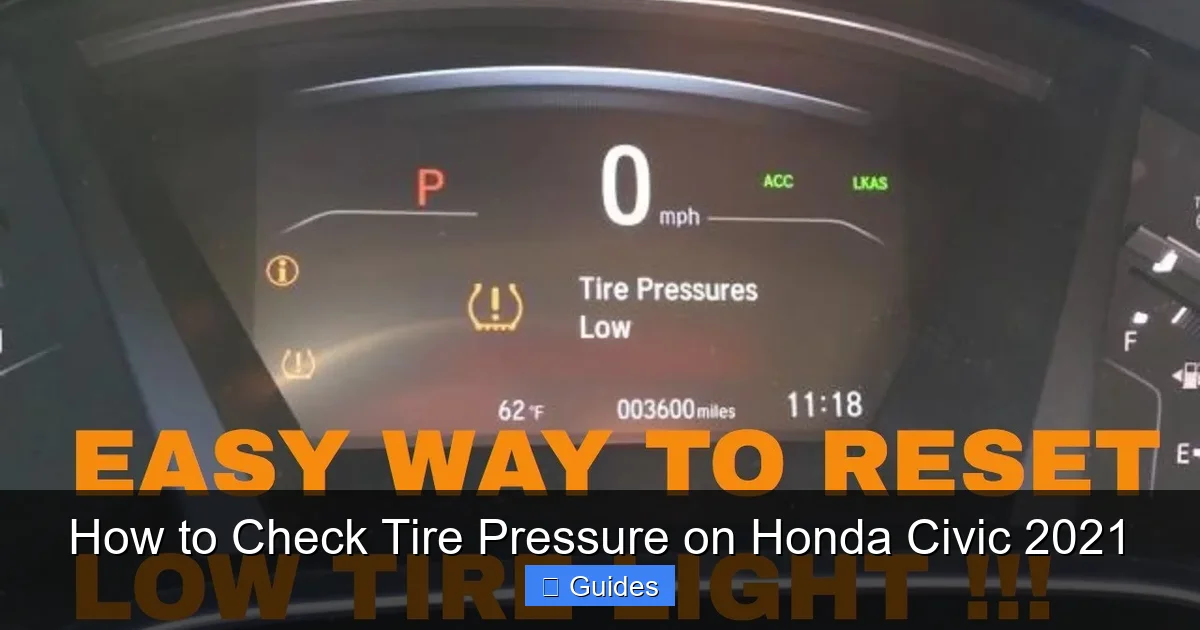
The 2021 Honda Civic comes equipped with a direct Tire Pressure Monitoring System. Each wheel has a sensor that measures actual air pressure and sends data to the car’s computer. If pressure drops below 25% of the recommended level, the TPMS warning light—a yellow icon shaped like a tire cross-section with an exclamation point—will illuminate on the dashboard.
This system is a great safety net, but it’s not perfect. It only alerts you after pressure is significantly low, and it can’t tell you the exact PSI. That’s why manual checks are still essential.
Interpreting the TPMS Light
If the TPMS light comes on, don’t panic—but don’t ignore it either. Pull over safely and check all four tires with a gauge. The light could indicate a slow leak, a damaged valve stem, or simply cold weather. If one tire is significantly lower than the others, inspect it for nails, cracks, or punctures.
In rare cases, the light may flash for 60–90 seconds and then stay on. This usually means a TPMS sensor has failed or the system needs recalibration. Visit a Honda dealer for diagnosis.
Maintaining TPMS Sensors
TPMS sensors are powered by small batteries that last 5–10 years. When a sensor fails, it must be replaced—usually during a tire change. Some shops charge $50–$100 per sensor, so it’s worth asking about warranties or discounts. Always ensure new sensors are properly programmed to your Civic’s system.
Common Mistakes to Avoid
Checking Tires When Hot
One of the biggest mistakes drivers make is checking tire pressure after driving. Heat increases pressure, so readings will be artificially high. Always check when tires are cold for accuracy.
Ignoring the Spare Tire
Many people forget the spare. But if you get a flat, you’ll need it. Check the spare monthly and keep it inflated to the recommended PSI (usually higher than regular tires).
Relying Solely on TPMS
TPMS is helpful, but it’s not a substitute for manual checks. It only warns you after pressure is dangerously low. Regular inspections catch issues early.
Using the Sidewall PSI
The number on the tire sidewall is the maximum pressure, not the recommended. Always use the door jamb sticker for the correct PSI.
Overinflating to Improve Fuel Economy
Some drivers inflate tires beyond the recommended PSI to reduce rolling resistance. But this can lead to a rough ride, reduced traction, and uneven wear. Stick to the manufacturer’s guidelines.
When to Check Tire Pressure
Make tire pressure checks part of your monthly routine. Set a reminder on your phone or calendar. Also check pressure:
- Before long trips
- After significant temperature changes (e.g., winter to spring)
- When the TPMS light comes on
- After hitting a pothole or curb
- When installing new tires or rotating them
Consistency is key. A little time each month can prevent big problems down the road.
Conclusion
Checking tire pressure on your 2021 Honda Civic is one of the simplest yet most impactful maintenance tasks you can do. It takes just five minutes, requires minimal tools, and delivers big benefits: better fuel economy, safer handling, longer tire life, and peace of mind. With the Civic’s advanced TPMS and your own reliable gauge, you have everything you need to keep your tires in top shape.
Don’t wait for the warning light to come on. Make tire pressure checks a habit. Your car—and your wallet—will thank you. Whether you’re a new driver or a seasoned Civic owner, this small step ensures every journey is as smooth, efficient, and safe as Honda intended.
Frequently Asked Questions
How often should I check tire pressure on my 2021 Honda Civic?
Check tire pressure at least once a month and before long trips. Also check it when temperatures change significantly or if the TPMS light comes on.
Can I rely only on the TPMS light to know if my tires are low?
No, the TPMS only alerts you after pressure drops significantly. Manual checks with a gauge are more accurate and help catch issues early.
What PSI should my 2021 Honda Civic tires be?
Most 2021 Civics require 32–35 PSI. Check the sticker on the driver’s door jamb for the exact recommended pressure for your model.
Is it okay to check tire pressure after driving?
No, always check when tires are cold—before driving or after the car has sat for at least three hours—for accurate readings.
Why does my TPMS light come on in cold weather?
Cold temperatures cause air to contract, lowering tire pressure. Check and inflate tires as needed, and the light should turn off after driving.
Do I need to check the spare tire?
Yes, if your Civic has a spare, check its pressure monthly. A flat spare is no help in an emergency.

At CarLegit, we believe information should be clear, factual, and genuinely helpful. That’s why every guide, review, and update on our website is created with care, research, and a strong focus on user experience.