
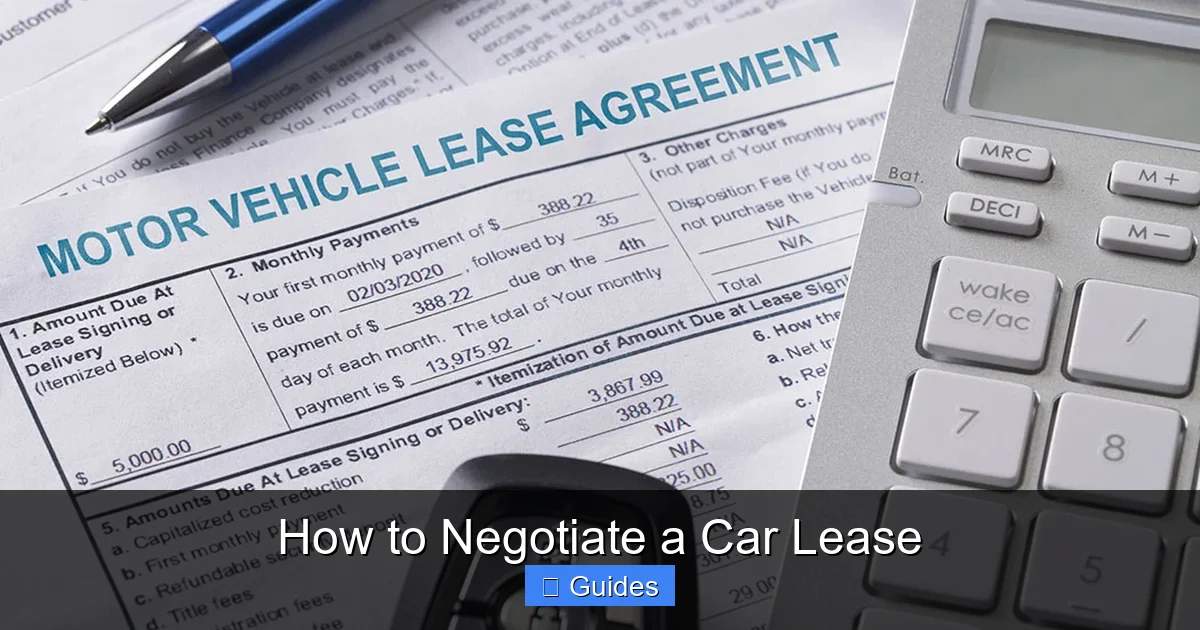
Negotiating a car lease doesn’t have to be intimidating. With the right knowledge and preparation, you can secure a better deal, lower monthly payments, and avoid hidden fees. This guide walks you through every step to help you drive away with confidence.
In This Article
- 1 Key Takeaways
- 2 📑 Table of Contents
- 3 How to Negotiate a Car Lease: A Step-by-Step Guide
- 4 Understand How Car Leasing Works
- 5 Do Your Homework Before You Walk In
- 6 Negotiate the Capitalized Cost
- 7 Understand and Negotiate the Money Factor
- 8 Evaluate the Residual Value and Lease Term
- 9 Watch Out for Hidden Fees and Charges
- 10 Time Your Lease for Maximum Savings
- 11 Final Tips for a Successful Negotiation
- 12 Frequently Asked Questions
Key Takeaways
- Know your credit score: A higher score can qualify you for lower interest rates and better lease terms.
- Research the car’s value: Use tools like Kelley Blue Book and Edmunds to understand the vehicle’s true market price.
- Negotiate the capitalized cost: This is the equivalent of the purchase price—lower it to reduce your monthly payments.
- Understand the money factor: This is the lease’s interest rate; convert it to an APR to compare offers fairly.
- Check the residual value: A higher residual means lower depreciation and lower payments.
- Watch out for fees: Be aware of acquisition, disposition, and excess mileage fees before signing.
- Time your lease wisely: End-of-month, end-of-quarter, and end-of-year sales often offer the best deals.
📑 Table of Contents
- How to Negotiate a Car Lease: A Step-by-Step Guide
- Understand How Car Leasing Works
- Do Your Homework Before You Walk In
- Negotiate the Capitalized Cost
- Understand and Negotiate the Money Factor
- Evaluate the Residual Value and Lease Term
- Watch Out for Hidden Fees and Charges
- Time Your Lease for Maximum Savings
- Final Tips for a Successful Negotiation
How to Negotiate a Car Lease: A Step-by-Step Guide
So you’re thinking about leasing a car. Maybe you love driving a new vehicle every few years, or you want lower monthly payments compared to buying. Whatever your reason, one thing’s for sure: you don’t want to overpay. The good news? Leasing a car doesn’t have to be a mystery—and you *can* negotiate a better deal.
Unlike buying a car, where the focus is on the total price, leasing involves several moving parts: the capitalized cost, residual value, money factor, and mileage limits. It’s easy to feel overwhelmed, but with the right approach, you can walk into the dealership prepared and confident. This guide will walk you through everything you need to know to negotiate a car lease like a pro—without the stress.
Whether you’re leasing your first car or you’ve done it before, this guide will help you avoid common pitfalls, understand the fine print, and save real money. We’ll break down each component of a lease agreement, show you how to research your target vehicle, and give you practical tips to use during negotiations. By the end, you’ll know exactly what to ask for—and how to get it.
Understand How Car Leasing Works
Visual guide about How to Negotiate a Car Lease
Image source: media.wheelscene.com
Before you start negotiating, it’s crucial to understand how leasing actually works. A car lease is essentially a long-term rental. You’re paying for the vehicle’s depreciation during the lease term, plus interest and fees—not the full value of the car.
Let’s say you lease a $30,000 car for three years. Over that time, the car might lose $15,000 in value due to depreciation. That $15,000, plus interest and fees, is what you’ll pay in monthly installments. At the end of the lease, you return the car (assuming you’ve met the mileage and condition requirements), and you’re free to lease another vehicle or walk away.
The Key Components of a Lease
There are four main factors that determine your monthly lease payment:
- Capitalized Cost: This is the price of the car you agree to lease. It’s similar to the purchase price when buying. The lower this number, the lower your payments.
- Residual Value: This is the estimated value of the car at the end of the lease. It’s expressed as a percentage of the car’s MSRP. A higher residual means the car holds its value better, which lowers your monthly cost.
- Money Factor: This is the interest rate on your lease, written as a decimal (e.g., 0.00250). To convert it to an APR, multiply by 2,400. So 0.00250 × 2,400 = 6% APR.
- Lease Term: Most leases are 24, 36, or 48 months. Shorter terms usually mean higher monthly payments but less total interest paid.
Understanding these components is the foundation of a successful negotiation. Dealers often focus on monthly payments to distract you from the bigger picture. But if you know how each part affects your cost, you can push back effectively.
Why Leasing Can Be a Smart Choice
Leasing isn’t for everyone, but it has real advantages. You get to drive a new car every few years with lower monthly payments than financing. You’re also covered under the manufacturer’s warranty for the entire lease term, so major repairs are usually not your problem. And if you don’t drive a lot or prefer not to deal with selling a car, leasing can be a hassle-free option.
That said, leasing has downsides: you don’t build equity, you’re limited on mileage, and you’ll always have a car payment. But if you understand the trade-offs and negotiate wisely, leasing can be a smart financial move.
Do Your Homework Before You Walk In

Visual guide about How to Negotiate a Car Lease
Image source: media.wheelscene.com
The most powerful tool in your negotiation arsenal is knowledge. The more you know about the car, the market, and the lease terms, the more leverage you have. Don’t walk into a dealership blind—do your research first.
Research the Car’s True Value
Start by identifying the exact make, model, trim, and options you want. Then, use trusted resources like Kelley Blue Book (KBB), Edmunds, and TrueCar to find the car’s fair market value. These sites show you what others are paying in your area, which gives you a strong starting point for negotiation.
For example, if the MSRP of a 2024 Honda CR-V EX is $32,000, but KBB shows that most buyers are paying $30,500, you know the dealer should be able to lease it to you for close to that price—or lower.
Check Incentives and Promotions
Manufacturers often offer lease specials to move inventory. These can include cash rebates, low money factors, or waived fees. Visit the automaker’s website and search for “lease deals” or “current offers.” You can also check sites like Leasehackr or Edmunds for updated promotions.
Let’s say Honda is offering a $2,000 lease cash incentive on the CR-V. That’s $2,000 the dealer can apply to reduce your capitalized cost—directly lowering your monthly payment. Make sure to mention this during negotiations.
Know Your Credit Score
Your credit score plays a big role in the money factor you’re offered. The higher your score, the lower the interest rate. Check your credit report from AnnualCreditReport.com (it’s free once a year) and know your FICO score before you shop.
If your score is 720 or higher, you’ll likely qualify for the best lease rates. If it’s below 650, you may face higher money factors or need a co-signer. But don’t let that stop you—some dealers work with subprime lenders, and improving your score even slightly can make a difference.
Negotiate the Capitalized Cost

Visual guide about How to Negotiate a Car Lease
Image source: chattersource.com
The capitalized cost is the starting point for your lease payment—so it’s the most important number to negotiate. Think of it as the “price” of the car for leasing purposes. The lower you can get it, the better your deal.
Start Below Invoice Price
Just like when buying a car, you should aim to negotiate below the dealer’s invoice price—the amount the dealer paid the manufacturer. You can find invoice prices on Edmunds or TrueCar. For example, if the invoice price is $29,800 and the MSRP is $32,000, starting your offer at $29,000 gives you room to negotiate.
Don’t be afraid to go low. Dealers expect negotiation, and they often build in profit margins. If they say no, ask what the lowest they can go is—and be ready to walk away if it’s not good enough.
Use Competing Offers
Get quotes from multiple dealerships—even if they’re not local. Many dealers will honor quotes from competitors to win your business. Call or email three or four dealers with the same car configuration and ask for their best lease offer.
When you go to your preferred dealer, show them the best offer you’ve received and ask them to beat it. This creates healthy competition and increases your chances of getting a better deal.
Avoid Add-Ons and Extras
Dealers may try to increase the capitalized cost by adding unnecessary extras like paint protection, fabric coating, or VIN etching. These can add hundreds—or even thousands—to your lease cost.
Politely decline these add-ons unless you truly want them. If they’re already included in the quote, ask to have them removed to lower the capitalized cost.
Understand and Negotiate the Money Factor
The money factor is the lease equivalent of an interest rate. It’s usually a small decimal like 0.00200 or 0.00350. But don’t let the tiny number fool you—it has a big impact on your monthly payment.
Convert to APR for Clarity
To make it easier to compare, convert the money factor to an annual percentage rate (APR). Multiply the money factor by 2,400.
For example:
– 0.00200 × 2,400 = 4.8% APR
– 0.00350 × 2,400 = 8.4% APR
Now you can see that a 0.00350 money factor is significantly more expensive. If you have good credit, you should expect a money factor close to or below 0.00200 (4.8% APR).
Ask for the “Buy Rate”
The buy rate is the lowest money factor the dealer can offer based on your credit. Dealers sometimes mark this up to make extra profit. Ask directly: “What is the buy rate for someone with my credit score?”
If they give you a higher number, ask why. You can also mention that you’ve seen lower rates at other dealerships or online. Most dealers will adjust the money factor to keep your business.
Watch for “Money Factor Markup”
Some dealers inflate the money factor without telling you. This is called a markup, and it’s a hidden profit center. If your credit is strong but the money factor seems high, it might be marked up.
Always ask for the buy rate and compare it to what you’re being offered. If there’s a gap, negotiate it down.
Evaluate the Residual Value and Lease Term
The residual value and lease term also affect your monthly payment—and they’re not always negotiable, but you should still understand them.
Higher Residual = Lower Payments
The residual value is the car’s estimated worth at the end of the lease. It’s set by the leasing company (often the manufacturer’s financial arm) and is based on the car’s expected depreciation.
For example, a car with a $30,000 MSRP and a 60% residual after three years has a residual value of $18,000. That means you’re only paying for the $12,000 in depreciation (plus interest and fees).
Cars that hold their value well—like Toyotas, Hondas, and Subarus—typically have higher residuals and lower lease payments. Luxury brands like BMW and Mercedes often have lower residuals, meaning higher payments.
Choose the Right Lease Term
Most leases are 24, 36, or 48 months. Shorter terms mean higher monthly payments but less total interest. Longer terms spread out the cost but may result in higher overall spending.
Consider your driving habits and budget. If you drive a lot or want the lowest monthly payment, a 36-month lease is usually the sweet spot. Avoid 48-month leases unless necessary—they increase the risk of owing more than the car is worth if you want to end the lease early.
Negotiate Mileage Limits
Standard leases include 10,000 to 15,000 miles per year. If you drive more, you’ll pay extra—usually $0.15 to $0.25 per mile over the limit.
If you know you’ll exceed the mileage, negotiate a higher allowance upfront. It’s cheaper to pay a little more per month than a big penalty at the end. For example, increasing your limit from 12,000 to 15,000 miles might add $20–$30 to your monthly payment—but it could save you $1,000 in overage fees.
Watch Out for Hidden Fees and Charges
Lease agreements are full of fees—some reasonable, some not. Knowing what to look for can save you hundreds.
Acquisition Fee
This is a one-time fee charged by the leasing company to set up your lease. It can range from $500 to $1,000. Some dealers roll it into the capitalized cost, while others let you pay it upfront.
Ask if the acquisition fee can be waived or reduced. Some manufacturers offer promotions that include a waived acquisition fee.
Disposition Fee
This fee—typically $300 to $500—is charged when you return the car at the end of the lease. It covers the cost of cleaning and reconditioning the vehicle.
You can’t avoid this fee if you return the car, but you can negotiate it down or ask the dealer to cover it as part of the deal.
Excess Wear and Tear
Leases include guidelines for acceptable wear and tear. Scratches, dents, or stained upholstery beyond normal use can result in charges.
Take photos of the car before you drive it off the lot. Keep records of any damage. At the end of the lease, consider getting a pre-inspection to identify issues early.
Early Termination Fees
Ending your lease early can be expensive. Most leases charge a fee equivalent to several months of payments. Only sign a lease if you’re confident you’ll keep the car for the full term.
Time Your Lease for Maximum Savings
Timing can make a big difference in your lease deal. Dealers and manufacturers are often motivated to meet sales targets at certain times of the year.
End-of-Month and End-of-Quarter
Salespeople have monthly and quarterly goals. At the end of these periods, they may be more willing to negotiate to hit their targets. Visit the dealership in the last week of the month for better leverage.
End-of-Year and Model-Year Clearance
When new models arrive (usually in late summer or fall), dealers want to clear out old inventory. This is a great time to lease a current-year model at a discount.
Manufacturers also offer special lease deals during holiday weekends like Memorial Day, July 4th, and Labor Day. Keep an eye out for promotions.
New Model Year Launch
When a new model year is introduced, the previous year’s model often comes with deep discounts. If you don’t mind driving a “last year” car, you can save significantly.
Final Tips for a Successful Negotiation
Now that you know the ins and outs of leasing, here are a few final tips to seal the deal:
- Stay calm and confident: You’re in control. Don’t let pressure tactics rush you.
- Negotiate one item at a time: Focus on the capitalized cost first, then the money factor, then fees.
- Get everything in writing: Don’t rely on verbal promises. Ask for a written quote with all terms clearly listed.
- Read the lease agreement carefully: Before signing, review every line. Make sure the numbers match your negotiated terms.
- Consider a lease takeover: Websites like Swapalease let you take over someone else’s lease. This can be a great way to get a short-term deal with low payments.
Negotiating a car lease doesn’t have to be stressful. With preparation, knowledge, and a clear strategy, you can drive away in the car you want—at a price you can afford.
Frequently Asked Questions
Can you negotiate a car lease?
Yes, absolutely. Nearly every part of a lease agreement—including the capitalized cost, money factor, and fees—can be negotiated. The key is to do your research and approach the process with confidence.
What is a good money factor for a lease?
A good money factor is typically 0.00200 or lower, which equals a 4.8% APR or less. If your credit score is strong, you should expect to qualify for rates at or below this level.
Is it better to lease or buy a car?
It depends on your priorities. Leasing offers lower monthly payments and the chance to drive a new car every few years, but you don’t build equity. Buying costs more upfront but saves money in the long run if you keep the car.
How much should I put down on a lease?
It’s often better to put little or nothing down. A large down payment increases your risk if the car is stolen or totaled. Instead, roll any fees into the lease or pay them upfront to keep your capitalized cost low.
Can you negotiate the residual value?
No, the residual value is set by the leasing company and is not negotiable. However, choosing a car with a high residual value (like a Toyota or Honda) can lower your payments.
What happens at the end of a lease?
At the end of the lease, you return the car to the dealership. You’ll be charged for any excess mileage or wear and tear. You can also choose to buy the car at its residual value or lease a new vehicle.

At CarLegit, we believe information should be clear, factual, and genuinely helpful. That’s why every guide, review, and update on our website is created with care, research, and a strong focus on user experience.