
Featured image for how to put jeep cherokee in neutral with dead battery
Image source: i.ytimg.com
If your Jeep Cherokee’s battery is dead, you can still shift it into neutral by locating and engaging the shift interlock override mechanism, usually found near the gear selector. This manual release bypasses the electronic lock, allowing you to move the vehicle for towing or service. Typically, you’ll need to remove a small cap or cover near the shifter and press the exposed button or lever to disengage the parking pawl.
The dreaded silence. You turn the key in your Jeep Cherokee, or press the start button, and instead of the familiar roar of the engine, you’re met with a chilling quiet. Maybe a faint clicking, perhaps a few flickering dashboard lights, but certainly no sign of life from the powertrain. Your battery, it seems, has decided to call it quits. This isn’t just an inconvenience; it can be a significant problem, especially if your beloved Jeep Cherokee is stuck in park with a dead battery, blocking a driveway, an alley, or worse, making it impossible to move for a jump-start or towing.
The situation intensifies when you realize that without power, the transmission is often locked in ‘Park’ – a safety feature designed to prevent unintended rolling. But what happens when that safety feature becomes a formidable obstacle? How do you get your robust Jeep Cherokee into neutral with a dead battery so it can be moved, jump-started, or loaded onto a flatbed? This comprehensive guide will walk you through the necessary steps, considerations, and model-specific nuances to conquer this common automotive dilemma, ensuring you’re prepared to tackle the challenge head-on.
Understanding the mechanism behind your Jeep Cherokee’s transmission and its interaction with a dead battery is crucial. Whether you drive a classic XJ, a more modern KJ or KK, or a contemporary KL, the approach to manually releasing the shifter can vary significantly. This post aims to provide clear, actionable advice, helping you regain control and get your Jeep moving again, even when its heart (the battery) has stopped beating.
In This Article
- 1 Key Takeaways
- 2 The Unexpected Halt: Understanding Your Jeep Cherokee’s Dead Battery Predicament
- 3 Preparation is Key: Safety Measures and Essential Tools for Neutral Release
- 4 Mechanical Shift Lock Release: For Older Jeep Cherokee Models (XJ, KJ, KK Generations)
- 5 Navigating Electronic Shifters: Strategies for Newer Jeep Cherokee Models (KL Generation and Beyond)
- 6 Troubleshooting Common Challenges and When to Seek Professional Help
- 7 Beyond the Immediate Fix: Preventing Future Dead Battery & Stuck Shifter Scenarios
- 8 Conclusion
- 9 Frequently Asked Questions
- 9.1 Why do I need to put my Jeep Cherokee in neutral if its battery is dead?
- 9.2 How do I locate the shift interlock release for my Jeep Cherokee?
- 9.3 What are the step-by-step instructions to put a Jeep Cherokee in neutral with a dead battery?
- 9.4 Are there any special tools required to put my Jeep Cherokee in neutral without power?
- 9.5 Can putting my Jeep Cherokee in neutral manually cause any damage?
- 9.6 Does the procedure to put a Jeep Cherokee in neutral with a dead battery vary by model year?
Key Takeaways
- Engage Parking Brake: Always ensure the parking brake is set for safety.
- Locate Cover: Find the small shift interlock release cover near the shifter.
- Pry Off: Gently remove the plastic cover to reveal the release slot.
- Insert Tool: Use a screwdriver or key to press down the release button.
- Shift to Neutral: While pressing, move the gear selector to “N”.
- Confirm Neutral: Verify the transmission is disengaged before any movement.
- Consult Manual: Specific steps may vary by Jeep Cherokee model year.
The Unexpected Halt: Understanding Your Jeep Cherokee’s Dead Battery Predicament
A dead battery is more than just a minor hiccup; it can paralyze your vehicle, turning what should be a straightforward task like moving your car into a complex engineering challenge. For many vehicles, including your Jeep Cherokee, a dead battery means the transmission is locked in park. This is a deliberate safety mechanism, often governed by a shift interlock solenoid, which prevents the driver from shifting out of park unless the brake pedal is depressed and, critically, there is sufficient electrical power.
Why Does My Jeep Cherokee Get Stuck in Park with a Dead Battery?
- Shift Interlock Solenoid: Most automatic transmissions employ a shift interlock system. This system is designed to prevent accidental shifting out of park. It requires both the brake pedal to be pressed and a functional electrical signal from the battery to disengage. When the battery is dead, this electrical signal is absent, and the solenoid remains engaged, effectively locking the shifter.
- Electronic Shifters: Newer generations of the Jeep Cherokee, particularly the KL series (2014-present), often use electronic shifters instead of traditional mechanical linkages. These shifters rely entirely on electrical power to communicate with the transmission control module (TCM) and execute shifts. Without power, these systems are inert, making it impossible to manually shift into neutral in the conventional sense.
- Safety Protocols: The entire system is designed with safety in mind. A vehicle should not be able to roll freely unless the driver explicitly intends it. A dead battery scenario triggers these safety protocols, ironically making it difficult to move the vehicle even when moving it is the primary goal.
Common Scenarios for a Dead Battery Immobilization
Understanding how you got into this predicament can sometimes help in troubleshooting, or at least in preventing future occurrences. Here are some typical scenarios:
- Forgotten Lights/Accessories: Leaving headlights, interior lights, or other accessories on overnight is perhaps the most common cause of a dead battery.
- Parasitic Drain: A faulty electrical component, even a small one, can continuously draw power from the battery when the vehicle is off, leading to a gradual drain.
- Old Battery: Batteries have a finite lifespan, typically 3-5 years. An aging battery is more susceptible to dying, especially in extreme temperatures.
- Alternator Failure: If the alternator isn’t charging the battery while the engine is running, the battery will eventually drain, even if it’s new.
- Infrequent Use: Vehicles that sit unused for extended periods can also suffer from battery drain, as small electrical components still draw minimal power.
Regardless of the cause, the immediate challenge remains: how to get your Jeep Cherokee into neutral with a dead battery. The solution hinges on your specific model year, as Jeep Cherokees have evolved significantly over the generations, each with its own approach to manual shift release.
Preparation is Key: Safety Measures and Essential Tools for Neutral Release
Before you attempt any procedure to manually shift your Jeep Cherokee into neutral with a dead battery, it’s paramount to prioritize safety. Working around a disabled vehicle, especially one that might suddenly become free-rolling, carries inherent risks. A few moments of preparation can prevent accidents and ensure the process is as smooth as possible.
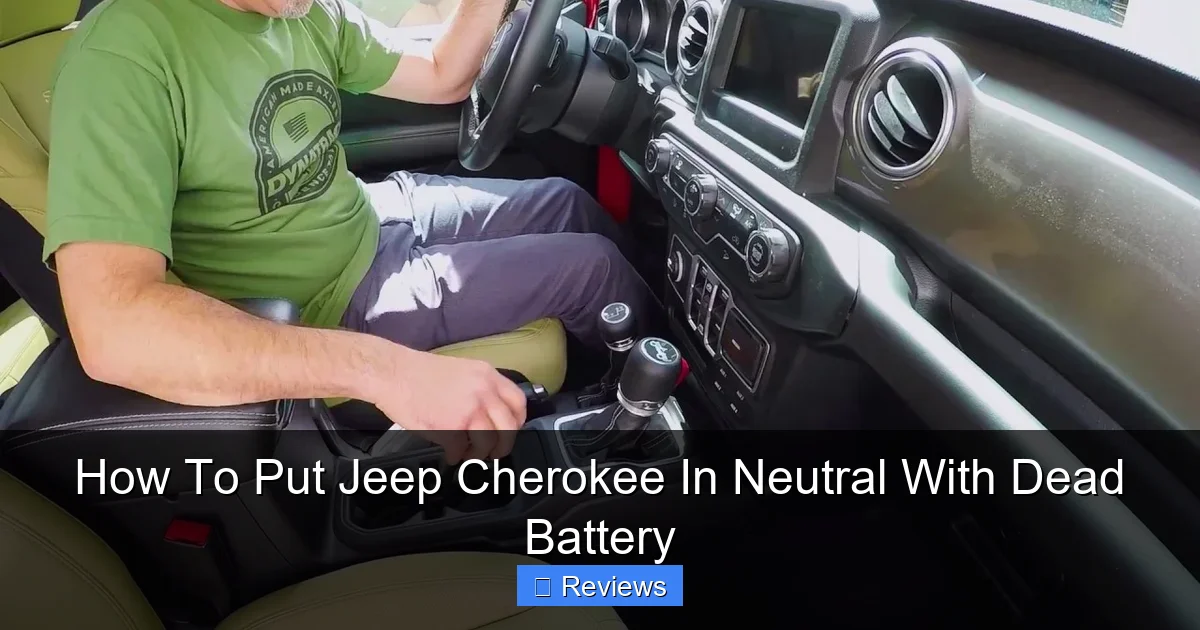
Visual guide about how to put jeep cherokee in neutral with dead battery
Image source: thecarhow.com
Prioritizing Your Safety
- Flat and Level Ground: Ensure your Jeep Cherokee is on a flat, stable surface. An incline can cause the vehicle to roll unexpectedly once it’s taken out of park, even with wheel chocks.
- Wheel Chocks: Always place wheel chocks (or sturdy blocks of wood, bricks, etc.) firmly against the wheels that are still engaged (usually the front if the rear is to be lifted, or vice-versa, depending on how you plan to move it). This is critical once the vehicle is in neutral to prevent unintended movement.
- Emergency Brake: While a dead battery might affect some electronic parking brakes, if your Jeep Cherokee has a manual handbrake or foot pedal parking brake, engage it firmly. However, be aware that once the vehicle is in neutral, the parking brake might be the only thing holding it, so use chocks in addition.
- Visibility: If you are on the side of a road or in a poorly lit area, use hazard lights (if the battery has enough residual power), reflective triangles, or flares to alert other drivers to your presence. A flashlight or headlamp is also essential for seeing under the dashboard or around the shifter console.
- Gloves: Protect your hands from grime, sharp edges, and potential pinches.
- Have Assistance: If possible, have a second person assist you. One person can operate the release mechanism while the other monitors the vehicle’s movement and ensures safety.
Essential Tools You’ll Need
The tools required will vary slightly depending on your Jeep Cherokee model, but a basic kit will cover most scenarios:
- Flathead Screwdriver: Often used to pry open trim pieces or to depress a shift lock release button. A medium-sized one is usually sufficient.
- Phillips Head Screwdriver: Less commonly needed for neutral release, but useful if you need to remove any console screws.
- Flashlight or Headlamp: Absolutely vital for seeing into dimly lit areas around the shifter console or under the dashboard.
- Wheel Chocks: As mentioned, for safety.
- Owner’s Manual: Your vehicle’s owner’s manual is an invaluable resource. It contains model-specific instructions for emergency procedures, including how to put your Jeep Cherokee in neutral with a dead battery. It often illustrates the exact location of the shift lock override.
- (Optional) Jump Starter Pack or Jumper Cables: While the goal is to get it into neutral *without* power, for newer Jeep Cherokee models with electronic shifters, a temporary power boost might be the only way to achieve a shift. Having these on hand can save you a lot of hassle.
Once you’ve secured the area and gathered your tools, you’re ready to proceed to the specific methods for your Jeep Cherokee’s generation.
Mechanical Shift Lock Release: For Older Jeep Cherokee Models (XJ, KJ, KK Generations)
For many older Jeep Cherokee models, specifically the XJ (1984-2001), KJ (Liberty, 2002-2007), and KK (Liberty, 2008-2012), the transmission shift interlock system is mechanical, or at least has a mechanical override. This design is more forgiving in a dead battery situation, as it allows for a direct manual release of the shift lever lock. The key is to locate a small access slot or button near the shifter console.
Visual guide about how to put jeep cherokee in neutral with dead battery
Image source: koala.sh
Understanding the Mechanical Override
The mechanical shift lock release is typically a small button or a slot that, when pressed or activated, physically disengages the solenoid that prevents the shifter from moving out of park. It’s an emergency feature designed precisely for situations where there’s no power, or a fault in the brake light switch or shift interlock system.
Step-by-Step Guide for XJ, KJ, and KK Jeep Cherokees
Follow these steps carefully to put your Jeep Cherokee (XJ, KJ, KK) into neutral with a dead battery:
- Engage Parking Brake and Chock Wheels: Even though your battery is dead, firmly engage the parking brake. Place wheel chocks securely around the wheels that are not going to be moved initially. Safety first!
- Locate the Shift Lock Release Slot/Button:
- For most XJ, KJ, and KK models, look closely around the base of the gear shifter console. You’re searching for a small, often inconspicuous, slot, button, or removable cap. It might be labeled with a ‘Shift Lock’ icon or a small circle.
- Typical Locations:
- Near the shifter base: Often on the front or side of the shifter bezel.
- Under a small removable plastic cap: Some models have a small plastic cover that you need to pry off with a flathead screwdriver to reveal the slot/button.
- Within the shift gate: Sometimes, it’s integrated into the shifter gate itself, requiring a specific angle to access.
- Consult your owner’s manual for the exact location and appearance for your specific model year. This is the most reliable source.
- Insert Tool and Depress/Activate:
- Once you’ve located the slot or button, take your flathead screwdriver, a pen, or even your car key.
- Insert the tip of the tool into the slot or firmly press the button. You might feel a slight resistance or a click as you engage the mechanism. Keep it depressed.
- Important: You often need to hold the release button/lever down while attempting to shift.
- Shift to Neutral:
- While holding the shift lock release mechanism, simultaneously press the brake pedal (even if there’s no power, it’s good practice and might activate a residual mechanical linkage if present) and attempt to move the gear shifter from ‘Park’ to ‘Neutral’.
- It might require a firm but not forceful push. If it doesn’t move, ensure you’re pressing the release mechanism completely and that the tool is fully inserted.
- Verify Neutral and Release Parking Brake:
- Once the shifter is in ‘Neutral’, release the shift lock mechanism.
- Carefully remove the wheel chocks (ensure you have a clear path or someone to guide the vehicle) and slowly release the parking brake.
- Confirm the vehicle is truly in neutral by attempting to push it gently. It should roll.
Practical Tip for Older Models: Checking Your Brake Lights
While dealing with a dead battery, it’s worth noting that a common cause for a shifter being stuck in park (even with a good battery) is a faulty brake light switch. If the switch isn’t telling the car you’re pressing the brake, the shift interlock won’t release. If your Jeep Cherokee does get partial power back (e.g., after a partial jump-start) but still won’t shift, check if your brake lights illuminate when you press the pedal. If not, the switch might be the culprit, but for a truly dead battery, the manual override is your primary solution.
This mechanical override is a lifesaver for older Jeep Cherokee owners. However, as vehicle technology advanced, so did the complexity of transmission systems, particularly with the introduction of electronic shifters.
The landscape of automotive technology significantly shifted with the introduction of electronic shifters, prominent in newer vehicles, including the Jeep Cherokee KL generation (2014-present). These modern systems replace traditional mechanical linkages with ‘shift-by-wire’ technology, where the shifter merely sends electronic signals to the transmission control module (TCM). This advancement brings convenience but poses a unique challenge when you have a dead battery and need to put your Jeep Cherokee into neutral.
Visual guide about how to put jeep cherokee in neutral with dead battery
Image source: koala.sh
The Reality of Electronic Shifters with a Dead Battery
Unlike their mechanical predecessors, electronic shifters typically *do not* have a readily accessible, consumer-friendly mechanical override for a completely dead battery. If your Jeep Cherokee’s battery is truly dead (0 volts), meaning no electrical power whatsoever, the electronic shifter will be completely unresponsive. It won’t send signals, and the transmission will remain locked in park.
This is a critical distinction: for a Jeep Cherokee with an electronic shifter and a completely dead battery, the primary “manual” solution often involves restoring *some* electrical power to the system, even if temporarily, to allow the electronic shifter to function.
Strategies When Your KL Jeep Cherokee Has a Dead Battery
1. The Preferred Method: Jump-Starting or Temporary Power
For most Jeep Cherokee KL models with electronic shifters, the most reliable way to get the vehicle into neutral with a dead battery is to provide temporary power. This usually means a jump-start.
- Attempt a Jump-Start:
- Using jumper cables and another running vehicle (or a portable jump starter pack), connect to your Jeep Cherokee’s battery terminals (or jump-start posts, if specified in your manual).
- Allow the battery to charge for 5-10 minutes. Even if the engine doesn’t start, this might be enough to restore minimal power to the vehicle’s electrical system.
- Try Shifting:
- With the temporary power connected, try pressing the brake pedal (which will now likely engage the brake light switch) and then attempt to shift the electronic shifter into neutral.
- If successful, the shifter should respond, and you can move it to ‘N’.
- Important Consideration: Even if the engine doesn’t turn over, if you can get enough residual voltage into the system, the shifter may activate. This is often the *only* “manual” override for electronic systems without mechanical backups.
2. Searching for a “Hidden” Manual Release (If It Exists for Your Specific Model Year)
While less common for electronic shifters, some manufacturers (though rarely Jeep for the KL) *might* incorporate a very discreet, less obvious manual override for extreme cases. This would typically be detailed in the owner’s manual under “Emergency Procedures” or “Towing.”
- Consult Your Owner’s Manual Immediately: This is your primary resource. Look for sections on “Towing,” “Emergency Shifting,” or “Dead Battery.”
- Deep Dive into Console Access: If a manual release exists, it’s usually deeply recessed, requiring significant console disassembly or a very specific tool to access. This is generally not a roadside fix and is often intended for dealer service technicians.
- Example: Transmission Park Rod Release: Some vehicles (not widely documented for KL Cherokee) have a mechanism that directly releases the transmission park rod. This is a very involved process, typically requiring the vehicle to be lifted and accessed from underneath, definitely a job for a professional.
The takeaway here is crucial: for a KL-generation Jeep Cherokee with a truly dead battery, direct mechanical shifting into neutral without *any* power is usually not possible. Your best bet is always to attempt to restore minimal power (via jump-start) to enable the electronic shifter.
When Jump-Starting Isn’t an Option
If you’re in a situation where jump-starting is not feasible (e.g., no other vehicle, jump starter pack is also dead, or the battery is so utterly flat it won’t even take a superficial charge), you’re facing a more challenging scenario.
- Professional Towing: In this case, your safest and most practical option is to call for professional towing services. Inform them that your Jeep Cherokee is stuck in park with a dead battery and has an electronic shifter. A reputable towing company will have equipment like wheel dollies or a flatbed truck with a winch, which can safely move your immobilized vehicle without needing it to be in neutral.
- Manual Rocking (Extreme Caution!): In very rare, desperate situations on a *perfectly flat surface*, some people attempt to gently rock the vehicle back and forth to try and jiggle the park pawl. This is extremely risky, can damage the transmission, and is NOT recommended. It should only be considered if there is absolutely no other option and you understand the severe risks involved. Always prioritize safety and professional help.
Navigating an electronic shifter with a dead battery can be frustrating, but knowing your options, and the limitations of the technology, empowers you to make the right decision for your Jeep Cherokee.
Troubleshooting Common Challenges and When to Seek Professional Help
Even with the right knowledge and tools, sometimes your Jeep Cherokee still won’t shift into neutral with a dead battery. Several factors can complicate the process, and it’s important to know when to persist with troubleshooting and when to recognize that professional assistance is the safest and most efficient path forward.
Common Troubleshooting Scenarios
1. The Shift Lock Release Mechanism Won’t Budge (Older Models)
- Insufficient Force: Ensure you are pressing the release button or inserting the tool fully and firmly. Sometimes it requires more pressure than expected.
- Misaligned Tool: Double-check that your screwdriver or tool is correctly aligned with the mechanism. It’s a small target, and a slight misalignment can prevent activation.
- Stuck Mechanism: If the vehicle has been sitting for a very long time, or if dirt/debris has entered the console, the mechanical release might be stiff or jammed. Try wiggling the tool slightly while applying pressure. Avoid excessive force that could break the mechanism.
- Broken Component: Internally, the plastic or metal linkage for the shift lock release might be broken. If you hear a click but the shifter still won’t move, this might be the case.
2. Shifter Moves, But Vehicle Doesn’t Roll
- Parking Brake Still Engaged: Ensure the parking brake is fully disengaged. For foot pedal parking brakes, sometimes they don’t release completely without a strong pull on the release lever.
- Frozen Brakes: If your Jeep Cherokee has been sitting in cold or wet conditions, the brake pads can sometimes freeze to the rotors, especially the rear ones. You might need to gently rock the vehicle, or in extreme cases, a quick tap with a rubber mallet on the wheel hub might free them (use extreme caution).
- Transmission Issue (Beyond Battery): While less likely to be the primary cause of being stuck in park with a dead battery, an underlying transmission issue (e.g., a faulty park pawl) could prevent it from truly entering neutral. This would require professional diagnosis.
3. Electronic Shifter Remains Unresponsive Even After Jump Attempt (Newer Models)
- Insufficient Power/Bad Connection: Ensure your jumper cables are connected correctly and securely, and that the donor battery is strong. Sometimes a truly depleted battery requires a longer charging period to get enough juice for the electronics.
- Fuses: Check the fuses related to the transmission control module (TCM) or shifter. A blown fuse, even with a dead battery, could prevent the shifter from responding once power is restored. Consult your owner’s manual for fuse box locations and relevant fuse diagrams.
- Faulty Shifter/TCM: If you’re confident the battery has received enough charge and all connections are good, but the electronic shifter still doesn’t respond, there might be a more significant electrical or transmission control module fault.
When to Call for Professional Help
Knowing your limits is crucial. There are situations where attempting to force a solution can lead to further damage or, more importantly, put your safety at risk. Here are clear indicators that it’s time to call a professional tow service or mechanic:
- No Success After Repeated Attempts: If you’ve diligently followed the steps for your Jeep Cherokee model and tried troubleshooting, but the shifter remains stubbornly in park, it’s time to call in the experts.
- Lack of Proper Tools or Assistance: If you don’t have the necessary tools, or if you’re alone and the task requires two people (especially for moving the vehicle), professional help is warranted.
- Uncertainty About the Mechanism: If you’re unsure about the exact location or operation of the shift lock release for your specific Jeep Cherokee year, or if you fear breaking something, don’t guess.
- Vehicle is on an Incline or Uneven Ground: Moving a disabled vehicle on anything but perfectly flat ground is extremely dangerous, even if you manage to get it into neutral. Professionals have the right equipment to handle these situations safely.
- Visible Damage or Unusual Noises: If you notice anything unusual (e.g., broken plastic, grinding noises from the shifter area) while attempting the shift, stop immediately.
- Modern Electronic Shifters Without Any Power Response: For newer Jeep Cherokee KLs, if a jump-start doesn’t even temporarily restore power to the shifter, professional towing is the only safe option. They can use wheel dollies to move the vehicle without it being in neutral.
Remember, the cost of a tow is often less than the potential damage caused by forcing a stuck shifter or an accident resulting from an uncontrolled vehicle. Your Jeep Cherokee is a valuable asset, and treating it with care, even when it’s disabled, will pay off in the long run.
Beyond the Immediate Fix: Preventing Future Dead Battery & Stuck Shifter Scenarios
Successfully putting your Jeep Cherokee in neutral with a dead battery is a great accomplishment, but the ultimate goal is to prevent this frustrating situation from recurring. Proactive maintenance and awareness can save you significant hassle, time, and money in the future. Here’s how to minimize the chances of a repeat performance.
Regular Battery Maintenance and Checks
The battery is the heart of your Jeep Cherokee’s electrical system. Keeping it in top condition is paramount.
- Routine Battery Testing: Have your battery tested annually, especially before winter or summer, when extreme temperatures stress batteries the most. Most auto parts stores offer free battery testing. This checks its charge, cold-cranking amps (CCA), and overall health.
- Clean Battery Terminals: Regularly inspect your battery terminals for corrosion (a white or bluish powdery substance). Clean them with a wire brush and a battery terminal cleaner solution (or a baking soda and water paste). Corroded terminals impede electrical flow, making it harder for your battery to charge or deliver power.
- Check Battery Tightness: Ensure the battery is securely mounted in its tray. Vibrations can loosen internal components and connections, shortening battery life.
- Check Electrolyte Levels (if applicable): Some non-sealed batteries allow you to check and top off electrolyte levels with distilled water. Always wear protective eyewear and gloves when doing this.
- Know Your Battery’s Age: Most car batteries last 3-5 years. If yours is approaching or past this age, consider proactive replacement, even if it seems to be working fine.
Addressing Electrical Drains and Habits
Prevention also involves understanding and modifying habits that contribute to battery drain.
- Turn Off Lights and Accessories: Always double-check that headlights, interior lights, radio, and phone chargers are off when you exit your Jeep Cherokee.
- Mind the Parasitic Drain: If your battery repeatedly dies without an obvious cause, you might have a parasitic drain. This means a component is drawing power even when the vehicle is off. Diagnosing this often requires a multimeter and can be a job for a professional mechanic.
- Drive Regularly: Short trips might not allow your alternator to fully recharge the battery. If your Jeep Cherokee sits for extended periods, consider taking it for a longer drive (30 minutes or more) at least once a week, or use a trickle charger/battery tender to maintain its charge.
- Inspect Charging System: Have your alternator and voltage regulator checked periodically. A failing alternator won’t properly charge your battery, leading to repeated dead battery scenarios.
Preparedness for Emergencies
Even with the best maintenance, batteries can fail unexpectedly. Being prepared can drastically reduce stress and inconvenience.
- Keep Jumper Cables/Jump Starter Pack: A quality set of jumper cables or a portable jump starter pack (especially useful if no other vehicle is around) is an essential item for any Jeep Cherokee owner. Ensure they are in good working order and you know how to use them safely.
- Owner’s Manual Access: Keep your vehicle’s owner’s manual readily accessible, or at least know where to find a digital copy online. It’s your most accurate resource for specific emergency procedures.
- Roadside Assistance Membership: Consider a roadside assistance plan (e.g., through your insurance, car manufacturer, or a dedicated service). This can be a lifesaver for dead batteries, flat tires, and other roadside emergencies, ensuring professional help is just a call away.
- Know Your Towing Options: Understand your insurance policy’s towing coverage and keep the contact information for reliable local tow services handy.
Data Table: Jeep Cherokee Generations and Neutral Release Approaches
To help summarize the different approaches discussed, here’s a comparative table:
| Jeep Cherokee Generation | Model Years | Transmission Type | Dead Battery Neutral Release Method | Key Considerations |
|---|---|---|---|---|
| XJ (Cherokee) | 1984-2001 | Automatic (mechanical linkage) | Mechanical Shift Lock Release: Locate and depress small button/slot near shifter. | Typically straightforward. Consult manual for exact location. |
| KJ (Liberty) | 2002-2007 | Automatic (mechanical linkage) | Mechanical Shift Lock Release: Locate and depress small button/slot near shifter. | Often a visible slot on the shifter bezel. |
| KK (Liberty) | 2008-2012 | Automatic (mechanical linkage) | Mechanical Shift Lock Release: Locate and depress small button/slot near shifter. | Similar to KJ, often under a small cap. |
| KL (Cherokee) | 2014-Present | Automatic (electronic “shift-by-wire”) | Requires Electrical Power: Jump-start to provide temporary power, then use electronic shifter. | No direct mechanical override for truly dead battery. Professional tow likely if jump-start fails. |
By implementing these preventative measures and staying prepared, you can significantly reduce the likelihood of facing the frustrating situation of a stuck Jeep Cherokee with a dead battery, ensuring your adventures remain on track.
Conclusion
Dealing with a dead battery in your Jeep Cherokee can be a significant inconvenience, especially when it leaves your vehicle immobilized in park. However, by understanding your specific Jeep Cherokee model’s transmission system and knowing the appropriate emergency procedures, you can effectively navigate this common automotive challenge. Whether you drive an older XJ with its accessible mechanical shift lock release or a newer KL that relies on an electronic shifter, the principles of safety, proper preparation, and knowing when to seek professional help remain paramount.
We’ve explored the detailed steps for mechanical overrides common in earlier generations and delved into the realities of electronic shifters, emphasizing the necessity of at least temporary power for modern Jeep Cherokee models. Beyond the immediate fix, this guide has equipped you with valuable insights into preventing future battery woes through diligent maintenance and preparedness. Remember, a well-maintained battery and a readiness for unexpected issues are your best defense against finding your beloved Jeep Cherokee stuck in neutral with a dead battery.
Keep this information handy, and the next time your Jeep Cherokee decides to take an unplanned nap due to a dead battery, you’ll be ready to swiftly and safely get it into neutral, moving it towards a solution and back to its adventurous spirit.
Frequently Asked Questions
Why do I need to put my Jeep Cherokee in neutral if its battery is dead?
You typically need to put your Jeep Cherokee in neutral when the battery is dead to allow it to be moved, towed, or loaded onto a flatbed. Without power, the electronic shifter often locks, preventing the vehicle from being shifted out of Park. Manually releasing the shift lock enables you to safely transport the immobilized vehicle.
How do I locate the shift interlock release for my Jeep Cherokee?
On most Jeep Cherokee models, the shift interlock release is located near the gear shifter, often under a small cover or cap. You might need to gently pry up a plastic panel or remove a small circular plug to reveal the access point. Consult your owner’s manual for the exact location and specific instructions for your model year.
What are the step-by-step instructions to put a Jeep Cherokee in neutral with a dead battery?
First, locate the shift interlock release access panel near your gear shifter. Insert a flathead screwdriver or similar tool into the release slot and push down firmly while simultaneously pressing the brake pedal. While holding the release, move the gear selector from Park to Neutral.
Are there any special tools required to put my Jeep Cherokee in neutral without power?
Generally, no special tools are required beyond a common flathead screwdriver or a similar slim, sturdy tool to actuate the shift interlock release. Some models might have a dedicated key or tool supplied in the vehicle’s glove compartment or with the spare tire kit. Always refer to your owner’s manual to confirm any specific tool requirements.
Can putting my Jeep Cherokee in neutral manually cause any damage?
When performed correctly according to the manufacturer’s guidelines, manually putting your Jeep Cherokee in neutral should not cause any damage. The shift interlock release mechanism is designed for this specific purpose. However, using excessive force or improper tools could potentially scratch interior trim or damage the release lever itself.
Does the procedure to put a Jeep Cherokee in neutral with a dead battery vary by model year?
Yes, while the general principle remains the same, the exact location and method of accessing the shift interlock release can vary slightly between different model years of the Jeep Cherokee. Newer models might have different types of covers or release mechanisms compared to older generations. Always consult your specific vehicle’s owner’s manual for the most accurate instructions.

At CarLegit, we believe information should be clear, factual, and genuinely helpful. That’s why every guide, review, and update on our website is created with care, research, and a strong focus on user experience.