
Disconnecting your Kia’s battery can reset the vehicle’s electronics, but it may also trigger warning lights or performance issues. This guide walks you through how to reset Kia after battery is disconnected, ensuring your infotainment, climate control, and safety systems work properly again.
In This Article
- 1 Key Takeaways
- 2 📑 Table of Contents
- 3 Why You Might Need to Reset Your Kia After Battery Disconnection
- 4 What Happens When You Disconnect the Battery?
- 5 Step-by-Step Guide to Resetting Your Kia After Battery Disconnection
- 6 Troubleshooting Common Reset Issues
- 7 Preventing the Need for a Full Reset
- 8 When to Visit a Kia Service Center
- 9 Final Thoughts
- 10 Frequently Asked Questions
- 10.1 Do I need to reset my Kia after changing the battery?
- 10.2 How long does it take for a Kia to reset after battery disconnection?
- 10.3 Where can I find my Kia radio code?
- 10.4 Why is my check engine light on after reconnecting the battery?
- 10.5 Can I drive my Kia immediately after reconnecting the battery?
- 10.6 What is a memory saver and do I need one?
Key Takeaways
- Why Resetting Is Necessary: Disconnecting the battery resets the ECU and other modules, which may require reinitialization for proper function.
- Common Issues After Disconnection: You might see warning lights, radio code prompts, or unresponsive climate controls.
- Step-by-Step Reset Process: Follow a systematic approach to reset the engine computer, infotainment, and key fob systems.
- Radio and Infotainment Reactivation: Most Kia models require a security code to unlock the radio after power loss.
- Driving Cycle for Full Reset: A short drive helps the ECU relearn driving patterns and clears pending error codes.
- When to Seek Professional Help: If warning lights persist or systems remain unresponsive, visit a Kia service center.
- Prevention Tips: Use a memory saver when replacing the battery to avoid full system resets.
📑 Table of Contents
- Why You Might Need to Reset Your Kia After Battery Disconnection
- What Happens When You Disconnect the Battery?
- Step-by-Step Guide to Resetting Your Kia After Battery Disconnection
- Troubleshooting Common Reset Issues
- Preventing the Need for a Full Reset
- When to Visit a Kia Service Center
- Final Thoughts
Why You Might Need to Reset Your Kia After Battery Disconnection
Disconnecting your Kia’s battery is sometimes necessary—whether you’re replacing an old battery, performing maintenance, or troubleshooting an electrical issue. While it may seem like a simple task, pulling the negative (or positive) terminal can have a ripple effect on your vehicle’s electronic systems. Modern Kias are packed with sophisticated technology, from advanced driver-assistance systems (ADAS) to smart infotainment and climate control. When power is cut, these systems lose their learned settings and may not function correctly until they’re reset.
Think of your car’s computer—the Engine Control Unit (ECU)—as the brain of the vehicle. It constantly monitors and adjusts engine performance, fuel delivery, emissions, and more based on real-time data. When the battery is disconnected, the ECU resets to factory defaults. This means it no longer remembers your driving habits, idle speeds, or even optimal fuel mixtures. As a result, you might notice rough idling, reduced fuel efficiency, or delayed throttle response right after reconnecting the battery.
But it’s not just the engine that’s affected. Infotainment systems, power windows, sunroofs, and even key fobs can behave oddly. For example, your radio might display a “CODE” message, or your automatic climate control might not remember your preferred temperature settings. In some cases, warning lights like the check engine light or ABS light may appear on the dashboard—even if there’s no real problem.
That’s why knowing how to reset Kia after battery is disconnected is essential. It’s not just about turning the key and driving off. A proper reset ensures all systems relearn their settings and operate smoothly. Whether you’re a DIY enthusiast or just trying to save a trip to the dealership, this guide will walk you through every step.
What Happens When You Disconnect the Battery?
Visual guide about How to Reset Kia After Battery Is Disconnected
Image source: batterytools.net
When you disconnect the battery in your Kia, you’re essentially cutting power to the vehicle’s entire electrical network. This includes the ECU, infotainment system, body control module (BCM), and various sensors. Each of these components stores temporary data and learned behaviors that help your car run efficiently. Once power is lost, that data is wiped clean.
One of the first things you’ll notice is the radio asking for a security code. Kia radios are protected by anti-theft systems that lock the unit when power is interrupted. Without entering the correct code, the radio won’t play music—even if everything else works fine. This is a common frustration, but it’s also a security feature designed to deter theft.
Other systems may also behave unexpectedly. For instance, power windows might not auto-up or auto-down properly. The sunroof might not respond to the one-touch open/close function. Even the climate control system might revert to default settings, losing your preferred fan speed, temperature, and airflow direction.
The ECU is particularly sensitive to power loss. It uses adaptive learning to optimize engine performance based on your driving style, fuel quality, and environmental conditions. When reset, it starts from scratch. This can lead to symptoms like:
– Rough or unstable idle
– Hesitation during acceleration
– Reduced fuel economy
– Delayed transmission shifts (in automatic models)
Additionally, some Kia models equipped with electronic stability control (ESC) or lane-keeping assist may require a recalibration after battery disconnection. These systems rely on precise sensor data, and a power interruption can throw off their calibration.
It’s also worth noting that disconnecting the battery can trigger diagnostic trouble codes (DTCs). Even if there’s no actual fault, the sudden loss of power may cause the ECU to log a “U” code (communication error) or a “P” code (powertrain issue). These codes often clear on their own after a few drive cycles, but they can be alarming if you’re not expecting them.
Common Symptoms After Battery Reconnection
After reconnecting the battery, you might experience one or more of the following issues:
– **Radio asks for a code:** This is the most common issue. You’ll need the radio’s security code to unlock it.
– **Warning lights on the dashboard:** Check engine, ABS, or airbag lights may appear temporarily.
– **Climate control not working properly:** The system may not remember settings or respond to touch inputs.
– **Power windows or sunroof malfunction:** Auto functions may not work until reinitialized.
– **Key fob not responding:** Remote start, lock/unlock, or trunk release may fail.
– **Rough idle or poor engine performance:** The ECU needs time to relearn optimal settings.
– **Infotainment system frozen or unresponsive:** Touchscreen may lag or not respond at all.
These symptoms are usually temporary and can be resolved with a proper reset procedure. However, if they persist, it could indicate a deeper electrical issue that requires professional diagnosis.
Step-by-Step Guide to Resetting Your Kia After Battery Disconnection
Visual guide about How to Reset Kia After Battery Is Disconnected
Image source: automotiveglory.com
Now that you understand why a reset is necessary, let’s walk through the actual process. The steps vary slightly depending on your Kia model and year, but the general procedure is consistent across most vehicles. Follow these steps carefully to ensure a smooth reset.
Step 1: Reconnect the Battery Properly
Before doing anything else, make sure the battery is securely reconnected. Start by cleaning the terminals with a wire brush to remove any corrosion. Then, reconnect the positive terminal first, followed by the negative. Tighten the clamps firmly—but don’t over-tighten, as this can damage the terminals.
Once connected, turn the ignition to the “ON” position (but don’t start the engine). Wait about 10–15 seconds, then turn it back to “OFF.” This allows the vehicle’s modules to power up and begin communicating with each other.
Step 2: Enter the Radio Code
If your radio displays a “CODE” or “ENTER CODE” message, you’ll need to input the security code. This code is unique to your vehicle and is usually found in the owner’s manual, on a sticker in the glove box, or on a card provided by the dealer.
If you can’t find the code, you can often retrieve it online through Kia’s official website or by contacting a dealership with your VIN and radio serial number. Once you have the code, use the radio’s preset buttons to enter it. For example, if the code is 1234, press preset 1 once, preset 2 twice, preset 3 three times, and preset 4 four times. Then press the “AM/FM” or “Enter” button to confirm.
If entered correctly, the radio should unlock and resume normal operation. If you enter the wrong code multiple times, the radio may lock for a period (usually 30–60 minutes). Be patient and try again later.
Step 3: Reinitialize Power Windows and Sunroof
Power windows and sunroofs often lose their auto-up/down or one-touch functions after a battery reset. To restore them, you’ll need to reinitialize each window and the sunroof individually.
For power windows:
1. Close all doors.
2. Turn the ignition to “ON.”
3. Press and hold the window switch in the “UP” position until the window is fully closed.
4. Continue holding the switch for 3–5 seconds after the window closes.
5. Release the switch, then press and hold it in the “DOWN” position until the window is fully open.
6. Hold for another 3–5 seconds, then release.
Repeat this process for each window.
For the sunroof:
1. Turn the ignition to “ON.”
2. Press and hold the “CLOSE” button until the sunroof is fully closed.
3. Continue holding for 3–5 seconds.
4. Release, then press and hold the “OPEN” button until fully open.
5. Hold for 3–5 seconds, then release.
This process teaches the motor the full range of motion and restores one-touch functionality.
Step 4: Reset the Climate Control System
The climate control system may not remember your preferred settings after a reset. To restore functionality:
1. Turn the ignition to “ON.”
2. Press the “AUTO” button on the climate control panel.
3. Set your desired temperature using the up/down arrows.
4. Adjust fan speed and airflow direction as needed.
5. Wait a few minutes for the system to stabilize.
Some models may require you to press and hold certain buttons (like “AUTO” and “DEFROST”) for 5–10 seconds to reset the system. Check your owner’s manual for model-specific instructions.
Step 5: Re-Sync the Key Fob
If your key fob isn’t working—remote lock/unlock, panic button, or trunk release—you may need to re-sync it. Here’s how:
1. Sit in the driver’s seat with all doors closed.
2. Insert the key into the ignition (or press the start button with the fob inside).
3. Turn the ignition to “ON” (do not start the engine).
4. Press and hold the “LOCK” button on the key fob for 5–10 seconds.
5. Turn the ignition to “OFF.”
6. Remove the key and test the fob.
This process re-establishes communication between the fob and the vehicle’s immobilizer system.
Step 6: Perform a Drive Cycle to Reset the ECU
The final and most important step is to allow the ECU to relearn your driving habits. This is done through a drive cycle—a series of driving conditions that help the computer recalibrate.
Here’s a basic drive cycle you can follow:
1. Start the engine and let it idle for 2–3 minutes to warm up.
2. Drive at a steady speed of 30–40 mph for 5–10 minutes.
3. Accelerate gently to 50–60 mph and maintain that speed for another 5 minutes.
4. Come to a complete stop and idle for 1–2 minutes.
5. Repeat the cycle once or twice.
During this process, the ECU will relearn idle speed, fuel trim, and transmission shift points. You may notice improved performance and smoother operation after completing the cycle.
Avoid aggressive driving during this time. The ECU needs calm, consistent inputs to build accurate models of your driving behavior.
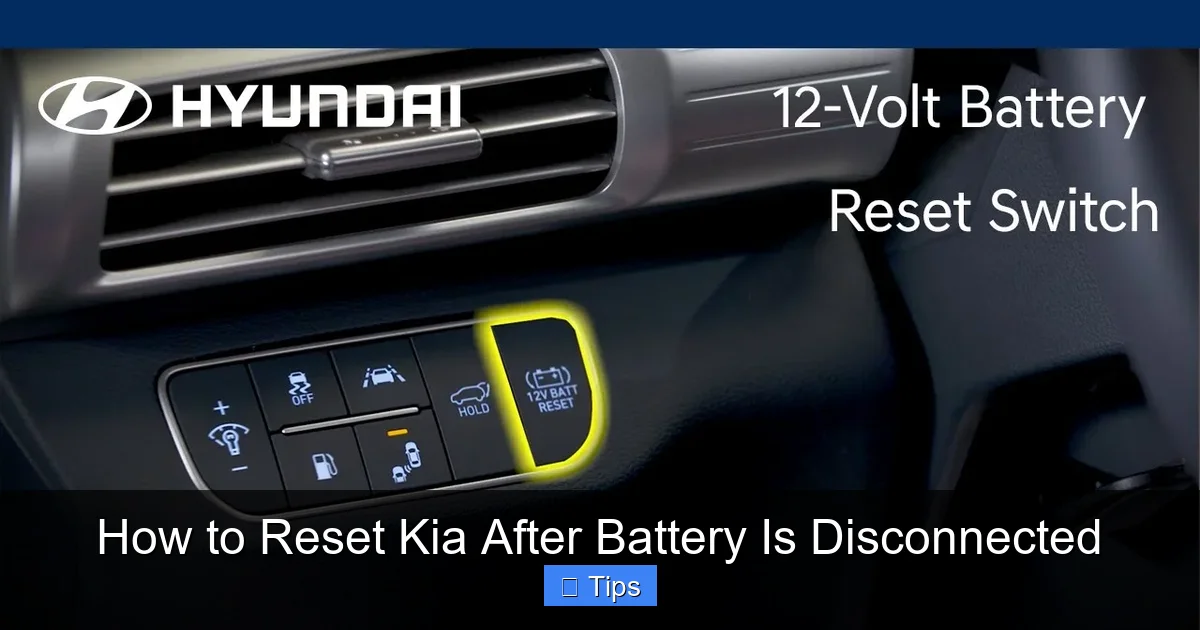
Troubleshooting Common Reset Issues
Visual guide about How to Reset Kia After Battery Is Disconnected
Image source: i.ytimg.com
Even after following the reset steps, you might still encounter problems. Here’s how to troubleshoot the most common issues.
Radio Still Asking for Code
If the radio continues to prompt for a code after entering it correctly, double-check the code. Make sure you’re using the right one for your specific radio model. Some Kias have multiple radios (e.g., base vs. premium), and each has its own code.
If the code is correct but still not working, try disconnecting the battery for 10–15 minutes to reset the radio’s memory, then reconnect and try again. In rare cases, the radio itself may be faulty and require replacement.
Warning Lights Remain On
If warning lights like the check engine light or ABS light stay on after a reset, it could indicate a real problem. Use an OBD2 scanner to read the trouble codes. Many auto parts stores offer free code reading.
Common post-reset codes include:
– P0606: ECU processor fault (often clears after drive cycle)
– U0100: Lost communication with ECU (temporary after reset)
– C1201: ABS system error (may require recalibration)
If the codes persist after a few drive cycles, visit a Kia service center for diagnosis.
Key Fob Still Not Working
If the key fob remains unresponsive after re-syncing, check the battery inside the fob. A weak battery can prevent proper signal transmission. Replace it with a new CR2032 battery if needed.
Also, ensure you’re within range (usually 10–20 feet) when testing the fob. Interference from other electronic devices can block the signal.
Climate Control Not Responding
If the climate control system is unresponsive or erratic, try resetting the infotainment system. Turn the ignition to “ON,” then press and hold the “POWER” and “HOME” buttons on the touchscreen for 10–15 seconds until the system reboots.
If that doesn’t work, check the fuse for the HVAC system. A blown fuse could indicate an electrical short.
Preventing the Need for a Full Reset
While knowing how to reset Kia after battery is disconnected is helpful, it’s even better to avoid the hassle altogether. Here are some tips to prevent a full system reset:
Use a Memory Saver
A memory saver is a small device that plugs into your cigarette lighter or OBD2 port and connects to a 9V battery. It provides temporary power to the vehicle’s electronics while the main battery is disconnected. This keeps the ECU, radio, and other systems alive, preventing a full reset.
Memory savers are inexpensive (usually $10–$20) and widely available online or at auto parts stores. They’re a smart investment if you plan to do regular maintenance.
Keep Your Radio Code Handy
Store your radio code in a safe place—like your phone’s notes app or a secure cloud storage service. This way, you’ll always have it when needed.
Replace the Battery Properly
When replacing the battery, do it quickly and carefully. Minimize the time the terminals are disconnected. If possible, use a memory saver or have a helper keep the ignition in the “ON” position (with the key in the ignition) to maintain power.
Schedule Regular Maintenance
A healthy battery reduces the need for unexpected disconnections. Have your battery and charging system checked annually, especially before winter. Most auto shops offer free battery testing.
When to Visit a Kia Service Center
While most reset issues can be resolved at home, some problems require professional attention. Visit a Kia service center if:
– Warning lights remain on after multiple drive cycles
– The radio code doesn’t work despite correct entry
– The infotainment system is frozen or unresponsive
– You suspect a faulty sensor or module
– The vehicle won’t start or runs poorly
Dealerships have specialized tools to recalibrate ADAS systems, update software, and perform advanced diagnostics. They can also retrieve your radio code directly from Kia’s database if you’ve lost it.
Don’t hesitate to seek help if you’re unsure. It’s better to get a professional opinion than risk further damage.
Final Thoughts
Disconnecting your Kia’s battery is a common task, but it’s not without consequences. Modern vehicles rely heavily on electronic systems that need to be reinitialized after a power loss. Knowing how to reset Kia after battery is disconnected saves time, reduces frustration, and ensures your vehicle performs at its best.
By following the steps in this guide—reconnecting the battery, entering the radio code, reinitializing windows and sunroof, resetting climate control, syncing the key fob, and completing a drive cycle—you can restore full functionality to your Kia. And with preventive measures like using a memory saver, you can avoid many of these issues in the future.
Remember, your Kia is more than just a car—it’s a sophisticated machine designed for comfort, safety, and performance. Treat it with care, and it will reward you with years of reliable service.
Frequently Asked Questions
Do I need to reset my Kia after changing the battery?
Yes, in most cases you will need to reset certain systems like the radio, power windows, and ECU after changing the battery. While the car will still run, some features may not work properly until reinitialized.
How long does it take for a Kia to reset after battery disconnection?
The initial reset process takes about 10–15 minutes, but the ECU may take several drive cycles (30–60 minutes of driving) to fully relearn optimal settings and clear all error codes.
Where can I find my Kia radio code?
Your radio code is usually found in the owner’s manual, on a sticker in the glove box, or on a card provided by the dealer. You can also retrieve it online through Kia’s website or by contacting a dealership with your VIN.
Why is my check engine light on after reconnecting the battery?
The check engine light may appear temporarily due to the ECU reset. It often clears after a few drive cycles. If it stays on, use an OBD2 scanner to check for trouble codes.
Can I drive my Kia immediately after reconnecting the battery?
Yes, you can drive immediately, but performance may be rough until the ECU relearns settings. It’s best to complete a drive cycle to ensure smooth operation.
What is a memory saver and do I need one?
A memory saver is a device that provides temporary power to your car’s electronics during battery replacement. It prevents system resets and is highly recommended for DIY maintenance.

At CarLegit, we believe information should be clear, factual, and genuinely helpful. That’s why every guide, review, and update on our website is created with care, research, and a strong focus on user experience.