
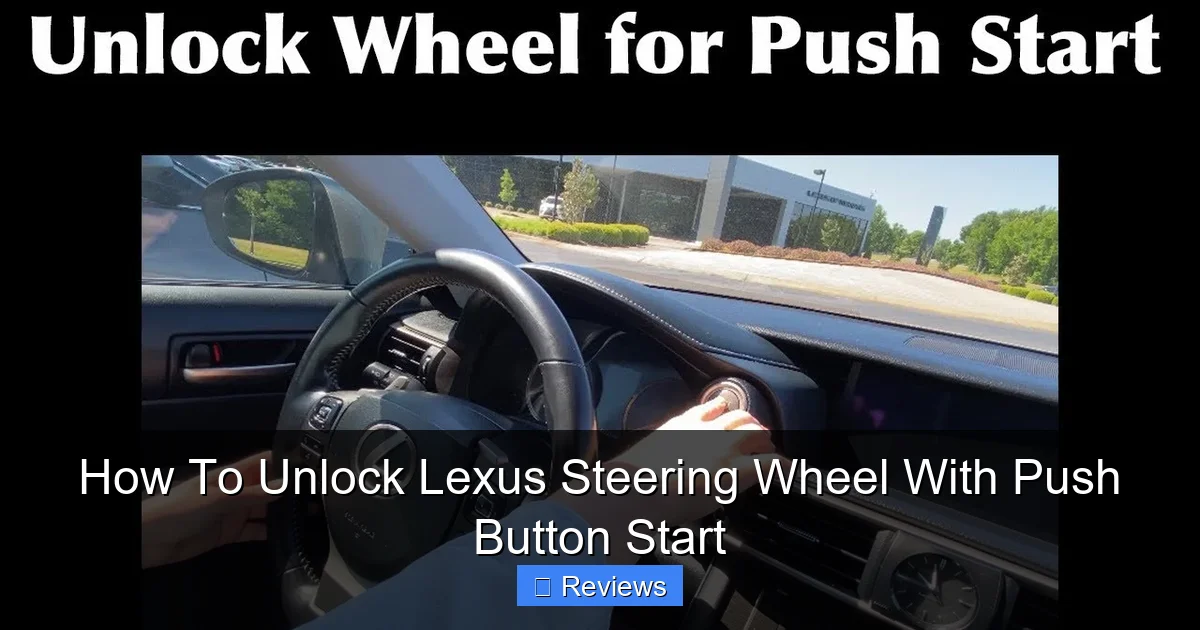
Featured image for how to unlock lexus steering wheel with push button start
Image source: i.ytimg.com
To unlock your Lexus steering wheel with push-button start, the primary method involves applying slight pressure to the steering wheel in either direction while simultaneously pressing the start button. This common security feature engages when the wheel is turned after the engine is off, requiring this specific two-part action to disengage the lock. Simply jiggle the wheel gently as you press the button, and it should release smoothly.
<h1>How To Unlock Lexus Steering Wheel With Push Button Start</h1>
<p>Imagine this: You slide into the luxurious cabin of your Lexus, eager to begin your journey. The plush leather seats cradle you, the digital dashboard lights up with a welcoming glow, and you confidently press the <strong>push-button start</strong>… only to find your <strong>Lexus steering wheel</strong> stubbornly locked. A sense of mild panic might set in, especially if you’re new to modern vehicles or unfamiliar with the sophisticated security features built into your premium car. This isn’t just an inconvenience; it can be a significant source of frustration when you have places to be.</p>
<p>The <strong>steering lock</strong> mechanism in your Lexus is a crucial anti-theft device, designed to immobilize the <strong>steering wheel</strong> and prevent unauthorized driving. While an essential layer of security, it can sometimes engage unexpectedly or refuse to <strong>unlock</strong> as readily as you’d hope. For owners of a <strong>Lexus with push-button start</strong>, the process of disengaging this lock differs significantly from the traditional key-and-tumbler systems of older cars. Understanding the electronic nuances of your <strong>Lexus</strong> is key to swiftly resolving this common yet perplexing issue.</p>
<p>This comprehensive guide will walk you through everything you need to know about your <strong>Lexus steering wheel</strong> lock. From deciphering its purpose and operation to providing step-by-step instructions on how to <strong>unlock</strong> it, alongside detailed troubleshooting tips for persistent problems, we aim to empower you with the knowledge to handle any such situation confidently. Whether you’re dealing with a simple momentary glitch or a more complex electronic hiccup, we’ll ensure you’re well-equipped to get your <strong>Lexus</strong> moving again.</p>
<h2>Understanding the Lexus Steering Lock Mechanism with Push Button Start</h2>
<p>Before diving into solutions, it’s essential to grasp the underlying principles of why your <strong>Lexus steering wheel</strong> locks and how its electronic system operates. Unlike older cars where a physical key directly engaged and disengaged a pin in the steering column, modern <strong>Lexus</strong> vehicles with <strong>push-button start</strong> employ a more sophisticated, entirely electronic mechanism.</p>
<h3>The Purpose of the Steering Lock: A Vital Security Feature</h3>
<p>At its core, the <strong>steering lock</strong> is a robust anti-theft measure. When your vehicle is parked and turned off, the Electronic Steering Lock (ESL) module activates, sending a physical pin into a notch on the <strong>steering column</strong>. This effectively prevents anyone from turning the <strong>steering wheel</strong>, even if they manage to hotwire the ignition. For a premium brand like <strong>Lexus</strong>, security is paramount, and the ESL system plays a significant role in deterring theft and ensuring your vehicle remains where you left it. It’s a review of modern security design – an often-unseen but critical component that enhances vehicle safety.</p>
<h3>How Electronic Steering Locks Work in Push Button Start Systems</h3>
<p>In a <strong>Lexus with push-button start</strong>, the process is digitally orchestrated. When you approach your vehicle with the smart key fob, the car’s immobilizer system communicates with the fob. Once verified, the Engine Control Unit (ECU) or a dedicated steering lock ECU receives a signal. Upon your command to start the engine (pressing the <strong>start button</strong> with your foot on the brake), the ECU instructs the ESL module to retract the locking pin using an electric solenoid. This all happens in a fraction of a second, ideally making the process seamless and unnoticeable to the driver.</p>
<p>However, for the system to <strong>unlock</strong> the <strong>steering wheel</strong> and allow the engine to <strong>start</strong>, several conditions must be met:</p>
<ul>
<li><strong>Key Fob Present and Recognized:</strong> The smart key fob must be inside the vehicle and its battery strong enough to transmit a signal.</li>
<li><strong>Brake Pedal Depressed:</strong> A safety interlock requires the brake pedal to be pressed before the engine can <strong>start</strong>.</li>
<li><strong>Steering Column Pressure Released:</strong> If the <strong>steering wheel</strong> is under tension (e.g., turned hard to one side when parked), the locking pin might be jammed, preventing its retraction.</li>
<li><strong>Sufficient Vehicle Battery Voltage:</strong> The ESL module, like all electronic components, requires adequate power from the 12V car battery to operate correctly.</li>
</ul>
<h3>Common Scenarios Leading to a Locked Steering Wheel</h3>
<p>While sophisticated, the electronic <strong>steering lock</strong> can sometimes act up. Here are the most common reasons why you might find your <strong>Lexus steering wheel</strong> locked and unwilling to <strong>unlock</strong>:</p>
<ul>
<li><strong>Steering Column Tension:</strong> This is by far the most frequent cause. If you parked your <strong>Lexus</strong> and inadvertently turned the <strong>steering wheel</strong> slightly after turning off the engine, the locking pin can get wedged against the column. The electronic solenoid might not have enough force to retract the pin against this physical pressure.</li>
<li><strong>Weak or Dead Smart Key Fob Battery:</strong> A failing key fob battery might transmit a weak or intermittent signal, preventing the vehicle from fully recognizing the fob and initiating the <strong>unlock</strong> sequence for the <strong>steering lock</strong> and <strong>push-button start</strong>.</li>
<li><strong>Low Vehicle 12V Battery:</ 杨The car’s main 12V battery powers all electronic systems, including the ESL. If it’s weak or depleted, there might not be enough voltage to actuate the solenoid and <strong>unlock</strong> the <strong>steering wheel</strong>.</li>
<li><strong>System Glitch/Communication Error:</strong> Occasionally, like any complex electronic system, there might be a temporary communication error between the smart key, the immobilizer, and the ESL module. This can manifest as the <strong>steering wheel</strong> remaining locked.</li>
<li><strong>ESL Module Malfunction:</strong> In rare cases, the Electronic Steering Lock module itself can fail. This is a more serious mechanical or electronic issue requiring professional attention.</li>
</ul>
<h2>The Primary Method to Unlock Your Lexus Steering Wheel</h2>
<p>When your <strong>Lexus steering wheel</strong> is locked, the most common solution involves a simple yet specific technique that often resolves the issue instantly. This method addresses the prevalent problem of physical tension on the <strong>steering lock</strong> mechanism. This is the first thing you should try when faced with a locked <strong>steering wheel</strong> in your <strong>Lexus with push-button start</strong>.</p>
<h3>The Standard Procedure: Push, Wiggle, and Start</h3>
<p>This is the tried-and-true method recommended by <strong>Lexus</strong> and experienced owners alike. It effectively releases the tension on the locking pin, allowing the electronic system to retract it. Follow these steps carefully:</p>
<ol>
<li><strong>Get in Your Lexus:</strong> Ensure your smart key fob is <strong>inside the vehicle</strong> with you. Its proximity is essential for the vehicle to recognize your authorization to <strong>start</strong> and <strong>unlock</strong> the <strong>steering wheel</strong>.</li>
<li><strong>Depress the Brake Pedal:</strong> Firmly press and hold the brake pedal with your foot. This is a mandatory safety interlock for <strong>push-button start</strong> vehicles.</li>
<li><strong>Wiggle the Steering Wheel:</strong> While keeping the brake pedal pressed, gently but firmly <strong>wiggle the steering wheel</strong> left and right. You might hear a slight click or feel the wheel “give” a little. The goal is to relieve any pressure on the <strong>steering lock</strong> pin.</li>
<li><strong>Press the Start Button:</strong> While still wiggling the <strong>steering wheel</strong> and holding the brake, press the <strong>push-button start</strong> button. You should feel the <strong>steering lock</strong> disengage with an audible click, and the engine should <strong>start</strong>.</li>
</ol>
<p>The “wiggle” action is crucial here. It’s not about forcing the wheel, but rather about creating a momentary window where the pressure on the internal locking pin is released, allowing the electric solenoid to retract it. Think of it as releasing a stuck door bolt by slightly shifting the door.</p>
<h3>Ensuring Proper Fob Detection</h3>
<p>For your <strong>Lexus</strong> to initiate the <strong>unlock</strong> and <strong>start</strong> sequence, it needs to reliably detect your smart key fob. If the fob battery is low, or if there’s interference, detection can be an issue. Always ensure the fob is clearly inside the vehicle – not in a pocket that’s barely inside or in a bag on the back seat. Keep it in a central console, a cup holder, or directly on your person. If you’re encountering persistent issues, consider replacing the fob battery as a first troubleshooting step.</p>
<h3>The Role of the Brake Pedal</h3>
<p>It might seem obvious, but sometimes in the heat of the moment, the simple act of pressing the brake pedal firmly can be overlooked. The brake pedal sensor sends a signal to the vehicle’s computer, confirming that you intend to <strong>start</strong> the engine and are not accidentally pressing the <strong>start button</strong> without being ready to drive. Without this signal, the <strong>Lexus</strong> will not even attempt to <strong>unlock</strong> the <strong>steering wheel</strong> or <strong>start</strong> the engine. Always ensure your foot is firmly on the brake.</p>
<h3>Practical Example: A Morning Commute Gone Awry</h3>
<p>Consider Sarah, a busy professional, who parks her <strong>Lexus RX</strong> in her driveway every night. One morning, running late, she jumps in, presses the <strong>push-button start</strong>, but nothing happens except a “Steering Wheel Locked” message on the dash. Panic starts to set in. She remembers this guide, takes a deep breath, and applies the steps:</p>
<ul>
<li>She ensures her <strong>Lexus</strong> fob is in the cup holder.</li>
<li>She firmly depresses the brake pedal.</li>
<li>While holding the brake, she gently <strong>wiggles the steering wheel</strong> left and right. She feels a slight give.</li>
<li>Still wiggling and pressing the brake, she presses the <strong>start button</strong>.</li>
</ul>
<p>Suddenly, she hears a satisfying click, the engine roars to life, and the <strong>steering wheel</strong> is free to turn. Her commute is back on track. This scenario highlights how frequently this simple technique can resolve a seemingly major issue with your <strong>Lexus</strong> <strong>steering lock</strong>.</p>
<h2>Troubleshooting Common Issues and Advanced Unlocking Techniques</h2>
<p>While the “wiggle and start” method works for most instances of a locked <strong>Lexus steering wheel</strong>, there are times when deeper issues might be at play. If the primary method doesn’t resolve the problem, you’ll need to delve into more advanced troubleshooting. These steps address common electronic and power-related culprits that can prevent your <strong>Lexus</strong> from recognizing your command to <strong>unlock</strong> and <strong>start</strong>.</p>
<h3>Dealing with a Weak or Dead Smart Key Fob Battery</h3>
<p>The smart key fob is the cornerstone of your <strong>Lexus’s push-button start</strong> and <strong>steering lock</strong> system. A weak battery within the fob can cause intermittent or complete failure of the vehicle to detect your authorization. Symptoms include:</p>
<ul>
<li>Needing to press the <strong>start button</strong> multiple times.</li>
<li>Messages like “Key Not Detected” or “Steering Wheel Locked” despite the fob being inside.</li>
<li>Remote <strong>unlock</strong>/lock features working intermittently or not at all.</li>
</ul>
<p><strong>Solution:</strong></p>
<ol>
<li><strong>Replace the Fob Battery:</strong> Most <strong>Lexus</strong> smart keys use a CR2032 lithium coin cell battery. These are readily available. Refer to your owner’s manual for specific instructions on how to open your fob and replace the battery safely.</li>
<li><strong>Emergency Start Procedure:</strong> Even with a completely dead fob battery, your <strong>Lexus</strong> has an emergency bypass. Hold the smart key fob <strong>directly against the push-button start</strong> button. The fob typically contains a passive RFID chip that the vehicle can read even without battery power, providing enough authentication to <strong>unlock</strong> the <strong>steering wheel</strong> and <strong>start</strong> the engine. Some older <strong>Lexus</strong> models might have a dedicated slot for the fob.</li>
</ol>
<h3>The Vehicle’s 12V Battery: A Silent Culprit</h3>
<p>The main 12V battery in your <strong>Lexus</strong> powers all electrical components, including the Electronic Steering Lock (ESL) module. If this battery is weak or discharged, it may not supply sufficient voltage to actuate the solenoid that retracts the <strong>steering lock</strong> pin. Other symptoms of a weak car battery might include:</p>
<ul>
<li>Slow engine crank (if the engine eventually tries to <strong>start</strong>).</li>
<li>Dim interior lights or flickering dashboard lights.</li>
<li>Reset infotainment settings.</li>
<li>Clicking noises when attempting to <strong>start</strong>.</li>
</ul>
<p><strong>Solution:</strong></p>
<ol>
<li><strong>Jump Start the Vehicle:</strong> If you suspect a weak car battery, attempting a jump <strong>start</strong> from another vehicle or a portable jump pack can provide the necessary power. Once enough voltage reaches the ESL module, it should be able to <strong>unlock</strong> the <strong>steering wheel</strong>.</li>
<li><strong>Charge the Battery:</strong> If you have access to a battery charger, a slow charge might restore enough power for the systems to function normally. After charging, try the primary “wiggle and <strong>start</strong>” method.</li>
</ol>
<h3>Resetting the System (The “Soft Reset” Approach)</h3>
<p>Sometimes, electronic glitches can cause components like the ESL module to become unresponsive. A “soft reset” can sometimes clear these temporary errors, similar to restarting a computer. <em>Proceed with caution</em> as disconnecting the battery can reset other vehicle systems (radio presets, learning algorithms for transmission/engine).</p>
<p><strong>Solution:</strong></p>
<ol>
<li><strong>Disconnect the 12V Battery:</strong> Locate your <strong>Lexus</strong>’s 12V battery (usually under the hood or in the trunk). Using a wrench, carefully disconnect the negative (-) battery terminal first, then the positive (+) terminal. Wait for about 10-15 minutes to allow any residual charge to dissipate from the vehicle’s capacitors. This ensures a full reset of the electronic control units.</li>
<li><strong>Reconnect the Battery:</strong> Reconnect the positive (+) terminal first, then the negative (-) terminal. Ensure connections are tight.</li>
<li><strong>Attempt Start:</strong> Get back into your <strong>Lexus</strong> and try the primary “wiggle and <strong>start</strong>” method. With the system reset, the <strong>steering lock</strong> might now <strong>unlock</strong> as intended.</li>
</ol>
<h3>The Lexus Emergency Start Procedure (Fob Placement)</h3>
<p>As mentioned earlier, <strong>Lexus</strong> engineers have included an emergency override for situations where the smart key fob battery is dead or extremely weak. This procedure allows the vehicle to read the fob’s RFID chip directly, bypassing the need for a strong wireless signal.</p>
<p><strong>Solution:</strong></p>
<ol>
<li><strong>Locate the <strong>Push Button Start</strong> Button:</strong> This is usually on the dashboard near the <strong>steering wheel</strong>.</li>
<li><strong>Press Fob Against Button:</strong> With your foot firmly on the brake pedal, take your smart key fob and physically press it against the <strong>push-button start</strong> button. Then, while maintaining pressure with the fob, press the <strong>start button</strong> itself. Hold it there for a few seconds. This allows the immobilizer to read the fob’s internal chip directly.</li>
<li><strong>Listen for Unlock:</strong> You should hear the <strong>steering lock</strong> disengage, and the engine should <strong>start</strong>. This is a critical feature to remember for any <strong>Lexus with push-button start</strong> owner.</li>
</ol>
<h2>Preventing Steering Wheel Lock-Ups and Maintaining Your Lexus</h2>
<p>While knowing how to <strong>unlock</strong> your <strong>Lexus steering wheel</strong> is crucial for emergencies, preventing the issue in the first place is even better. Regular maintenance and adherence to best practices can significantly reduce the likelihood of encountering a locked <strong>steering wheel</strong> problem with your <strong>Lexus</strong>. This section reviews preventative measures and good habits to ensure the longevity and smooth operation of your <strong>Lexus’s push-button start</strong> and <strong>steering lock</strong> systems.</p>
<h3>Best Practices for Shutting Down Your Vehicle</h3>
<p>How you turn off and exit your <strong>Lexus</strong> can influence whether the <strong>steering lock</strong> engages smoothly or ends up under tension.</p>
<ul>
<li><strong>Park on Level Ground:</strong> Whenever possible, try to park your <strong>Lexus</strong> on a level surface with the <strong>steering wheel</strong> straight. This minimizes any natural tendency for the wheels to turn and put pressure on the <strong>steering lock</strong> pin.</li>
<li><strong>Release Steering Wheel Pressure Before Shut Down:</strong> Before pressing the <strong>push-button start</strong> to turn off the engine, ensure you’ve released any significant turning pressure from the <strong>steering wheel</strong>. Let it settle in a neutral position.</li>
<li><strong>Ensure Transmission is in P (Park):</strong> This is a basic safety measure, but also ensures all vehicle systems complete their shutdown sequence correctly, including the <strong>steering lock</strong> engagement.</li>
</ul>
<h3>Regular Smart Key Fob Maintenance</h3>
<p>Your smart key fob is a miniature piece of technology vital to your <strong>Lexus</strong>’s operation. Treating it with care and maintaining its power source is crucial.</p>
<ul>
<li><strong>Routine Battery Replacement:</strong> Manufacturers typically recommend replacing the smart key fob battery every 1-2 years, depending on usage. Don’t wait for a “low battery” warning to appear on your dash; proactively replace it. This is a small investment that prevents significant hassle.</li>
<li><strong>Avoid Extreme Conditions:</strong> Don’t leave your key fob in direct sunlight, extreme heat, or freezing temperatures, as these can shorten battery life and potentially damage internal components.</li>
<li><strong>Keep Fob Dry:</strong> Water damage is a common killer of key fobs. Be mindful when near liquids.</li>
<li><strong>Have a Spare Fob:</strong> Always keep a working spare smart key fob at home. This provides an immediate solution if your primary fob fails and is invaluable for testing if the issue is with the fob or the car.</li>
</ul>
<h3>Monitoring Your Vehicle’s 12V Battery Health</h3>
<p>The main 12V battery is the unsung hero of your <strong>Lexus</strong>’s electronics. A failing battery can cause a cascade of seemingly unrelated issues, including a stubborn <strong>steering lock</strong>.</p>
<ul>
<li><strong>Watch for Warning Signs:</strong> Pay attention to any sluggishness when starting, dimming lights, or slow operation of power windows. These are all indicators of a weakening battery.</li>
<li><strong>Regular Battery Checks:</strong> Most service centers or auto parts stores offer free battery testing. Have your <strong>Lexus</strong> battery tested annually, especially as it approaches 3-5 years of age.</li>
<li><strong>Consider a Battery Tender for Extended Parking:</strong> If you store your <strong>Lexus</strong> for long periods, a trickle charger or battery tender can keep the 12V battery optimally charged, preventing deep discharge that damages the battery and can lead to <strong>steering lock</strong> issues.</li>
</ul>
<h3>Keeping the Steering Column Area Clear</h3>
<p>While less common, physical obstructions or excessive weight on the <strong>steering wheel</strong> or column can exacerbate issues with the <strong>steering lock</strong> mechanism.</p>
<ul>
<li><strong>Avoid Heavy Items on the Wheel:</strong> Do not hang heavy bags or place excessive weight on the <strong>steering wheel</strong> when parked. This can put unnecessary strain on the locking pin.</li>
<li><strong>Ensure Clear Movement:</strong> Check that no loose items have fallen into the <strong>steering column</strong> area that could physically impede the ESL module’s operation.</li>
</ul>
<h2>When to Seek Professional Help and Understanding Costs</h2>
<p>While most <strong>Lexus steering wheel</strong> lock issues can be resolved with the simple techniques outlined above, there are times when the problem indicates a more serious underlying fault. Knowing when to call in the professionals is vital for your safety, peace of mind, and the proper functioning of your <strong>Lexus</strong>.</p>
<h3>Recognizing Persistent or Recurrent Issues</h3>
<p>If you find yourself repeatedly performing the “wiggle and <strong>start</strong>” method, or if your <strong>Lexus</strong> experiences a locked <strong>steering wheel</strong> even after replacing the fob battery and checking the main 12V battery, it’s a strong indicator that something more is amiss. <em>Persistent issues are not normal</em> for a well-maintained <strong>Lexus</strong> system. Ignoring these warning signs can lead to complete failure at an inopportune moment, leaving you stranded.</p>
<p>Symptoms that suggest professional intervention is needed:</p>
<ul>
<li>The <strong>steering wheel</strong> remains locked even after trying all troubleshooting steps.</li>
<li>The <strong>steering lock</strong> repeatedly engages when it shouldn’t, or fails to <strong>unlock</strong> randomly.</li>
<li>Error messages on the dashboard explicitly related to the <strong>steering lock</strong> system.</li>
<li>Unusual noises (grinding, clunking) coming from the <strong>steering column</strong> when attempting to <strong>start</strong> or <strong>unlock</strong>.</li>
</ul>
<h3>Diagnosing Electronic Steering Lock (ESL) Failures</h3>
<p>The Electronic Steering Lock (ESL) module is a complex component containing an electric motor, gears, and sensors. It is designed for reliability, but like any electronic part, it can fail. A failing ESL module is often indicated by the inability of the system to physically retract the locking pin, even when all other conditions (key fob, brake, power) are met. Diagnosis typically requires specialized diagnostic tools (like <strong>Lexus</strong>’s Techstream software) to read fault codes from the vehicle’s ECU. A technician will be able to pinpoint whether the issue is the module itself, its wiring, or a related control unit.</p>
<h3>Estimated Repair Costs and Dealership vs. Independent Mechanic</h3>
<p>Replacing an ESL module can be a significant expense due to the cost of the part and the labor involved. Here’s a general overview:</p>
<ul>
<li><strong>Part Cost:</strong> The ESL module itself can range from approximately $400 to $1000+, depending on the <strong>Lexus</strong> model and year.</li>
<li><strong>Labor Cost:</strong> Replacing the ESL often requires disassembling parts of the <strong>steering column</strong> and recalibrating the new module with the vehicle’s immobilizer system. This can be a labor-intensive job, potentially ranging from 2 to 5 hours of shop time, at typical hourly rates of $100-$200+.</li>
<li><strong>Total Estimated Cost:</strong> You could be looking at a total bill anywhere from $600 to $2000+ for an ESL replacement.</li>
</ul>
<p><strong>Dealership:</strong> <strong>Lexus</strong> dealerships have factory-trained technicians, proprietary diagnostic tools, and access to genuine <strong>Lexus</strong> OEM parts. They are generally the best option for complex electronic issues and ensure proper programming. While often more expensive upfront, they offer peace of mind and often a warranty on their work and parts.</p>
<p><strong>Independent Mechanic:</strong> A reputable independent shop specializing in <strong>Lexus</strong> or luxury vehicles might offer a lower labor rate. However, ensure they have the necessary diagnostic equipment and expertise to handle advanced electronic <strong>Lexus</strong> systems. Always ask if they use OEM or aftermarket parts and inquire about their warranty.</p>
<p><em><strong>Warranty Considerations:</strong> If your <strong>Lexus</strong> is still under factory warranty or an extended service agreement, an ESL failure should be covered. Always check your warranty details first.</em></p>
<h3>Importance of OEM Parts for Steering Components</h3>
<p>When dealing with critical safety components like the <strong>steering lock</strong> system, using Original Equipment Manufacturer (OEM) parts is highly recommended. OEM parts are identical to those installed during vehicle assembly, ensuring perfect fitment, compatibility with other vehicle systems, and adherence to <strong>Lexus</strong>’s rigorous safety and quality standards. Aftermarket parts, while sometimes cheaper, may not offer the same level of reliability or integration, potentially leading to future issues or compromising safety.</p>
<h2>Data Table: Troubleshooting Lexus Steering Lock Issues</h2>
<p>This table summarizes common scenarios leading to a locked <strong>Lexus steering wheel</strong> and outlines immediate steps to <strong>unlock</strong> it, serving as a quick reference for <strong>Lexus</strong> owners facing this issue.</p>
<table border=”1″ style=”width:100%; border-collapse: collapse;”>
<thead>
<tr>
<th style=”padding: 8px; text-align: left; background-color: #f2f2f2;”>Symptom/Issue</th>
<th style=”padding: 8px; text-align: left; background-color: #f2f2f2;”>Probable Cause</th>
<th style=”padding: 8px; text-align: left; background-color: #f2f2f2;”>Immediate Solution</th>
<th style=”padding: 8px; text-align: left; background-color: #f2f2f2;”>Preventative Measure</th>
</tr>
</thead>
<tbody>
<tr>
<td style=”padding: 8px; border: 1px solid #ddd;”><strong>Steering wheel</strong> locked, engine won’t <strong>start</strong>, no other issues.</td>
<td style=”padding: 8px; border: 1px solid #ddd;”>Physical tension on <strong>steering lock</strong> pin.</td>
<td style=”padding: 8px; border: 1px solid #ddd;”>Depress brake, <strong>wiggle steering wheel</strong> gently, simultaneously press <strong>push-button start</strong>.</td>
<td style=”padding: 8px; border: 1px solid #ddd;”>Ensure <strong>steering wheel</strong> is straight and free of tension when parking.</td>
</tr>
<tr>
<td style=”padding: 8px; border: 1px solid #ddd;”>”Key Not Detected” or intermittent <strong>start</strong> attempts.</td>
<td style=”padding: 8px; border: 1px solid #ddd;”>Weak or dead smart key fob battery.</td>
<td style=”padding: 8px; border: 1px solid #ddd;”><strong>Emergency Start Procedure:</strong> Press fob directly against <strong>push-button start</strong>. <em>Replace battery ASAP.</em></td>
<td style=”padding: 8px; border: 1px solid #ddd;”>Replace fob battery every 1-2 years proactively. Keep a spare fob.</td>
</tr>
<tr>
<td style=”padding: 8px; border: 1px solid #ddd;”>Dim lights, slow crank, clicking, <strong>steering wheel</strong> locked.</td>
<td style=”padding: 8px; border: 1px solid #ddd;”>Weak or dead vehicle 12V battery.</td>
<td style=”padding: 8px; border: 1px solid #ddd;”>Jump <strong>start</strong> the <strong>Lexus</strong> or charge the battery. Then use “wiggle and <strong>start</strong>” method.</td>
<td style=”padding: 8px; border: 1px solid #ddd;”>Regular 12V battery checks (annual). Replace battery when it shows signs of weakening.</td>
</tr>
<tr>
<td style=”padding: 8px; border: 1px solid #ddd;”>Persistent <strong>steering lock</strong> issues after all basic troubleshooting.</td>
<td style=”padding: 8px; border: 1px solid #ddd;”>Electronic System Glitch or ESL Module Malfunction.</td>
<td style=”padding: 8px; border: 1px solid #ddd;”>Attempt a soft reset (disconnect 12V battery for 10-15 mins). If issue persists, seek professional <strong>Lexus</strong> service.</td>
<td style=”padding: 8px; border: 1px solid #ddd;”>Ensure proper vehicle shutdown procedures. Regular maintenance by qualified technicians.</td>
</tr>
</tbody>
</table>
<h2>Conclusion</h2>
<p>A locked <strong>Lexus steering wheel</strong> with a <strong>push-button start</strong> can be an unnerving experience, especially when you’re caught off guard. However, as this comprehensive guide illustrates, it is almost always a resolvable issue, often stemming from simple causes such as physical tension on the <strong>steering lock</strong> mechanism or a low smart key fob battery. Understanding the elegant security features integrated into your <strong>Lexus</strong> is the first step toward confident ownership and swift problem-solving.</p>
<p>By familiarizing yourself with the primary “wiggle, brake, and <strong>start</strong>” method, and the various troubleshooting techniques – from utilizing the smart key’s emergency start function to monitoring your vehicle’s 12V battery health – you are well-equipped to handle the vast majority of <strong>steering lock</strong> incidents. Proactive maintenance, such as regular key fob battery replacement and mindful parking practices, will further enhance your <strong>Lexus</strong> ownership experience, minimizing the chances of encountering such a hiccup.</p>
<p>Remember, your <strong>Lexus</strong> is a marvel of engineering, designed for reliability and luxury. While its advanced electronic systems can sometimes present minor challenges, the solutions are often straightforward. Should you encounter persistent problems or suspect a more serious electronic steering lock malfunction, do not hesitate to consult a qualified <strong>Lexus</strong> technician. Their expertise ensures that your vehicle’s sophisticated security features are properly maintained, allowing you to enjoy the unparalleled driving experience your <strong>Lexus</strong> promises, without unexpected interruptions.</p>
In This Article
- 1 Key Takeaways
- 2 Frequently Asked Questions
- 2.1 How do I unlock my Lexus steering wheel if it’s stuck with a push-button start?
- 2.2 Why does my Lexus steering wheel lock up in the first place?
- 2.3 What should I do if the standard jiggling method doesn’t unlock the Lexus steering wheel?
- 2.4 How can I prevent my Lexus steering wheel from locking frequently?
- 2.5 Do I need my key fob to unlock the Lexus steering wheel with push-button start?
- 2.6 Is a locked Lexus steering wheel a sign of a serious mechanical problem?
Key Takeaways
- Gentle Wiggle: Apply gentle steering wheel pressure while pressing the engine start button.
- Brake Essential: Depress the brake pedal firmly before pressing the engine start button.
- Avoid Force: Never apply excessive force to the steering wheel; it can cause damage.
- Check Fob: Ensure your key fob is detected and its battery is not dead.
- Parking Caution: Avoid turning the steering wheel excessively after turning off the engine.
- Try Again: If it doesn’t unlock, release, then gently repeat the wiggle and button press.
- Seek Help: If all methods fail, consult a Lexus dealership or roadside assistance.
Frequently Asked Questions
This is a common issue. Gently jiggle the Lexus steering wheel left and right while simultaneously pressing the start/stop button without your foot on the brake. You should hear a click as the lock disengages, allowing you to turn the wheel freely.
Why does my Lexus steering wheel lock up in the first place?
The steering wheel locks as an anti-theft feature, designed to prevent unauthorized movement of the vehicle. It typically engages when the car is turned off and the steering wheel is moved slightly, or if the system detects an unusual power-off sequence, ensuring vehicle security.
What should I do if the standard jiggling method doesn’t unlock the Lexus steering wheel?
If the usual method doesn’t work, ensure your key fob battery isn’t low and that you’re using the correct key inside the car. Try applying a bit more force while jiggling the wheel, and make sure you’re simultaneously pressing the push-button start firmly. If it persists, there might be an electrical issue requiring professional attention.
How can I prevent my Lexus steering wheel from locking frequently?
To minimize the Lexus steering wheel lock engaging, try to avoid turning the wheel after you’ve turned off the engine. Always ensure your vehicle is in Park (P) before shutting off the ignition, as this can sometimes prevent the lock from setting.
Yes, your Lexus key fob must be present inside the vehicle and recognized by the system for the push-button start to activate and thus unlock the steering wheel. If the key fob battery is low, it might make the unlocking process more difficult or impossible until the battery is replaced.
Is a locked Lexus steering wheel a sign of a serious mechanical problem?
Usually, a locked Lexus steering wheel is not a sign of a serious mechanical problem; it’s a normal anti-theft function. However, if you consistently struggle to unlock it even with the correct procedure, it could indicate a minor issue with the ignition switch or the steering column lock mechanism, which might warrant inspection.

At CarLegit, we believe information should be clear, factual, and genuinely helpful. That’s why every guide, review, and update on our website is created with care, research, and a strong focus on user experience.