
Choosing between a Jeep and a truck for snowy conditions depends on your needs. Jeeps offer excellent off-road capability and compact size, while trucks provide superior towing, payload, and stability in deep snow. Both can excel with the right setup.
In This Article
- 1 Key Takeaways
- 2 📑 Table of Contents
- 3 Is a Jeep or Truck Better in Snow?
- 4 Understanding the Basics: Jeep vs. Truck Design
- 5 4WD and Drivetrain Systems: The Heart of Snow Performance
- 6 Tires: The Most Important Factor in Snow Traction
- 7 Real-World Performance: Jeep vs. Truck in Snow
- 8 Which Is Better for You? A Decision Guide
- 9 Final Tips for Driving in Snow
- 10 Conclusion: It’s Not Just About the Vehicle
- 11 Frequently Asked Questions
Key Takeaways
- Jeeps are nimble and agile in snow: Their compact size, tight turning radius, and advanced 4×4 systems make them ideal for tight trails and light to moderate snow.
- Trucks offer greater stability and power: With higher ground clearance, heavier frames, and stronger engines, trucks handle deep snow and heavy loads better.
- 4WD and AWD systems matter most: Whether Jeep or truck, the type of drivetrain—like Jeep’s Selec-Trac or Ford’s 4×4—determines real-world snow performance.
- Tires are the #1 factor in snow traction: Even the best 4×4 vehicle struggles in snow without proper winter or all-terrain tires.
- Payload and towing needs favor trucks: If you’re hauling snowplows, trailers, or gear, trucks generally outperform Jeeps in utility.
- Jeeps excel in off-road snow scenarios: For backcountry trails, mountain passes, or unplowed roads, Jeeps often have the edge due to superior approach angles and articulation.
- Fuel efficiency and daily drivability vary: Compact Jeeps like the Wrangler may be easier to park and drive daily, while full-size trucks can be less efficient but more capable.
📑 Table of Contents
- Is a Jeep or Truck Better in Snow?
- Understanding the Basics: Jeep vs. Truck Design
- 4WD and Drivetrain Systems: The Heart of Snow Performance
- Tires: The Most Important Factor in Snow Traction
- Real-World Performance: Jeep vs. Truck in Snow
- Which Is Better for You? A Decision Guide
- Final Tips for Driving in Snow
- Conclusion: It’s Not Just About the Vehicle
Is a Jeep or Truck Better in Snow?
When winter rolls in and snow blankets the roads, the question of which vehicle handles snow best becomes urgent. Is a Jeep or truck better in snow? It’s a common debate among outdoor enthusiasts, commuters, and rural drivers alike. Both vehicle types have loyal followings, and both can be excellent in snow—depending on the situation.
At first glance, Jeeps and trucks seem similar. They’re both known for ruggedness, off-road capability, and a no-nonsense attitude. But under the surface, they differ in design, weight, drivetrain options, and intended use. A Jeep, especially the iconic Wrangler, is built for agility and trail dominance. Trucks, like the Ford F-150 or Toyota Tacoma, are workhorses designed for hauling, towing, and heavy-duty use.
So which one truly shines when the snow starts falling? The answer isn’t black and white. It depends on your driving environment, how much snow you face, what you’re hauling, and how you use your vehicle. In this guide, we’ll break down the strengths and weaknesses of Jeeps and trucks in snowy conditions. We’ll look at real-world performance, drivetrain systems, tire importance, and practical tips to help you decide which is better for your winter needs.
Understanding the Basics: Jeep vs. Truck Design
Visual guide about Is a Jeep or Truck Better in Snow
Image source: images.pexels.com
Before diving into snow performance, it’s important to understand the fundamental differences between Jeeps and trucks. These design choices directly impact how each vehicle behaves in winter weather.
What Makes a Jeep a Jeep?
Jeeps, particularly the Wrangler and Gladiator models, are built with off-roading as their primary mission. They feature a body-on-frame construction, solid front and rear axles, and high ground clearance. Most Jeeps come with part-time or full-time four-wheel drive (4WD) systems, and many offer locking differentials and sway bar disconnects for extreme terrain.
Their compact size—especially the two-door Wrangler—gives them a tight turning radius, making them highly maneuverable. This is a big advantage when navigating narrow, snow-covered mountain roads or tight trails. Jeeps also tend to have shorter wheelbases, which helps with climbing over obstacles without getting stuck.
However, their lighter weight can be a double-edged sword in snow. While it helps with agility, it can reduce traction on icy or packed snow, especially when not loaded down.
What Defines a Truck?
Trucks, on the other hand, are built for utility. Whether it’s a midsize like the Toyota Tacoma or a full-size beast like the Chevrolet Silverado, trucks prioritize payload, towing capacity, and durability. They also use body-on-frame construction, but they’re generally larger, heavier, and more powerful than Jeeps.
Trucks often come with advanced 4WD systems, including electronic shift-on-the-fly and terrain management modes. Many modern trucks also feature automatic 4WD modes that engage when slippage is detected—perfect for unpredictable winter roads.
The added weight of a truck helps with traction in snow. A heavier vehicle presses down on the snow, improving grip. Plus, trucks can be loaded with sandbags, firewood, or other cargo to increase rear traction—something that’s harder to do in a smaller Jeep.
Key Design Differences in Snow
So how do these design differences play out in snow? Let’s compare a few key factors:
– **Weight:** Trucks are heavier, which can improve traction but may reduce fuel efficiency and increase stopping distance.
– **Ground Clearance:** Both Jeeps and trucks offer high ground clearance, but Jeeps often have an edge in extreme off-road scenarios.
– **Wheelbase:** Longer wheelbases (common in trucks) improve stability on highways but can make tight turns harder.
– **Cargo Space:** Trucks win here—beds allow for hauling snowplows, generators, or emergency supplies.
– **Maneuverability:** Jeeps are easier to park and navigate in tight spaces, a plus in snowy urban areas.
In short, Jeeps are like snowshoes—light, nimble, and great for exploring. Trucks are like snowplows—strong, steady, and built to push through.
4WD and Drivetrain Systems: The Heart of Snow Performance
Visual guide about Is a Jeep or Truck Better in Snow
Image source: jeepkingdom.com
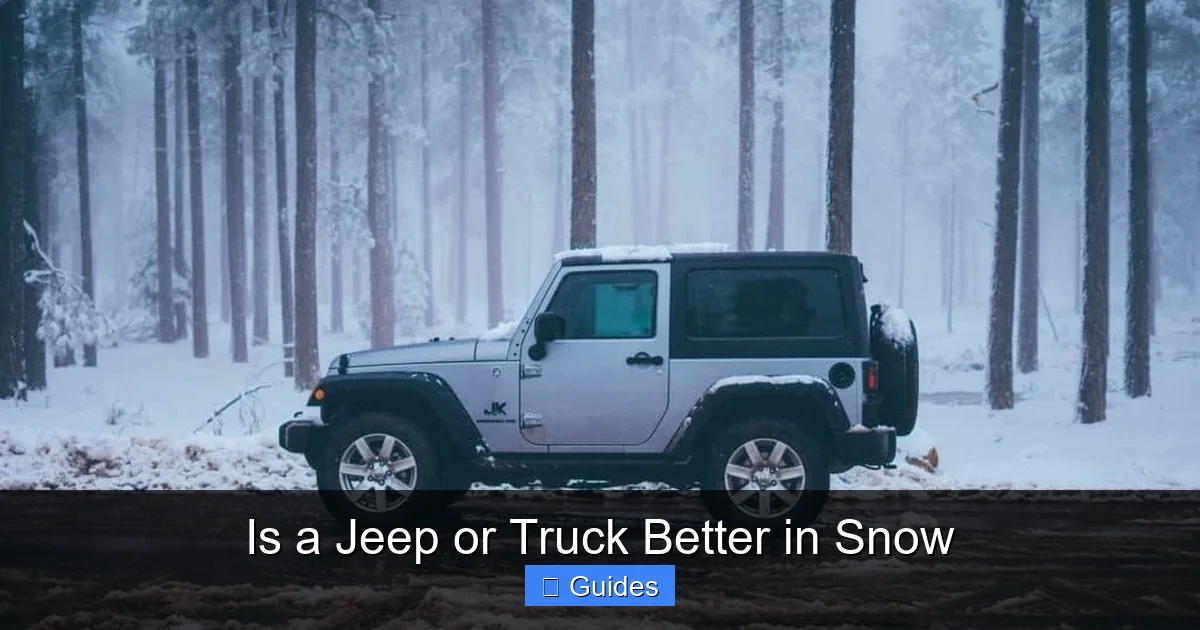
When it comes to driving in snow, the drivetrain is arguably the most important factor. Both Jeeps and trucks offer advanced 4WD systems, but they work differently and excel in different scenarios.
Jeep’s 4WD Systems: Built for the Trail
Jeep offers several 4WD systems, each tailored to different needs:
– **Command-Trac:** A part-time 4WD system found in most Wranglers. It’s simple, durable, and great for snow and light off-roading. You manually shift into 4WD when needed.
– **Rock-Trac:** Available in Rubicon models, this system includes a 4:1 low-range transfer case and locking differentials. It’s overkill for most snow, but unbeatable in deep snow or icy trails.
– **Selec-Trac:** A full-time 4WD system that can run in 4WD Auto mode, automatically sending power to the wheels with the most grip. This is ideal for variable winter conditions.
One of Jeep’s biggest advantages is its ability to disconnect the front sway bar (on Rubicon models), allowing for greater wheel articulation. This means one wheel can stay grounded even if others are lifted—critical when driving over snow-covered rocks or uneven terrain.
Truck 4WD Systems: Power and Precision
Trucks offer a range of 4WD systems, often more refined than Jeeps due to their use in both work and daily driving:
– **Part-Time 4WD:** Common in trucks like the Ford F-150 or Ram 1500. It’s reliable and effective in snow, but should only be used on low-traction surfaces.
– **Full-Time 4WD/AWD:** Found in models like the Toyota Tacoma TRD Pro or GMC Sierra AT4. These systems can run in 4WD all the time, improving safety on icy roads.
– **Automatic 4WD:** Many trucks now feature systems that engage 4WD only when needed. For example, the Ford Intelligent 4WD system monitors wheel slip and adjusts power accordingly.
Some trucks also offer terrain management systems. The Ram 1500, for instance, has a “Snow” mode that adjusts throttle response, transmission shift points, and traction control for optimal winter performance.
Real-World Comparison: Which Drivetrain Wins?
In light to moderate snow, both Jeeps and trucks with good 4WD systems perform well. But in deep snow or off-road conditions, the differences become clear.
A Jeep Rubicon with Rock-Trac and locking differentials can climb over snowdrifts and navigate icy trails that would stop most trucks. Its short wheelbase and high approach angle let it tackle steep, snowy inclines without scraping the undercarriage.
On the other hand, a full-size truck like the Ford F-150 with 4WD and a heavy payload can plow through deep snow more easily. The added weight helps it maintain momentum, and the longer wheelbase provides stability on highways.
For daily winter commuting, a truck with automatic 4WD might be more convenient—no need to manually shift into 4WD. But for weekend adventures in the backcountry, a Jeep’s specialized 4WD system often has the edge.
Tires: The Most Important Factor in Snow Traction
Visual guide about Is a Jeep or Truck Better in Snow
Image source: shutterstock.com
Here’s a truth that surprises many drivers: the vehicle matters less than the tires when it comes to snow performance. Even the most capable Jeep or truck will struggle in snow without the right rubber.
Why Tires Matter More Than 4WD
Think of it this way: 4WD helps you go forward, but tires determine whether you can stop, turn, or avoid skidding. In snow and ice, traction is everything. A vehicle with poor tires—even with full-time 4WD—can spin out or slide dangerously.
Winter tires are made from a softer rubber compound that stays flexible in cold temperatures. They also have deeper treads and siping (tiny grooves) that bite into snow and ice. All-terrain tires are a good compromise for year-round use, but true winter tires are best for severe conditions.
Jeep Tire Considerations
Jeeps, especially Wranglers, often come with all-terrain tires from the factory. These are decent in snow but not optimal. Upgrading to winter tires—like the Michelin X-Ice or Bridgestone Blizzak—can dramatically improve performance.
Because Jeeps are lighter, they benefit more from tire upgrades. A set of quality winter tires can make a stock Jeep handle like a snowmobile. Plus, their smaller tire size (often 31” to 33”) means winter tires are more affordable than for larger trucks.
Truck Tire Considerations
Trucks, especially full-size models, often come with larger, heavier tires. This can be a disadvantage in snow if the tires are highway-focused or all-season. But it also means there’s more rubber on the ground, which can improve grip—if the tread is right.
Many truck owners opt for all-terrain tires like the BFGoodrich All-Terrain T/A KO2 or Goodyear Wrangler Duratrac. These offer excellent snow performance and durability. For extreme conditions, winter-specific tires are still recommended.
One advantage trucks have: they can run larger tires without major modifications. A 35” tire on a lifted truck provides incredible flotation in deep snow—like driving on snowshoes.
Practical Tip: Always Use Winter Tires in Snow
No matter whether you drive a Jeep or truck, invest in a set of winter tires if you live in a snowy region. The difference in braking distance, cornering, and overall control is night and day. Don’t rely on 4WD alone—tires are your first and last line of defense.
Real-World Performance: Jeep vs. Truck in Snow
Let’s look at how Jeeps and trucks actually perform in real snowy conditions. We’ll break it down by common winter driving scenarios.
City and Highway Driving
For daily commuting on plowed roads, both Jeeps and trucks can handle snow well—especially with 4WD and winter tires. However, trucks tend to feel more stable at highway speeds due to their weight and longer wheelbase.
Jeeps, being smaller, are easier to park and maneuver in tight city streets. But their shorter wheelbase can make them feel “twitchy” on icy highways, especially in crosswinds.
Deep Snow and Unplowed Roads
This is where the differences really show. A Jeep Wrangler with 33” tires and 4WD can crawl through snowdrifts that would stop a stock truck. Its high ground clearance and short overhangs prevent it from getting high-centered.
But a lifted truck with 35” tires and a winch can power through even deeper snow. The added weight helps it maintain momentum, and the longer wheelbase reduces the chance of getting stuck on uneven terrain.
Off-Road and Trail Use
For backcountry trails, mountain passes, or forest roads, Jeeps often have the advantage. Their superior approach, departure, and breakover angles let them tackle steep, snowy inclines without scraping. Features like sway bar disconnects and locking differentials give them unmatched articulation.
Trucks can be modified for off-road use, but their size and weight can be a liability on narrow, technical trails. That said, a well-equipped truck like the Toyota Tacoma TRD Pro or Ford F-150 Raptor can hold its own—and even outperform some Jeeps in certain conditions.
Towing and Hauling in Snow
If you need to tow a snowmobile trailer, plow a driveway, or haul firewood, trucks are the clear winner. Their higher towing capacity (often 8,000–13,000 lbs) and payload (1,500–3,000 lbs) make them ideal for winter work.
Jeeps, especially the Wrangler, have limited towing capacity (around 3,500 lbs). The Gladiator pickup improves this, but it still can’t match a full-size truck.
Fuel Efficiency and Daily Use
Jeeps, particularly the four-cylinder Wrangler, are more fuel-efficient than most trucks. This matters in winter, when cold engines and 4WD use increase fuel consumption.
Trucks, especially V8 models, can be gas guzzlers. But newer turbocharged V6 engines (like Ford’s EcoBoost) offer a good balance of power and efficiency.
For daily driving, a compact Jeep might be more practical. For heavy-duty use, a truck is hard to beat.
Which Is Better for You? A Decision Guide
So, is a Jeep or truck better in snow? The answer depends on your lifestyle, location, and needs. Here’s a quick guide to help you decide.
Choose a Jeep If:
- You live in a mountainous or rural area with unplowed roads.
- You enjoy off-roading, trail riding, or overlanding in winter.
- You want a compact, maneuverable vehicle for tight spaces.
- You don’t need to tow heavy loads or haul large cargo.
- You value agility and trail capability over raw power.
Choose a Truck If:
- You need to tow trailers, plows, or heavy equipment.
- You live in an area with deep, drifting snow.
- You want maximum stability and payload capacity.
- You use your vehicle for work or heavy-duty tasks.
- You prefer a smoother, more comfortable ride on highways.
Hybrid Option: The Jeep Gladiator
For those who want the best of both worlds, the Jeep Gladiator is worth considering. It’s a pickup truck based on the Wrangler, offering Jeep’s legendary 4WD capability with a usable truck bed.
The Gladiator can tow up to 7,650 lbs and has a payload of over 1,700 lbs—far more than a Wrangler. It also retains the Wrangler’s off-road prowess, including locking differentials and high ground clearance.
It’s not as capable as a full-size truck for heavy towing, but it’s a great compromise for weekend warriors who need both trail ability and utility.
Final Tips for Driving in Snow
No matter which vehicle you choose, here are some essential tips for safe winter driving:
– **Install winter tires.** This is the single best upgrade for snow performance.
– **Use 4WD wisely.** Engage it before you need it—don’t wait until you’re stuck.
– **Add weight to the rear.** In RWD vehicles, sandbags in the bed or trunk improve traction.
– **Clear snow from your vehicle.** Remove snow from the roof, hood, and lights to prevent hazards.
– **Drive slowly and smoothly.** Avoid sudden acceleration, braking, or steering.
– **Keep an emergency kit.** Include blankets, food, water, a shovel, and a flashlight.
Conclusion: It’s Not Just About the Vehicle
So, is a Jeep or truck better in snow? The truth is, both can be excellent—if they’re equipped and driven properly. Jeeps offer unmatched agility and off-road capability, making them ideal for trails and tight spaces. Trucks provide superior power, stability, and utility, perfect for deep snow and heavy loads.
The real difference comes down to your needs. If you’re a weekend adventurer who loves exploring snowy trails, a Jeep might be your best friend. If you’re a contractor, farmer, or commuter facing harsh winters, a truck could be the smarter choice.
And remember: no vehicle is invincible in snow. Tires, driving habits, and preparation matter just as much as the make and model. With the right setup, both Jeeps and trucks can conquer winter—safely and confidently.
Frequently Asked Questions
Can a Jeep Wrangler handle deep snow?
Yes, a Jeep Wrangler with 4WD, high ground clearance, and winter tires can handle deep snow very well. Its short wheelbase and off-road design make it excellent for snowy trails and unplowed roads.
Are trucks better than Jeeps for towing in snow?
Generally, yes. Trucks have higher towing capacities and heavier frames, which improve stability when pulling trailers or plows in snowy conditions. Jeeps are more limited in towing power.
Do I need winter tires on a 4WD vehicle?
Absolutely. Even with 4WD, winter tires provide the best traction, braking, and control in snow and ice. They’re essential for safe winter driving, regardless of vehicle type.
Is a Jeep Gladiator good in snow?
Yes, the Jeep Gladiator combines Wrangler off-road capability with truck utility. It’s excellent in snow, especially with 4WD and winter tires, and can handle both trails and light towing.
Can a truck get stuck in snow easier than a Jeep?
It depends. A stock truck with low ground clearance can high-center in deep snow. But a lifted truck with large tires often outperforms a Jeep in deep, soft snow due to better flotation.
Which is more fuel-efficient in snow: a Jeep or truck?
Jeeps, especially four-cylinder models, are generally more fuel-efficient than trucks. However, both vehicles consume more fuel in winter due to cold starts, 4WD use, and increased rolling resistance in snow.

At CarLegit, we believe information should be clear, factual, and genuinely helpful. That’s why every guide, review, and update on our website is created with care, research, and a strong focus on user experience.